
Greater Crested Tern
Thalasseus bergii
大凤头燕鸥
Introduction
A large tern occurring along tropical and subtropical coastlines from Africa to the Pacific Ocean. It nests colonially on sandy and rocky islands, as well as artificial habitats including building roofs, salt pan islands, and sewage treatment ponds. It forages over coastal waters and follows fishing vessels to exploit discards. Breeding colonies number over 10,000 pairs at major sites, though individuals show little site fidelity and frequently relocate. During the non-breeding season, populations disperse widely along coastlines, with some individuals traveling thousands of kilometers. It nests in shallow scrapes and is highly vocal in colonies. Local threats include egg harvesting and habitat disturbance in parts of its range, though the species remains abundant across its extensive global distribution.
Description
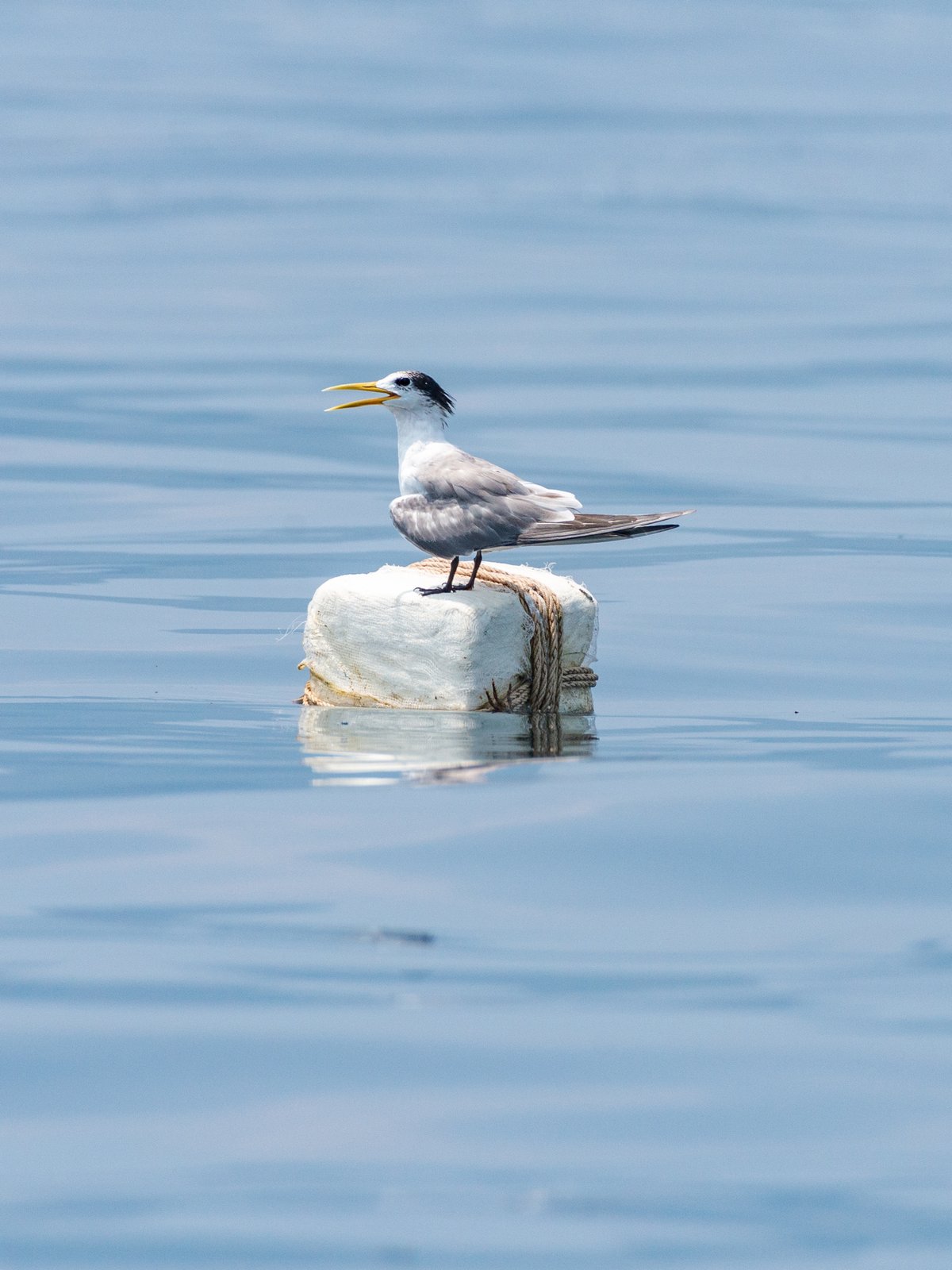
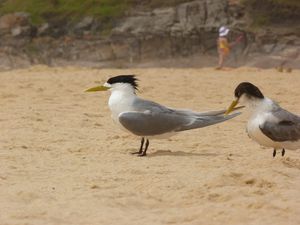
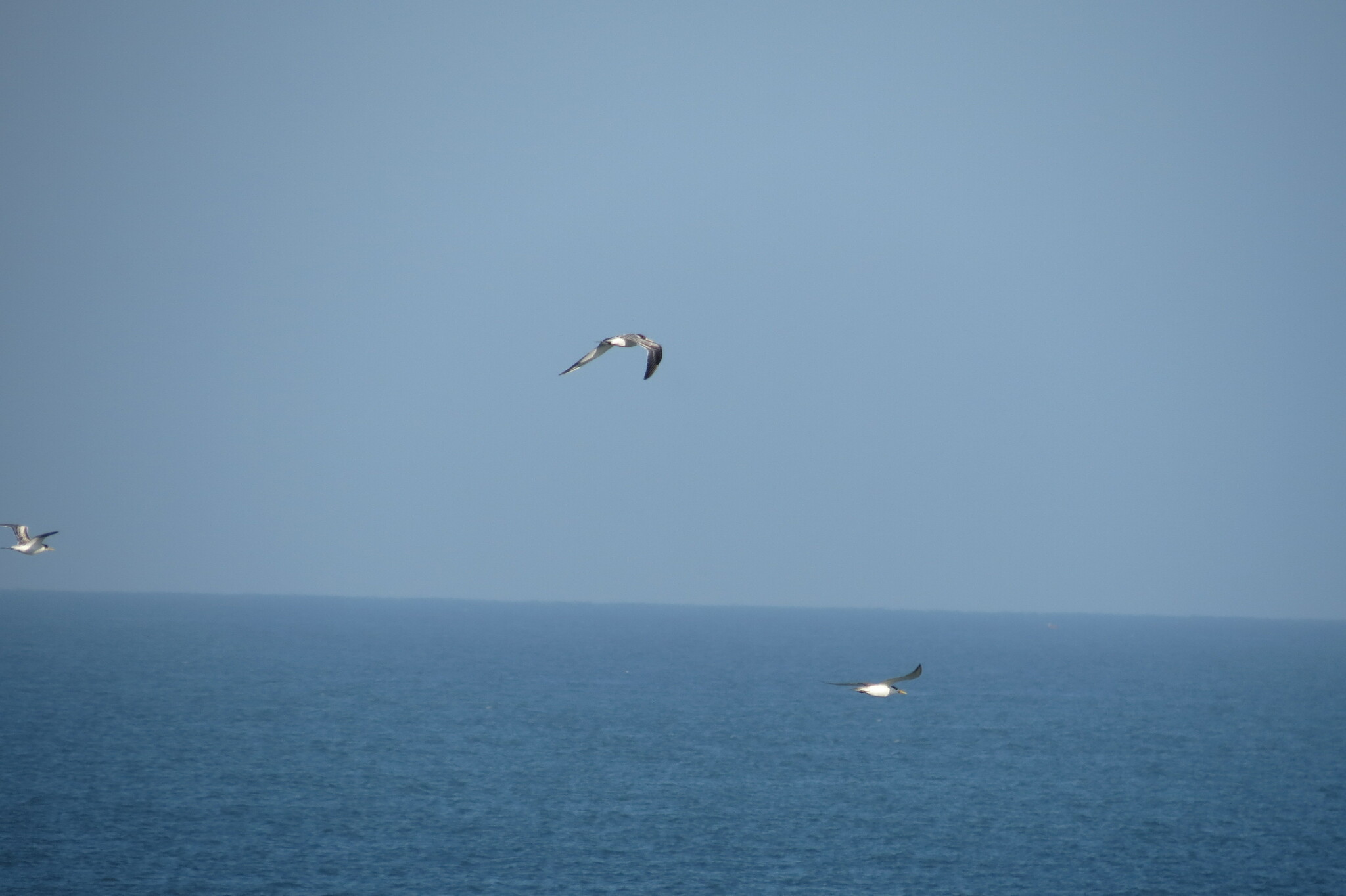
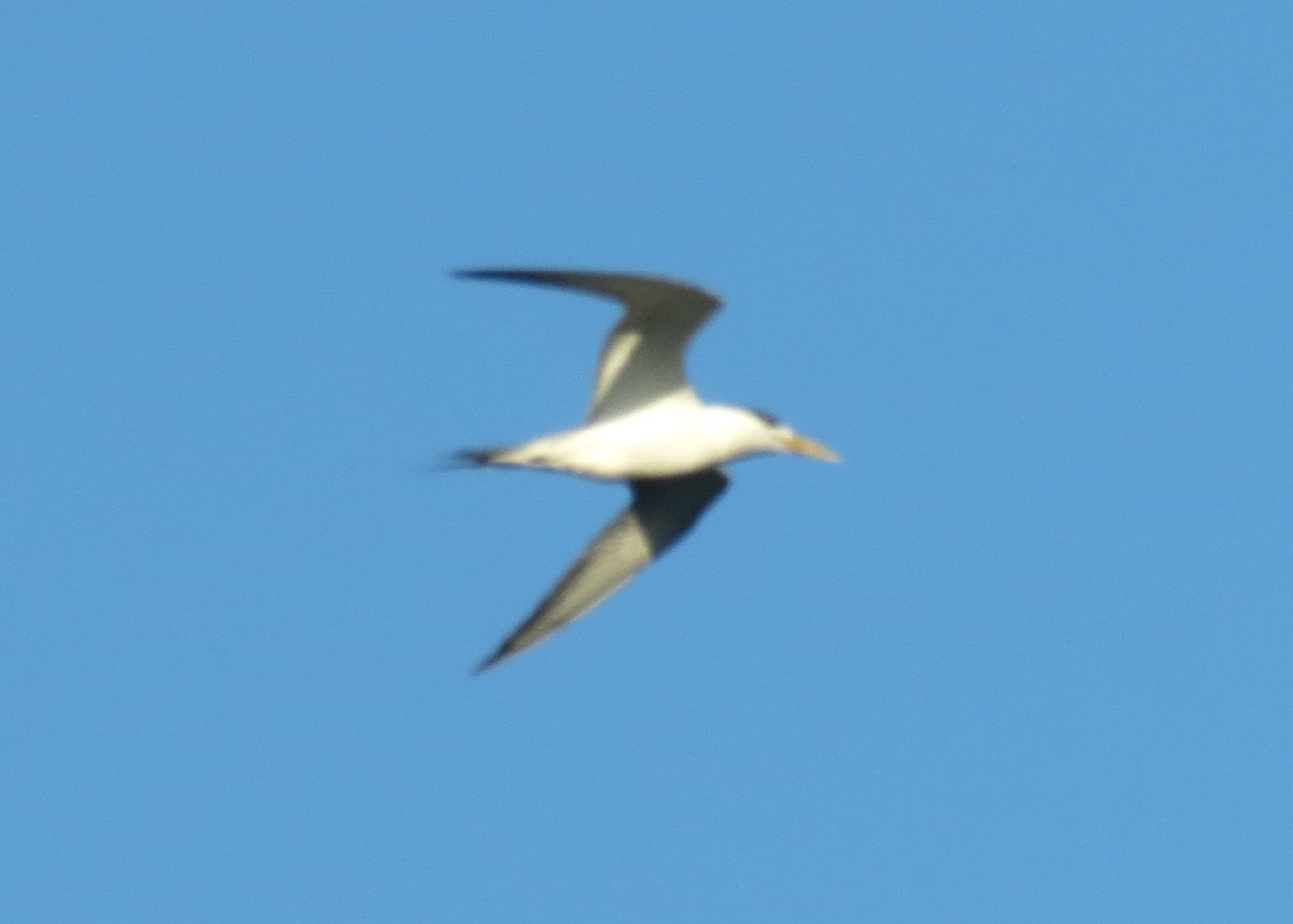
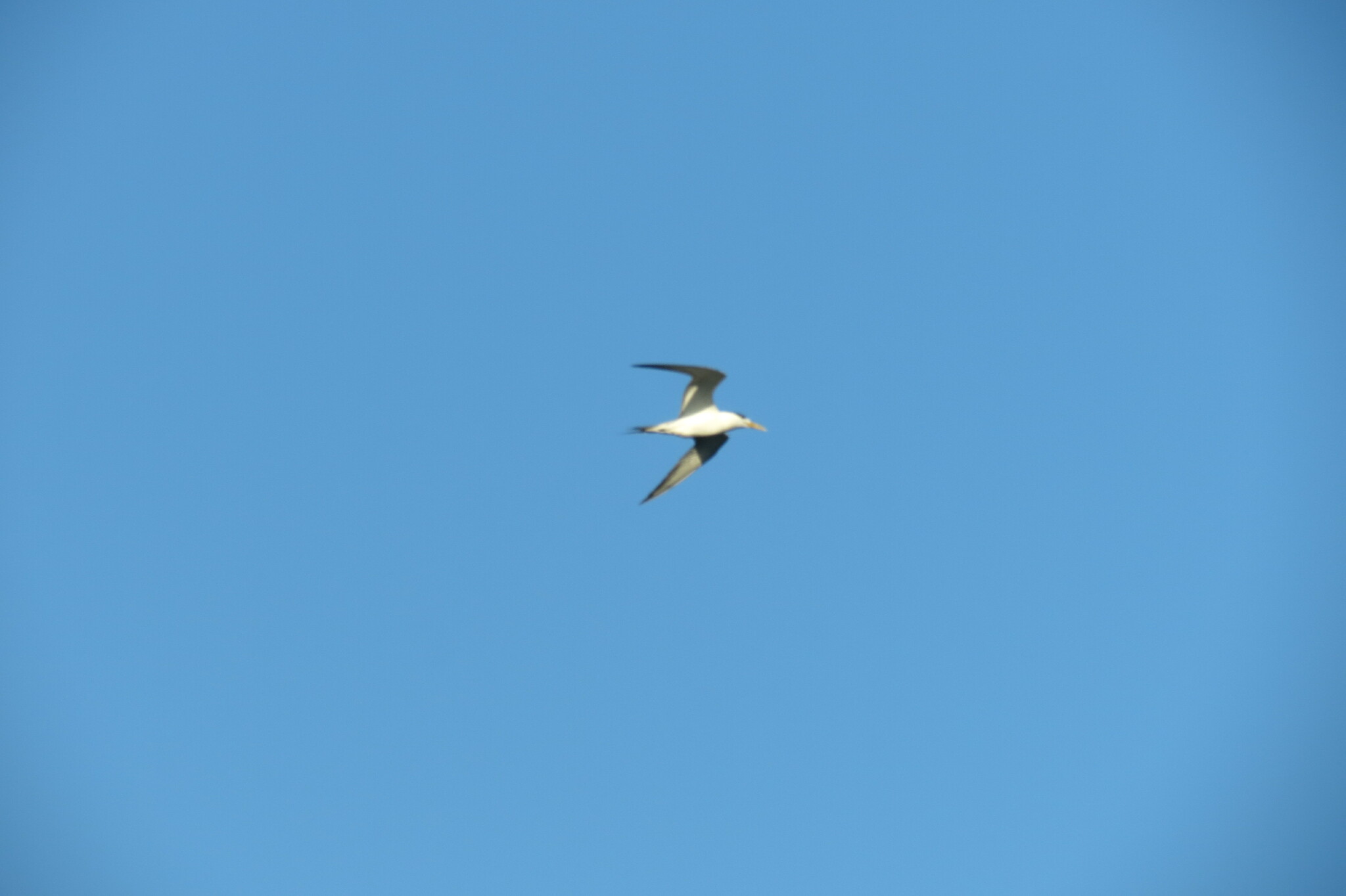
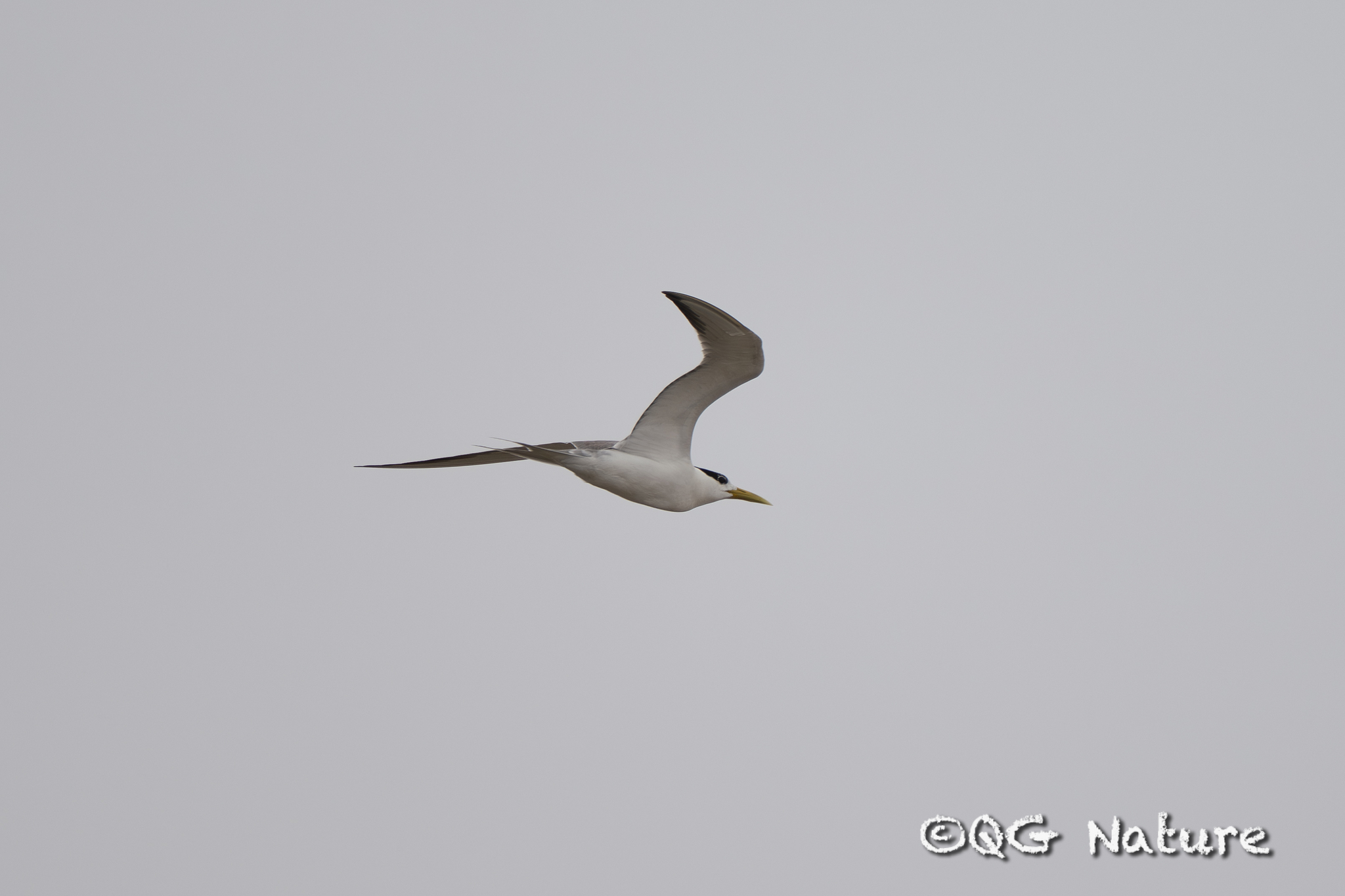
A substantial tern measuring 46-49 cm in length with a wingspan of 125-130 cm and weighing 325-397 grams. The most striking features are its long, tapering yellow bill measuring 5.4-6.5 cm and its glossy black crest that appears distinctly shaggy at the rear. The underparts and forehead are pure white, contrasting with dusky-grey upperparts and inner wings. Black legs complete the profile. In winter plumage, the crown becomes white, blending into a peppered black mask and crest on the head's rear. Adults of both sexes look identical, but juveniles are boldly marked with a winter-adult head pattern and upperparts strongly patterned in grey, brown and white, giving closed wings a barred appearance. After their first moult, young birds resemble adults but retain distinctive variegated wing markings including a dark bar on the inner flight feathers.
Identification
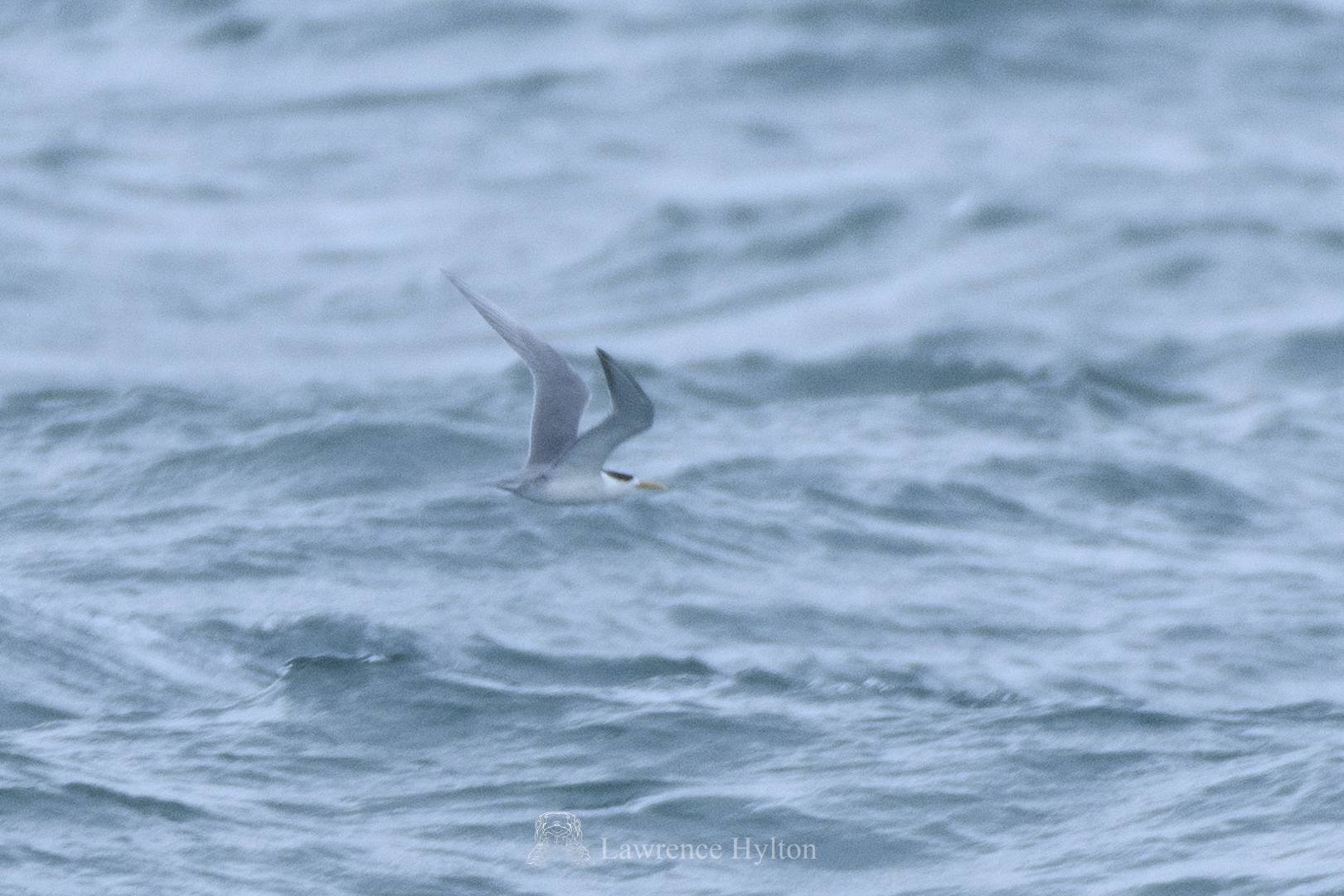
The combination of dark battleship-grey upperparts and white forehead distinguishes this species even when in full breeding plumage, unlike most terns that lose their black cap in non-breeding dress. The greenish-tinged yellow bill is diagnostic, as it differs from the orange-billed lesser crested tern and the heavier orange-tinted bill of the similar royal tern. Royal terns also have a paler back, more orange bill, and bulkier build. This species is approximately 25% larger than the lesser crested tern with a proportionately longer bill, heavier head, and bulkier body. In flight, the dark upperwings contrast sharply with the white underparts and long yellow bill. The shaggy black crest is visible at close range.
Distribution & Habitat
Found along tropical and warm temperate coasts of the Old World from South Africa, around the Indian Ocean, throughout the Pacific to Australia. Five subspecies occupy distinct regions: southern Africa from Namibia to Tanzania; the Red Sea and Persian Gulf region; Indian Ocean islands including Seychelles and Chagos; and Pacific islands from China and Indonesia east to Polynesia, with populations extending south to Tasmania. Breeding occurs on low-lying sandy, coral, or rocky islands with minimal vegetation. All populations disperse after breeding, with southern African birds moving east along the coast and some traveling over 2,000 km. Northern populations are largely sedentary or dispersive rather than migratory. Vagrant records exist from Hawaii, New Zealand, and various points around the Indian Ocean basin.
Behavior & Ecology
Breeds in dense colonies that can contain thousands of pairs, often alongside other seabirds. Monogamous pairs maintain bonds year-round and show elaborate courtship rituals involving fish offerings. The male establishes a territory and performs display flights with fish to attract females. Nests are simple scrapes in open sand, typically unlined, where one to two eggs are laid and incubated by both parents for 25-30 days. Chicks are precocial but remain dependent on parents for four months after fledging at 38-40 days. Feeds almost exclusively on fish by plunge diving to depths of one meter, though it readily takes discards from trawlers and may follow fishing boats up to 10 km offshore. Pelagic species like anchovy and sardine are typical prey. The territorial advertising call is a loud, raucous crow-like 'kerrak', with other vocalizations including 'korrkorrkorr' at the nest and 'wep wep' in flight.
Conservation
Classified as Least Concern globally with an estimated population exceeding 500,000 individuals and a vast range of 1-10 million square kilometers. The species does not approach thresholds for population decline or size criteria that would warrant higher concern. However, localized declines have occurred in the Gulf of Thailand, where the species no longer breeds, and in Indonesia where egg harvesting remains problematic. All subspecies except T. b. cristatus are protected under the Agreement on the Conservation of African-Eurasian Migratory Waterbirds. Threats include predation by gulls, ibises, cats, and dogs; egg collection; shooting; and collisions with infrastructure. Fisheries present mixed impacts—trawl discards provide beneficial food resources in some areas, while purse-seine operations reduce available prey. The species has shown remarkable adaptability to human-modified landscapes, colonizing artificial islands and building roofs.
Culture
In India, this species is protected within the PM Sayeed Marine Birds Conservation Reserve, demonstrating formal recognition of its conservation value. No specific folklore or traditional cultural significance is documented in the available sources.
Source: Wikipedia · CC BY-SA 3.0
Taxonomy
- Order
- Charadriiformes
- Family
- Laridae
- Genus
- Thalasseus
- eBird Code
- grcter1
Vocalizations
Subspecies (4)
-
Thalasseus bergii bergii
coastal southern Africa (Namibia to Mozambique)
-
Thalasseus bergii cristatus
southeastern China and Ryukyu Islands (southern Japan) to Philippines, Sundas, Wallacea, New Guinea, Australia, and the tropical Pacific Ocean (to southeastern Polynesia)
-
Thalasseus bergii thalassinus
breeds Tanzania, Seychelles, Aldabra, Rodrigues, and northern Madagascar; disperses north to Somalia, and southward to southern Madagascar
-
Thalasseus bergii velox
Red Sea and northwestern Somalia to Maldives, Myanmar, and Sri Lanka
Data Sources
Species description from Wikipedia, licensed under CC BY-SA 3.0.
Bird images and sounds sourced from GBIF, contributed by citizen scientists worldwide under Creative Commons licenses.
Taxonomy data from AviList 2025.