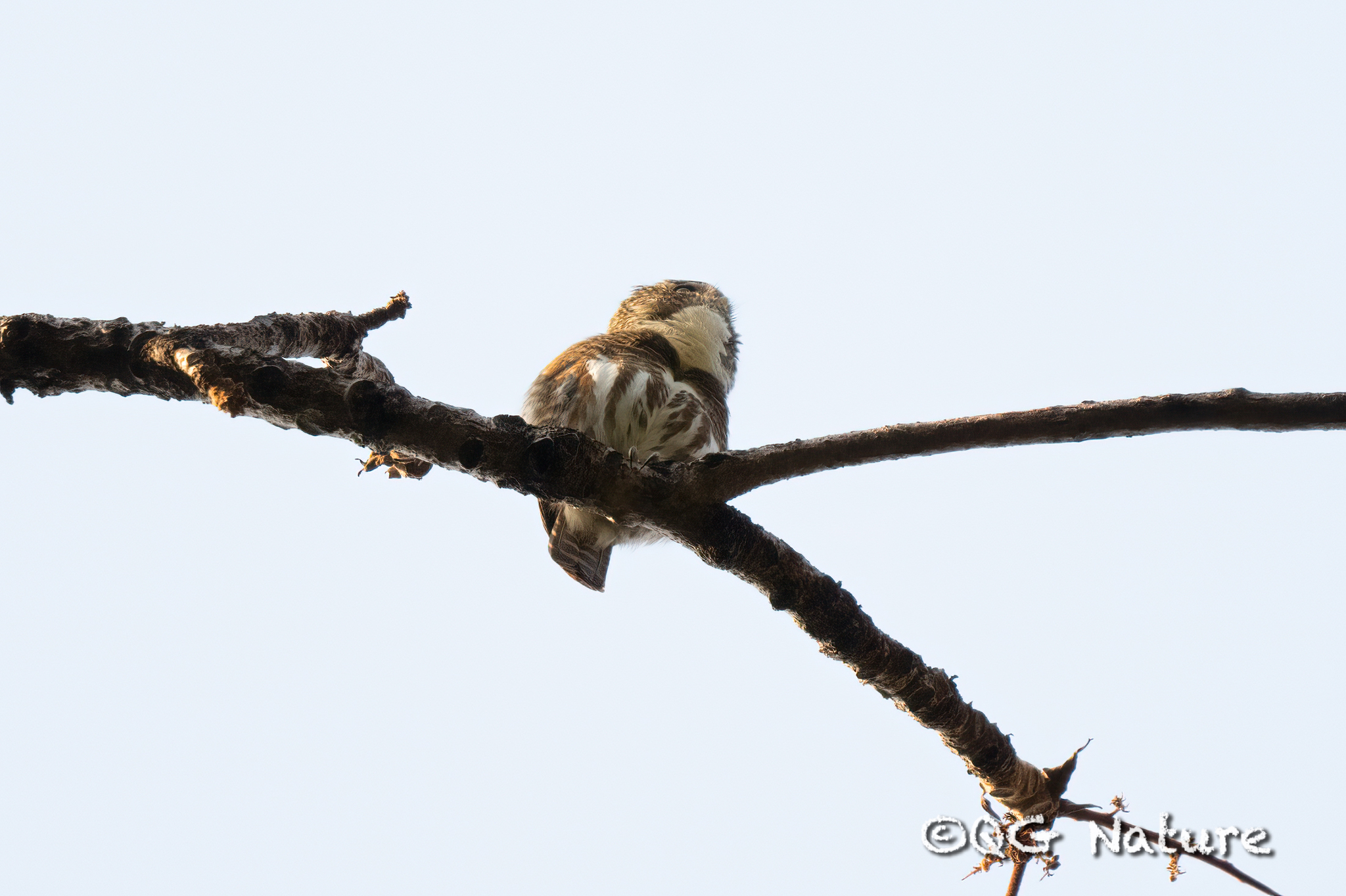
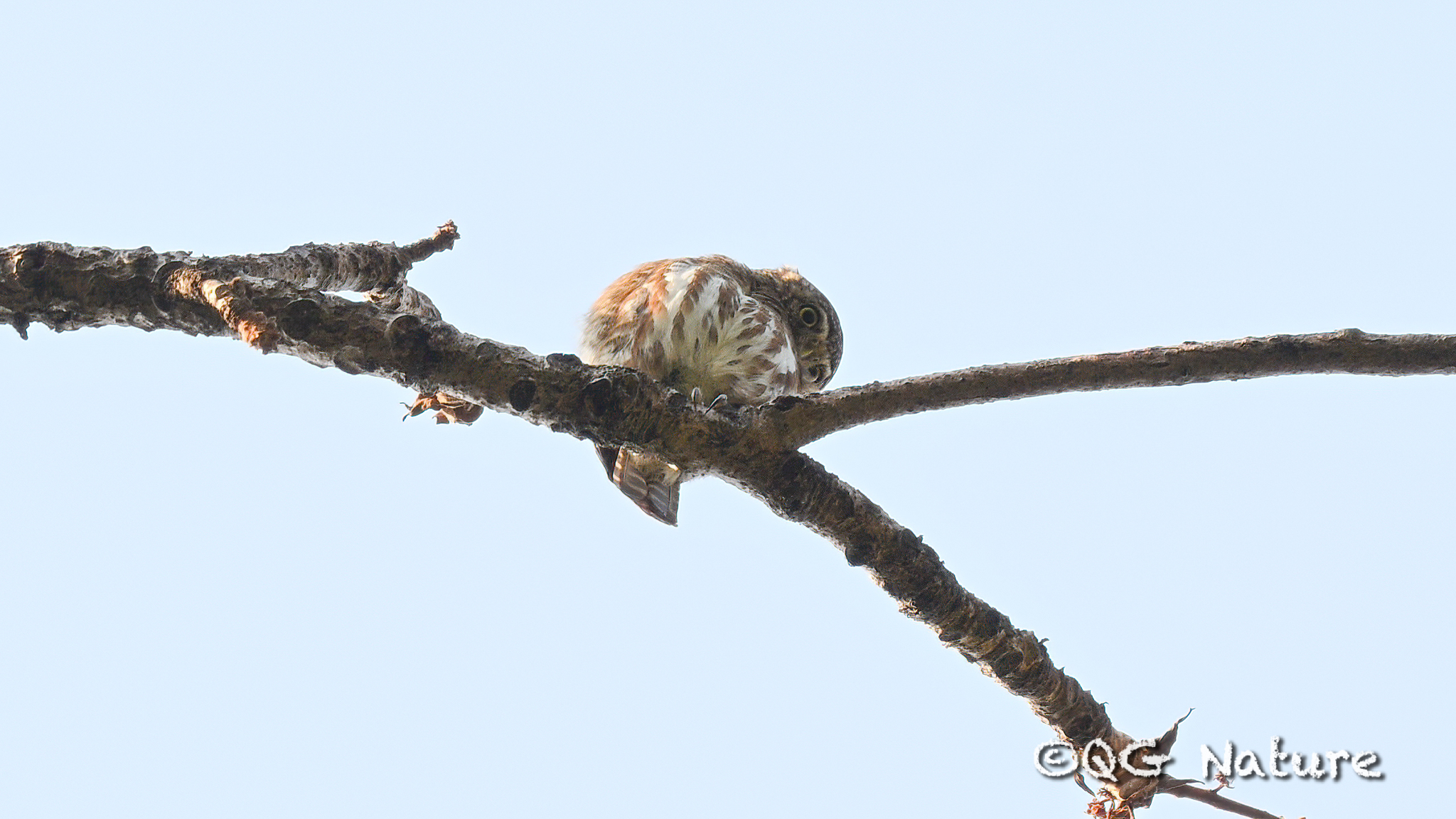
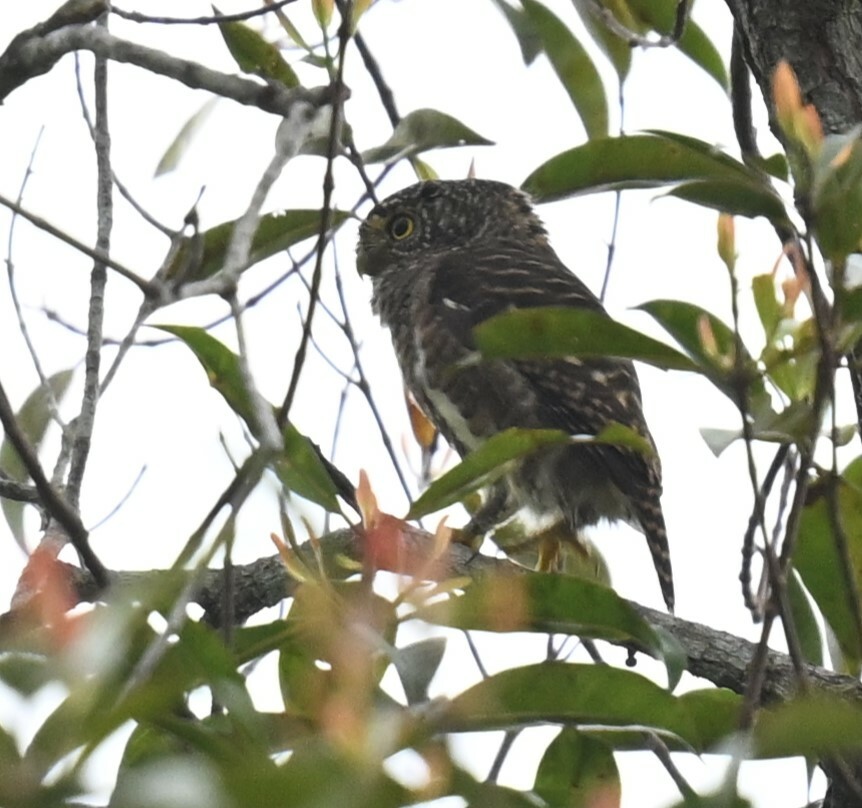
Collared Owlet
Taenioptynx brodiei
领鸺鹠
Introduction
Small owl in family Strigidae, native to oriental Asia. Geographic range extends from Himalayas of northern Pakistan through south China, Indochina, and Malay Peninsula to Taiwan. Inhabits submontane and montane evergreen forests, forest edges, and mixed deciduous-evergreen forests with oak, rhododendron, and fir. The smallest owl in Asia, measuring 15 cm and weighing 60 g. Diurnal activity pattern with distinctive 4-note vocalization. Classified as Least Concern on IUCN Red List, though habitat fragmentation poses conservation concerns.
Description
Asia's smallest owl species, measuring 15-17 cm in length. Females weigh approximately 63 g, males about 52 g. Grey-brown plumage with barred back and flanks; head is more spotted than barred. Prominent white eyebrows and vibrant lemon-yellow eyes. White throat patch, with chin, center of breast and belly mostly white. Pale collar and two black spots on each side of nape create an 'occipital face' resembling eyespots. Greyish-brown pale-spotted pectoral band on upper breast. Lacks ear-tufts. Tail is longer than most pygmy owls and visible in flight.
Identification
Smallest owl in Asia, reaching only 15-17 cm. The distinctive 'occipital face' with pale collar and two black nape spots creates the illusion of being watched from behind. Lemon-yellow eyes and prominent white eyebrows are diagnostic. Grey-brown barred plumage separates it from similar species. The longer tail compared to other pygmy owls is visible during flight. Colour morphs range from rufous in juveniles to grey in adults.
Distribution & Habitat
Resident species distributed from Himalayas of northern Pakistan through south China and Indochina to Taiwan and south through Malaysia. Occurs in Bhutan, Brunei Darussalam, Cambodia, China, India, Laos, Malaysia, Myanmar, Nepal, Pakistan, Taiwan, Thailand, and Vietnam. Inhabits evergreen forests, forest edges, mixed deciduous-evergreen forests with oak, rhododendron, and fir, and open woodlands with scrub. Found at altitudes of 1,350-2,750 m, occasionally as low as 700 m near cultivated lands.
Behavior & Ecology
Diurnal, active during daylight hours when it perches, hunts, and calls. Male produces distinctive 4-note phrase 'wüp-wüwü-wüp' repeated at intervals, becoming shriller with excitement. Call creates ventriloquial effect as bird turns head in all directions, making location difficult. Breeds March to April, nesting in natural tree hollows or woodpecker/barbet holes in tree trunks. Clutch size 3-5 round white eggs, laid late April to mid-June. Fledging occurs mid-June to early August. Diet consists of small birds, insects, lizards, invertebrates, and small mammals. Despite small size, captures prey as large as itself.
Conservation
IUCN Red List classification: Least Concern. Main threat is habitat loss from deforestation. Study findings indicate collared owlets are absent from forest fragments smaller than 100 hectares, demonstrating that anthropogenic pressures affect even small owl species. Requires relatively large, intact forest areas.
Source: Wikipedia · CC BY-SA 3.0
Taxonomy
- Order
- Strigiformes
- Family
- Strigidae
- Genus
- Taenioptynx
- eBird Code
- colowl1
Vocalizations
Subspecies (2)
-
Taenioptynx brodiei brodiei
Pakistan to southern China, southeastern Tibet, northern Indochina, and Malay Peninsula
-
Taenioptynx brodiei pardalotus
Taiwan
Data Sources
Species description from Wikipedia, licensed under CC BY-SA 3.0.
Bird images and sounds sourced from GBIF, contributed by citizen scientists worldwide under Creative Commons licenses.
Taxonomy data from AviList 2025.