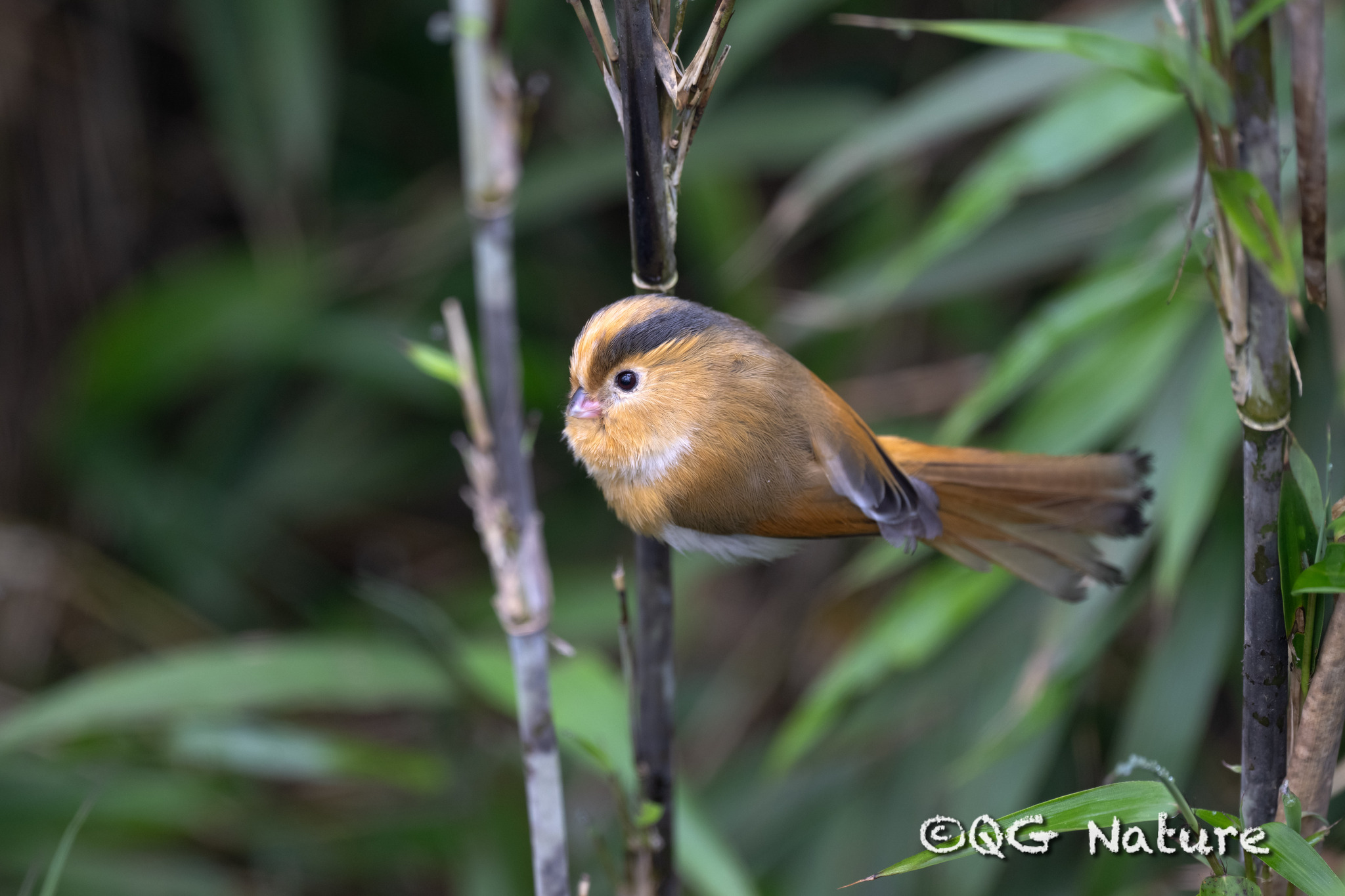
Passeriformes / Paradoxornithidae / Suthora
Fulvous Parrotbill
Suthora fulvifrons · 黄额鸦雀
Introduction
A small parrotbill in the family Paradoxornithidae, sometimes placed in the genus Paradoxornis. It is a bamboo specialist inhabiting dense montane bamboo stands in forests across the Himalayas and China. The species is non-migratory and forms flocks outside the breeding season.
Description
Small bird, 12 to 12.5 cm (4.7–4.9 in) in length. Nominate plumage features a rich buff head, upper wing coverts, flanks, rump, and tail, with a white belly. The face has a black stripe above the eye that widens in the middle and a faint white stripe below. Sexes are alike; juveniles are darker, particularly below. Subspecies P. f. chayulensis has a paler belly; P. f. albifacies has a darker supraocular stripe; P. f. cyanophrys displays a blue-grey eyestripe and brighter overall plumage.
Distribution & Habitat
Range includes central Nepal, Bhutan, north-east India, north India, south China, north Burma, and central China. Four subspecies are recognized: nominate (central Nepal, Bhutan, north-east India), P. f. chayulensis (north India, south China), P. f. albifacies (north Burma, nearby south China), and P. f. cyanophrys (central China). Habitat consists of dense bamboo stands in or near forests at elevations of 1,700–3,660 m (5,600–12,010 ft), most commonly above 2,700 m (8,900 ft).
Behavior & Ecology
Feeds on bamboo and birch buds, tiny seeds, and insects, swallowing grit to aid digestion. Forms flocks of up to 20–30 birds when not breeding. Nests are bowl-shaped structures built by both parents from bamboo leaves, rootlets, and mosses, placed 0.7–1.9 m (2.3–6.2 ft) off the ground in dense bamboo. Average clutch size is approximately 3.3 pale blue eggs. Both parents incubate and care for nestlings.
Source: Wikipedia · CC BY-SA 3.0
Taxonomy
- Order
- Passeriformes
- Family
- Paradoxornithidae
- Genus
- Suthora
Subspecies (4)
-
Suthora fulvifrons albifacies
montane forest of southwestern China (southeastern Qinghai and northwestern Yunnan)
Data Sources
Species description from Wikipedia, licensed under CC BY-SA 3.0.
Bird images and sounds sourced from GBIF, contributed by citizen scientists worldwide under Creative Commons licenses.
Taxonomy data from AviList 2025.