Passeriformes / Sturnidae / Sturnus
Common Starling
Sturnus vulgaris · 紫翅椋鸟
Introduction
Medium-sized passerine in the family Sturnidae. Native to temperate Europe and the Palearctic to western Mongolia; introduced to Australia, New Zealand, North America, South Africa, and other regions. Inhabits open habitats, urban areas, and farmland. Highly gregarious, forming large flocks and murmurations; notable for vocal mimicry and probing foraging technique. Classified as Least Concern by the IUCN.
Description
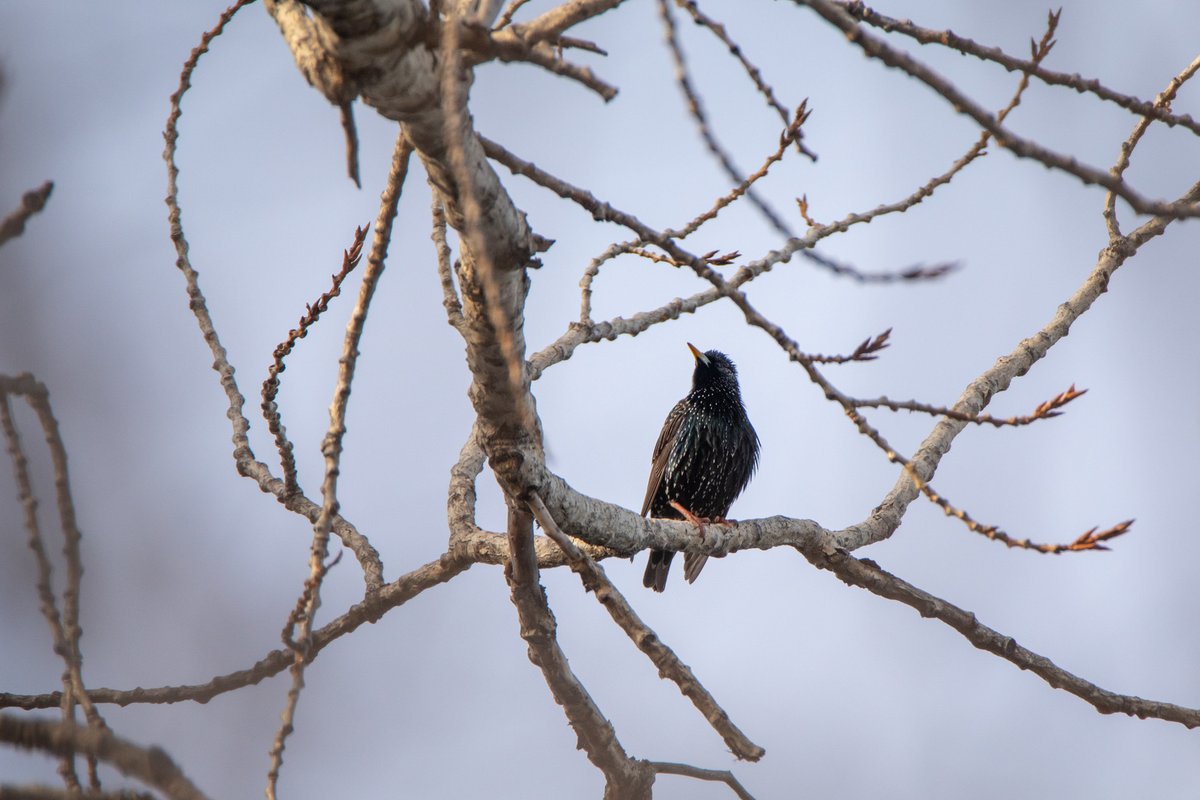
Length 19–23 cm (7.5–9.1 in), wingspan 31–44 cm (12–17 in), weight 58–101 g (2.0–3.6 oz). Plumage is iridescent black, glossed purple or green, spangled with white, especially in winter. Adult males have less spotted underparts than females and longer, loose throat feathers used in display. Legs are pinkish- or greyish-red in breeding season, darker in winter. Bill is narrow and conical; brownish-black in winter, yellow in summer (males have blue-grey bases, females have pink bases). Juveniles are grey-brown. Sex can be determined by iris color: rich brown in males, mouse-brown or grey in females.
Identification
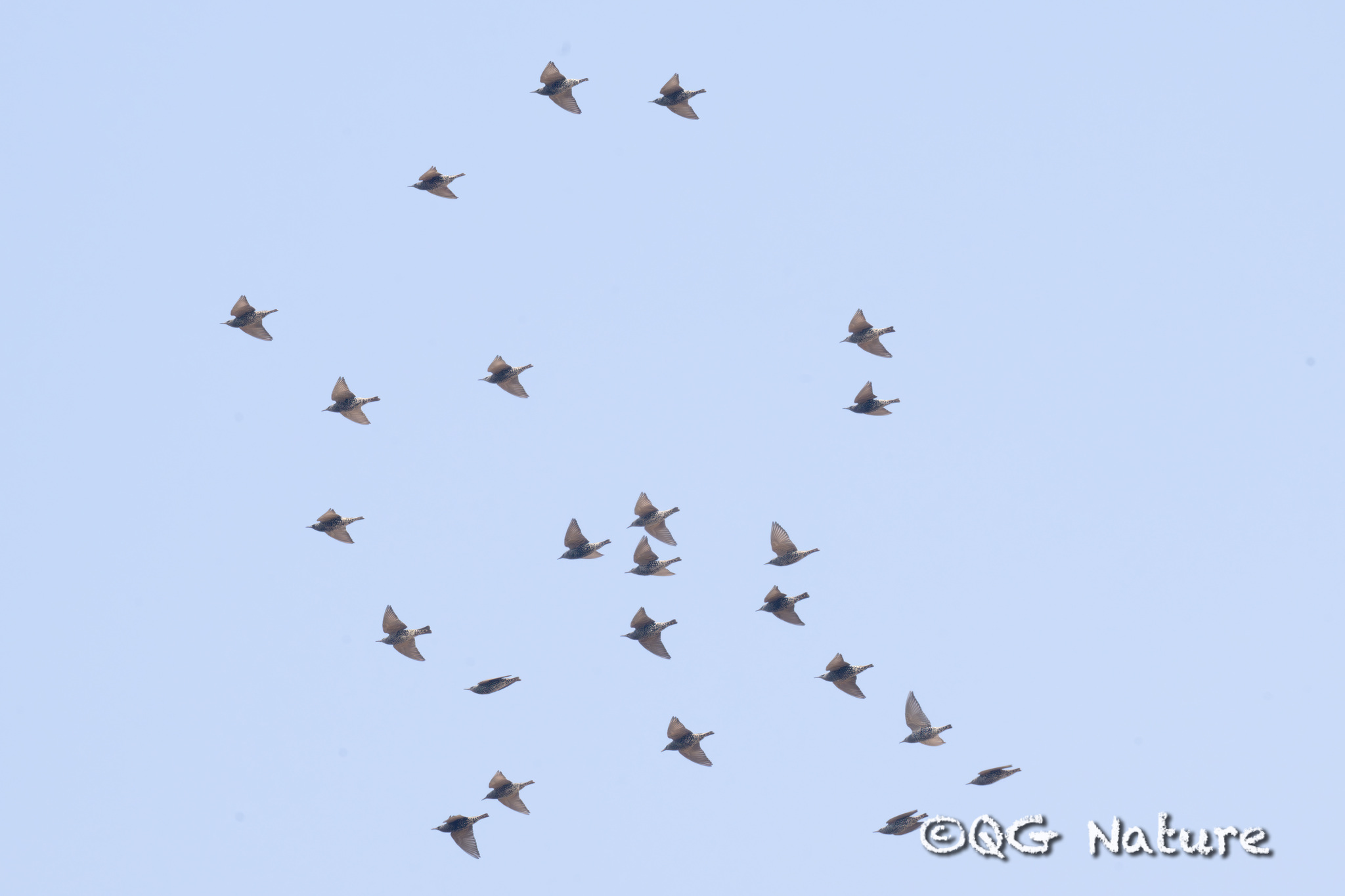
Distinguished from other mid-sized passerines by short tail, sharp blade-like bill, round-bellied shape, and strong legs. Flight features strongly pointed wings and rapid beating with periodic gliding. Ground movement is a characteristic waddle rather than hopping. Differentiated from the spotless starling by white feather tips in non-breeding plumage and shorter throat feathers. Bohemian waxwing is paler reddish-buff with a different flight call.
Distribution & Habitat
Native range includes Eurasia, northern Africa, India, Nepal, Middle East, and northwestern China. Resident in western/southern Europe and southwestern Asia; northeastern populations migrate south and west. Introduced and established in Australia, New Zealand, South Africa, North America, Fiji, and Caribbean islands. In North America, occupies area from southern Canada and Alaska to Central America. Prefers urban, suburban, and agricultural areas with short grass; avoids dense wet forests.
Behavior & Ecology
Highly gregarious, forming large flocks (murmurations) for roosting and defense against predators. Omnivorous diet includes invertebrates, seeds, fruit, and food waste. Forages by probing ground with open bill, hawking flying insects, or lunging. Nests in cavities, often decorating with green material. Breeding occurs in spring/summer; lays 4-5 pale blue eggs. Incubation lasts 13 days; young fledge after three weeks. Males sing complex songs incorporating mimicry of other species and environmental sounds to attract mates and defend territory.
Conservation
Classified as Least Concern by the IUCN with a global population estimated at over 310 million individuals. However, populations have declined significantly in parts of northern and western Europe since the 1980s, with numbers dropping more than 80% in the UK between 1966 and 2004. Declines are attributed to intensive agriculture reducing availability of grassland invertebrates for chicks. The species is listed among the world's 100 worst invasive species due to impacts on native biodiversity and agriculture.
Culture
Noted for mimicry in literature, including the Mabinogion, Pliny the Elder, and Shakespeare. Mozart kept a pet starling that could sing phrases from his Piano Concerto in G Major. Introduced to North America in 1890 by Eugene Schieffelin, allegedly to introduce all birds mentioned by Shakespeare. Considered an agricultural pest in introduced ranges but beneficial for insect control in native ranges. Trapped for food in some Arab countries.
Source: Wikipedia · CC BY-SA 3.0
Taxonomy
- Order
- Passeriformes
- Family
- Sturnidae
- Genus
- Sturnus
Subspecies (13)
-
Sturnus vulgaris caucasicus
Volga Delta and northern Caucasus to Caspian Sea and southern Iran
Data Sources
Species description from Wikipedia, licensed under CC BY-SA 3.0.
Bird images and sounds sourced from GBIF, contributed by citizen scientists worldwide under Creative Commons licenses.
Taxonomy data from AviList 2025.