Common Starling
Sturnus vulgaris
紫翅椋鸟
Introduction
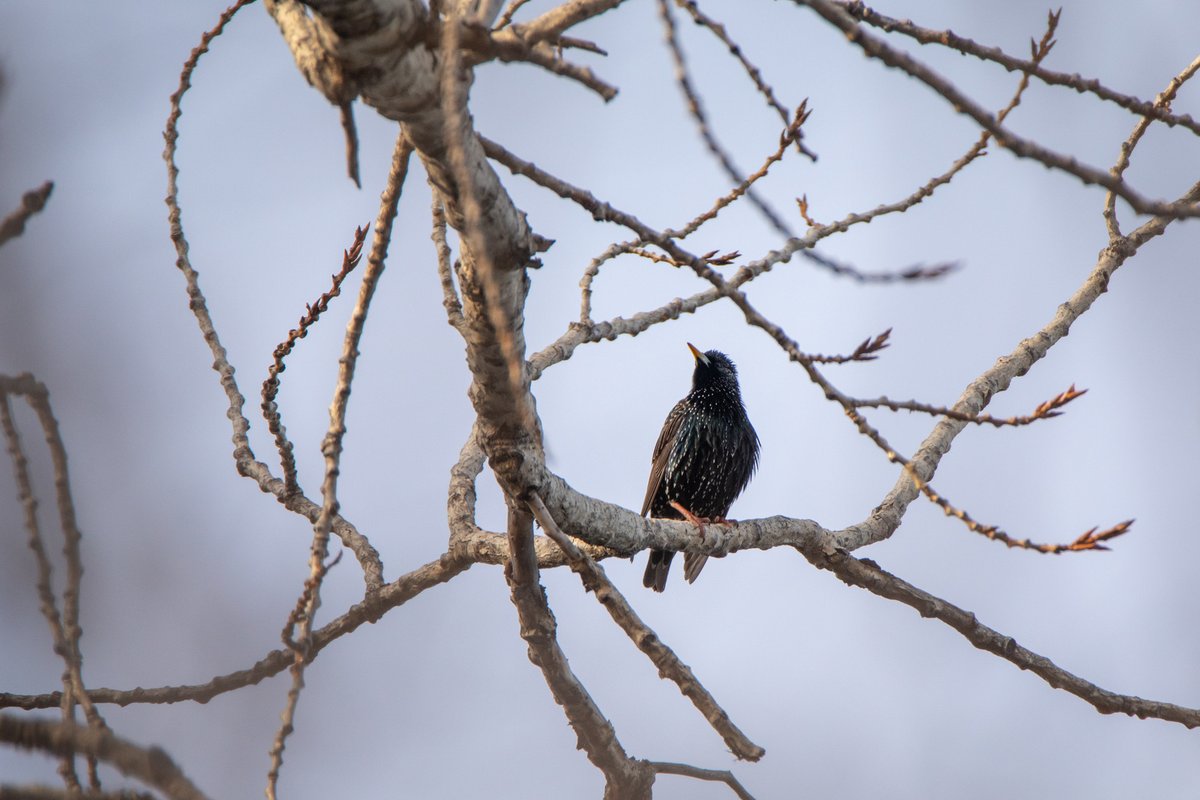
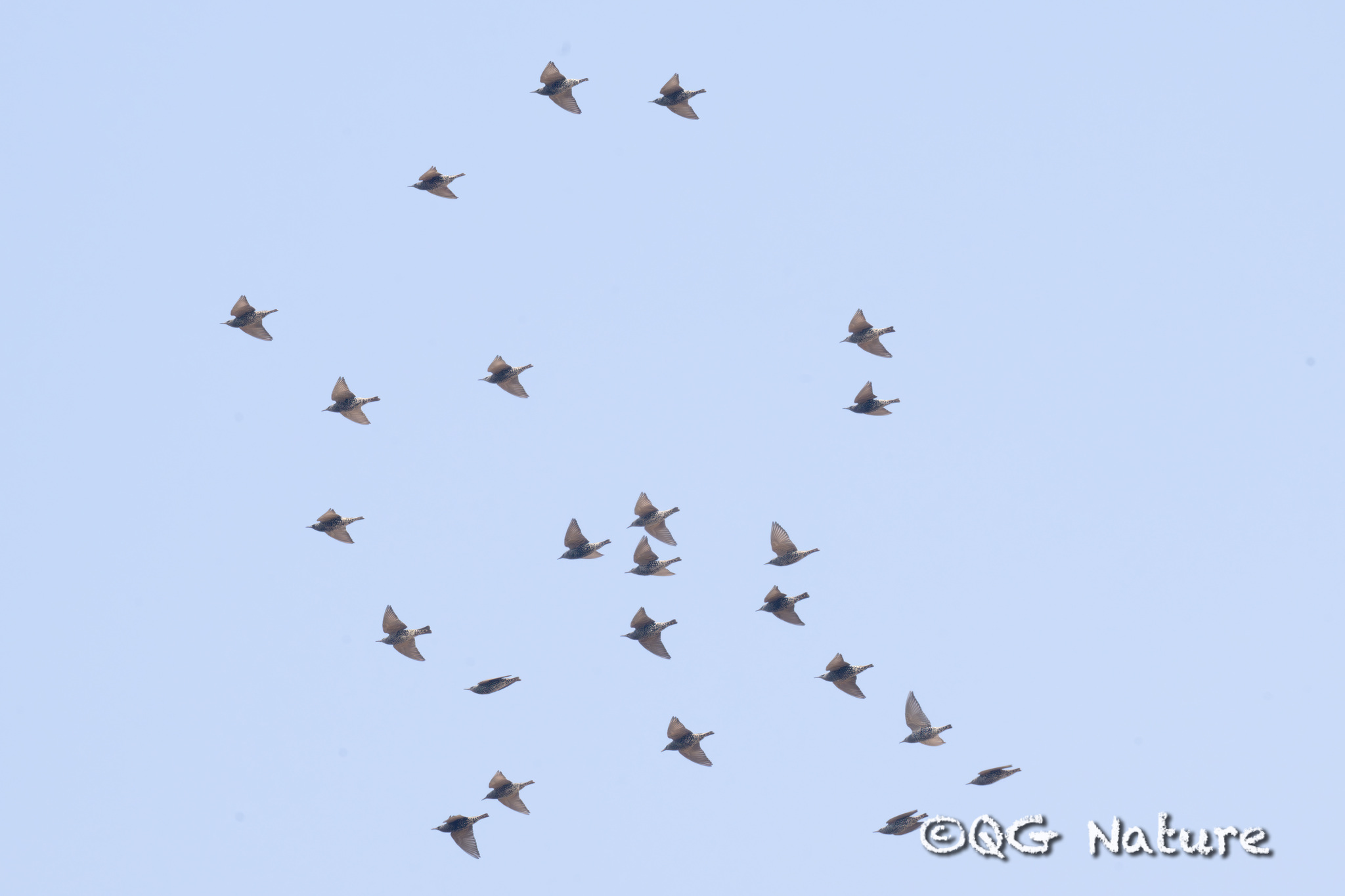
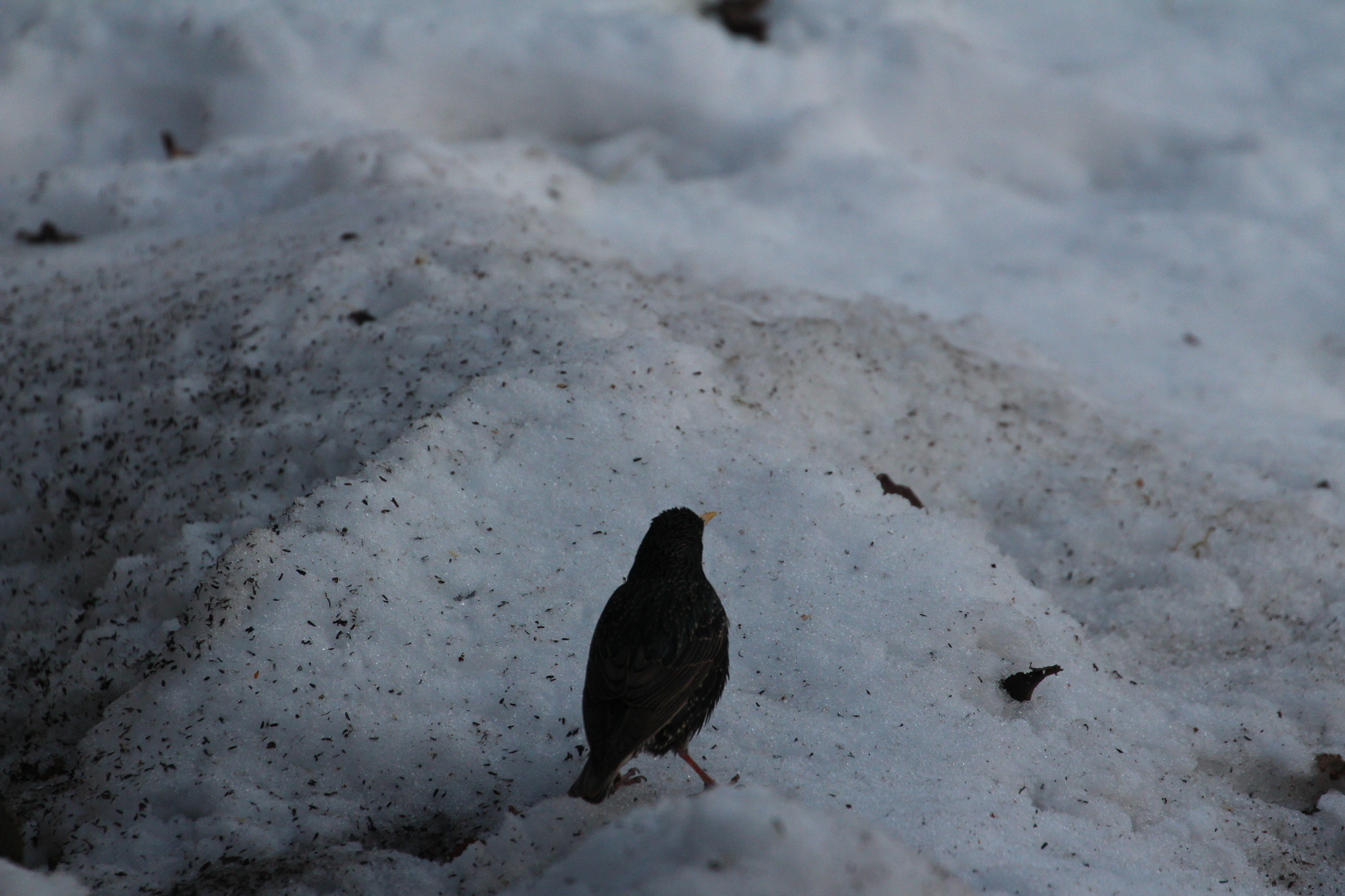
Passerine, widespread across the Northern Hemisphere. Length approximately 20 cm. Compact, round-bellied silhouette with short tail and rufous legs. Adult plumage iridescent black with purple and green metallic sheens, white spots in winter when fresh feathers have pale tips. Conical bill black in winter, bright yellow in breeding season. Sexes show subtle differences. Juveniles browner, gradually acquiring glossy adult plumage. Flight pattern direct, powerful on sharply pointed triangular wings with rapid beats, interspersed with short glides. Ground movement characterized by waddling gait. Forms large winter flocks, known as murmurations, numbering hundreds of thousands of birds. These flocks move in coordinated patterns before descending to communal roosts.
Description
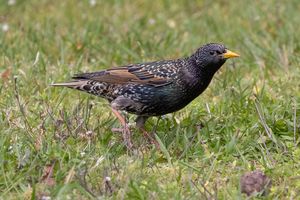
This compact passerine measures 19-23 centimetres in length with a wingspan of 31-44 centimetres and weighs 58-101 grams. The plumage is iridescent black, glossed with purple or green reflections, and prominently spangled with white, especially in winter when fresh feathers are prominently white-tipped on the breast and buff-tipped on the wing and back feathers. The stout legs are pinkish-red during breeding season, darkening slightly in winter. The narrow, conical bill is brownish-black in winter; summer bills are lemon yellow with pink bases in females and yellow with blue-grey bases in males. Throat feathers are long and loose in males for display, shorter and more pointed in females. Juveniles are grey-brown and resemble adults by their first winter, though often retaining some brown feathering on the head. The bill shape, short tail, round belly and strong legs distinguish it from similar-sized passerines.
Identification
This species is readily distinguished from most other mid-sized passerines by its relatively short tail, sharp blade-like bill, round-bellied shape and strong rufous legs. In flight, the strongly pointed wings and dark coloration are distinctive, while the rapid, powerful wingbeats set it apart from similarly sized birds. The closely related spotless starling may cause confusion in Iberia and northwest Africa; it lacks the pale feather tip spots in adult breeding plumage and has longer throat feathers visible when singing. The bohemian waxwing is similar in flight and also flies in dense flocks, but is a paler reddish-buff colour, marginally smaller, and has a very different flight call. The strange, waddling gait on the ground is also characteristic and helps separate it from thrushes, icterids and small corvids.
Distribution & Habitat
This species is native across temperate Eurasia from Iceland and the British Isles eastwards to western Mongolia, and throughout Europe, northern Africa, the Middle East, India and northwestern China. It has been introduced successfully to Australia, New Zealand, North America, South Africa, Fiji and several Caribbean islands. Western and southern European populations are largely resident, while northeastern populations migrate south and west within the breeding range and further to Iberia and North Africa. The species prefers urban and suburban areas, farmland, grazing pastures, reedbeds and open woodlands, rarely inhabiting dense wet forests. Large winter roosts form in city centres, woodlands and reedbeds, sometimes reaching 1.5 million birds.
Behavior & Ecology
Highly gregarious outside the breeding season, this species forms huge, noisy flocks that move in coordinated murmurations, likely as defence against birds of prey. It is omnivorous, feeding on a wide range of invertebrates including spiders, flies, beetles, earthworms and moths, as well as seeds, fruits, nectar and food waste. Several foraging techniques are employed: probing the ground with the bill, hawking flying insects, lunging at ground prey and following grazing animals to catch disturbed insects. The breeding season produces one to three broods; nests are built in natural or artificial cavities using straw, grass and twigs lined with feathers. Four or five glossy pale blue eggs are laid and incubated for thirteen days by both parents. The famous gift for mimicry produces a complex song incorporating whistles, mechanical clicks and imitations of other species, with males having repertoires of up to 35 song types and 14 click types.
Conservation
Classified as Least Concern by the IUCN due to its huge global population estimated at over 310 million individuals. However, significant declines of more than 50% have occurred since the 1980s across northern and central Europe, including the United Kingdom where numbers fell by over 80% between 1966 and 2004. The primary threat is intensive agricultural practices that have reduced grassland invertebrates, the essential food source for growing chicks. The species remains common and abundant in many areas despite local reductions, and introduced populations in North America and elsewhere continue to thrive. The adaptability to diverse habitats and food sources has contributed to its success, though this same flexibility makes it an agricultural pest in many regions.
Culture
The remarkable mimicry abilities of this bird have been celebrated throughout history. The medieval Welsh Mabinogion tells of Branwen taming one and teaching it words to send a message across the Irish Sea. Pliny the Elder claimed they could be taught to speak whole sentences in Latin and Greek, while Shakespeare referenced them in Henry IV. Mozart owned a pet that could sing a phrase from his Piano Concerto in G Major; he became so attached that he arranged an elaborate funeral when it died. Austrian ethologist Konrad Lorenz wrote fondly of them as 'the poor man's dog' in his book King Solomon's Ring. The birds have been kept as pets and laboratory research subjects, second in numbers only to the domestic pigeon. In some Arab countries, they are trapped for food, though the tough meat requires lengthy stewing.
Source: Wikipedia · CC BY-SA 3.0
Taxonomy
- Order
- Passeriformes
- Family
- Sturnidae
- Genus
- Sturnus
- eBird Code
- eursta
Subspecies (13)
-
Sturnus vulgaris caucasicus
Volga Delta and northern Caucasus to Caspian Sea and southern Iran
-
Sturnus vulgaris faroensis
Faroe Islands
-
Sturnus vulgaris granti
Azores
-
Sturnus vulgaris humii
western Himalayas (Kashmir to Garhwal)
-
Sturnus vulgaris minor
locally in western Pakistan (Sind)
-
Sturnus vulgaris nobilior
Afghanistan, Transcaspia, and Khorasan
-
Sturnus vulgaris oppenheimi
southeastern Türkiye and northern Iraq
-
Sturnus vulgaris poltaratskyi
eastern Ural Mountains to Lake Baikal, Kazakhstan, and western Mongolia
-
Sturnus vulgaris porphyronotus
southern Dzungaria and Tien Shan Mountains to Pamir Mountains and Samarkand
-
Sturnus vulgaris purpurascens
western Transcaucasia to Georgia and Armenia
-
Sturnus vulgaris tauricus
eastern and southern Ukraine, Crimea, and Türkiye
-
Sturnus vulgaris vulgaris
Canary Islands and Iceland to Ural Mountains, northern Ukraine, and southeastern Europe; introduced to Africa, eastern Australia, New Zealand (self-introduced to subantarctic islands), North America, and southern South America
-
Sturnus vulgaris zetlandicus
Shetland Islands
Data Sources
Species description from Wikipedia, licensed under CC BY-SA 3.0.
Bird images and sounds sourced from GBIF, contributed by citizen scientists worldwide under Creative Commons licenses.
Taxonomy data from AviList 2025.