











Charadriiformes / Laridae / Sterna
Common Tern
Sterna hirundo · 普通燕鸥
Introduction
A seabird in the family Laridae with a circumpolar distribution, breeding in temperate and subarctic regions of Europe, Asia, and North America. It is strongly migratory, wintering in coastal tropical and subtropical regions. The species breeds in a wider range of habitats than its relatives, nesting on flat, poorly vegetated surfaces close to water, including artificial substrates. It feeds by plunge-diving for fish. Classified as Least Concern on the IUCN Red List, though North American populations have declined sharply.
Description
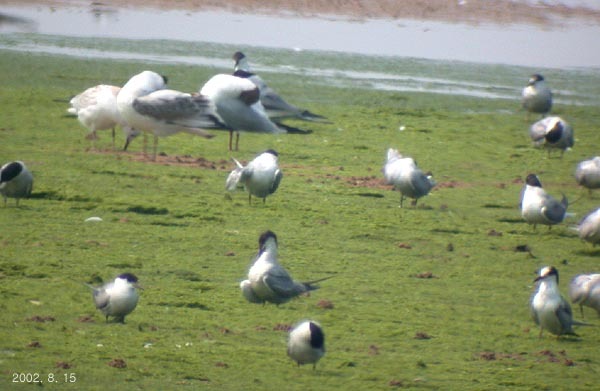
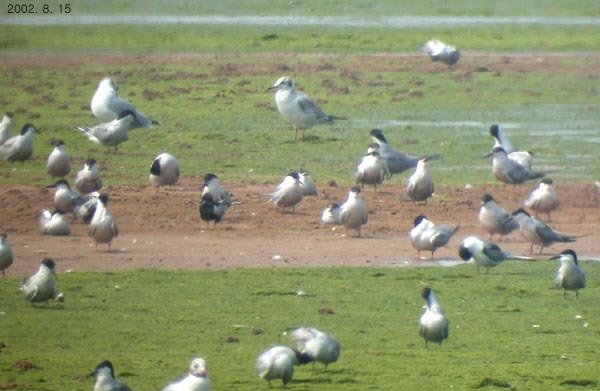
The nominate subspecies is 31–35 cm (12–14 in) long, with a 77–98 cm (30–39 in) wingspan and weighs 110–141 g (3.9–5.0 oz). Breeding adults have pale grey upperparts, very pale grey underparts, a black cap, orange-red legs, and a narrow pointed bill that is mostly red with a black tip or all black depending on subspecies. As summer progresses, dark feather shafts on outer flight feathers create a grey wedge on the wings. The rump and tail are white; the tail extends no further than folded wingtips. Non-breeding adults have white foreheads and underparts, an all-black bill or one with a red base, and dark red or black legs. Juveniles have pale grey upper wings with a dark carpal bar, brown crown and nape, ginger forehead, and scaled upper parts.
Identification
Distinguished from the similar Arctic tern by a larger head, thicker neck, longer legs, and more triangular, stiffer wings. The common tern has a more powerful, direct flight. Key plumage differences include whiter cheeks (Arctic has greyer underparts), a dark wedge developing on wings during breeding (Arctic wings stay white), and only the four innermost wing feathers being translucent against bright sky (all are translucent in Arctic). The bill is orange-red with a black tip (darker red without black tip in Arctic), and legs are bright red (darker in Arctic). In flight, the trailing edge of outer flight feathers is a thicker, less defined black line compared to the thin line in Arctic terns. Vocalizations have a lower pitch than Arctic terns; the alarm call KEE-yah is stressed on the first syllable.
Distribution & Habitat
Breeds in temperate and subarctic regions of Europe, Asia, and North America. In North America, ranges from Labrador to North Carolina along the Atlantic coast, inland across Canada east of the Rocky Mountains, and locally in the Great Lakes and Gulf coast. Small partially migratory colonies exist in the Caribbean. Eurasian breeding ranges extend across temperate and taiga zones, with outposts in the Persian Gulf, Iran, Sri Lanka, and Ladakh. Winters in coastal tropical and subtropical regions: New World birds migrate to Central and South America (as far as Argentina and northern Chile); European birds winter off western or southern Africa; Asian birds winter in the northern Indian Ocean, East Africa, and as far as southern Australia. Breeds at altitudes up to 4,800 m (15,700 ft) in Asia.
Behavior & Ecology
Feeds by plunge-diving for fish from 1–6 m height, submerging up to 50 cm. Also consumes molluscs, crustaceans, worms, and insects. Forages up to 15 km from colonies, often tracking predatory fish or dolphins. Nests in colonies on flat, poorly vegetated surfaces near water, using scrapes lined with debris. Clutch size is normally three eggs; incubation lasts 21–22 days by both sexes. Chicks fledge in 22–28 days. Highly defensive of nests, harassing intruders but rarely making contact. Adults recognize chicks by call. Maximum documented lifespan is 33 years in Europe and 23 years in North America.
Conservation
Classed as Least Concern on the IUCN Red List with a population of 1.6 to 3.3 million mature individuals. However, North American numbers have declined by more than 70% in the last forty years, with fewer than 80,000 pairs remaining. Threats include habitat loss, pollution (PCBs, DDE), disturbance of breeding colonies, predation by rats and gulls, and hunting in the Caribbean. Protected under the Agreement on the Conservation of African-Eurasian Migratory Waterbirds (AEWA) and the US–Canada Migratory Bird Treaty Act of 1918. Conservation measures include artificial nest rafts, vegetation management, and predator control.
Source: Wikipedia · CC BY-SA 3.0
Taxonomy
- Order
- Charadriiformes
- Family
- Laridae
- Genus
- Sterna
Subspecies (4)
-
Sterna hirundo hirundo
breeds Azores to Canary islands, inland Europe (except Arctic) eastward to northwestern Siberia and western China, and locally northwestern Africa, also inland Northwest Territories eastward to southeastern Canada and southward to Montana, Great Lakes, and New England, coastal North Atlantic to South Carolina, Bahamas (erratic), and islands north of Venezuela; migrates to southern oceans
Data Sources
Species description from Wikipedia, licensed under CC BY-SA 3.0.
Bird images and sounds sourced from GBIF, contributed by citizen scientists worldwide under Creative Commons licenses.
Taxonomy data from AviList 2025.