Roseate Tern
Sterna dougallii
粉红燕鸥
Introduction
A medium-sized tern measuring 33-36 cm in length with a 67-76 cm wingspan. Its range encompasses the Atlantic coast and includes key colonies in Ireland. It exhibits a strong marine preference, rarely occurring inland except to bathe in coastal lagoons. Identification features include very long tail streamers in adults, a distinctive 'chuwit' call, and fast, shallow wingbeats in flight. It can be confused at distance with common and Arctic terns.
Description
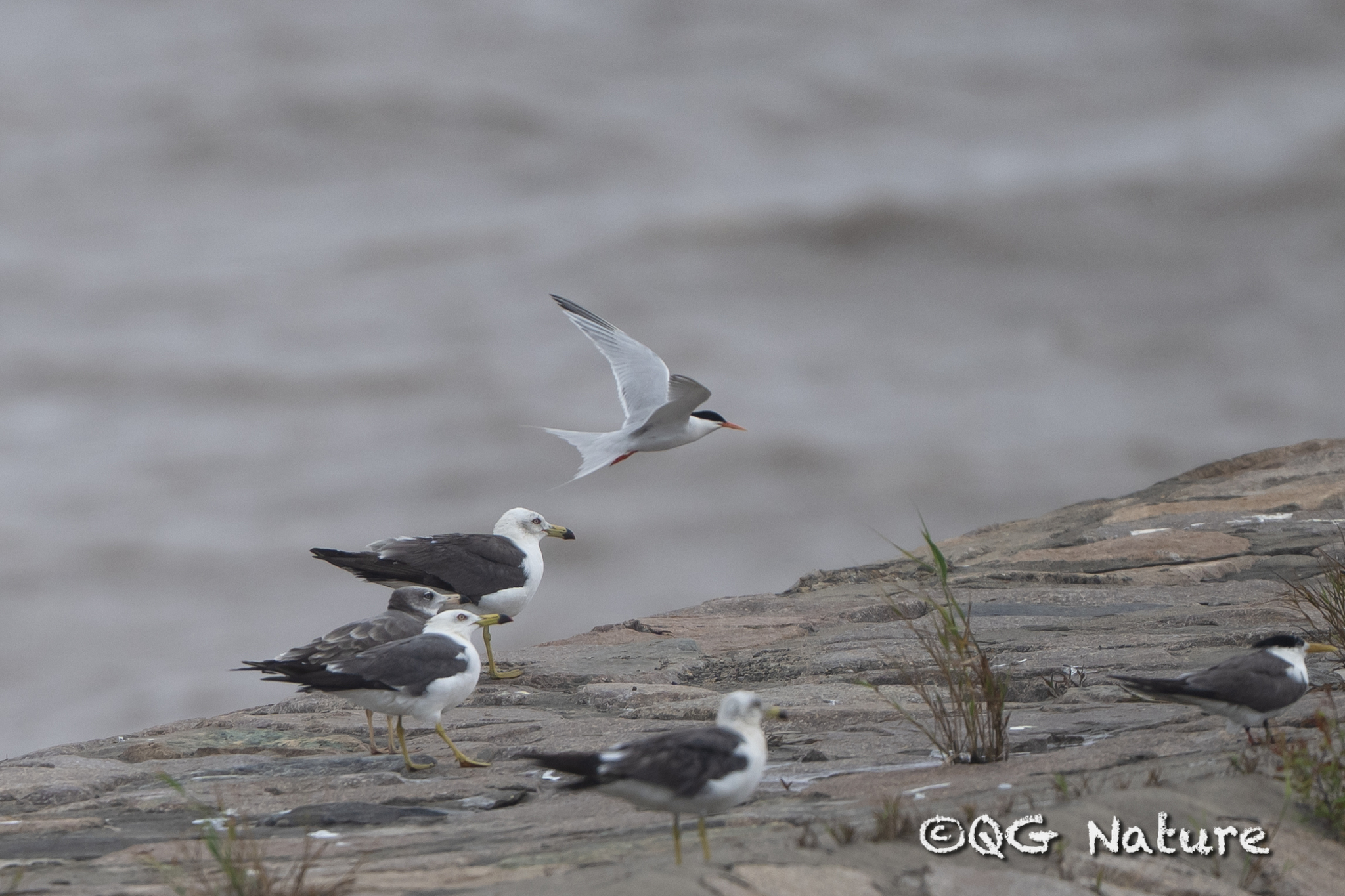
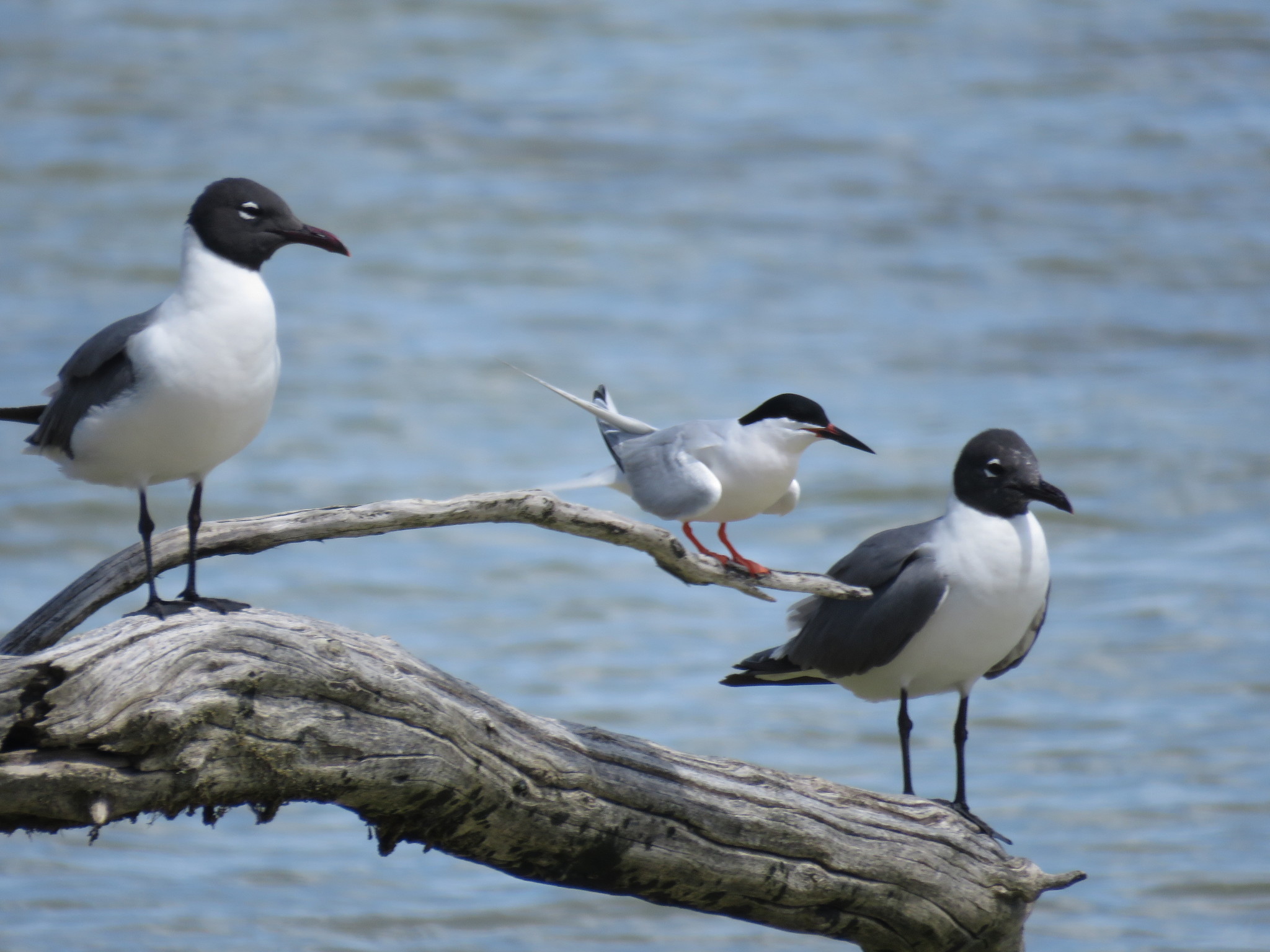
A small to medium-sized tern measuring 33-36 cm in length with a wingspan of 67-76 cm. The plumage is overall very pale, with pale grey upperwings and white underparts. The thin, sharp bill is black with a red base that becomes more extensive during the breeding season, reaching full red in tropical subspecies. Adults possess remarkably long, flexible tail streamers and orange-red legs. In breeding plumage, the underparts develop a delicate pink flush that gives the species its name. Non-breeding birds show a white forehead and entirely black bill. Juveniles display a scaly upperparts pattern similar to juvenile Sandwich Terns but with a fuller black cap.
Identification
The pale overall appearance and fast, shallow wingbeats distinguish this species from the common and Arctic terns, which have deeper wingbeats. In flight, it resembles a small Sandwich tern but lacks that species' yellow bill tip. The extremely long tail streamers are a key identifying feature when the bird is perched or in flight. The breeding plumage pink wash on the underparts is diagnostic but can be subtle in some individuals. The less aggressive nesting behavior, relying on neighbouring Arctic and common terns for defense, can sometimes be observed in colonies. The distinctive 'chuwit' call, similar to a spotted redshank, separates it aurally from all other tern species.
Distribution & Habitat
The nominate subspecies breeds on Atlantic coasts of Europe and North America, wintering south to the Caribbean and west Africa. Tropical subspecies (S. d. korustes and S. d. bangsi) are resident breeders from east Africa across the Indian Ocean to Japan, showing more extensive red on the bill. The Australian and New Caledonian population (S. d. gracilis) is long-billed and short-winged. The north-western Indian Ocean holds populations of S. d. arideensis. The species breeds colonially on coasts and islands, often alongside other seabird species. Ireland's Rockabill Island hosts most of the European population, with smaller colonies in Britain and North America.
Behavior & Ecology
Feeds almost exclusively at sea by plunge-diving for fish, making it more marine-oriented than related terns. It typically dives directly rather than using the stepped-hover technique of Arctic terns. Unusually for a tern, it exhibits kleptoparasitic behavior, stealing fish from other seabirds, particularly puffins at British colonies—a valuable strategy during bad weather when fish swim deeper. Males present fish to females as part of courtship displays. Breeding occurs in ground scrapes, often in hollows or under dense vegetation, with one to three eggs. The species is less defensive of its young than other white terns and relies on neighboring Arctic and common terns for protection. The characteristic vocalization is a distinctive 'chuwit' call.
Conservation
The species faces ongoing conservation concerns across its range. Historically hunted for the hat trade in the late 19th century, populations now suffer from competition and predation by expanding gull populations. It remains one of the UK's rarest breeding seabirds. The largest European colony at Rockabill Island, Ireland, holds about 1200 pairs (75% of European population), while Lady's Island Lake hosts 155 pairs. Conservation measures have proven highly successful: nestbox programs at Coquet Island, Northumberland, increased the colony from 25 pairs in 1997 to 154 pairs in 2022. Similar measures on Anglesey have yielded promising results. In the UK, it has Biodiversity Action Plan protection, with climate change identified as a key threat through altered fish distribution. The species is listed as Threatened in Canada, Endangered in the northeastern US, and Threatened for Caribbean populations. It is protected under AEWA.
Culture
No specific cultural significance or folklore is documented for this species in the available sources.
Source: Wikipedia · CC BY-SA 3.0
Taxonomy
- Order
- Charadriiformes
- Family
- Laridae
- Genus
- Sterna
- eBird Code
- roster
Subspecies (5)
-
Sterna dougallii arideensis
Seychelles to Madagascar and Rodrigues
-
Sterna dougallii bangsi
Arabian Sea; eastern China and Ryukyu Islands (southern Japan) eastward to New Guinea and Vanuatu
-
Sterna dougallii dougallii
breeds patchily, islands and coasts of Azores, British Isles, and western France, Somalia to southern Africa, also coastal southeastern Canada and northeastern USA, Florida Keys, Belize cays, islands off n Honduras, West Indies and islands north of Venezuela
-
Sterna dougallii gracilis
Moluccan islets and western and northern Australia (southwestern Australia to southeastern Queensland)
-
Sterna dougallii korustes
Sri Lanka, Andaman Islands, and Mergui Archipelago (southwestern Myanmar)
Data Sources
Species description from Wikipedia, licensed under CC BY-SA 3.0.
Bird images and sounds sourced from GBIF, contributed by citizen scientists worldwide under Creative Commons licenses.
Taxonomy data from AviList 2025.