Passeriformes / Eurylaimidae / Psarisomus
Long-tailed Broadbill
Psarisomus dalhousiae · 长尾阔嘴鸟
Introduction
A songbird in the family Eurylaimidae and the sole member of the genus Psarisomus. It inhabits broad-leaved evergreen forests across the Himalayas, Northeastern India, and Southeast Asia. Distinctive traits include a long blue tail, bright yellow throat, and sociable behavior in noisy parties. The species is listed as Least Concern by the IUCN.
Description
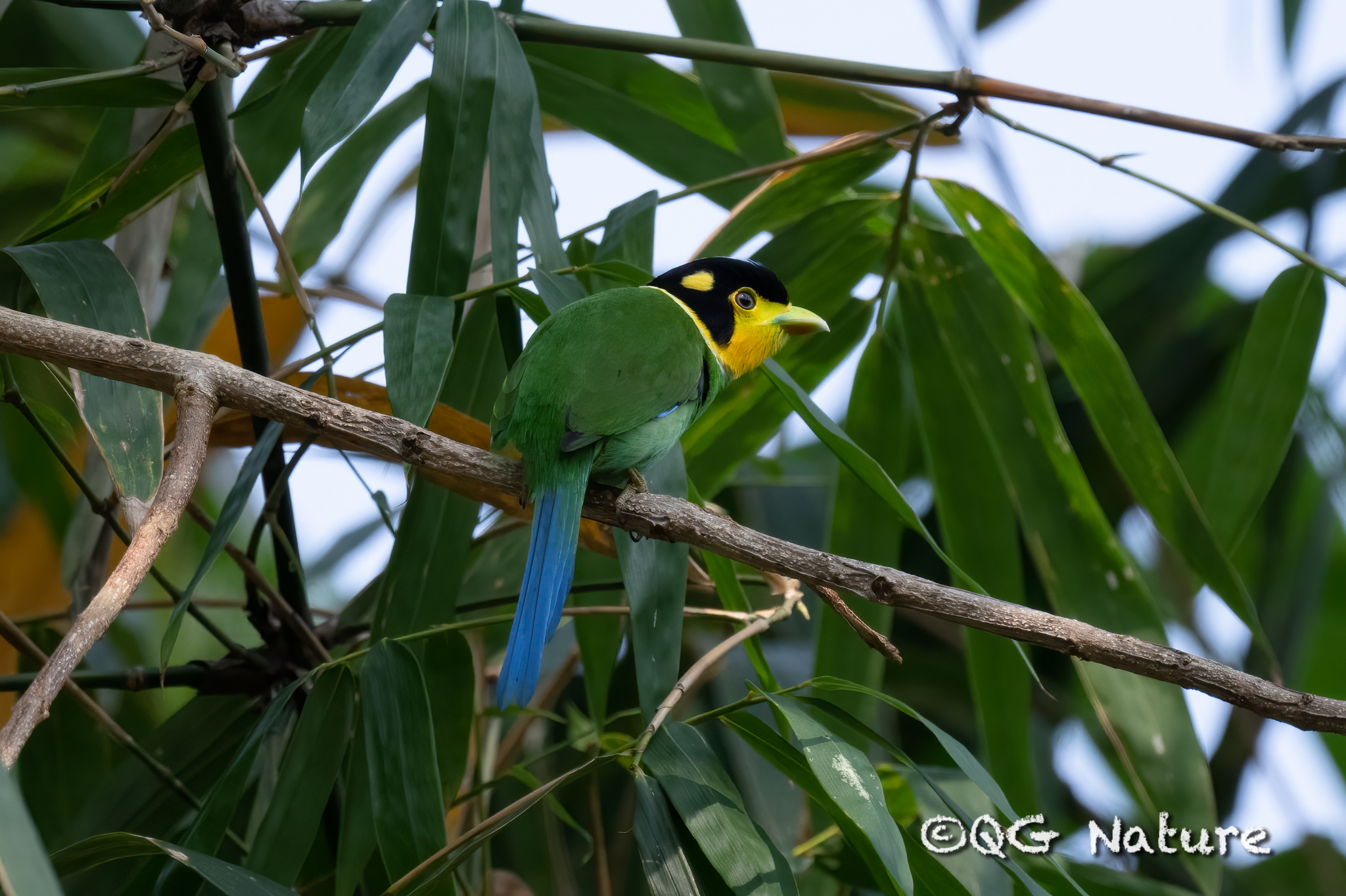
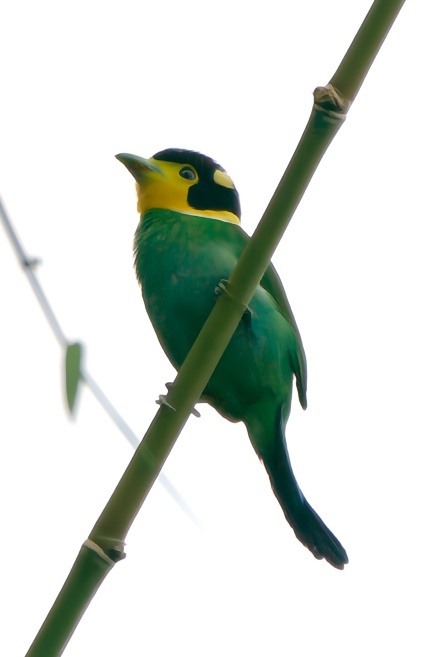
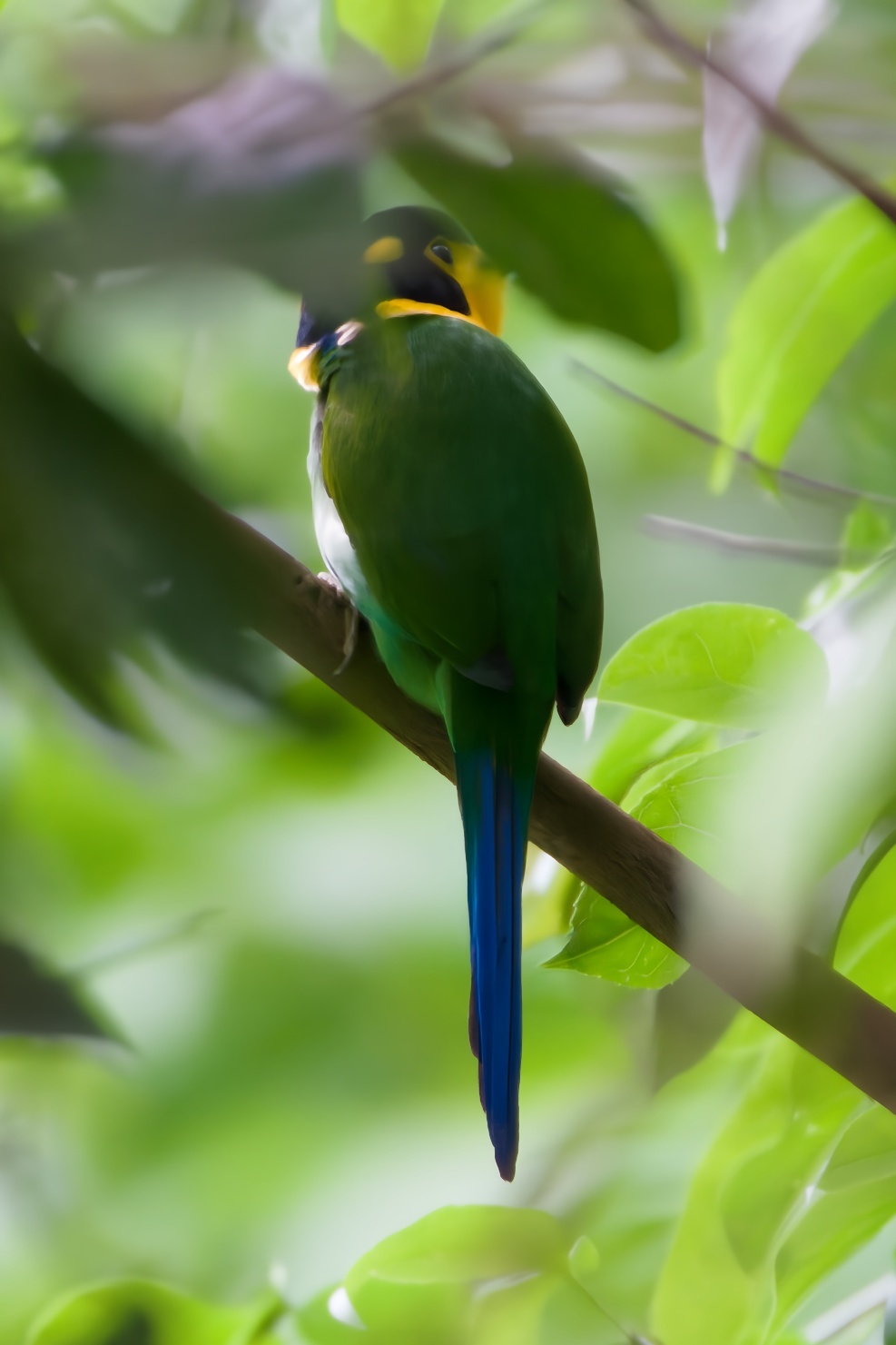
Adults measure about 25 cm (10 inches) in length and weigh 50–60 grams. They feature a bright yellow throat and face, with yellow feathers forming a thin neck band and pale-yellow or whitish feathers below the throat. A helmet-like black cap includes a sleek blue crown patch and a smaller blue nape patch. The back, belly, and upper wings are bright green, while underwing feathers are lighter green or blueish-green. Primary feathers are black with metallic blue margins and white spots on the inner web base. The long tail is blue above and black below. The bill is strong, broad, and yellowish-green with lighter edges; legs are brown and toes pea-green. Juveniles have shorter tails, green heads, and duller plumage.
Identification
Identified by a shrill call consisting of loud, sharp, downward-inflected whistles such as 'pseeu..pseeu..pseeu' and 'tseeay..tseeay', or a sharp rasping 'pseeup'. Key visual marks include the bright yellow throat and face contrasting with a black cap and blue crown, bright green body, and a long blue tail with black undertail coverts.
Distribution & Habitat
Found in the Himalayas, extending east through Northeastern India to Southeast Asia, including India, Nepal, Bhutan, Myanmar, Thailand, Cambodia, Laos, Vietnam, China, Malaysia, and Indonesia. Five subspecies are recognized: P. d. dalhousiae (Himalayan foothills to Indochina), P. d. cyanicauda (SE Thailand, Cambodia), P. d. divinus (S Vietnam), P. d. psittacinus (Peninsular Malaysia, Sumatra), and P. d. borneensis (N Borneo). Habitats include tropical and subtropical moist lowland and mountain forests, often near streams and wetlands, at altitudes from 150 to 2500 meters. Populations are resident but may move to lower altitudes in winter.
Behavior & Ecology
Social and insectivorous, foraging in small flocks of up to 15 individuals or mixed-species groups for grasshoppers, crickets, beetles, moths, and spiders; occasionally eats small frogs, berries, and fruit. Breeding seasons vary by location, occurring from March to April in the Indian Subcontinent and from April in Myanmar. Both sexes incubate 5–6 white, oval eggs and feed chicks. Nests are large, pear-shaped structures made of roots, leaves, moss, and creepers, attached to tall tree branches with a 1–2 inch side entrance protected by leaves. Cooperative breeding is suggested.
Conservation
Listed as Least Concern on the IUCN Red List. Populations are fairly common throughout their range and protected in many national parks.
Source: Wikipedia · CC BY-SA 3.0
Taxonomy
- Order
- Passeriformes
- Family
- Eurylaimidae
- Genus
- Psarisomus
Subspecies (5)
-
Psarisomus dalhousiae borneensis
northern Borneo
Data Sources
Species description from Wikipedia, licensed under CC BY-SA 3.0.
Bird images and sounds sourced from GBIF, contributed by citizen scientists worldwide under Creative Commons licenses.
Taxonomy data from AviList 2025.