Horned Grebe
Podiceps auritus
角䴙䴘
Introduction
A small waterbird resident of northern lakes and wetlands across the Northern Hemisphere. During breeding season, adults display red-and-black plumage. Orange-yellow crest feathers can be erected above and behind the eyes. Two subspecies are recognized: Eurasian and North American populations, differing subtly in plumage coloration. The species has experienced significant population declines in recent decades. In winter, plumage becomes black-and-white, and birds gather in flocks on coastal waters. Courtship displays include synchronized rituals on the water's surface.
Description
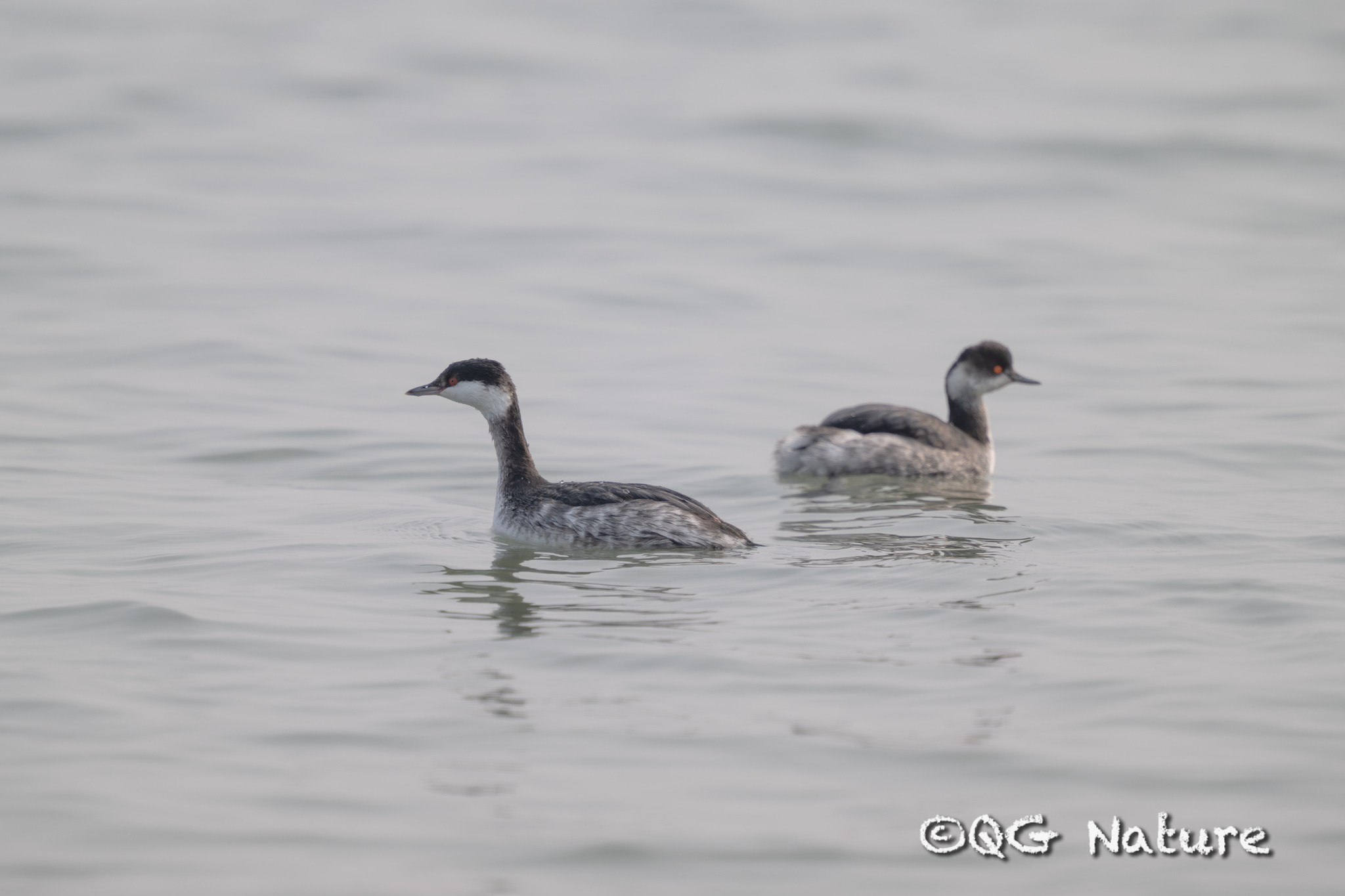
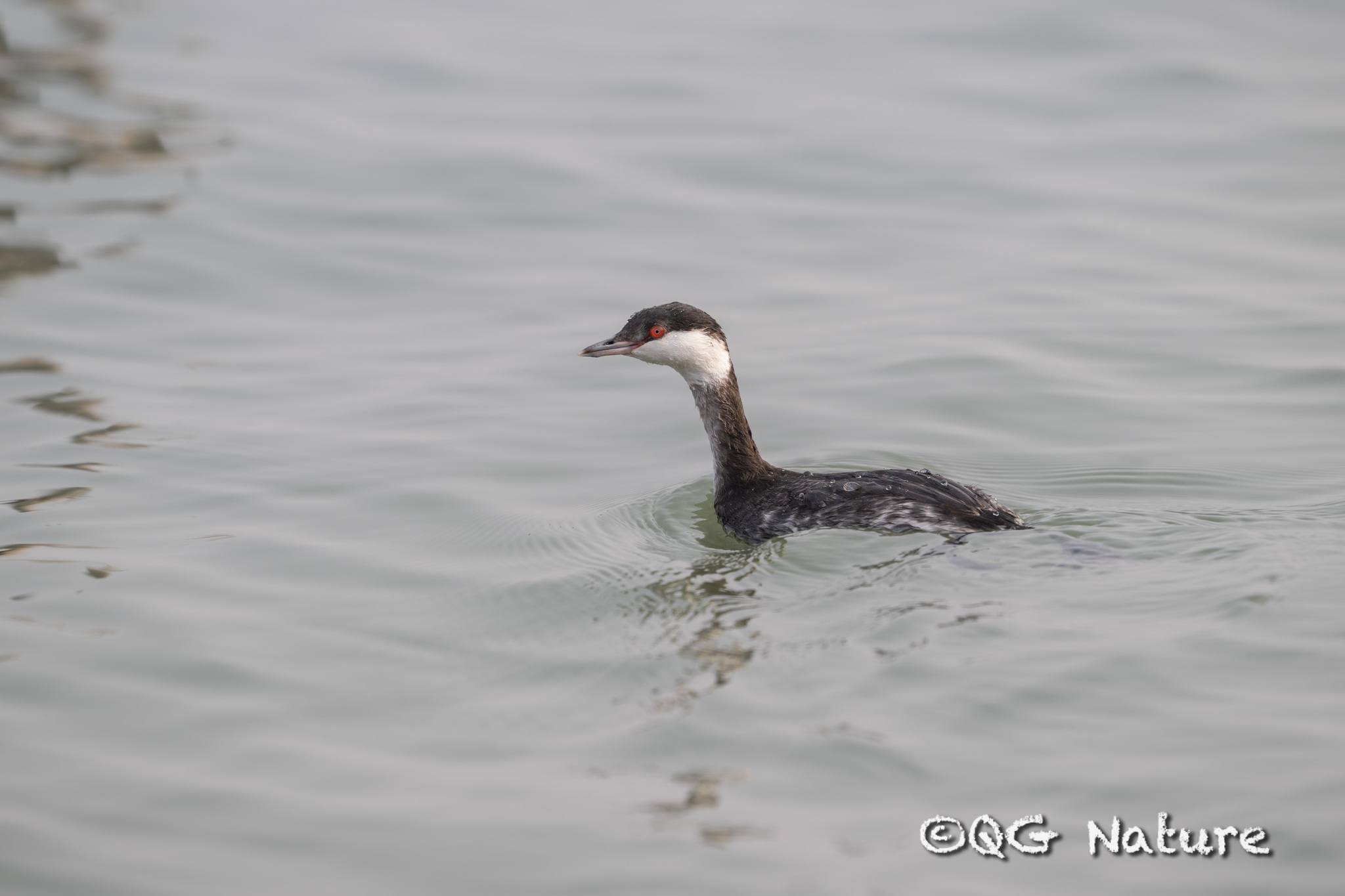
A small grebe measuring 31-38 cm in length with a wingspan of 55-74 cm and weighing 300-570 g. It has a moderately long neck, flat forehead, and a rear crown of black feathers. The straight, pointed beak has a distinctive white tip. In breeding plumage, the species is spectacular: bright orange-yellow erectable 'horns', black fan-shaped cheek feathers, chestnut brown on the neck, flanks, lores and upper-chest, with black crown and back and a dull white belly. Males appear slightly larger and brighter than females but are otherwise indistinguishable. Non-breeding plumage is more subdued: black and white overall with white neck, chest and cheeks, and dull black-grey back and crown. The border between crown and cheeks extends in a straight line behind the eyes. Juveniles resemble non-breeding adults but are duller with brown-tinged backs and paler beaks. Chicks are fluffy with grey backs, white bellies, and distinctive black-and-white facial striping.
Identification
In winter plumage, this species is frequently confused with the black-necked grebe, which is only slightly smaller. The key distinguishing features include a steeper forehead, a more slender and slightly uptilted bill, duskier cheeks, and a fluffier rump. During breeding season, the species is unmistakable due to its striking red-and-black plumage and prominent 'horns'. The straight line extending behind the eyes between the crown and white cheeks is a reliable field mark in non-breeding plumage.
Distribution & Habitat
Two subspecies are recognized. The Eurasian subspecies breeds across northern Europe and northern Asia, from Iceland east to the Russian Far East. The North American subspecies breeds across most of Canada and extends into some northern United States regions. A small population was recorded in Greenland in 1973 but is not confirmed by subsequent records. The species breeds primarily in boreal and subarctic regions with short frost-free periods, though it also occurs in temperate zones including prairies and parklands. During migration, birds stop at lakes, rivers and marshes. They winter in marine environments including estuaries, bays and sandy beaches, though large numbers may gather on inland lakes in some regions such as Norway.
Behavior & Ecology
These birds are skilled divers, using large feet for agile underwater maneuvering to catch aquatic arthropods, fish and crustaceans. They also capture airborne insects from the water's surface. They typically feed solitarily or in small groups of up to five individuals, with summer diet favoring aquatic and airborne arthropods while winter selection shifts toward fish and crustaceans. Like other grebes, they consume their own feathers from a young age to create a stomach filter for digesting fish. The species is monogamous, forming pairs through elaborate courtship rituals including advertising displays, 'penguin dances', synchronized weed-gathering and preening. Nests are built on platforms anchored to emergent vegetation, with 3-8 eggs incubated by both parents for 22-25 days. Young can swim and dive within days but require parental warmth for up to 14 days. The advertising call is a loud, nasally 'aaarrh' descending in pitch and ending in a trill. They are extremely vocal during breeding and territory defense but subdued during autumn migration and winter.
Conservation
The International Union for Conservation of Nature uplisted this species from least concern to vulnerable in 2015 due to significant global declines. The total North American population is estimated at 200,000-500,000 individuals, while the Eurasian population numbers only 12,900-18,500 mature individuals. The global population has declined by 30% over three decades, with a dramatic 79% decline in North America. Primary threats include human disturbance, forestry operations near breeding sites, fluctuating water levels, competition from stocked rainbow trout for aquatic insects, bycatch in fishing nets, oil spills and disease. Wetland and grassland drainage caused approximately 5% global habitat loss between 1985 and 2001. The western Canadian population is listed as a species of special concern, and the breeding population on the Magdalen Islands is classified as endangered. The small Scottish population is in severe decline, with only 26 pairs recorded in 2021 representing a 58% decline over 26 years. Conservation and research action plans have been implemented following the uplisting.
Culture
The species has two historical English names reflecting different cultural connections. The name 'horned grebe' refers to the distinctive orange-yellow crest feathers, while 'Slavonian grebe' derives from an old name for northern Prussia (Sclavonia), reflecting the species' main European breeding area. The spelling was changed from 'Sclavonian' to 'Slavonian' in 1912 without documented reason.
Source: Wikipedia · CC BY-SA 3.0
Taxonomy
- Order
- Podicipediformes
- Family
- Podicipedidae
- Genus
- Podiceps
- eBird Code
- horgre
Subspecies (2)
-
Podiceps auritus auritus
locally in Palearctic, breeding from northern Scandinavia eastward through Chukotsky and Kamchatka, southward to northern central Asia and Sakhalin; winters mainly coastally and in bays southward to central Europe and Japan to eastern China
-
Podiceps auritus cornutus
breeds subarctic southern and central Alaska mainland, western and central Canada, and northern tier of western and central contiguous USA states; winters Aleutian Islands to northern Baja California, and western North Atlantic and Gulf of Mexico coasts to central Florida
Data Sources
Species description from Wikipedia, licensed under CC BY-SA 3.0.
Bird images and sounds sourced from GBIF, contributed by citizen scientists worldwide under Creative Commons licenses.
Taxonomy data from AviList 2025.