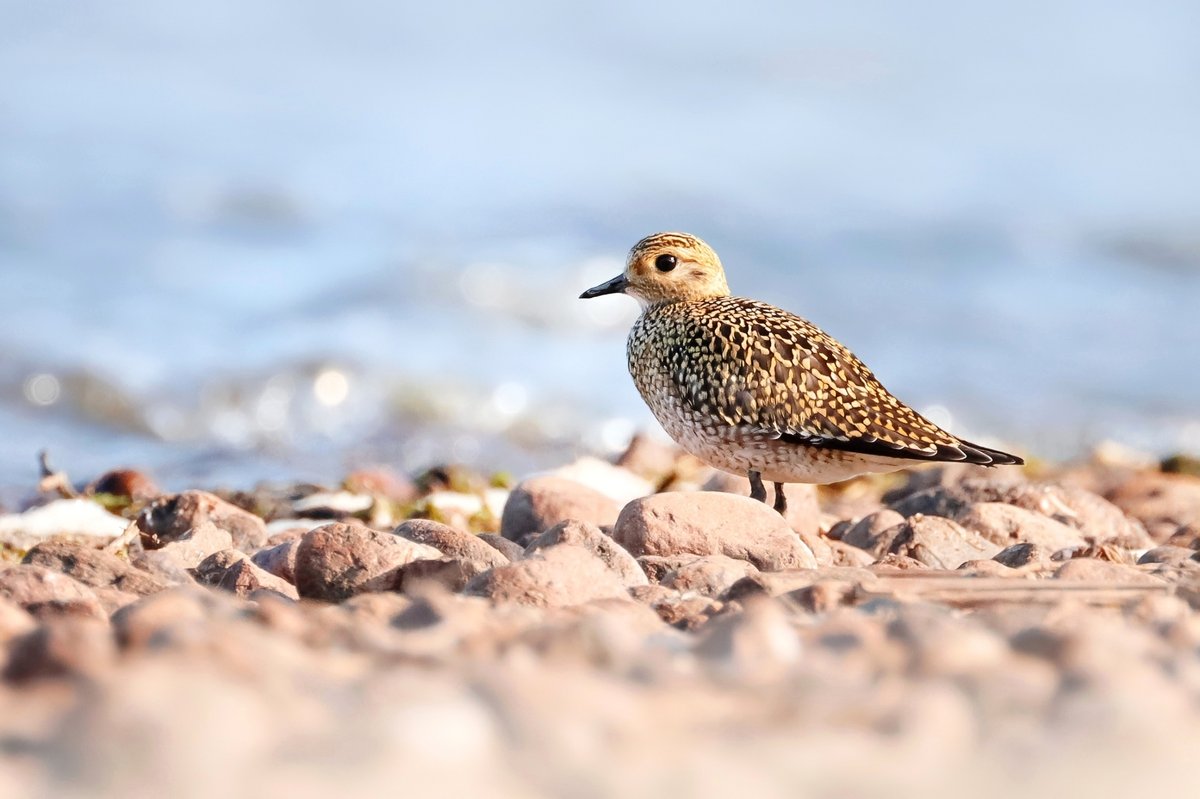
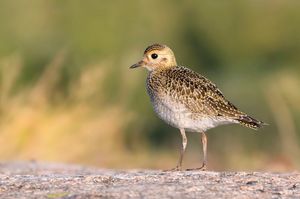
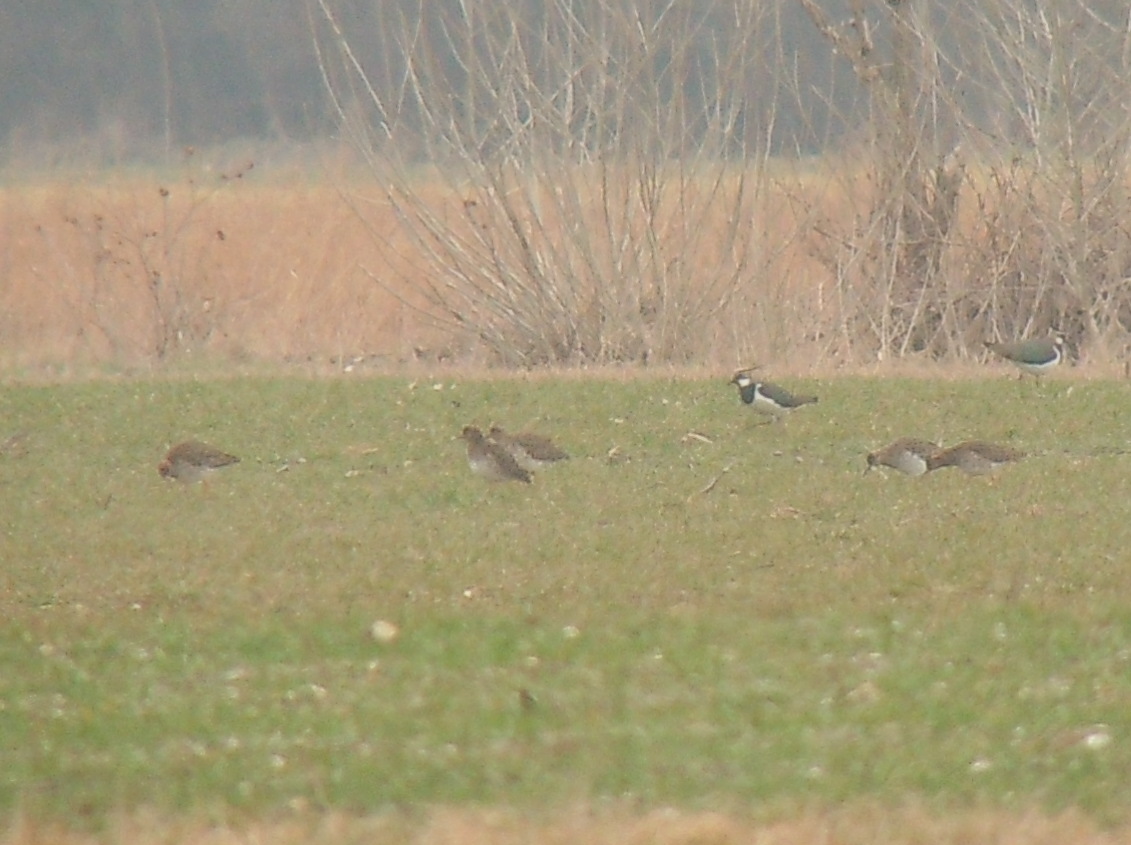






Charadriiformes / Charadriidae / Pluvialis
European Golden Plover
Pluvialis apricaria · 欧金鸻
Introduction
A relatively large plover species, monotypic with no recognized subspecies. It breeds in Arctic tundra and moorland from Iceland to central Siberia, migrating southwest for winter. Distinctive traits include a white 's'-shaped band in breeding plumage and white axillary feathers visible in flight. Listed as Least Concern by the IUCN.
Description
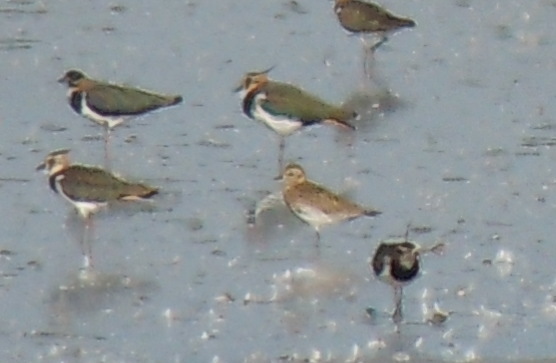
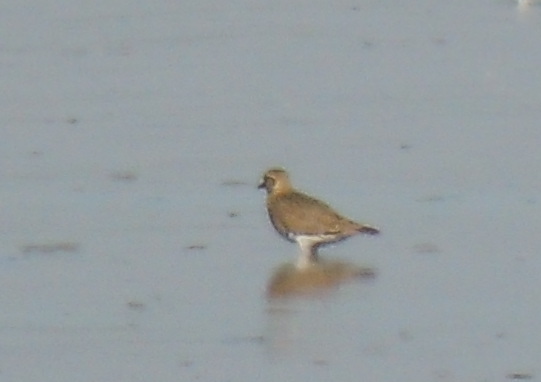
Thickset build with wings only slightly longer than the tail. The most distinct feature is a white 's'-shaped band stretching from the forehead to the flanks. Axillary (armpit) feathers are white, visible in flight and when wings are stretched on the ground. Slightly larger, less slim, and shorter-legged than American and Pacific golden plovers.
Identification
Distinguished from similar American and Pacific golden plovers by larger size, thicker build, and white rather than grey axillary feathers. Key field mark is the white 's'-shaped band from forehead to flanks. Flight action is rapid and powerful with regular wingbeats. Call is a monosyllabic, slightly descending 'tuu'.
Distribution & Habitat
Breeds in Arctic tundra and moorland from Iceland east to central Siberia; southernmost breeding sites include Wales and Belarus. Migrates southwest to winter in Europe, northwest Africa, and southwest Asia, ranging from Ireland and Denmark south to Algeria, northern Egypt, and the Caspian Sea coast of Iran. Habitats include agricultural plains, ploughed land, and short meadows near wetlands. Vagrants recorded in Canada, Gambia, Pakistan, and northern India.
Behavior & Ecology
Chicks rely on craneflies for feeding in the United Kingdom and march flies in Sweden. Tends to gather in large flocks in open areas during winter.
Conservation
Listed as Least Concern by the IUCN. One of the species covered by the Agreement on the Conservation of African-Eurasian Migratory Waterbirds (AEWA). Populations on the southern fringe of the breeding range are declining or extinct in several countries, including Britain, Denmark, Belgium, Poland, Germany, and southern Sweden. Iceland holds about one-third of the global population.
Culture
In Icelandic folklore, the arrival of the first plover signals the start of spring; the bird is also a symbol of femininity and womanhood in Iceland. A missed shot at this species in Ireland in 1951 led Sir Hugh Beaver to conceive the Guinness World Records after debating whether it was Europe's fastest game bird.
Source: Wikipedia · CC BY-SA 3.0
Taxonomy
- Order
- Charadriiformes
- Family
- Charadriidae
- Genus
- Pluvialis
Distribution
breeds inland low Arctic (mainly) to temperate zone from Greenland eastward to Taymyr Peninsula (north-central Russia); winters to inland and coastal southern Europe, northern Africa, and Middle East
Vocalizations
Data Sources
Species description from Wikipedia, licensed under CC BY-SA 3.0.
Bird images and sounds sourced from GBIF, contributed by citizen scientists worldwide under Creative Commons licenses.
Taxonomy data from AviList 2025.