Common Pheasant
Phasianus colchicus
环颈雉
Introduction
The common pheasant is native to Asia and the extreme southeastern edge of Europe in the Caucasus foothills. It has been introduced across Europe, North America, New Zealand, and Australia for hunting purposes, with established populations now widespread. Males have copper-red and gold plumage, a long barred tail, and a red wattle around the eye. Females have mottled brown plumage. This species inhabits agricultural areas with hedgerows, woodland edges, and scrub. Populations fluctuate significantly in heavily hunted areas but remain abundant overall.
Description
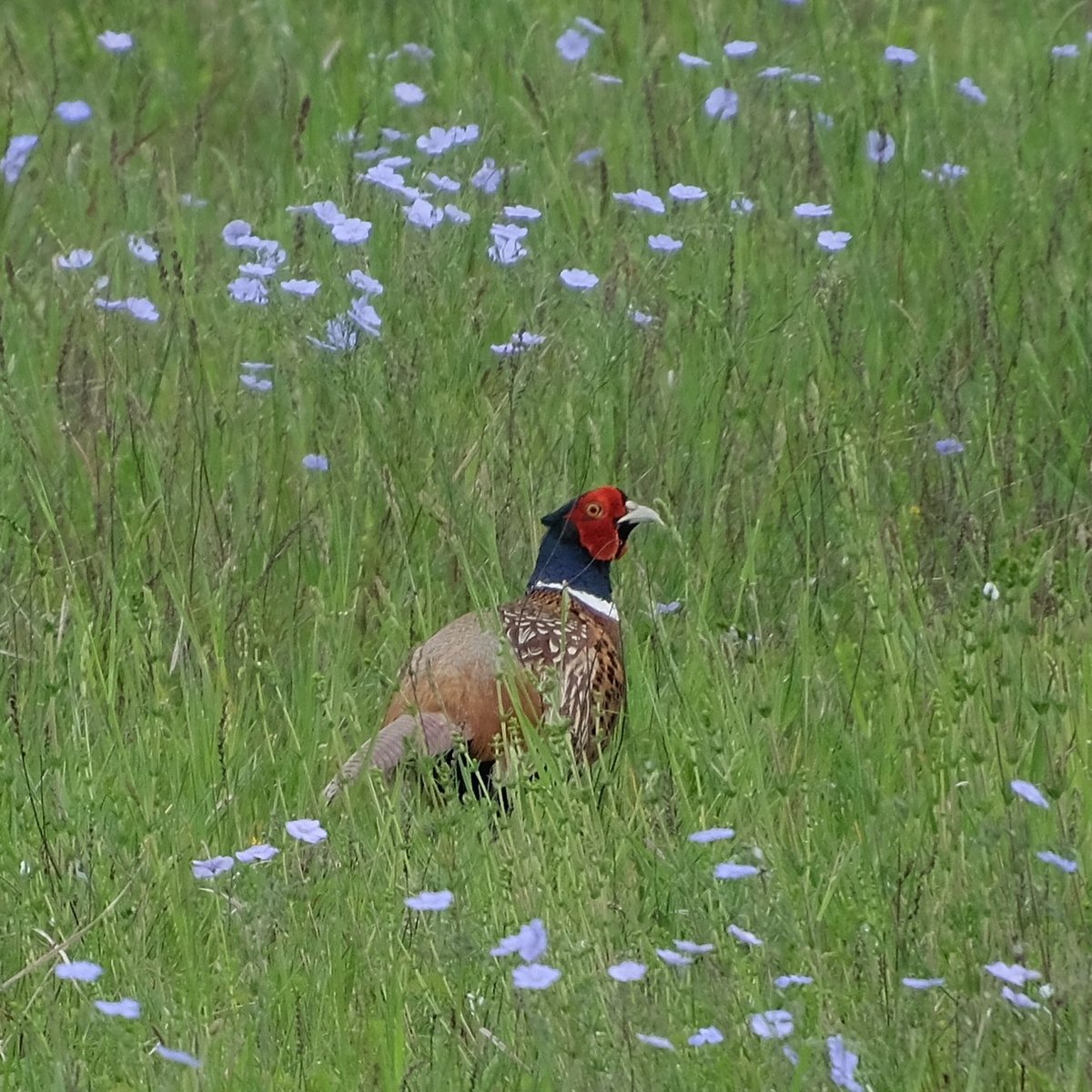
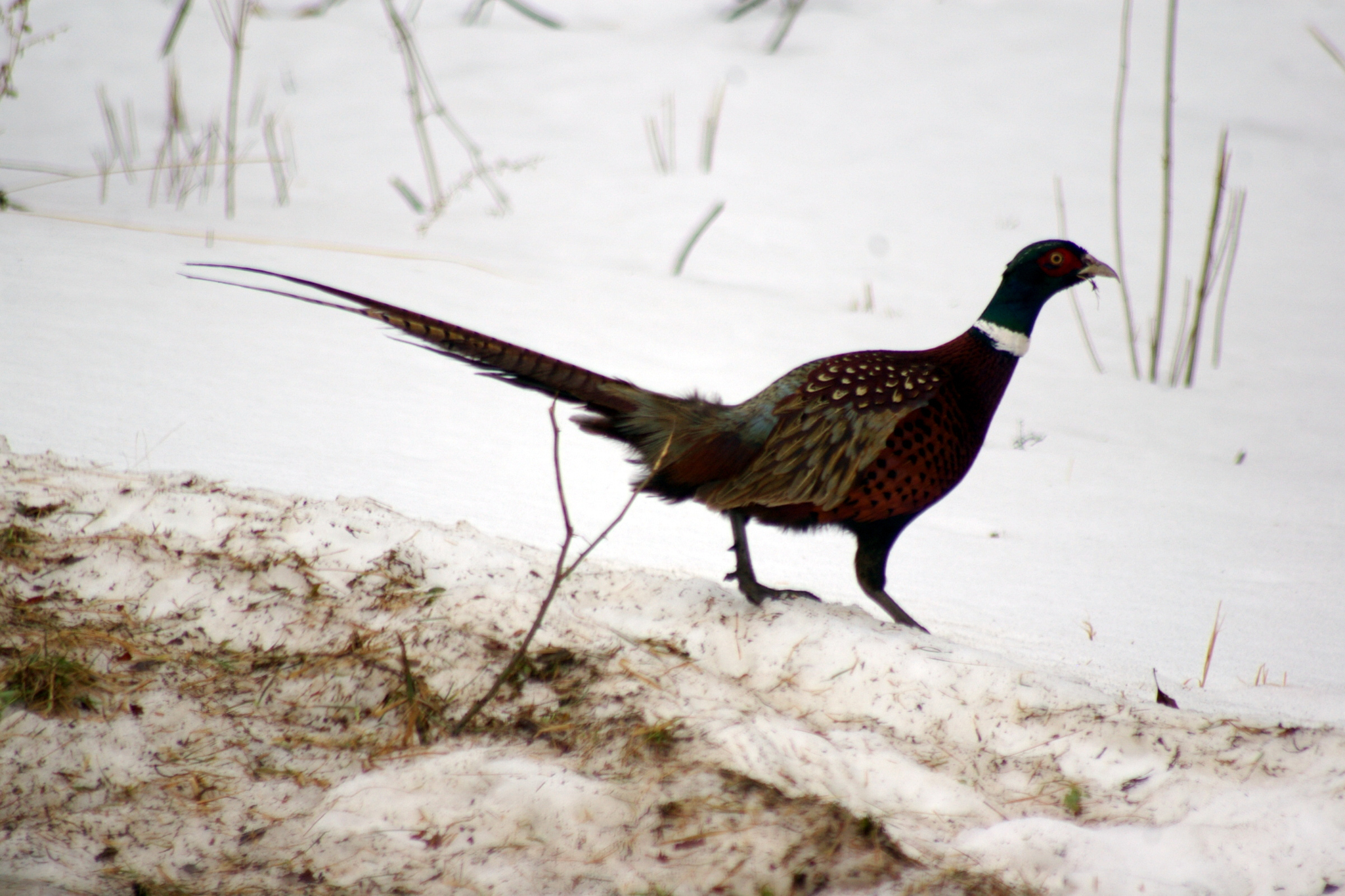
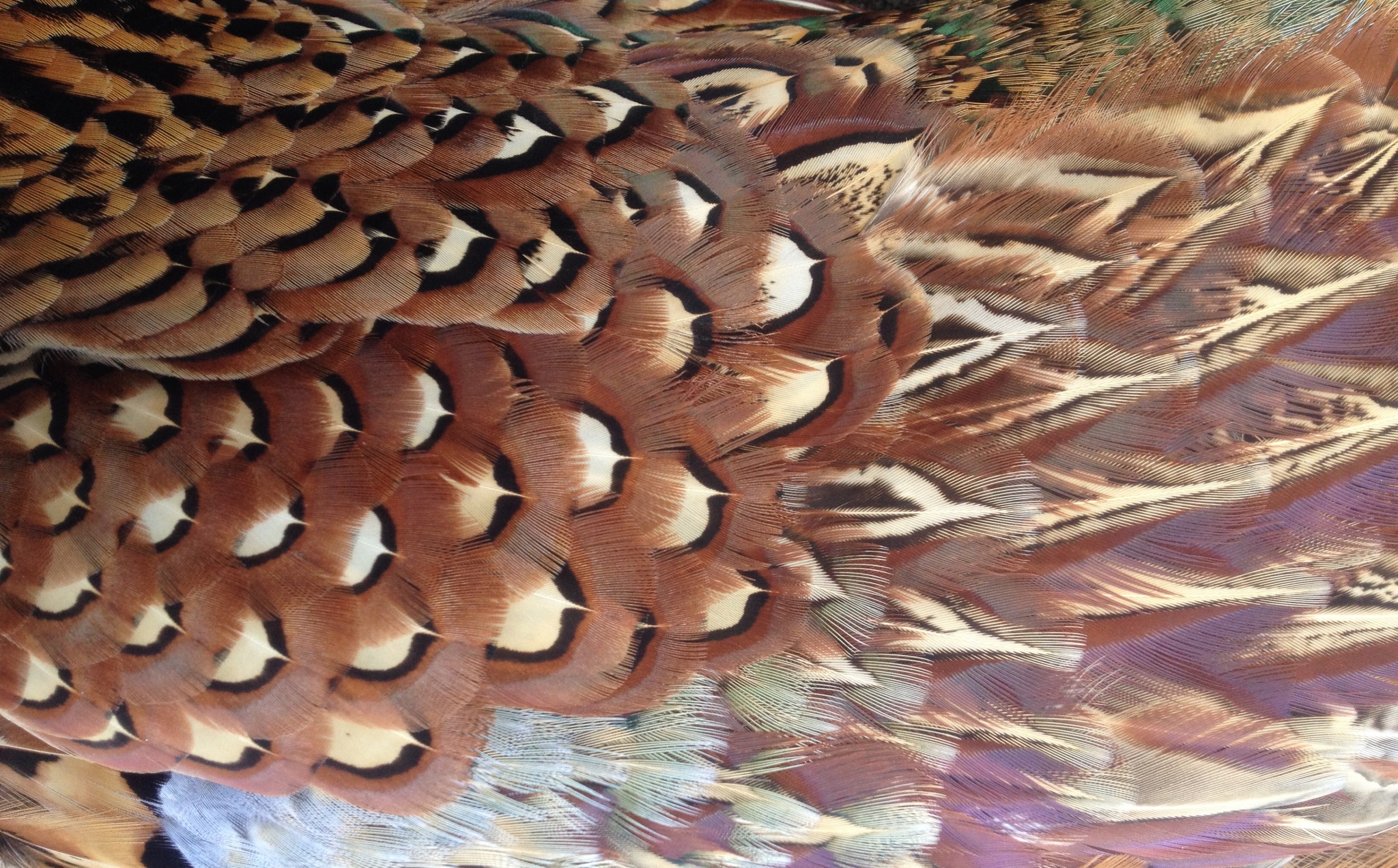
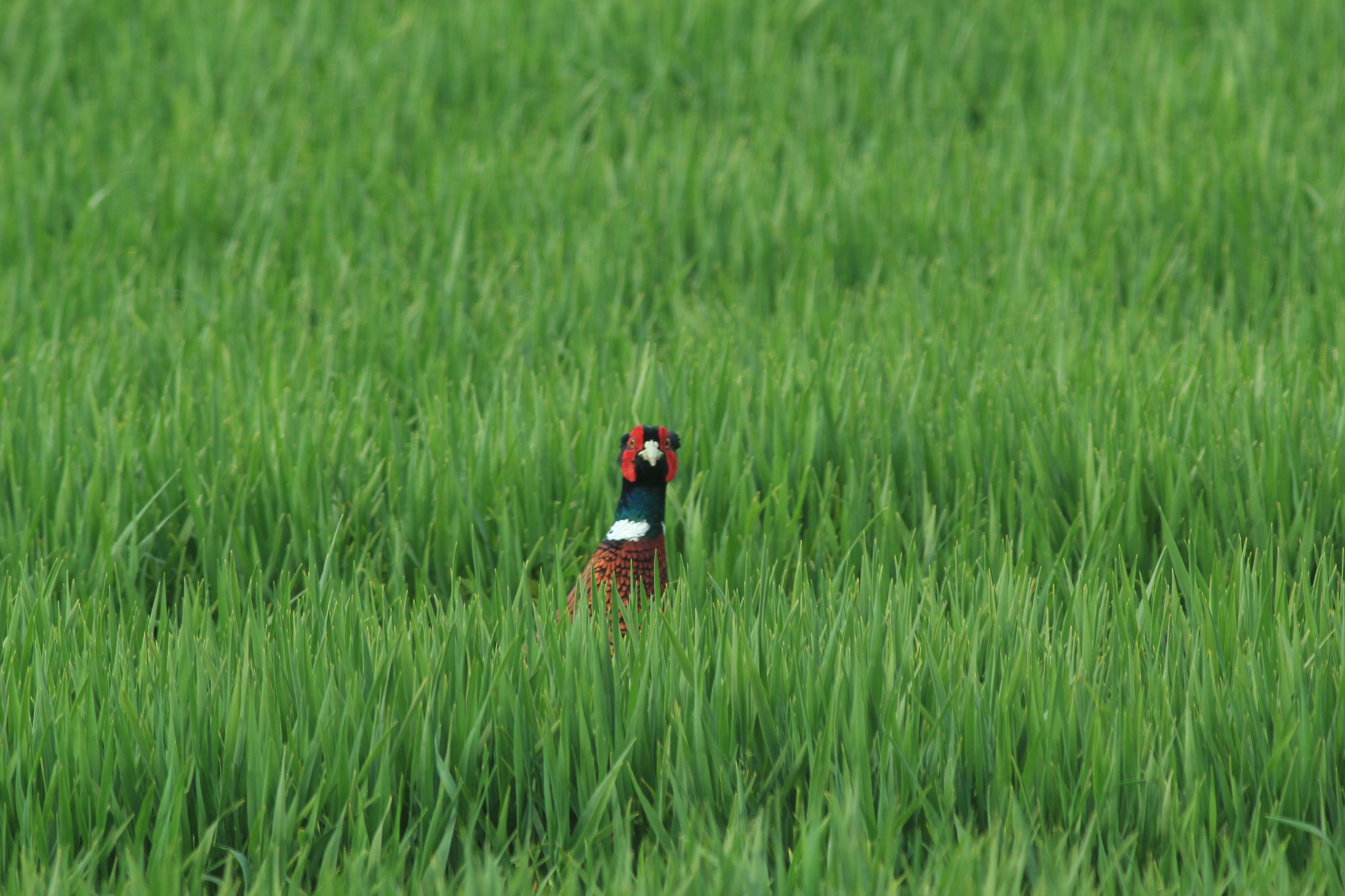
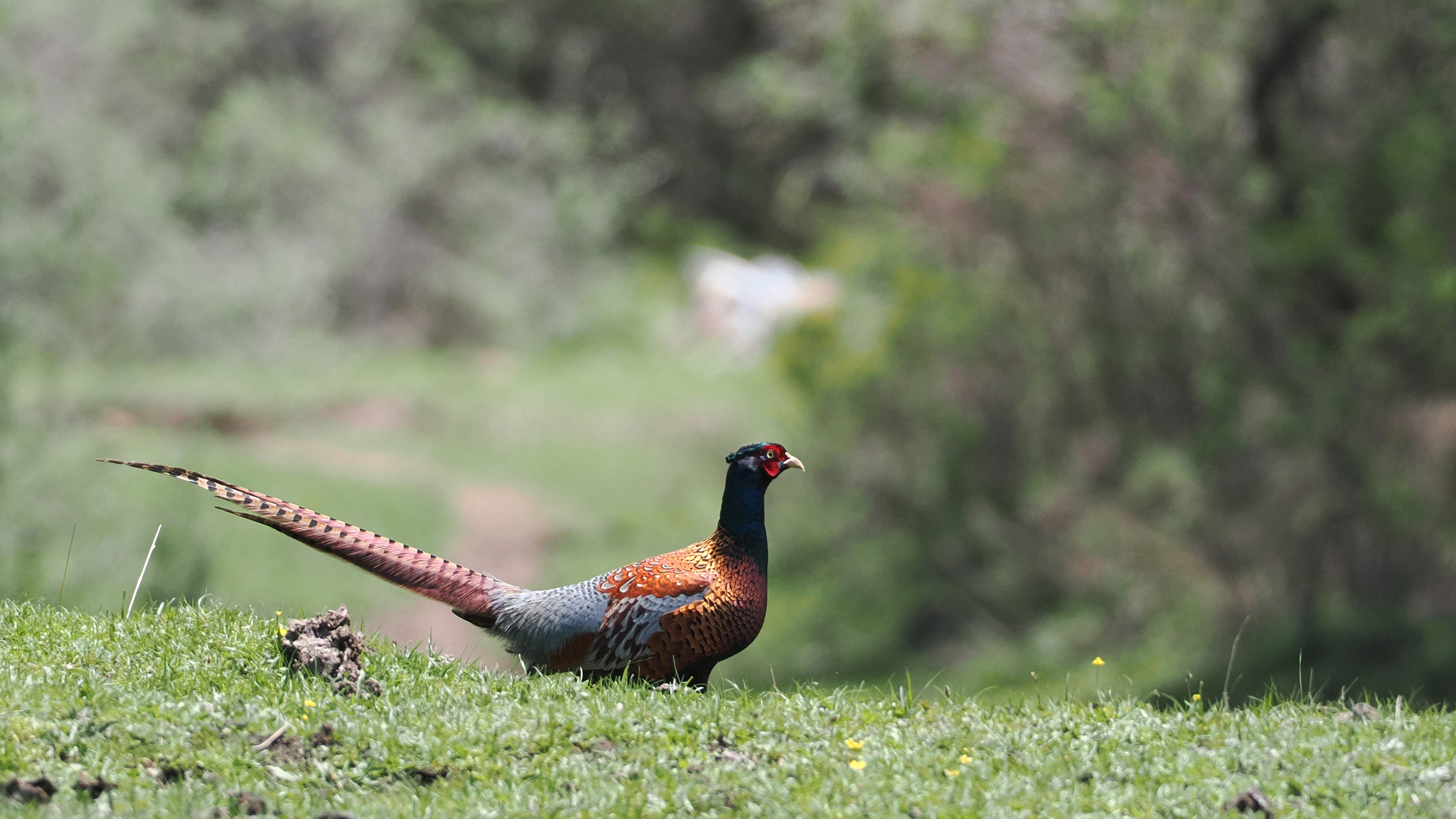
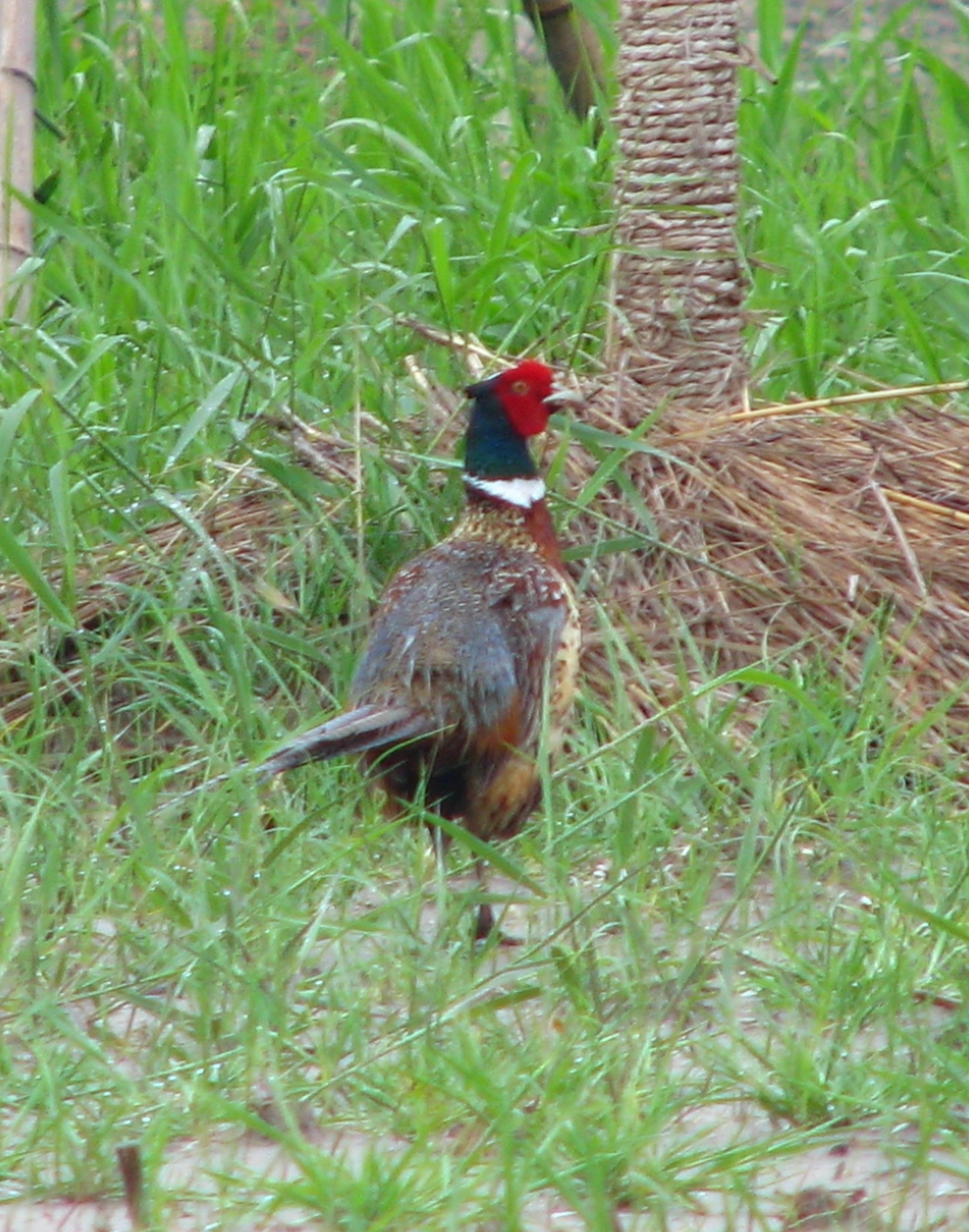
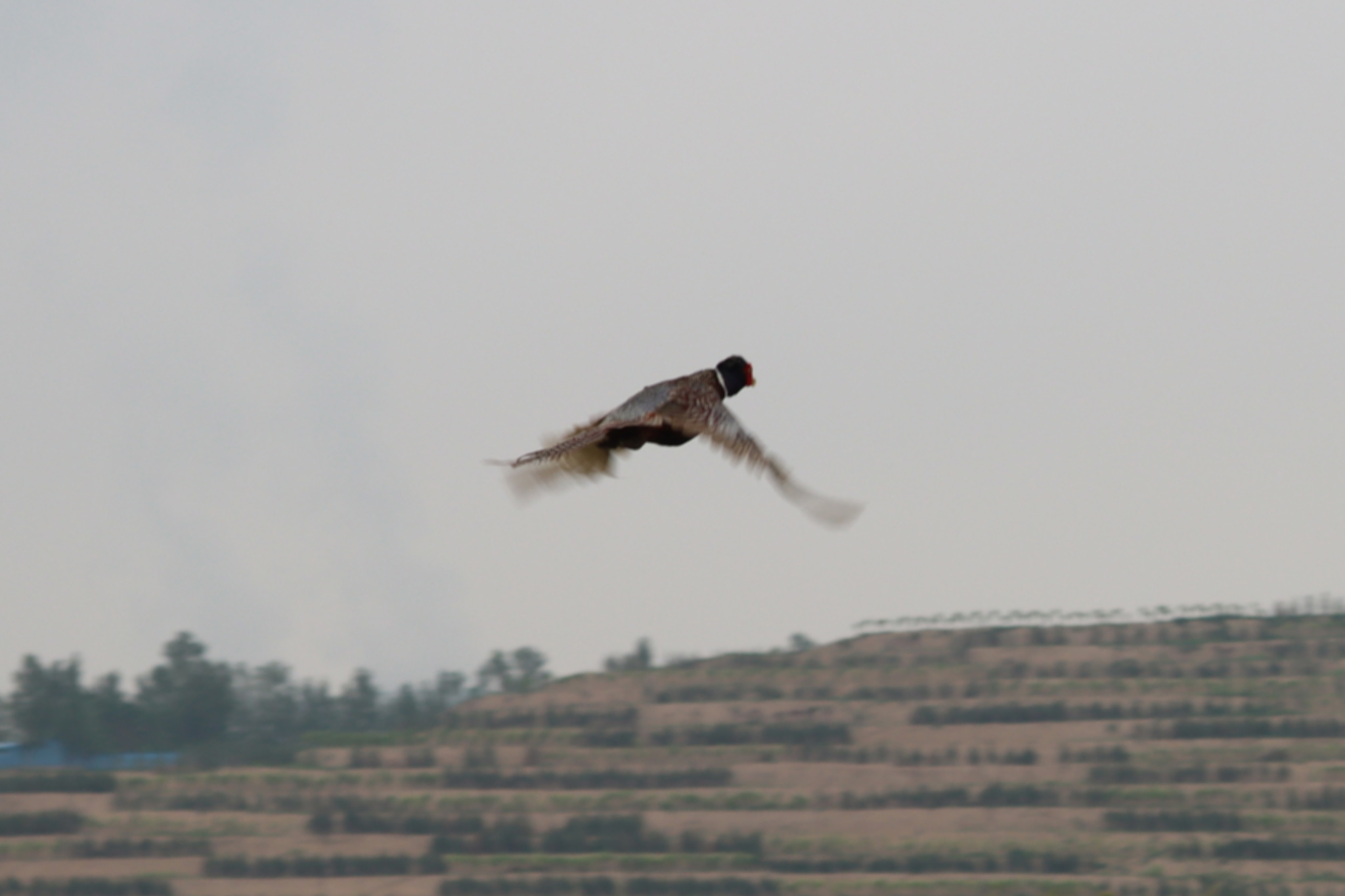
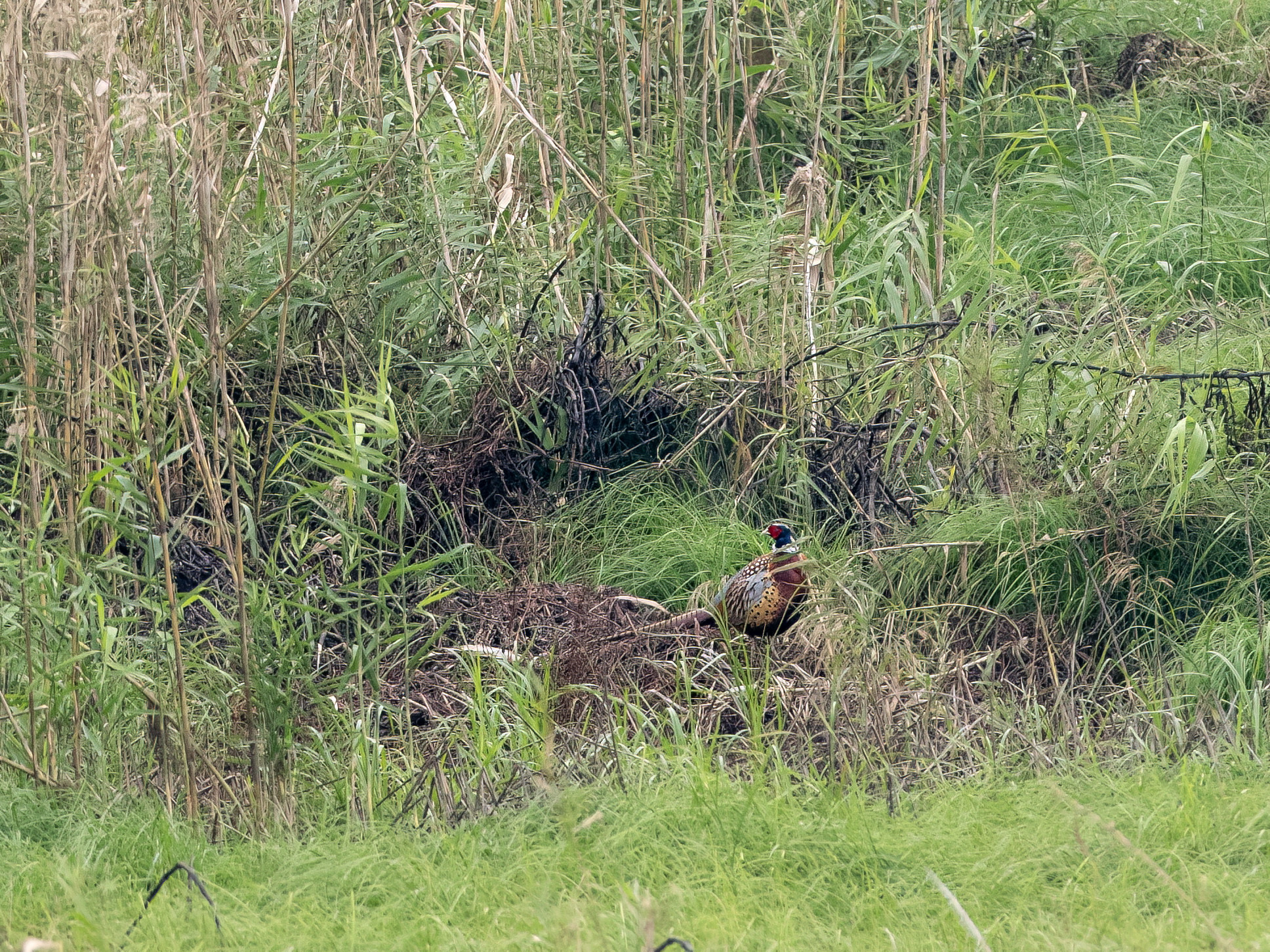
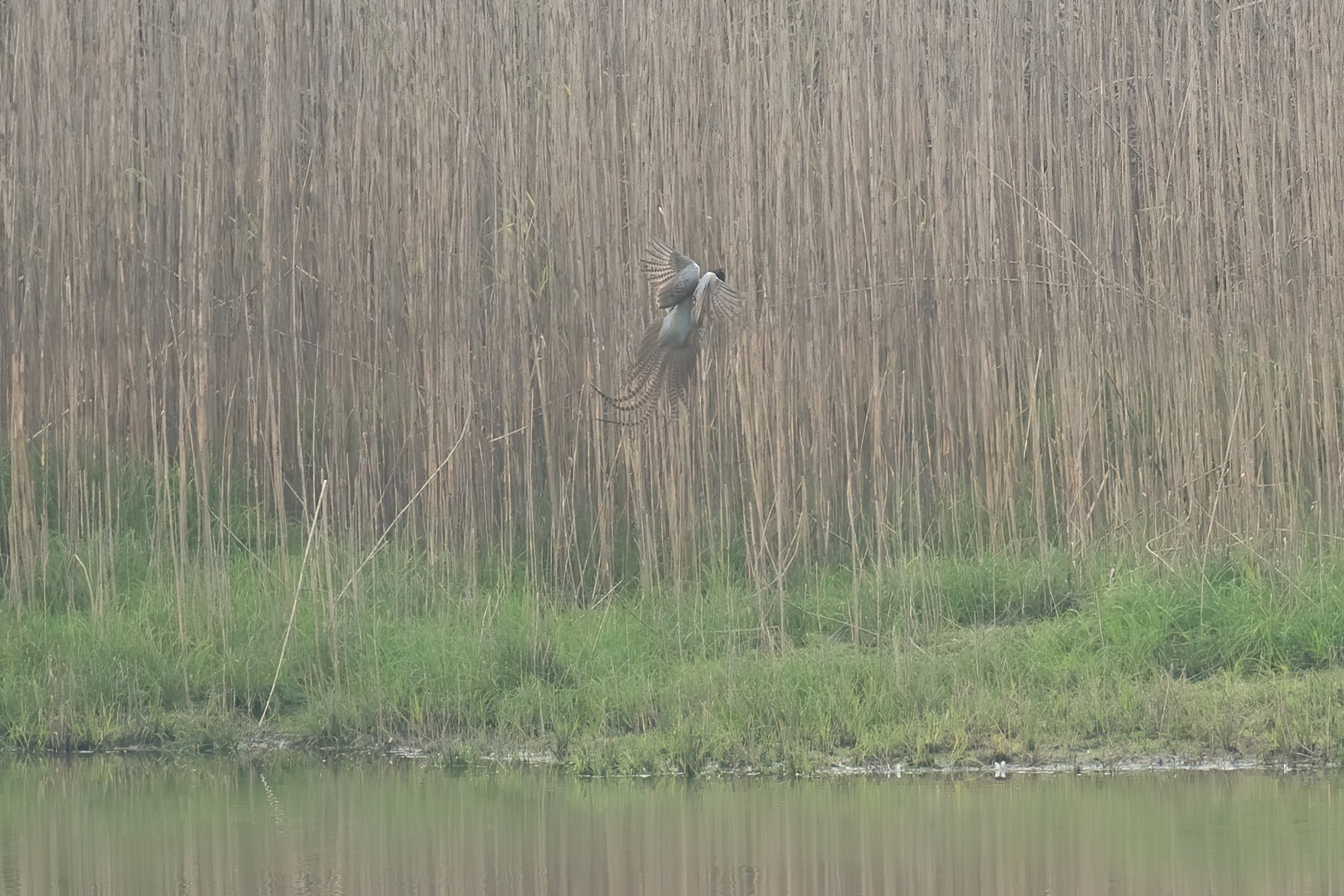
The common pheasant is a large, long-tailed gamebird with significant size variation between sexes. Males typically weigh 1.2 kg and measure 60-89 cm in length, with females averaging 0.9 kg and reaching 50-63 cm. The wingspan ranges from 56-86 cm. Male plumage is remarkably variable, displaying barred patterns of bright gold, fiery copper-red, and chestnut-brown with an iridescent green and purple sheen on the body. The head is bottle-green with a small crest and prominent red wattle. Two ear-tufts behind the face add to their alert appearance. The long brown tail, streaked with black, accounts for nearly half the total length. Females and juveniles are uniformly mottled brown throughout, providing effective camouflage. Color mutations occur regularly, including melanistic (black) and flavistic (isabelline or fawn) variants that are sometimes released for hunting.
Identification
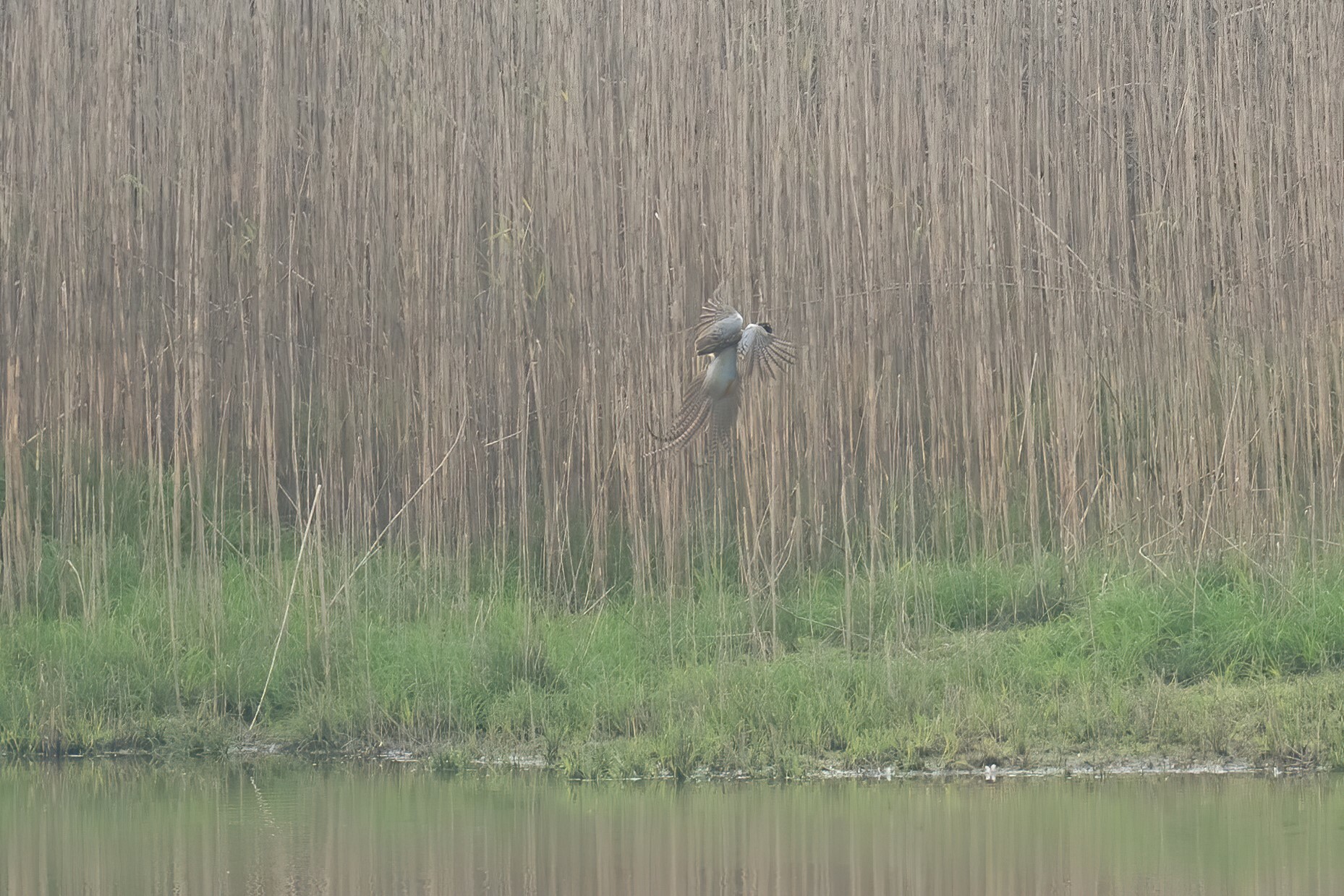
The most similar species is the green pheasant of Japan, though identification is complicated by widespread hybridisation between the two. Male green pheasants average a shorter tail and display darker, uniformly bottle-green plumage on the breast and belly, always lacking a neck ring. Females are darker with distinctive black dots on the breast and belly. In the field, common pheasants are distinguished by their preference for running over flying, though they will burst upward with a characteristic whirring wing sound when startled. The alarm call—a sharp series of 'kok kok kok' notes—often betrays their presence before they are seen. In North America, Australia, and much of Europe, the 'ring-necked' pheasant is a familiar sight, though these birds typically represent mixed heritage from multiple subspecies rather than any specific taxonomic group.
Distribution & Habitat
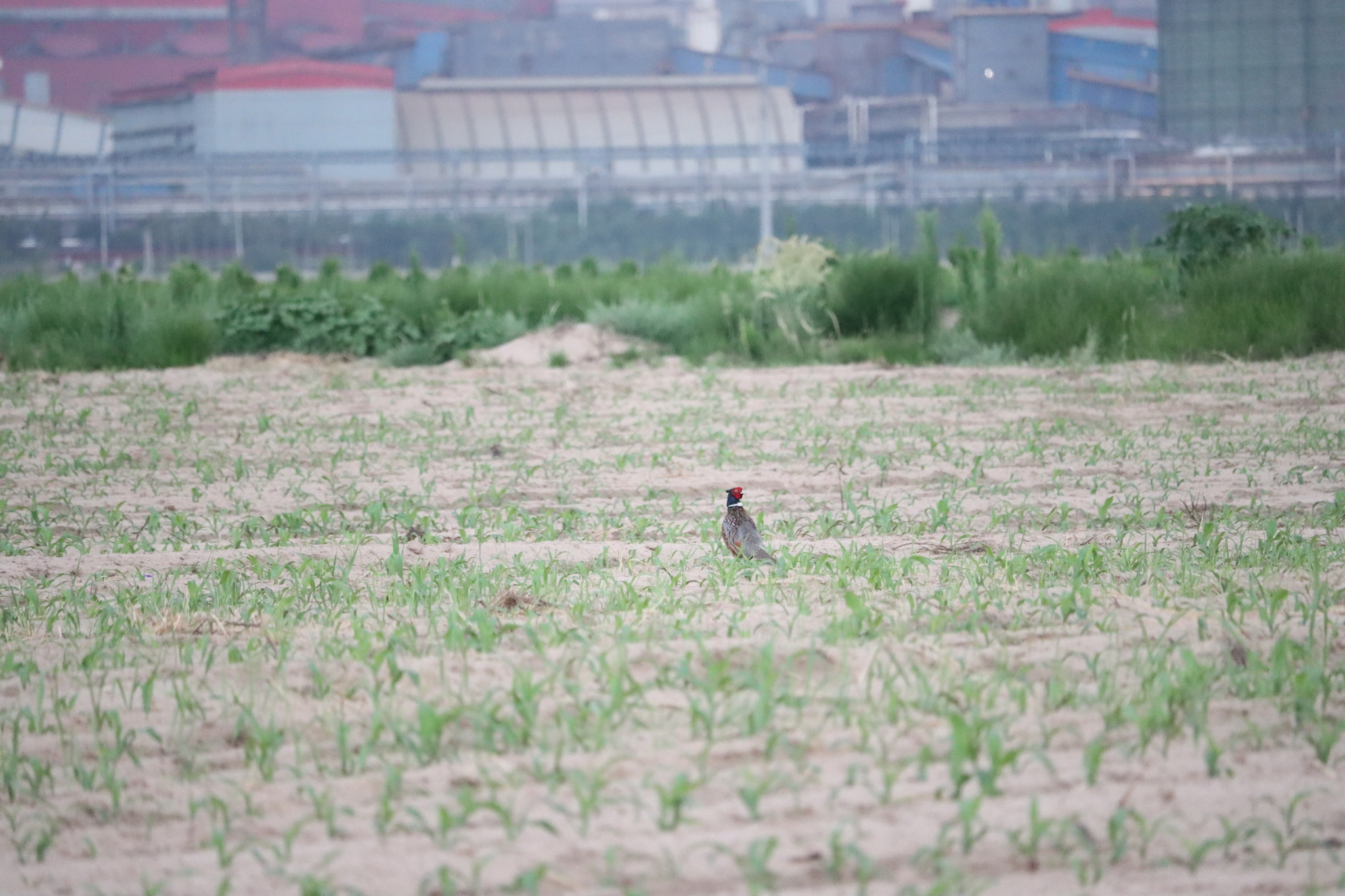
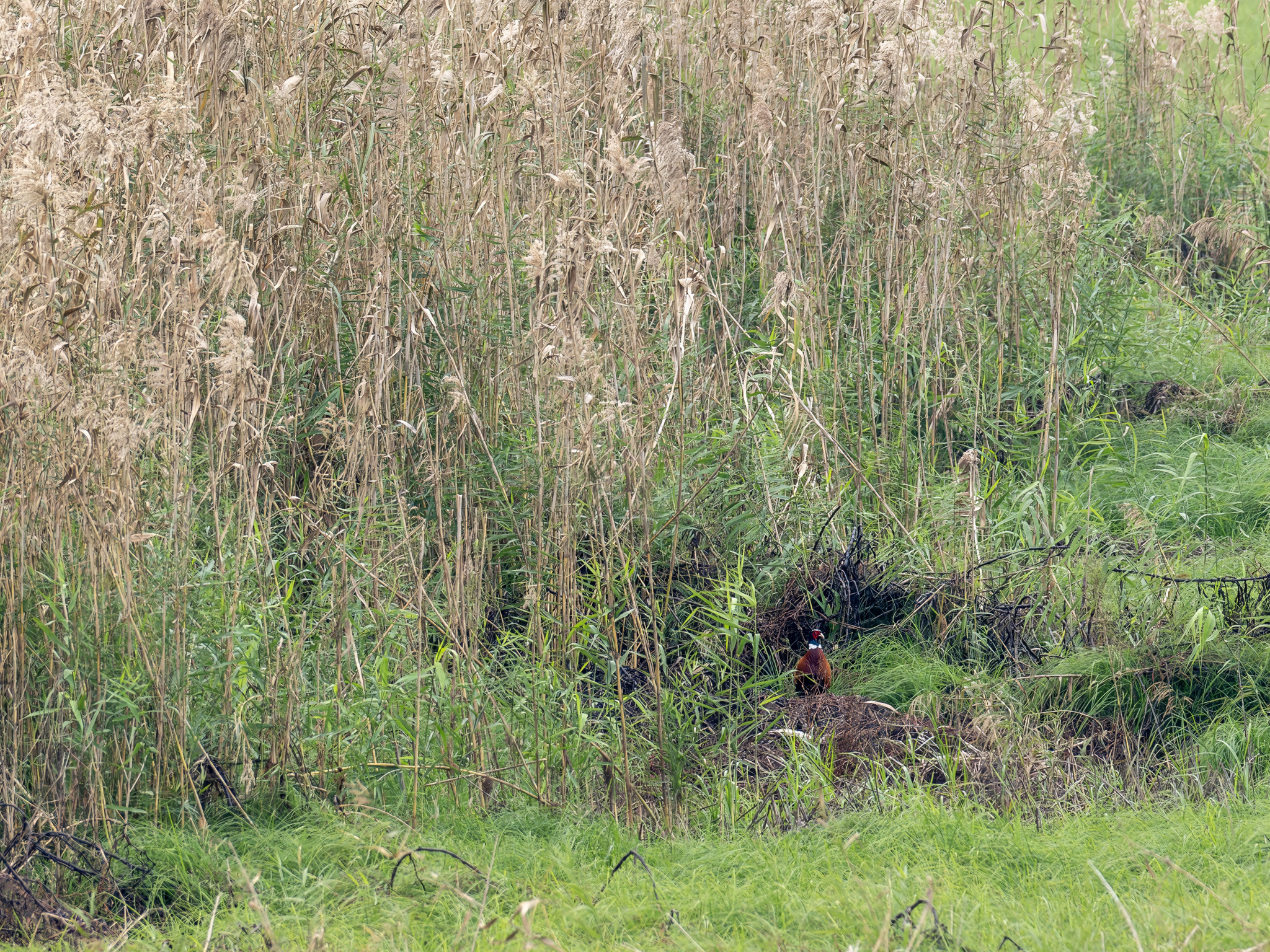
The native range spans from the eastern Black Sea and Caspian Sea regions across Asia to Manchuria, Siberia, Korea, mainland China, and Taiwan. The species inhabits woodland edges, farmland, scrub, and wetlands, showing preference for grassland near water with scattered copses of trees. It tolerates both dry and humid conditions but struggles in extensively cleared farmland that cannot support self-sustaining populations. Introduced populations are now established across much of Europe, North America, New Zealand, and Australia. In North America, the strongest populations occur across the Great Plains, Corn Belt, and Wheat Belt, extending into southern Canada. Introductions failed in the humid Southern United States and American Southwest. The species is non-migratory but forms loose flocks outside the breeding season.
Behavior & Ecology
Outside the breeding season, common pheasants form loose flocks and are highly gregarious, though captive-bred birds may show strong sexual segregation in their use of feeding stations. They are ground-dwelling birds that prefer running to flying but can achieve bursts of up to 90 km/h when chased. The breeding season begins in April, with males maintaining harems of several females—a typical polygynous mating system. Hens scrape shallow ground nests lined with grass and leaves beneath dense cover, laying clutches of eight to fifteen brown-olive eggs. Incubation lasts 23-25 days, and chicks leave the nest within hours, flying within 12-14 days. The diet is varied, including fruits, seeds, grain, and invertebrates such as slugs, earthworms, and insects, with occasional small vertebrates like lizards and voles.
Conservation
The common pheasant is listed as Least Concern by the IUCN due to its vast global population and extensive range. However, populations in the United States have declined over the past 30 years, particularly in agricultural regions, due to changes in farming practices, pesticide use, and habitat fragmentation. Many crops that benefited pheasants are no longer widely cultivated. Some subspecies face local threats: the last European population of the black-necked pheasant in Greece numbers only 100-250 individuals, and hybridisation with introduced eastern subspecies has eliminated pure populations in Bulgaria. In the UK, around 50 million captive-bred birds are released annually for hunting, causing dramatic population fluctuations but maintaining overall abundance.
Culture
The common pheasant holds significant cultural weight as one of the world's premier gamebirds. In Britain, pheasant shooting became an aristocratic pastime, with King George V reportedly shooting over 1,000 birds in a single competition in 1913. The tradition of organized driven shoots remains popular, governed by the Game Act of 1831. Literature has embraced the pheasant: Roald Dahl's novel 'Danny the Champion of World' features a poacher and his son hunting pheasants illegally. For the indigenous Paiwan people of Taiwan, pheasant feathers (called 'tiativ') symbolize honor—commoners, including skilled hunters and politicians, wear them in contrast to mountain hawk-eagle feathers reserved for hereditary chiefs. The ring-necked pheasant is the state bird of South Dakota, one of only two US state birds not native to the country.
Source: Wikipedia · CC BY-SA 3.0
Taxonomy
- Order
- Galliformes
- Family
- Phasianidae
- Genus
- Phasianus
- eBird Code
- rinphe1
Subspecies (30)
-
Phasianus colchicus alaschanicus
north-central China, in the foothills of the Helan (Alashan) Mountains
-
Phasianus colchicus bianchii
upper valley of the Amu Darya River in southern Uzbekistan, southwestern Tajikistan, and extreme northern Afghanistan
-
Phasianus colchicus chrysomelas
Amu Darya Delta, in western Uzbekistan and adjacent northern Turkmenistan
-
Phasianus colchicus colchicus
eastern Georgia to northeastern Azerbaijan, southern Armenia, and northwestern Iran; a mixture of colchicus, torquatus, and other subspecies now widely introduced, including across Europe, New Zealand, the Hawaiian Islands, North America, and South America (southern Chile)
-
Phasianus colchicus decollatus
central China (Sichuan to Liaoning, northeastern Yunnan, and Guizhou)
-
Phasianus colchicus edzinensis
south-central Mongolia
-
Phasianus colchicus elegans
west-central China (western Sichuan)
-
Phasianus colchicus formosanus
Taiwan
-
Phasianus colchicus hagenbecki
western Mongolia (Kobdo Valley)
-
Phasianus colchicus karpowi
northeastern China (southern Manchuria and northern Liaoning) to Korea
-
Phasianus colchicus kiangsuensis
northeastern China (northern Shanxi and Shaanxi) to southeastern Mongolia
-
Phasianus colchicus mongolicus
northern Tian Shan in northern Kyrgyzstan northward through eastern Kazakhstan to Lake Balkhash, and eastward to northwestern Xinjiang and Urumchi (western China)
-
Phasianus colchicus pallasi
southeastern Siberia and northeastern China
-
Phasianus colchicus persicus
southwestern Turkmenistan and northeastern Iran
-
Phasianus colchicus principalis
southeastern Turkmenistan, far northeastern Iran, and northwestern Afghanistan
-
Phasianus colchicus rothschildi
southwestern China (eastern Yunnan) and northern Vietnam
-
Phasianus colchicus satscheuensis
north-central China (far western Gansu)
-
Phasianus colchicus septentrionalis
northern Caucasus from Dagestan to north of the Volga Delta (Russia)
-
Phasianus colchicus shawii
western Tarim Basin (Xinjiang), in western China
-
Phasianus colchicus sohokhotensis
north-central China (Sohokhoto Oasis and Qilian Shan)
-
Phasianus colchicus strauchi
central China (southern Shaanxi and southern Gansu)
-
Phasianus colchicus suehschanensis
west-central China (northwestern Sichuan)
-
Phasianus colchicus takatsukasae
southern China and northern Vietnam
-
Phasianus colchicus talischensis
southeastern Transcaucasia (Azerbaijan and north-central Iran)
-
Phasianus colchicus tarimensis
eastern and southern Tarim Basin, in western China
-
Phasianus colchicus torquatus
eastern China (Shandong) to Vietnam border. Pheasants representing a mixture of colchicus, torquatus, and other subspecies now are widely introduced around the world, including across Europe, on New Zealand, the Hawaiian Islands, and North America
-
Phasianus colchicus turcestanicus
southern Kazakhstan (Syr Darya Valley) southeastward to the Fergana Basin in eastern Uzbekistan and the borders of Kyrgyzstan
-
Phasianus colchicus vlangalii
north-central China (northern Qinghai)
-
Phasianus colchicus zarudnyi
central valleys of the Amu Darya River on the eastern Turkmenistan–Uzbekistan border
-
Phasianus colchicus zerafschanicus
southern Uzbekistan (Bukhara and Zerafshan Valley)
Data Sources
Species description from Wikipedia, licensed under CC BY-SA 3.0.
Bird images and sounds sourced from GBIF, contributed by citizen scientists worldwide under Creative Commons licenses.
Taxonomy data from AviList 2025.