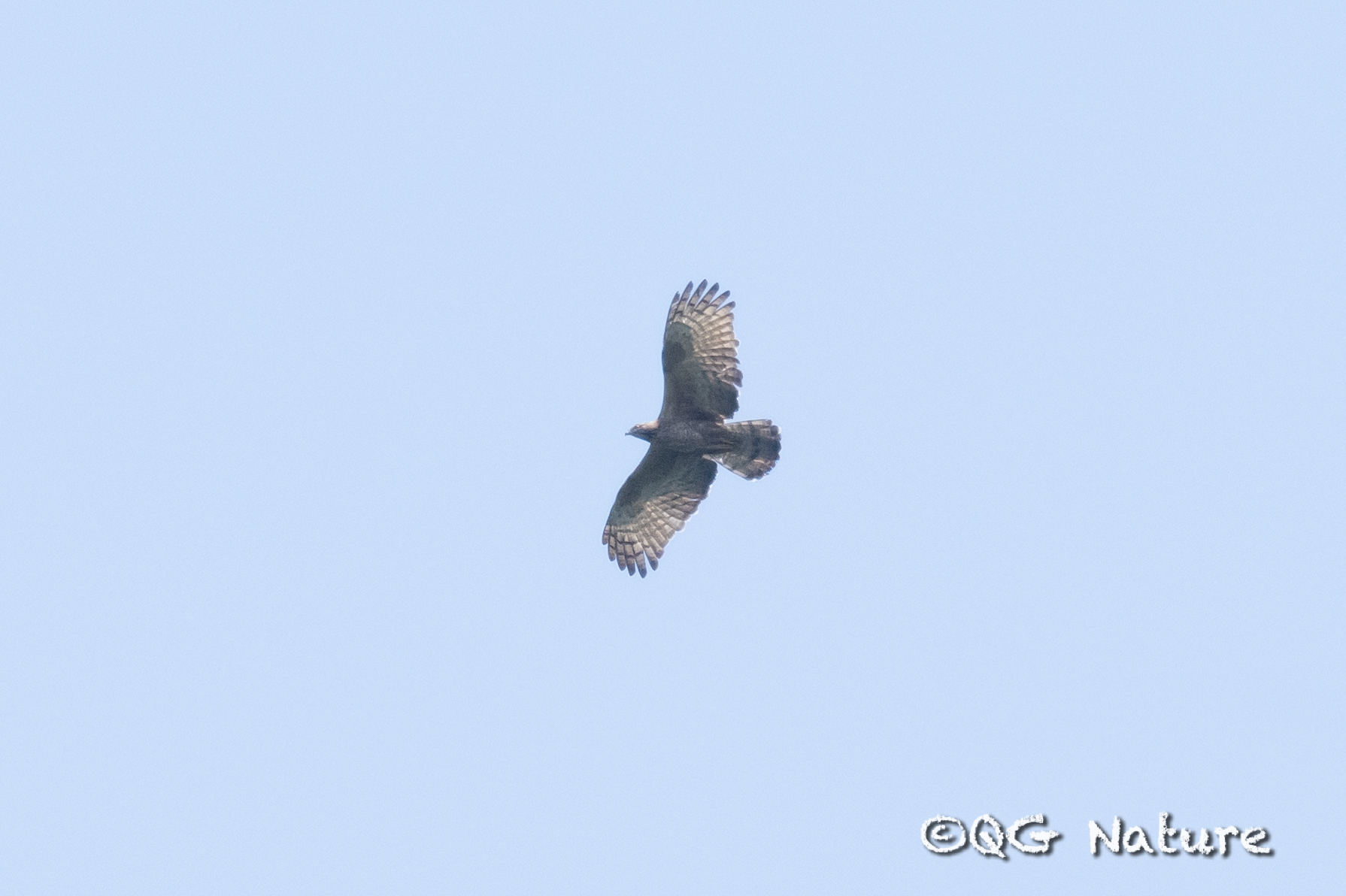
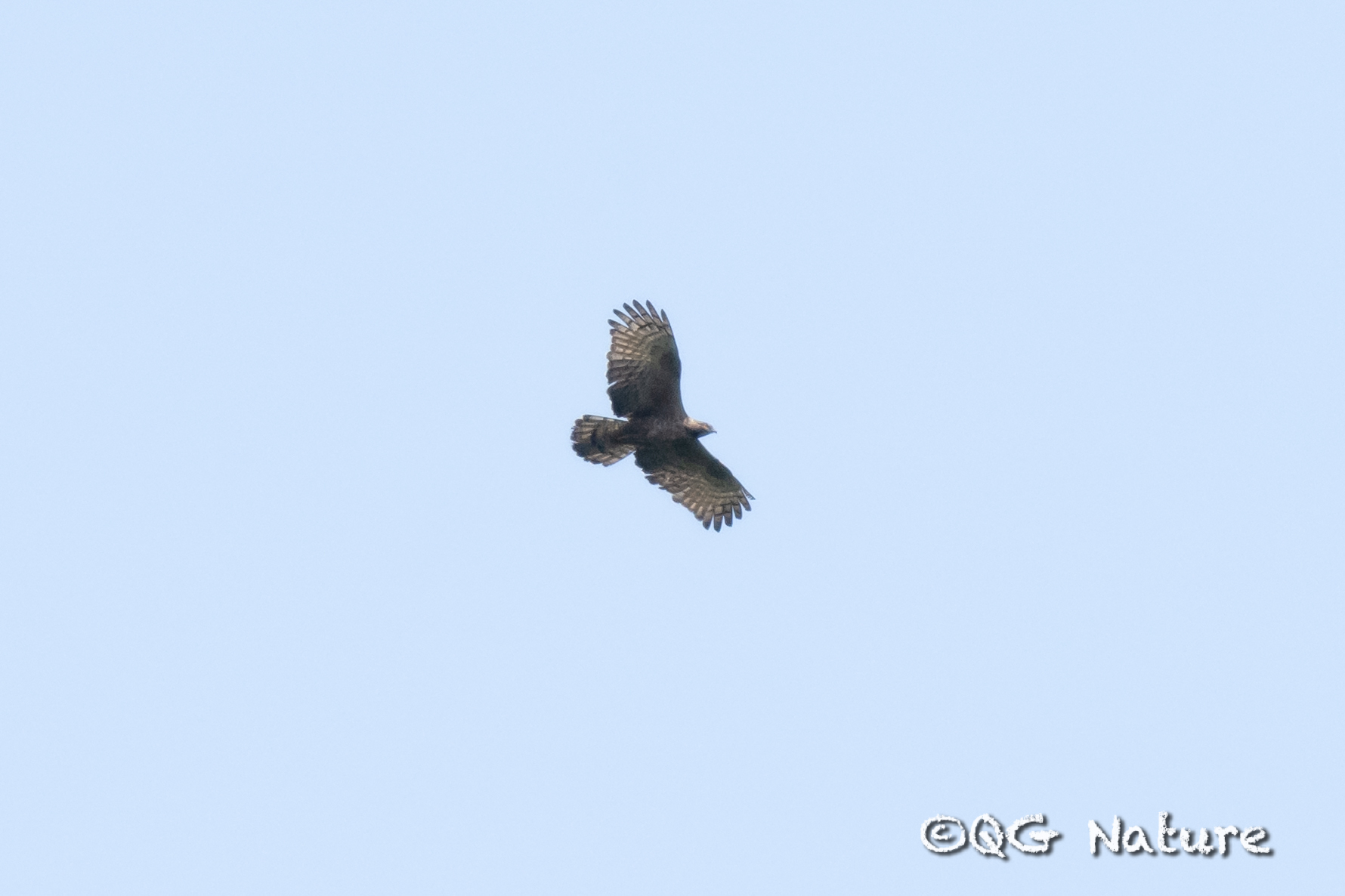
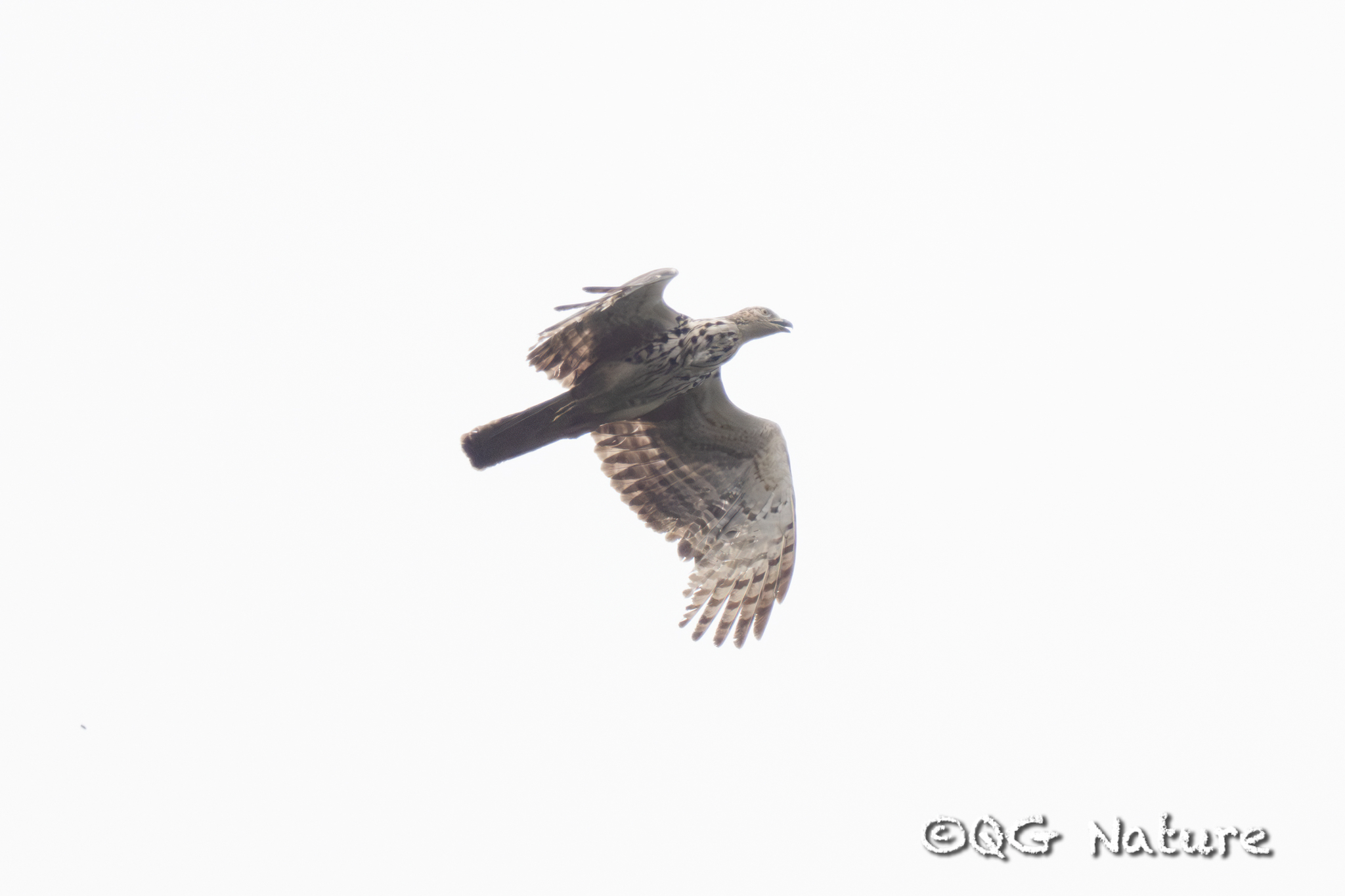
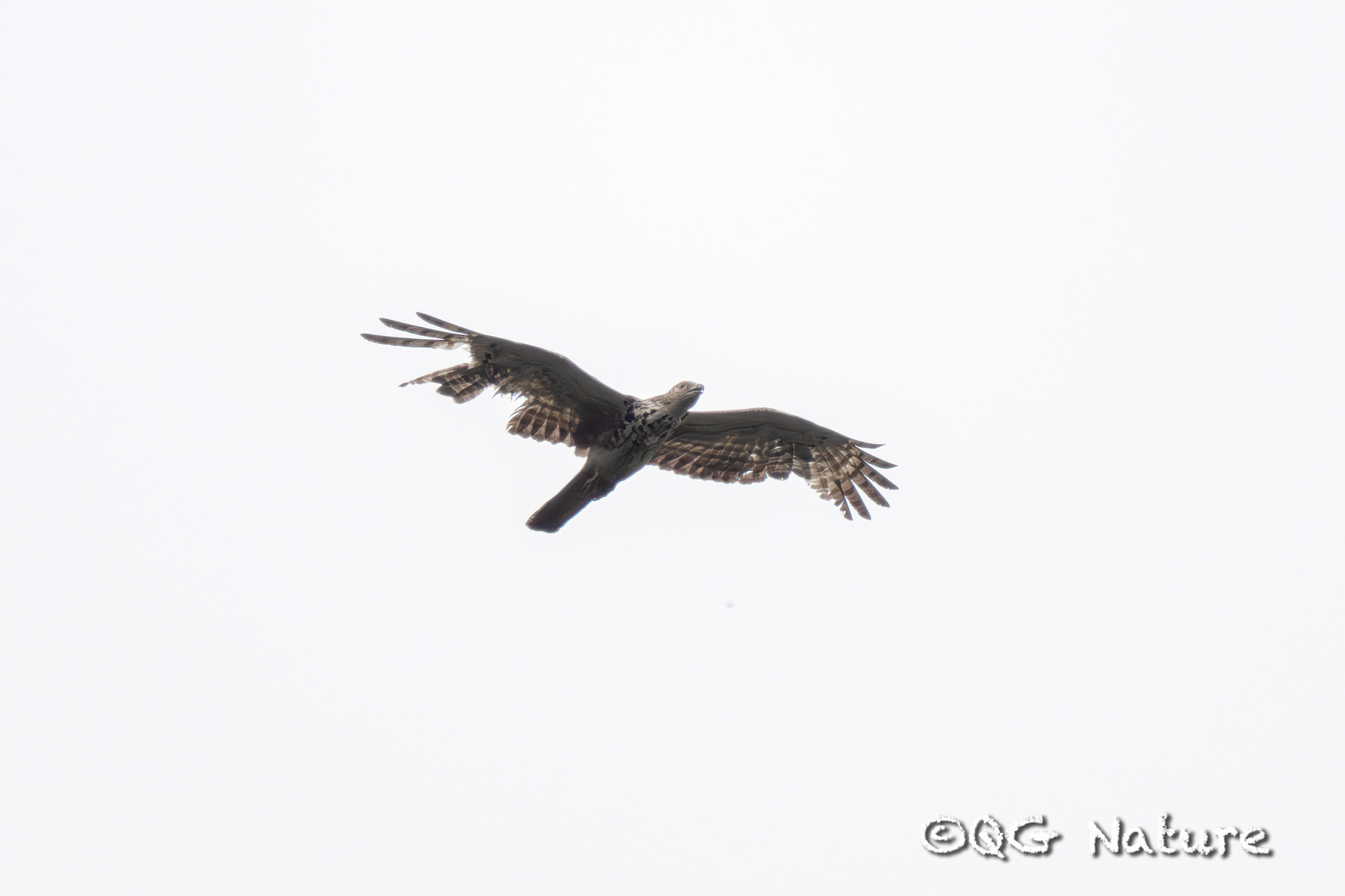
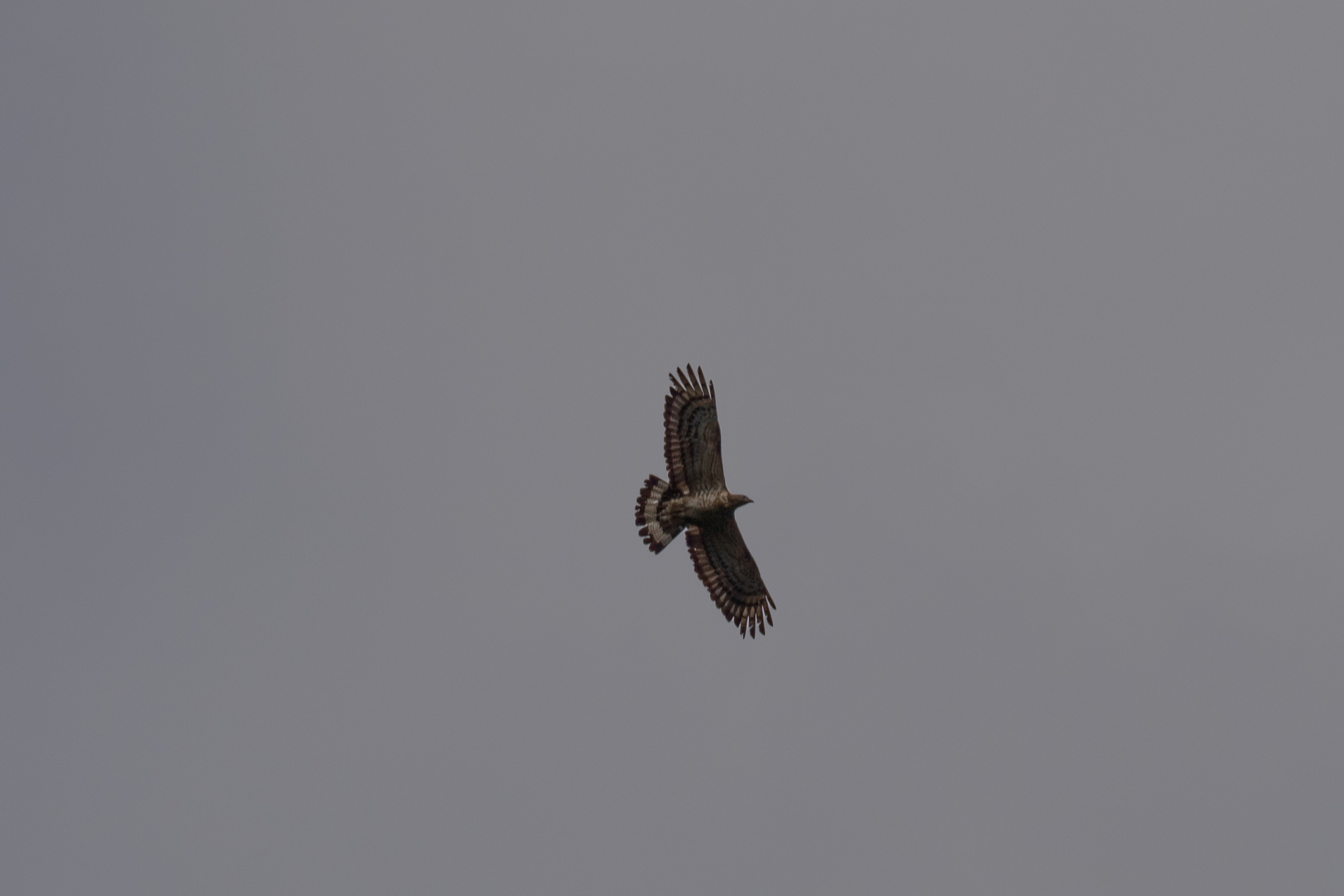
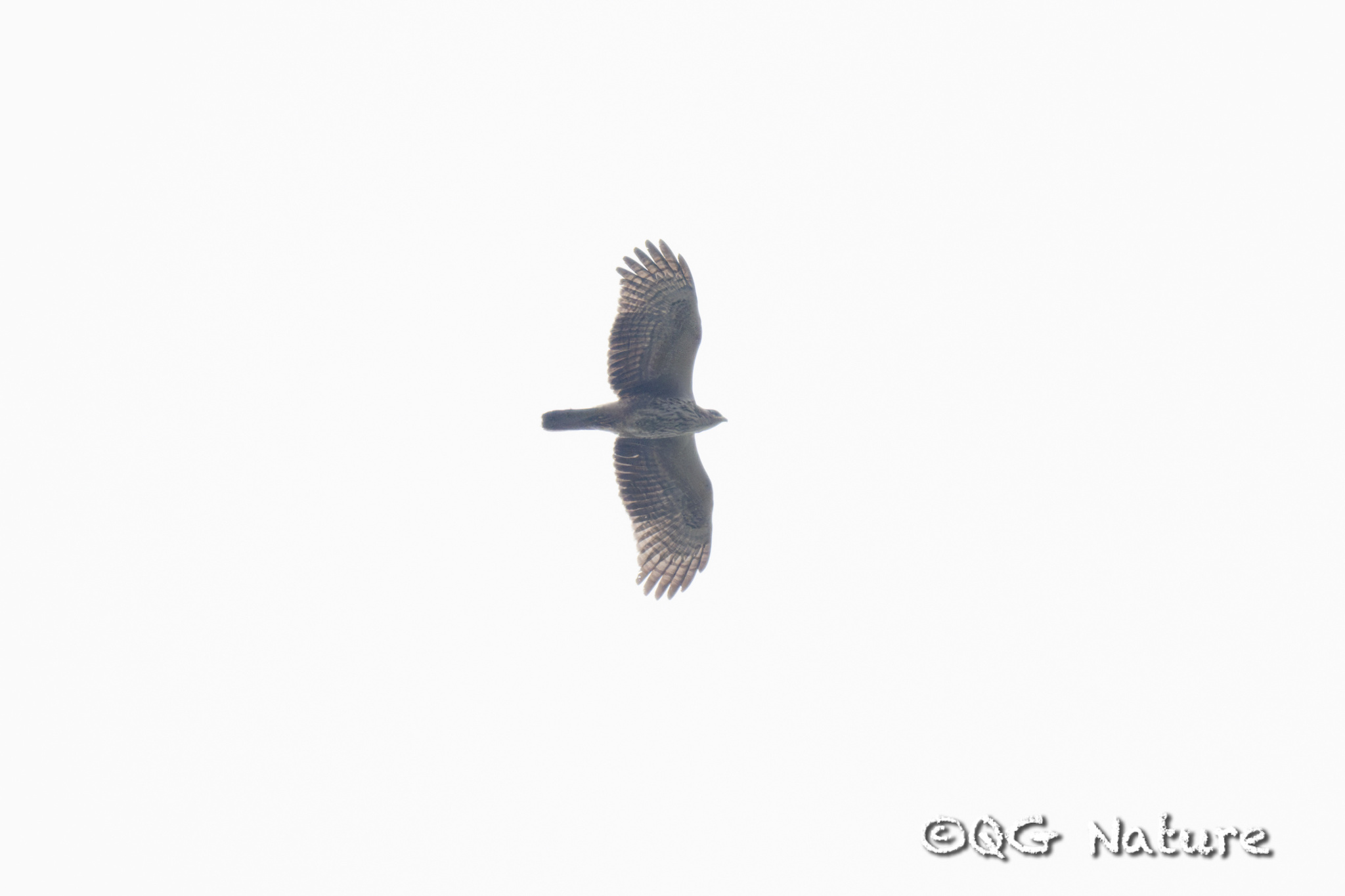
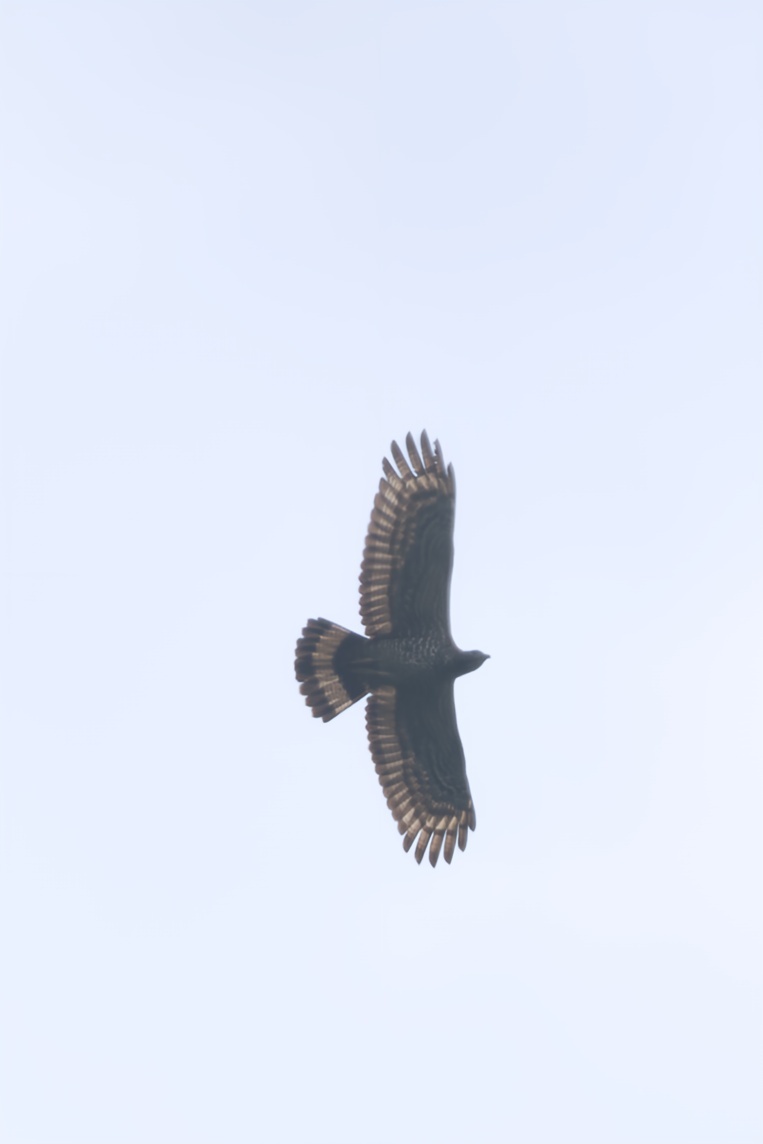
Crested Honey Buzzard
Pernis ptilorhynchus
凤头蜂鹰
Introduction
This large raptor of the Accipitridae family specializes in foraging for social bee and wasp larvae. It has evolved adaptations for extracting larvae from honeycombs, including an elongated head for underground foraging and a uniquely grooved tongue. The species exhibits sexual dimorphism: males have blue-grey heads and females have brown heads and yellow eyes. Six subspecies are recognized. It breeds in temperate zones of Siberia, Korea, and Japan during summer months, then migrates to tropical Southeast Asia and the Indian subcontinent for winter. Japanese populations make a nonstop 700-kilometer flight over the East China Sea. Year-round populations persist in southern portions of its range. The species inhabits well-forested areas with open glades, from lowlands to mid-elevations. Juveniles exhibit Batesian mimicry, resembling hawk-eagles. It is most often seen soaring over forest canopies or perched at tree tops.
Description
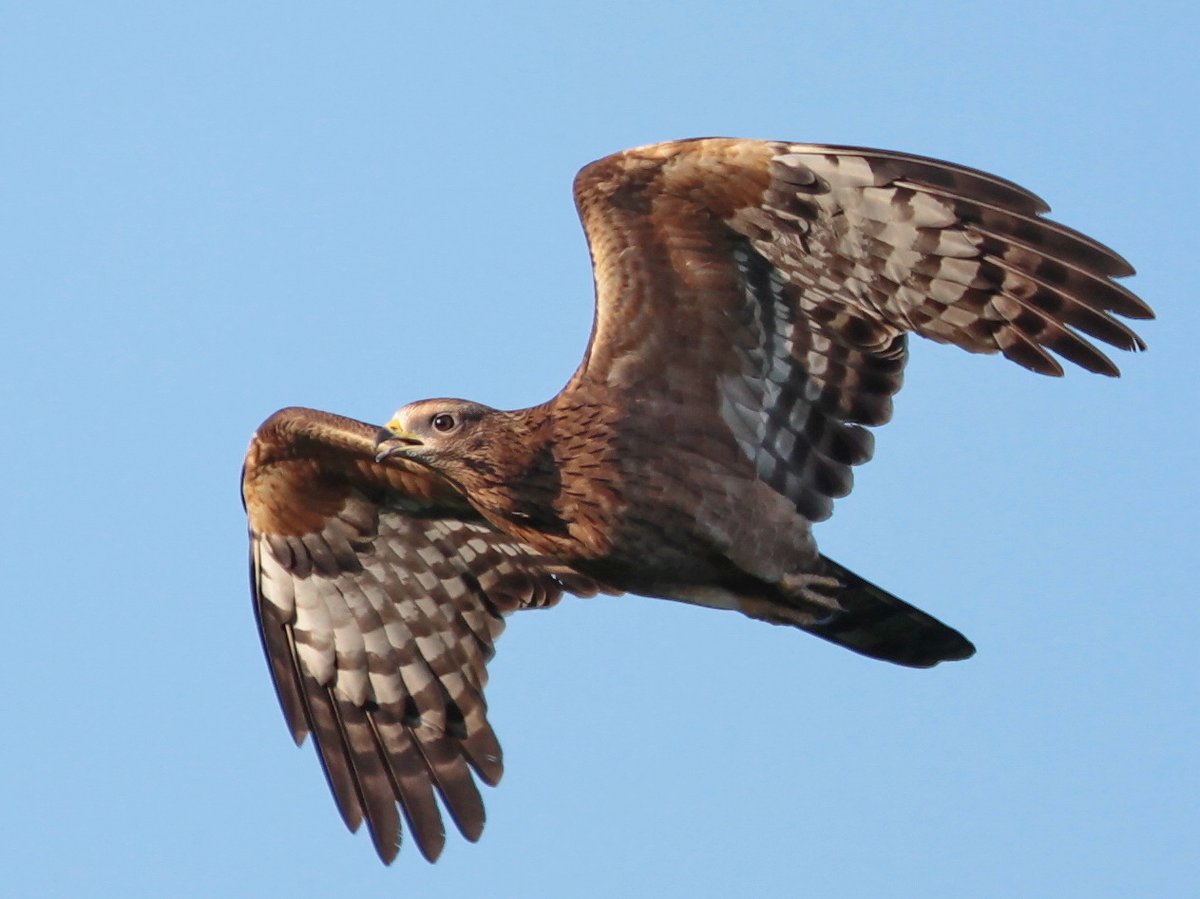
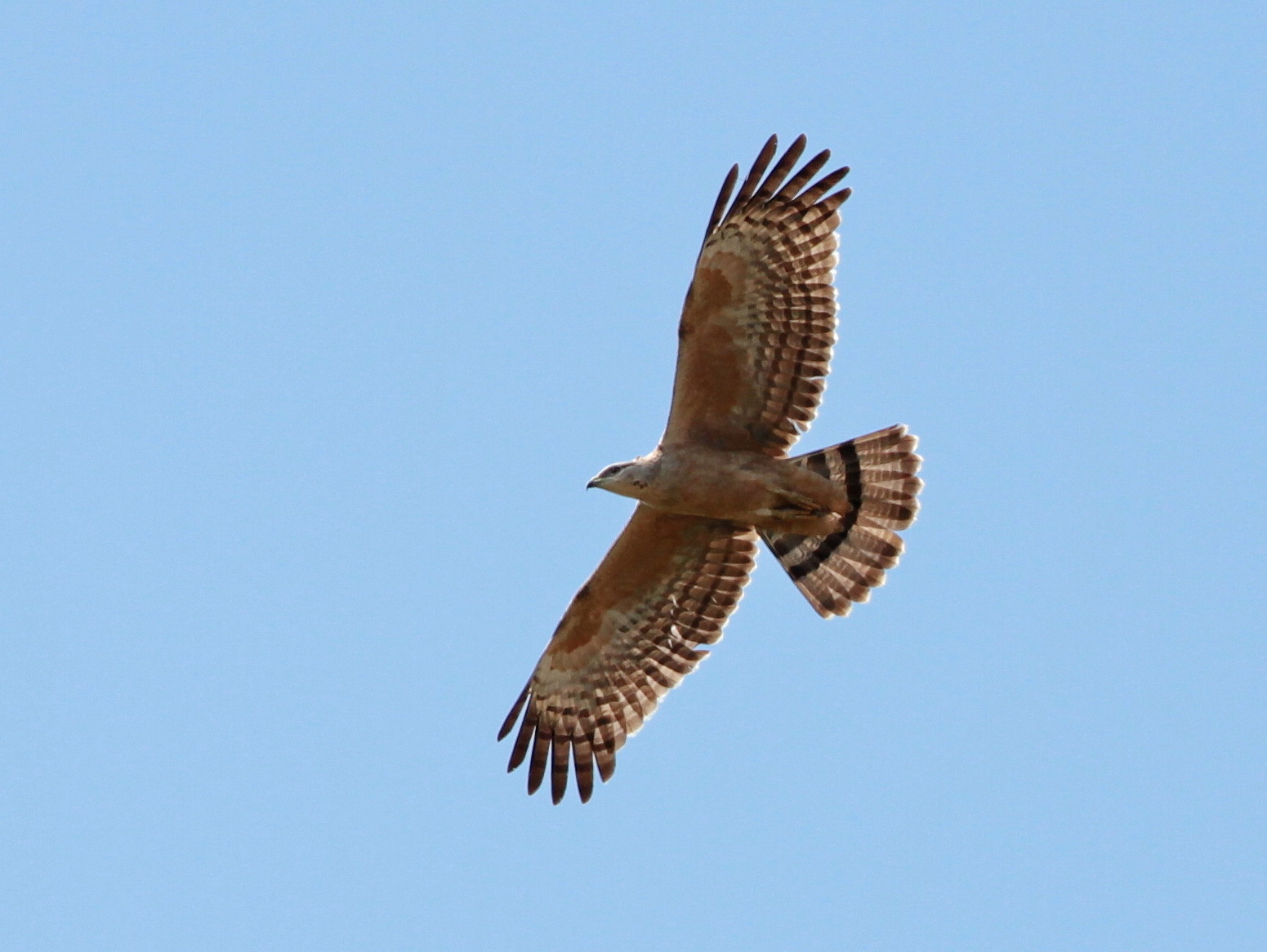
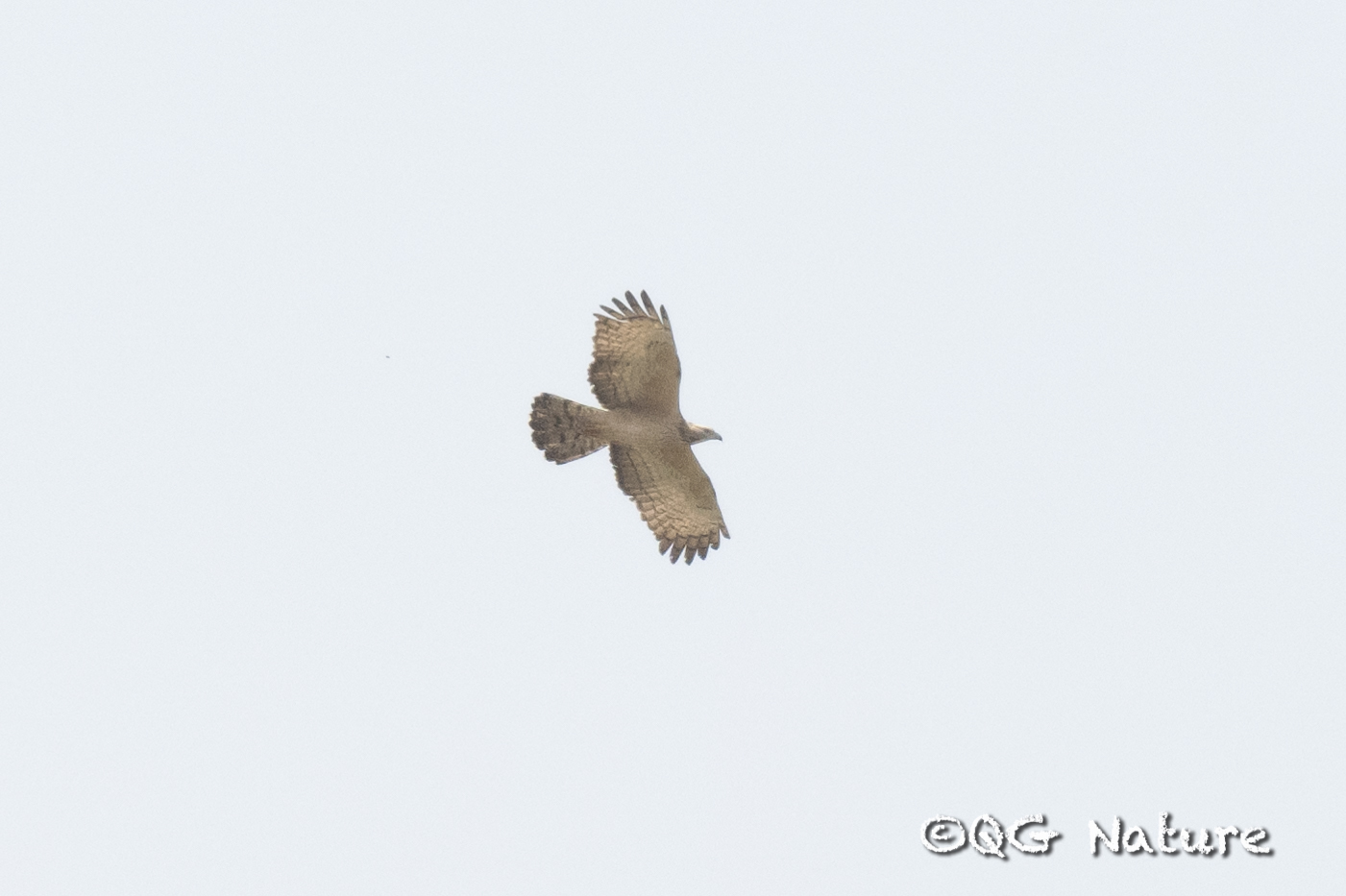
A fairly large raptor measuring 57-60 cm in length, this species has an unusually long neck and small head resembling a pigeon, lacking the strong superciliary ridge typical of most birds of prey. The upperparts are brown, though paler than the European honeybuzzard, with a dark throat stripe. The tail is long and broad with a rounded tip. Sexes differ notably: the male has a blue-grey head with brown iris and darker back, while the female has a brown head with yellow iris and is slightly larger. Males display two black tail bands and three black underwing bands, while females show three tail bands and four narrower underwing bands. Juveniles have extensive black primary tips and narrower underwing bands. The cere at the bill base is yellow, and the iris is dark. Coloration and tail patterns are highly variable throughout the range.
Identification
At distance, this species can be confused with the short-toed snake-eagle, but the slimmer head and longer neck are distinguishing features. It typically soars singly or in pairs on long, broad wings with distinctive rounded 'six-fingered' tips, gliding on flat or slightly arched wings held at right angles to the body. The tail is shorter than the wing base breadth. Flight action includes deep elastic wingbeats with high upstrokes. Birds are often seen perched atop tree tops. The species is typically silent, only occasionally uttering a single high-pitched screaming whistle. Juveniles may be confused with Nisaetus hawk-eagles due to similar plumage, a potential Batesian mimicry adaptation.
Distribution & Habitat
This species breeds across Siberia, Korea, and Japan during summer months, departing Siberia in late August and returning in May, with Japanese birds present from April-May through mid-September. It winters throughout tropical Southeast Asia and the Indian subcontinent, with year-round resident populations in southern areas. Japanese populations undertake a remarkable nonstop 700-kilometer flight over the East China Sea during migration, aided by favorable tailwinds. The species prefers well-forested lowland and hilly areas broken by open glades, sometimes found near village groves, occurring from sea level to 1,500 meters, occasionally to 1,800 meters. Migration occurs above 3,000 meters. It has occurred as a vagrant in Alaska and is spreading to the Middle East.
Behavior & Ecology
As a specialist feeder, this raptor primarily consumes larvae, pupae, and honeycombs of social bees and wasps, supplemented occasionally by cicadas and occasionally small birds, reptiles, and frogs. In Japan, birds dig up underground wasp nests using specialized talons with short toe depth and elongated second digit. The tongue features a groove for extracting larvae, while dense, stiff feathers around the head and neck provide protection against stinging attacks. Breeding occurs in woodland areas, with nests built as stick platforms 40-80 cm across, lined with leaves, positioned 10-28 meters high in conifers (north) or various trees in southern regions. The female lays two variable-colored eggs, and both parents share incubation lasting 4-5 weeks and fledging after 5-6 weeks. Spring courtship displays include wing clapping and characteristic 'roller coaster' flight patterns.
Conservation
Listed as Least Concern by IUCN, though the species is inconspicuous and likely undercounted. Population estimates range from 100,000 to 1,000,000 individuals. Climate change poses a significant threat: research predicts wind support for the 680-kilometer migratory corridor over the East China Sea will be reduced by mid-century and completely lost by late century, potentially eliminating this migratory pathway. However, the species shows adaptability, colonizing anthropogenic habitats like irrigated forest plantations in Pakistan and spreading to the Middle East. While falconry-related trade exists in Indonesia, this species represents only about 1% of raptors offered for sale in online markets.
Culture
In Java, Indonesia, local people in forested areas have historically blamed this bird for provoking attacks by giant honey bees. The belief held that honey buzzards deliberately flew near humans to transfer angry bee attacks after raiding nests. However, research conducted between 2003 and 2019 found no evidence of this strategy. Researchers instead suggest that habitat decline due to human activity has increased overall conflict between bees and humans, with the birds' natural foraging behavior bringing them into greater proximity with human settlements. The species thus became a scapegoat for bee attack incidents actually driven by broader environmental changes.
Source: Wikipedia · CC BY-SA 3.0
Taxonomy
- Order
- Accipitriformes
- Family
- Accipitridae
- Genus
- Pernis
- eBird Code
- orihob2
Vocalizations
Subspecies (6)
-
Pernis ptilorhynchus orientalis
southern Siberia to Manchuria and Japan; winters to Greater Sundas and coastal western Australia (regularly Perth, rarely elsewhere)
-
Pernis ptilorhynchus palawanensis
southern Philippines (Palawan and Calauit)
-
Pernis ptilorhynchus philippensis
northern and eastern Philippines
-
Pernis ptilorhynchus ptilorhynchus
Java
-
Pernis ptilorhynchus ruficollis
India and Sri Lanka through southwestern China and southeastern Asia except Malay Peninsula
-
Pernis ptilorhynchus torquatus
Malay Peninsula, Sumatra, and Borneo
Data Sources
Species description from Wikipedia, licensed under CC BY-SA 3.0.
Bird images and sounds sourced from GBIF, contributed by citizen scientists worldwide under Creative Commons licenses.
Taxonomy data from AviList 2025.