Passeriformes / Paridae / Parus
Great Tit
Parus major · 欧亚大山雀
Introduction
A small passerine bird in the tit family Paridae, widespread and common throughout Europe, the Middle East, Central Asia, and as far east as the Amur River, with populations in parts of North Africa. It is predominantly resident, migrating only during extremely harsh winters. The species is a cavity nester and has adapted well to human-induced environmental changes, becoming common in urban parks and gardens. It is classified as Least Concern on the IUCN Red List.
Description
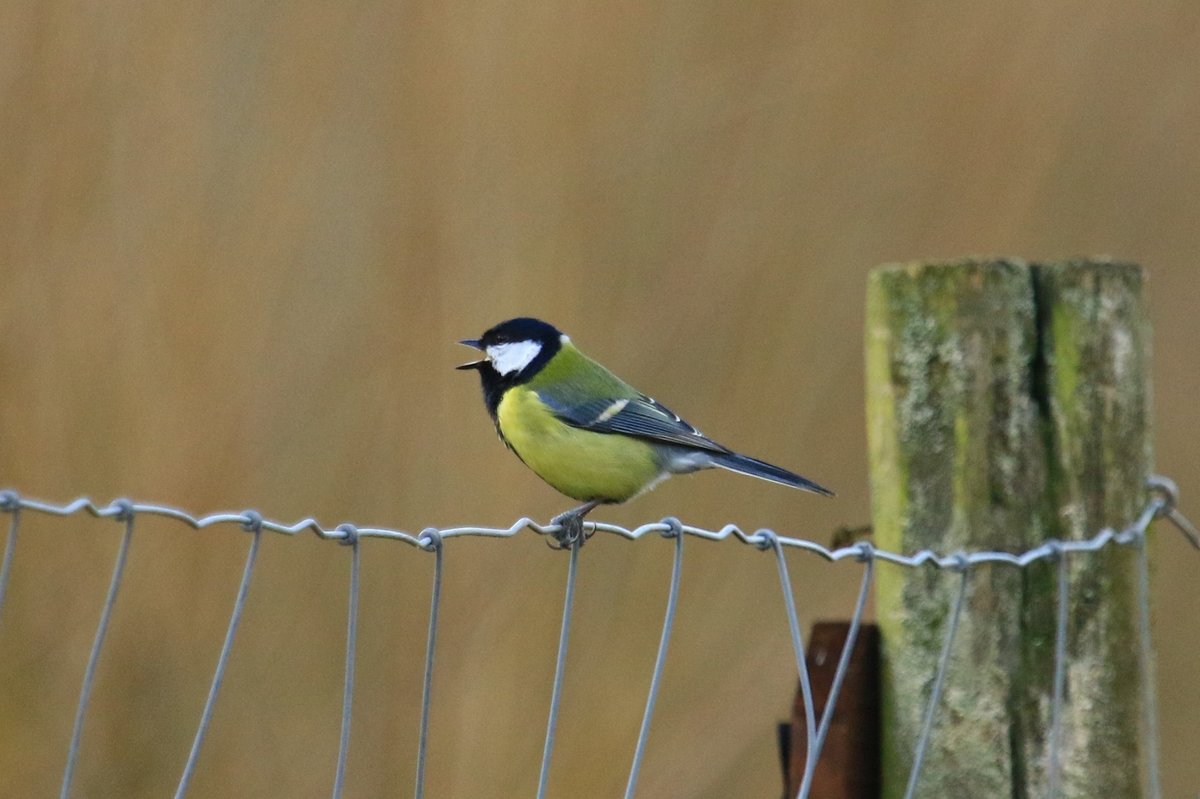
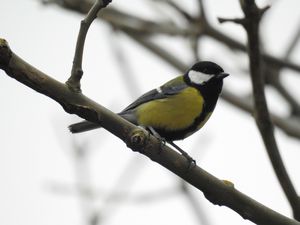
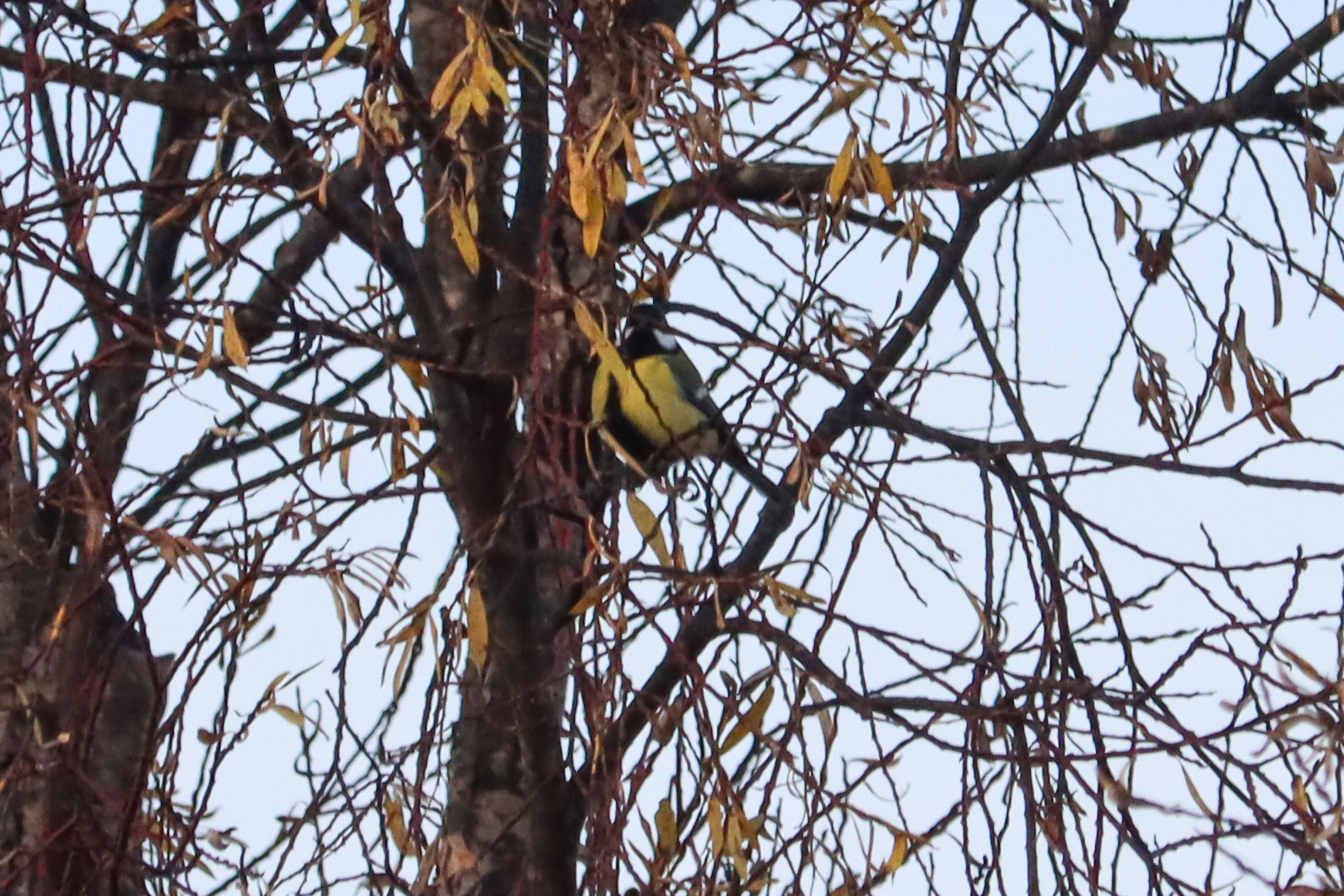
Large for a tit at 12.5 to 14 cm (4 7/8–5 1/2 in) in length. The nominate race has a bluish-black crown, black neck, throat, bib, and head, with prominent white cheeks and ear coverts. The breast is bright lemon-yellow with a broad black mid-line stripe running from the bib to the vent. Upperparts are green tinged with olive; wing-coverts are green, while the rest of the wing is bluish-grey with a white wing-bar. The tail is bluish-grey with white outer tips. Females have duller colours, a less intensely black bib, and a narrower, sometimes broken belly stripe. Young birds have dull olive-brown napes and necks, greyish rumps, and greyer tails. Subspecies vary in plumage tone, bill size, and tail markings.
Identification
Distinctive appearance with a black head and neck, prominent white cheeks, olive upperparts, and yellow underparts. The broad black mid-line stripe on the yellow breast is a key mark. Vocalizations include soft contact notes like 'pit' or 'chit', a loud 'tink' alarm call, and a familiar 'teacher, teacher' song likened to a squeaky wheelbarrow wheel.
Distribution & Habitat
Widespread across Eurasia, including all of Europe except Iceland and northern Scandinavia, numerous Mediterranean islands, North Africa (Morocco, Algeria, Tunisia), the Middle East, and Central Asia from northern Iran and Afghanistan to Mongolia. Range extends across northern Asia from the Urals to northern China and the Amur Valley. Habitats include open deciduous woodland, mixed forests, forest edges, gardens, conifer clearings, boreal taiga, oak forests, Atlas cedar stands, palm groves, and riverine willow and birch forests. Generally non-migratory, though populations may become irruptive in harsh winters, moving south from northern Europe.
Behavior & Ecology
Primarily insectivorous in summer, feeding on insects and spiders via foliage gleaning; diet shifts to berries, seeds, and nuts in autumn and winter. Known to prey on hibernating pipistrelle bats in severe winters. Uses 'hold-hammering' technique to crack hard seeds like hazelnuts. Exhibits insight learning, such as opening milk bottle caps. Monogamous cavity nester, often using tree holes or nest boxes. Female builds the nest and incubates 5–12 eggs alone for 12–15 days; both parents feed chicks. Clutch size correlates with laying timing and competitor density. Extra-pair copulations occur frequently. Chicks hatch blind and unfeathered; nestling period lasts 16–22 days.
Conservation
Classified as Least Concern on the IUCN Red List. Total population estimated at 300 to 1,100 million birds across a range of 32.4 million km². While localized declines occur in areas with poorer quality habitats, the large range and high numbers indicate the species is not threatened.
Source: Wikipedia · CC BY-SA 3.0
Taxonomy
- Order
- Passeriformes
- Family
- Paridae
- Genus
- Parus
Subspecies (16)
-
Parus major aphrodite
southern Italy, Sicily, southern Greece, and Mediterranean islands including Cyprus
Data Sources
CBR Notes: 中文名由大山雀改为欧亚大山雀
Species description from Wikipedia, licensed under CC BY-SA 3.0.
Bird images and sounds sourced from GBIF, contributed by citizen scientists worldwide under Creative Commons licenses.
Taxonomy data from AviList 2025.