Passeriformes / Panuridae / Panurus
Bearded Reedling
Panurus biarmicus · 文须雀
Introduction
A small, long-tailed passerine and the only species in the family Panuridae. It inhabits reed beds near water in the temperate zone of Eurasia. The species is strongly sexually dimorphic, forms life-long pairs, and exhibits high reproductive productivity with multiple broods per season. It is not considered threatened globally.
Description
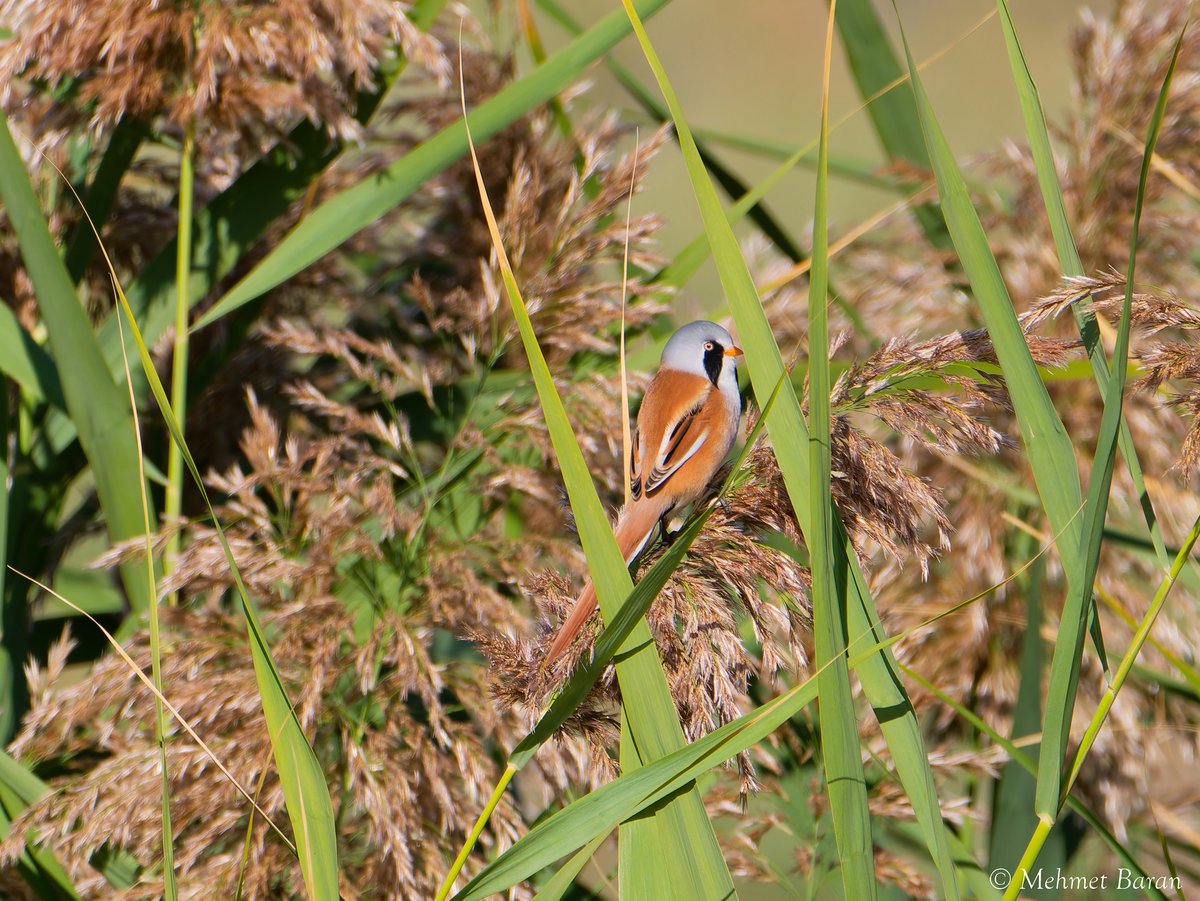
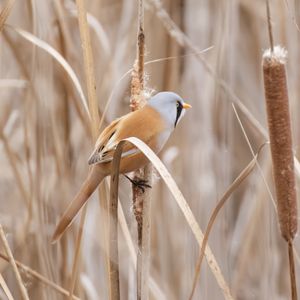
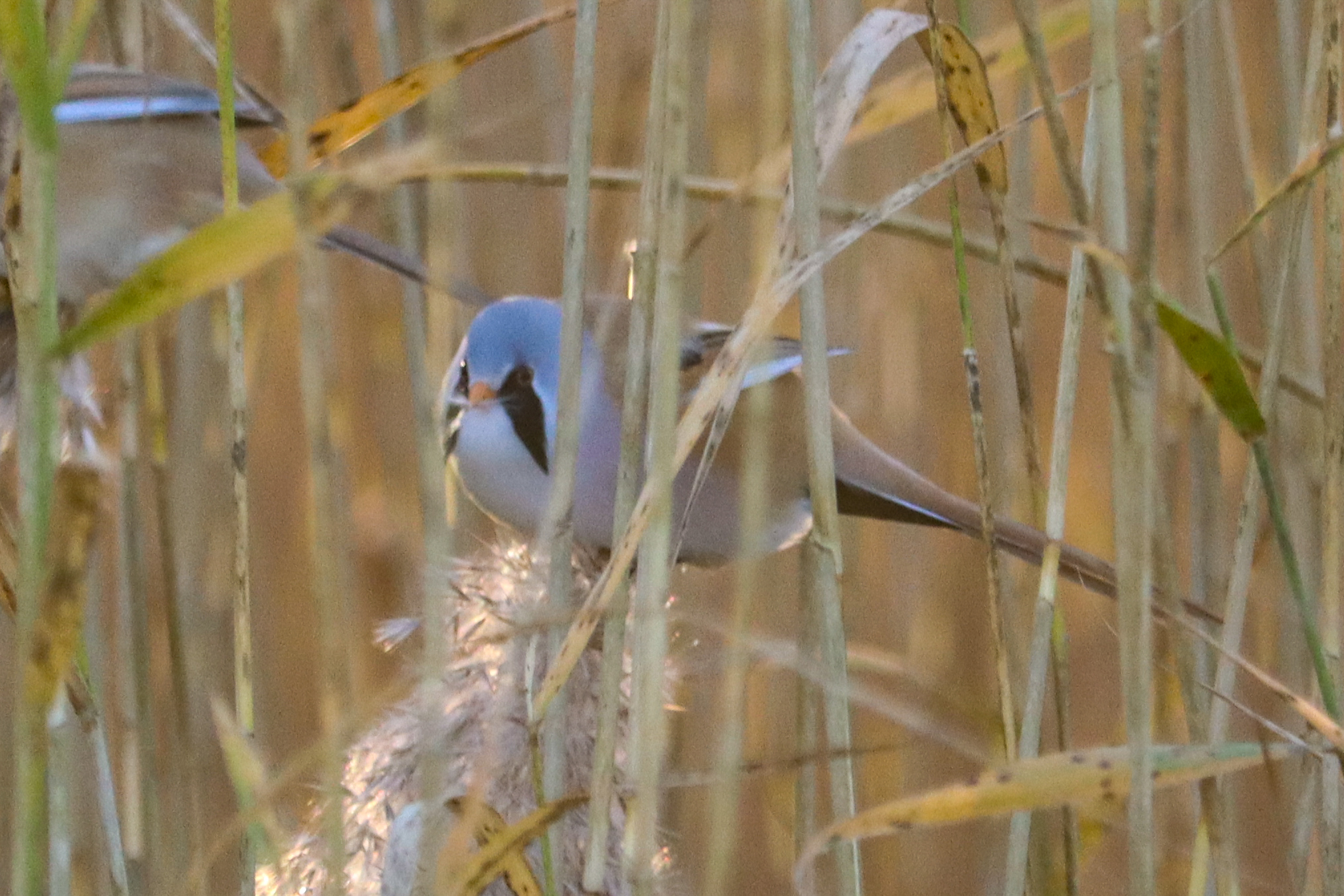
Length 14.5–17 cm (5.7–6.7 in) with a long tail. Plumage is mostly orange-brown with a whitish throat and chest, contrasting black and white wing parts, and white-edged tail feathers. Adult males have a grey head, black 'moustaches', black undertail coverts, and a bright orange-yellow bill. Adult females are paler with a brownish head, lack black moustaches and undertail coverts, and may have black streaks or spots on the crown or back; their bill is duller. Juveniles resemble females but are buffier, have a rectangular black patch on the back, extensive black on tail feathers, and dark brown eyes that turn grey then yellow. Juvenile males have a large black loreal patch and bright orange-yellow bill, while juvenile females have a smaller dusky-grey loreal patch and a blackish or brownish bill.
Identification
Key marks include the male's black 'moustaches' and grey head, and the female's plain or streaked brown head. Flight is undulating with short wings producing a whirring sound. Vocalizations include a characteristic metallic 'ping' contact call and a tuneful 'tschin-schik-schra' song from males. Well-camouflaged in dense reeds, often detected by voice.
Distribution & Habitat
Native to temperate Europe and Asia, ranging from Spain, France, and the British Isles to Manchuria. Distribution is spotty due to habitat specialization. Three subspecies: P. b. biarmicus (northern, western, southern Europe, Turkey, Azerbaijan), P. b. russicus (eastern Europe, southern Russia, Central Asia, Mongolia, northern China), and P. b. kosswigi (southern Turkey, possibly Syria). Habitat includes reed beds with common reed by fresh or brackish water, swamps, rivers, and nearby tall grass-like vegetation. Altitudinal range from sea level to 3,050 m in China. Generally resident with some short-distance winter movements south or southwest; occasional vagrant to Portugal, North Africa, Israel, Kuwait, Pakistan, Japan, and Korea.
Behavior & Ecology
Social outside breeding season, forming groups of up to 200; breeds in pairs or loose colonies. Forms life-long monogamous pairs, though infidelity occurs. Breeding spans late March to early September, typically producing two to three broods. Both sexes build cup-shaped nests (7.5–17 cm diameter) attached to reeds. Incubation lasts up to two weeks for 3–11 eggs; nestling period is up to two weeks. Young fledge before flying and rely on parents for ~2 weeks. Diet shifts seasonally: summer diet consists of insects, larvae, and small invertebrates; winter diet consists of seeds from reeds, rushes, and sedges. Swallows grit in autumn/winter to aid seed digestion. Vulnerable to starvation during hard winters with snow or ice cover.
Conservation
Global population presumed at least 3,000,000 adults, with ~500,000 in Europe. Not considered threatened globally, but local populations fluctuate greatly due to weather and habitat availability. Vulnerable to hard winters causing die-offs. Habitat loss has caused local declines. Subspecies P. b. kosswigi has not been recorded since 1962 and may be extinct. In the UK, the population recovered from near extermination in the 1940s to over 500 pairs as of 2019, though subject to winter crashes.
Source: Wikipedia · CC BY-SA 3.0
Taxonomy
- Order
- Passeriformes
- Family
- Panuridae
- Genus
- Panurus
Subspecies (3)
-
Panurus biarmicus biarmicus
western Europe to Sweden, Poland, Italy, Balkans, and Transcaucasia
Data Sources
Species description from Wikipedia, licensed under CC BY-SA 3.0.
Bird images and sounds sourced from GBIF, contributed by citizen scientists worldwide under Creative Commons licenses.
Taxonomy data from AviList 2025.