Great Bustard
Otis tarda
大鸨
Introduction
Bird in the bustard family (Otidae) and only living member of the genus Otis. Breeds in open grasslands and farmland from northern Morocco, South and Central Europe to temperate Central and East Asia. European populations are mainly resident; Asian populations migrate south in winter. Classified as Endangered as of 2023, having been listed as Vulnerable on the IUCN Red List since 1996. Portugal and Spain host about 60% of the world's population. The species was extirpated from Great Britain in the 19th century, with the last bird shot in 1832. Reintroduction efforts have been underway in England since 1998 on Salisbury Plain, where the lack of public access provides necessary seclusion for this large, ground-nesting bird.
Description
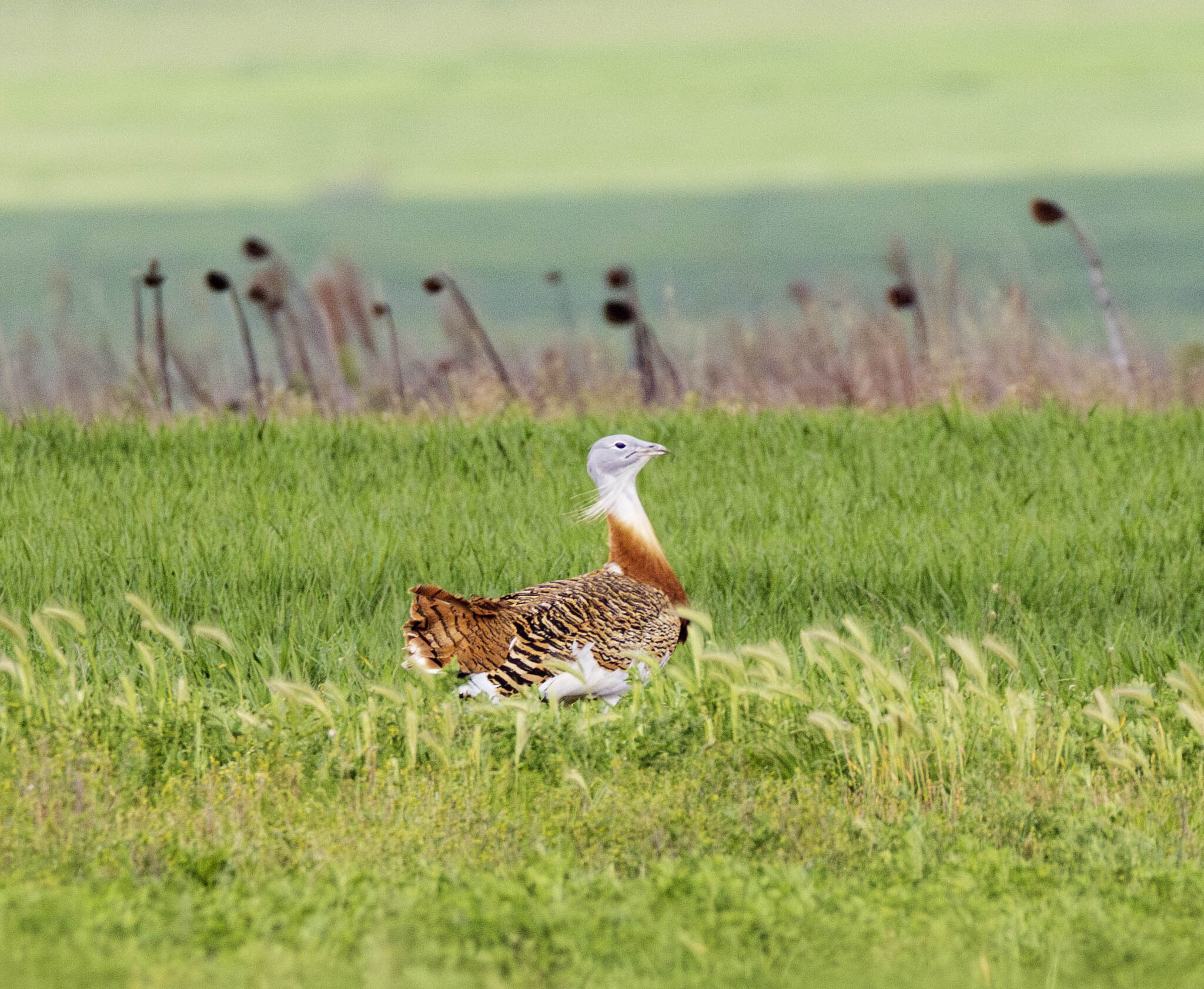
Among the heaviest living flying birds. Adult males measure 90-105 cm tall with 115 cm body length and 2.1-2.7 m wingspan, weighing 5.8-18 kg (heaviest verified specimen 21 kg from Manchuria). Females are about a third smaller at 75-85 cm tall, 90 cm length, and 180 cm wingspan, weighing 3.1-8 kg. This is the most sexually dimorphic extant bird species, with males averaging 2.48 times female weight. Adult males are brown above with blackish barring, white below, with long grey neck and head, chestnut breast and neck sides, and golden wash on the back. During breeding season, males have distinctive white neck bristles up to 12-15 cm long. Wings are predominantly white with brown edges. Females have buff breast and neck with brown and pale plumage for camouflage. The eastern subspecies O. t. dybowskii is more extensively grey in both sexes.
Identification
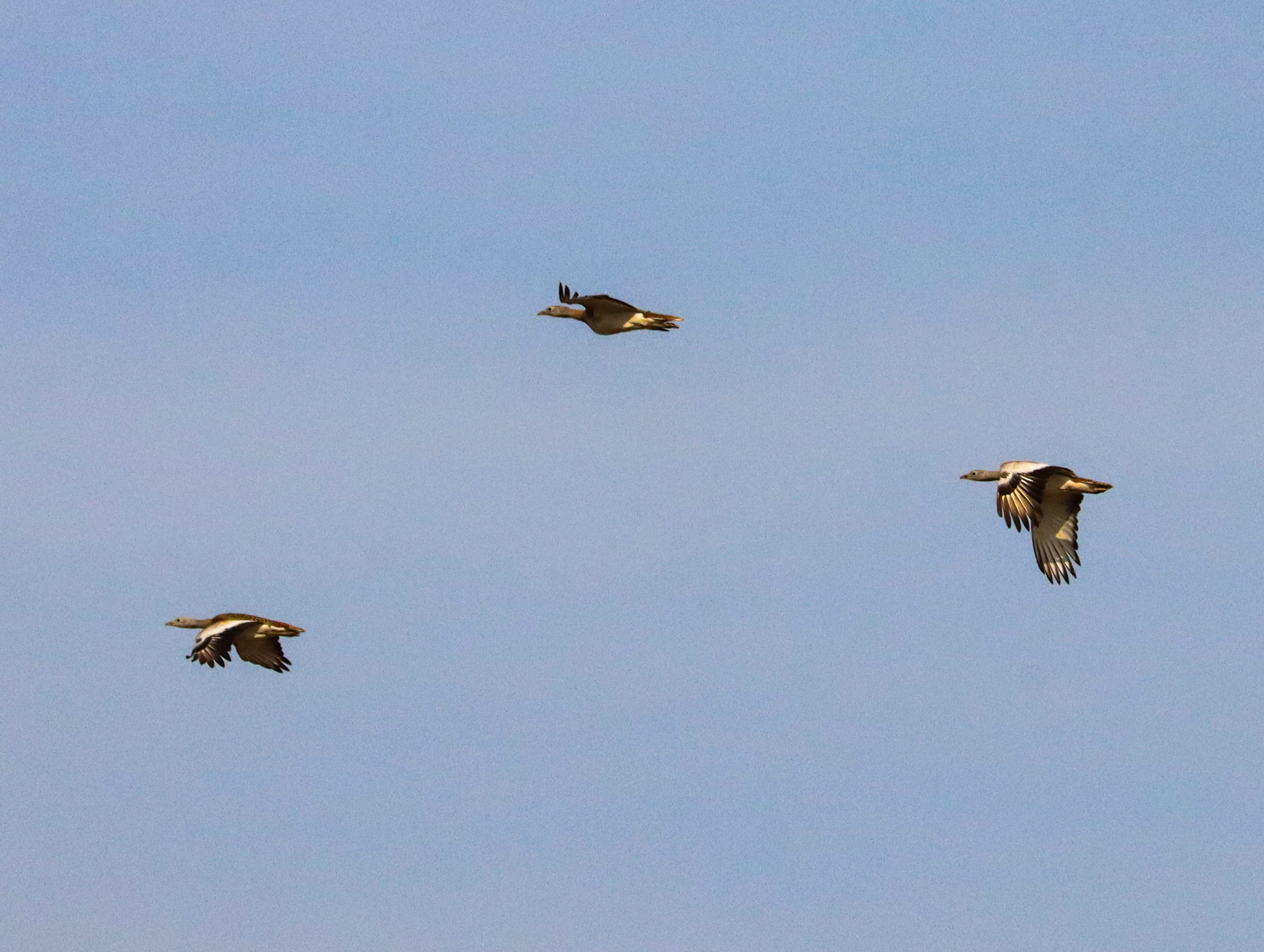
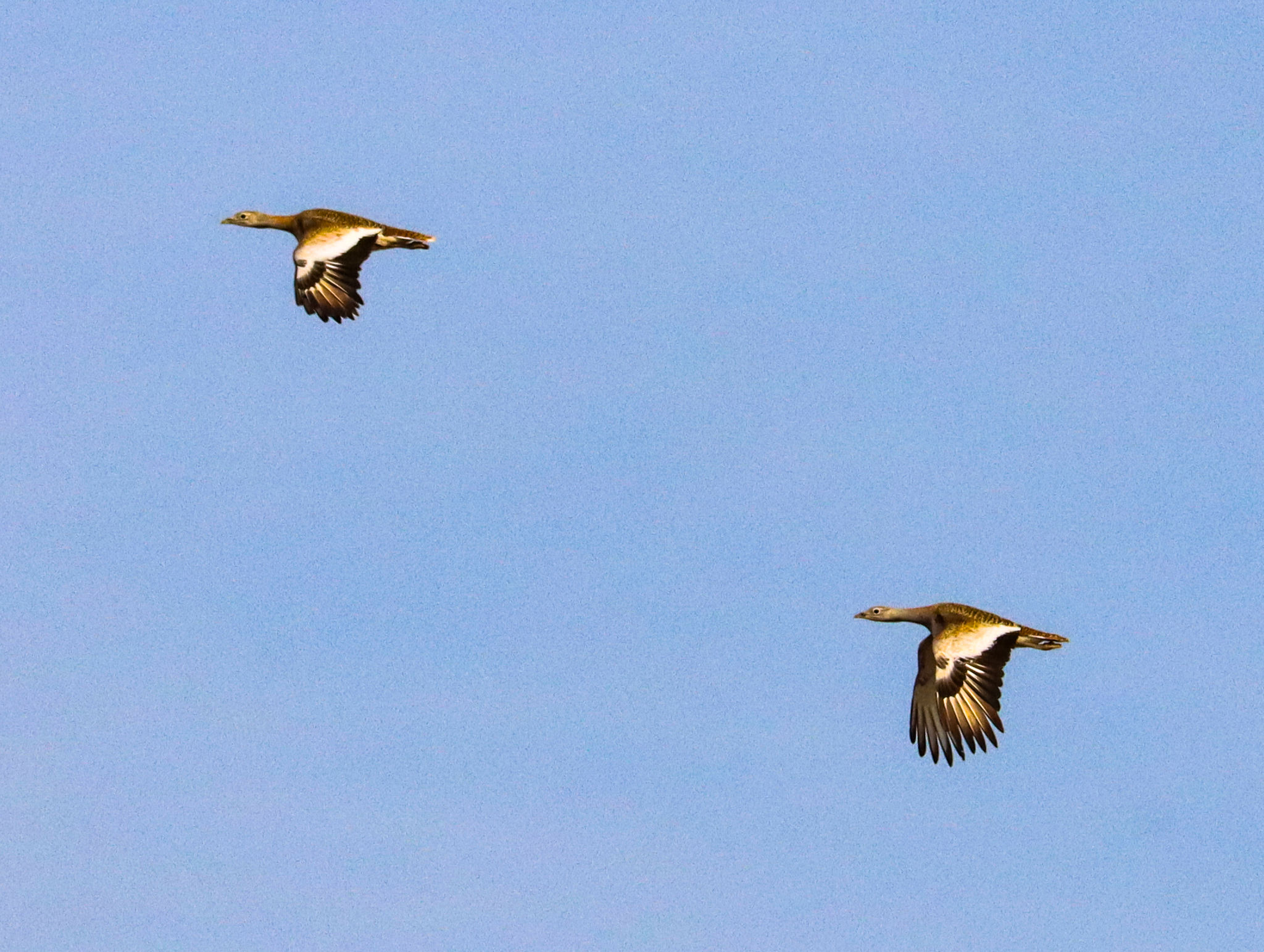
Essentially unmistakable due to its massive size and distinctive plumage. Males are unmistakable with their enormous grey neck and head, chestnut breast patches, and white underparts. The white wing panels with brown edges are visible in flight. Females are much smaller and cryptically colored with buff and brown plumage. The species is the largest bustard throughout its range. Three other bustard species overlap in range (MacQueen's, houbara, and little bustards), but none approach this species' size or plumage coloration. The combination of sexual size dimorphism (males 2.48 times heavier than females) and the white wing pattern are key identification features.
Distribution & Habitat
Range extends from Portugal to Manchuria, though populations have declined significantly. More than half the global population is now found in central Spain (around 30,000 individuals), with Castile and Leon hosting approximately 30%. Smaller populations exist in southern Russia and the Hungarian Plain. In Iran, only 19 individuals remained as of January 2025. Habitat consists of open, flat or rolling grasslands and steppes, including undisturbed farmland with cereals, vineyards, and fodder plants. Iberian populations make short seasonal movements of 5-200 km; Russian populations migrate ~1,000 km to Crimea; Mongolian populations migrate over 2,000 km to Shaanxi Province, China. Migration speeds reach 48-98 km/h.
Behavior & Ecology
Gregarious, especially in winter when flocks of several dozen gather. Males and females remain separate outside breeding season. Walking pace is slow and deliberate, but they run when disturbed (females can outrun red foxes at 48 km/h). Usually silent, but produce deep grunts when alarmed. Displaying males make booming, grunting, and raucous sounds. Breeds via lek display, with males establishing dominance through violent clashes. A single male may mate with up to five females. Females lay 1-3 olive or tan eggs (average 2) in shallow scrapes among dense grassy vegetation. Incubation lasts 21-28 days by the female alone. Chicks leave nest immediately but remain with mother until at least 1 year old. Omnivorous diet: plant material (48.4%), invertebrates (40.9%), and seeds (10.6%) in summer; mainly seeds and plants in winter. Lifespan typically 10 years, maximum recorded 28 years.
Conservation
IUCN Endangered status as of 2023 (Vulnerable since 1996). Global population estimated at 44,000-51,000 individuals (2008), with 38,000-47,000 in Europe and about 30,000 in Spain. Major threats include habitat loss from ploughing grasslands, intensive agriculture, afforestation, and development. Mechanization, chemical fertilizers, pesticides, and predation by dogs threaten chicks and juveniles. Overhead power lines cause significant mortality; mitigation measures include burying cables and marking remaining lines with fluorescent markers. Hunting contributes to adult mortality in some range countries. Reintroduction to the UK began in 2004 using eggs from Saratov, Russia, with the Wiltshire population exceeding 100 birds by 2020. A CMS Memorandum of Understanding for middle-European populations came into effect in 2001 to coordinate conservation efforts.
Culture
Formerly native to Great Britain, where it was hunted to extinction by the 1840s. The species appears on the Wiltshire Coat of Arms and as supporters for the Cambridgeshire arms. In Hungary, the great bustard holds national bird status, with authorities implementing active protection measures. The Hungarian area affected by special ecological treatment grew to 15 km² by 2006. As early as 1797, naturalist Thomas Bewick noted in A History of British Birds that both bustard species were excellent eating and suggested domestication could have prevented their decline in Britain. The reintroduction project by The Great Bustard Group received EU LIFE+ funding of £1.8 million in 2011.
Source: Wikipedia · CC BY-SA 3.0
Taxonomy
- Order
- Otidiformes
- Family
- Otididae
- Genus
- Otis
- eBird Code
- grebus1
Subspecies (2)
-
Otis tarda dybowskii
Mongolia to southern Siberia and northeastern China
-
Otis tarda tarda
now very local in southwestern and central Europe and northwestern Africa to southwestern Siberia and central Mongolia; reintroduced southern England
Data Sources
CBR Notes: IUCN红色名录等级由VU升为EN
Species description from Wikipedia, licensed under CC BY-SA 3.0.
Bird images and sounds sourced from GBIF, contributed by citizen scientists worldwide under Creative Commons licenses.
Taxonomy data from AviList 2025.