Mountain Hawk-Eagle
Nisaetus nipalensis
鹰雕
Introduction
A large bird of prey in the family Accipitridae (subfamily Aquilinae). Native to Asia, ranging from the northern Indian subcontinent through Nepal, Bhutan, Bangladesh, Thailand, Laos, Vietnam, southeastern China, Taiwan, to Japan. Inhabits dense hill and montane forests, primarily primary evergreen or mixed forests from temperate to tropical zones. Distinguished by its feathered tarsus, making it a member of the Aquilinae subfamily. As a forest-dwelling opportunistic predator, it readily varies prey selection between birds, mammals, and reptiles. Currently classified as least-concern by IUCN but is often quite rare and scarce throughout its range, with populations appearing to decrease due to large-scale habitat degradation and deforestation.
Description
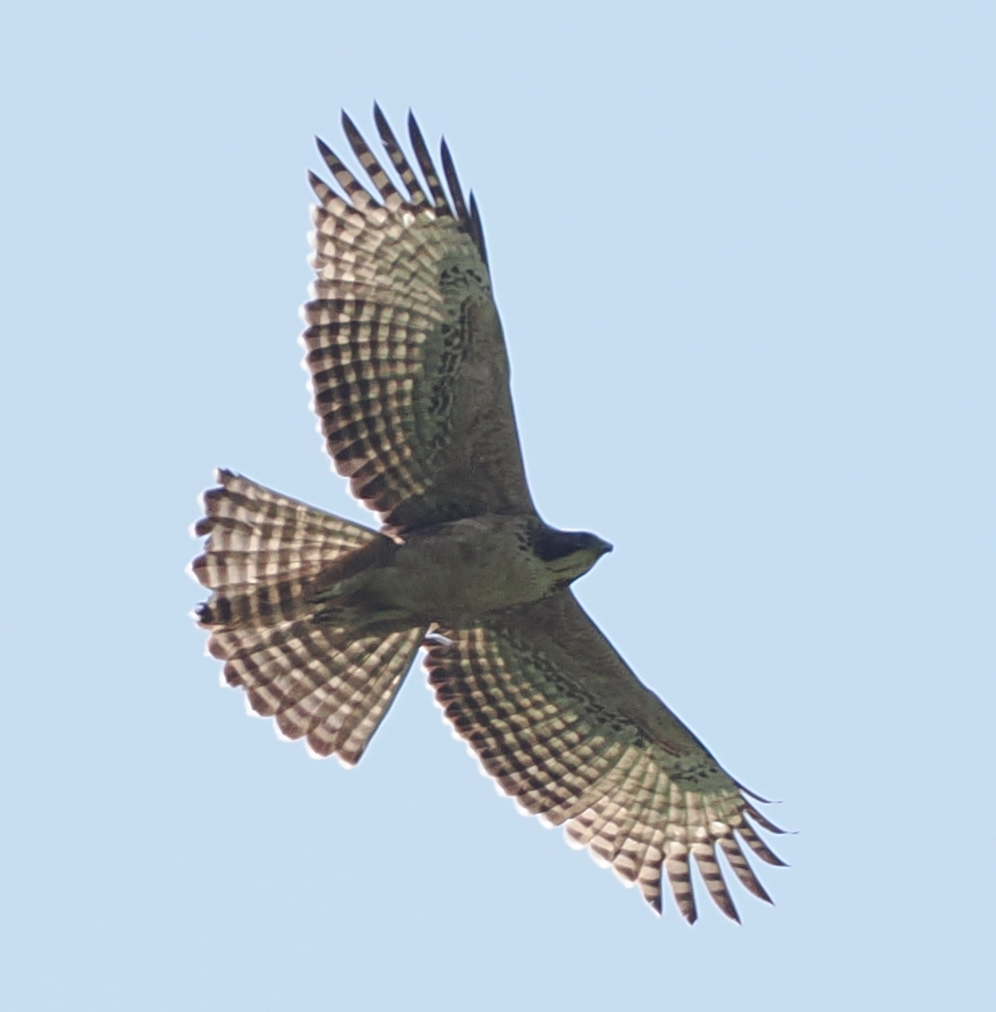
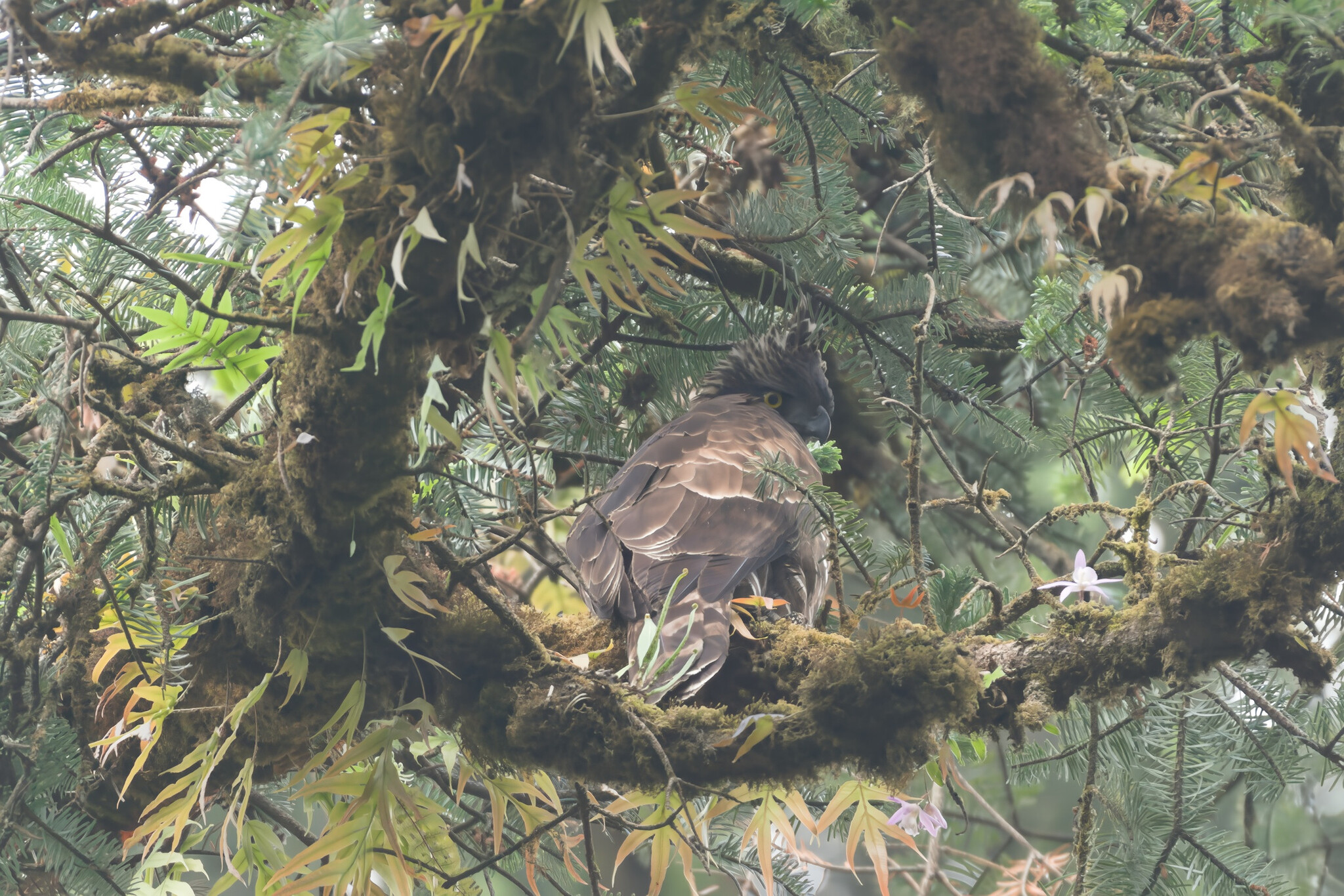
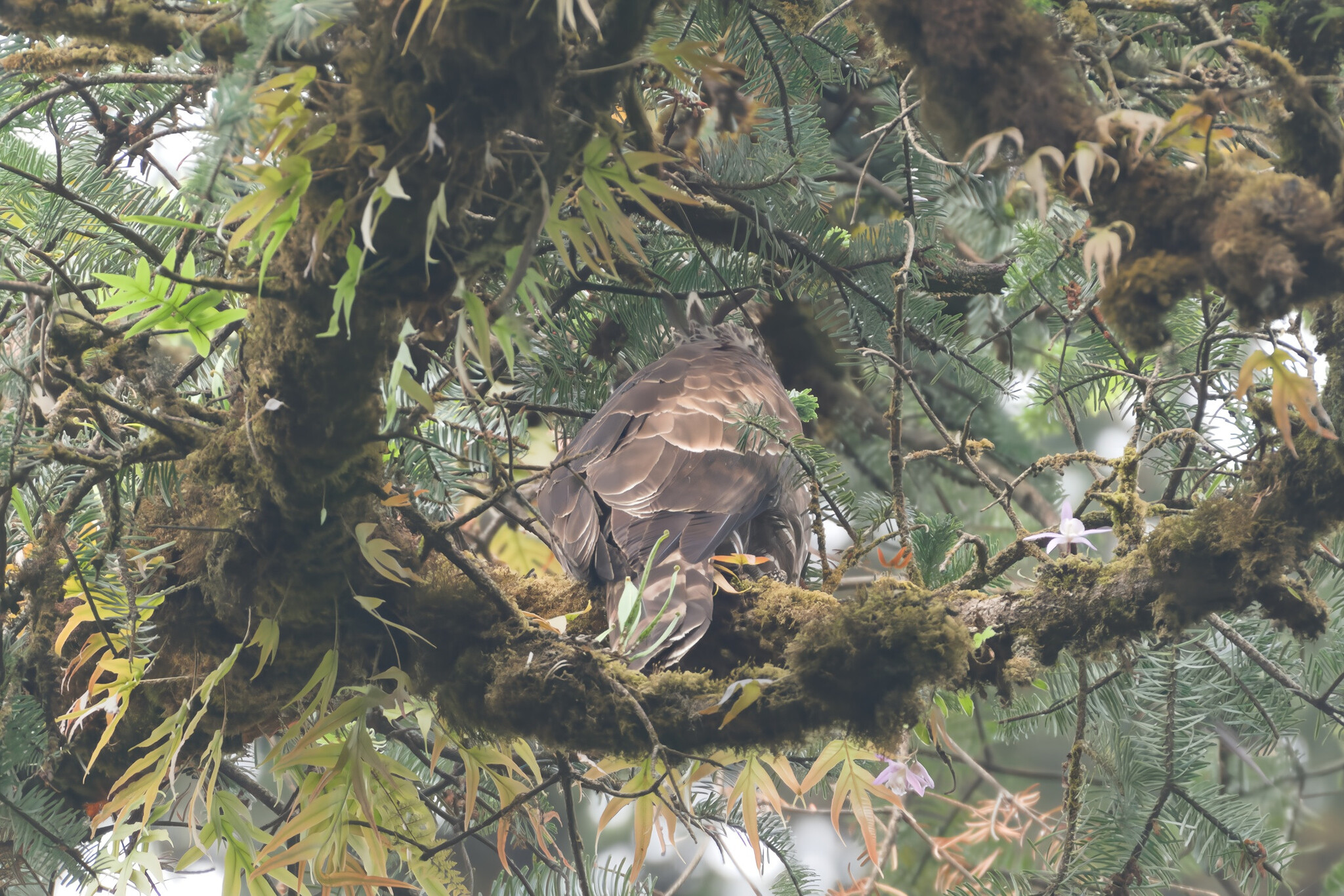
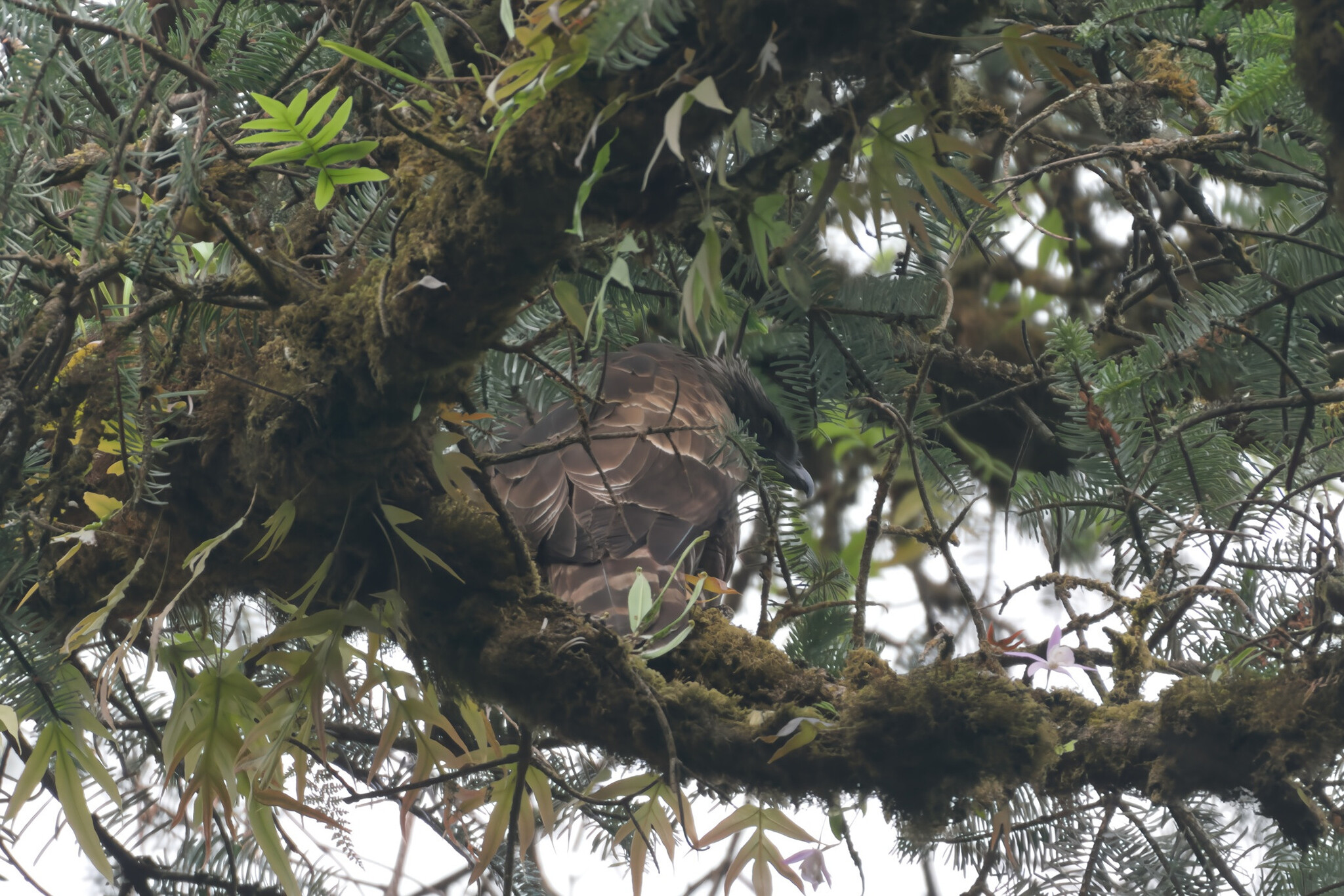
A large raptor, the largest member of the genus Nisaetus. Total length ranges from 69 to 84 cm with a wingspan of 134 to 175 cm. Females are 3-8% larger than males. Plumage is dark brown above with rusty head bearing strong black streaks and a rufous collar. The crest is largely black with a buffy tip. The underside shows a whitish ground colour with rufous barring and blackish ragged stripes on the throat and malar area. Legs are feathered. Adults have golden to yellowish-orange eyes with blackish-grey cere. Two subspecies exist: the nominate N. n. nipalensis (mainland) averaging 72 cm in length, and the Japanese race N. n. orientalis, which is about 9% larger. The Japanese race is generally paler with less heavy markings below.
Identification
Distinguished by relatively short rounded wings, long three-banded tail, prominent head in flight, and feathered legs. The longest wings of any hawk-eagle relative to size. Overlaps with pale morph changeable hawk-eagles (N. n. cirrhatus), but the latter has only a vestigial crest, is slimmer with a relatively longer tail, narrower wings, and streaking rather than heavy rusty barring below. In flight, changeable hawk-eagles hold flatter wings. Juvenile mountain hawk-eagles are bulkier with warm buffy to tawny underparts, unlike the much paler juveniles of changeable hawk-eagles. Capable of fast, agile flight with remarkable maneuverability, glides with powerful shallow beats, soars with wings in a shallow V.
Distribution & Habitat
Distributed through the Himalayas from northeastern Pakistan through northern India (Jammu and Kashmir, Himachal Pradesh, Uttarakhand), Nepal, Bhutan, and northern Assam, extending southward into the north and east Burmese highlands, western and peninsular Thailand, northern Laos and Vietnam. Range continues into southeastern China (Yunnan, Guangxi, Guangdong, Yangtze regions), Hainan, Taiwan, and Japan (highest concentration on northern islands like Hokkaido). Potentially breeds as far north as Mongolia and Primorsky Krai in Russia. Primarily sedentary with some altitudinal dispersal in winter. Found from 600 to 2,800 m elevation in Himalayas (recorded up to 4,000 m in northern Yunnan) and 250 to 1,500 m in Japan. Prefers primary evergreen or mixed forest habitats near streams.
Behavior & Ecology
A forest-dwelling opportunistic predator that primarily still-hunts from concealed perches, stooping to take prey on the ground. Also catches birds on the wing and takes arboreal prey from perches. Diet studies show preference for small mammals, particularly giant flying squirrels (47.4% of prey in Taiwan) and Pallas's squirrel (19.5%). Also takes reptiles, birds, and occasionally large prey including Japanese hares, young sika deer, Indian peafowl, water birds, and primates including infant monkeys and even an adult Japanese macaque (8.3-10 kg). Breeding season runs February to June in Himalayas and April to July in Japan. Builds large stick nests up to 1.8 m across in tall forest trees at 12-30 m height. Clutch size is typically 1-2 eggs. Display includes high circling and sky-dances with bubbling calls. The call is a shrill treble note compared to a green sandpiper or green magpie.
Conservation
Classified as least-concern species with an extremely large range of about 19 million square kilometers. However, total population was estimated at fewer than 10,000 individuals even when including the now-separated Legge's hawk-eagle. Primary threat is large-scale habitat degradation and deforestation throughout the range, particularly from increasing human density in northern India, southeastern China, and Japan. Secondary threats include persecution for killing poultry, lead poisoning from consuming sika deer carcasses shot with lead bullets, and disease. The Japanese population of 900-1,000 individuals is particularly declining. As a K-strategist like all eagles, ongoing population reduction raises concerns about genetic diversity and inbreeding depression.
Culture
The feathers are highly valued among indigenous Paiwan and Rukai peoples of Taiwan. The Rukai regard the eagle as sacred, believing it to be a reincarnation of the sharp-nosed viper that guided their ancestors. This cultural significance links the species to traditional beliefs and spiritual practices of these indigenous communities.
Source: Wikipedia · CC BY-SA 3.0
Taxonomy
- Order
- Accipitriformes
- Family
- Accipitridae
- Genus
- Nisaetus
- eBird Code
- mouhae1
Vocalizations
Subspecies (2)
-
Nisaetus nipalensis nipalensis
India to eastern China, Taiwan, Indochina, and Malay Peninsula
-
Nisaetus nipalensis orientalis
Japan
Data Sources
Species description from Wikipedia, licensed under CC BY-SA 3.0.
Bird images and sounds sourced from GBIF, contributed by citizen scientists worldwide under Creative Commons licenses.
Taxonomy data from AviList 2025.