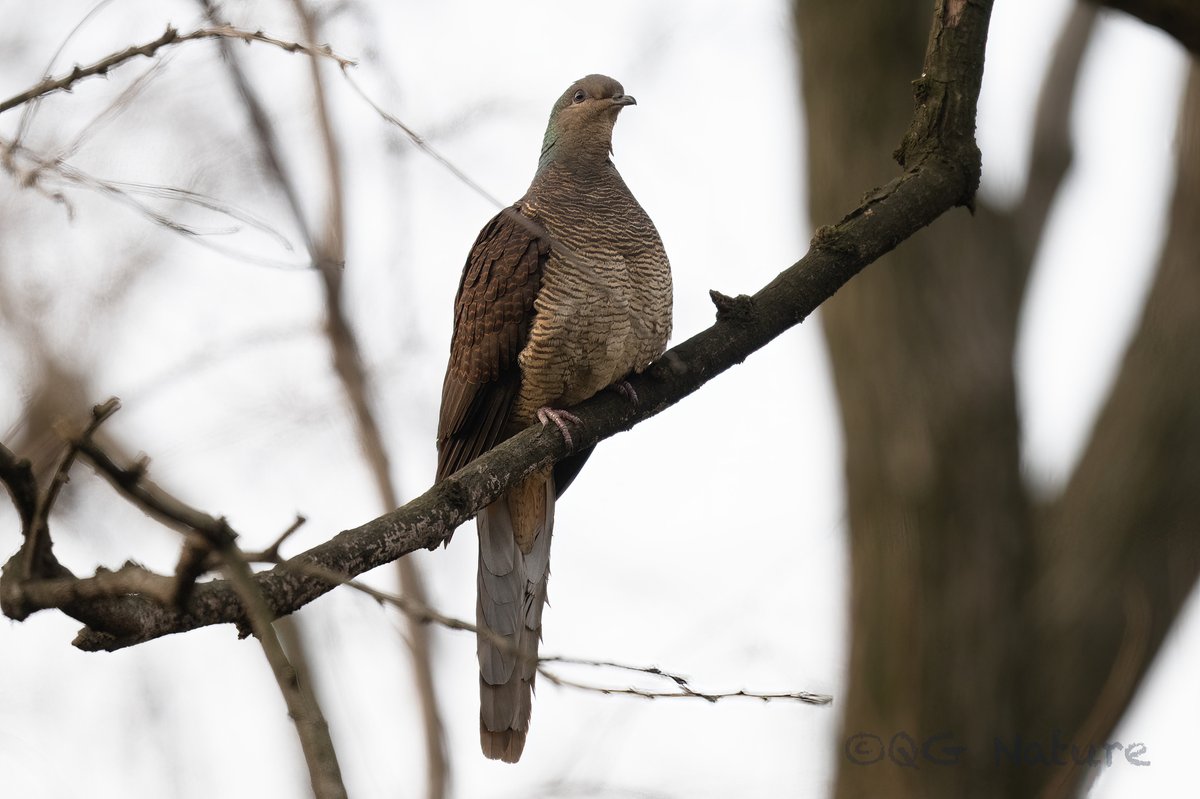
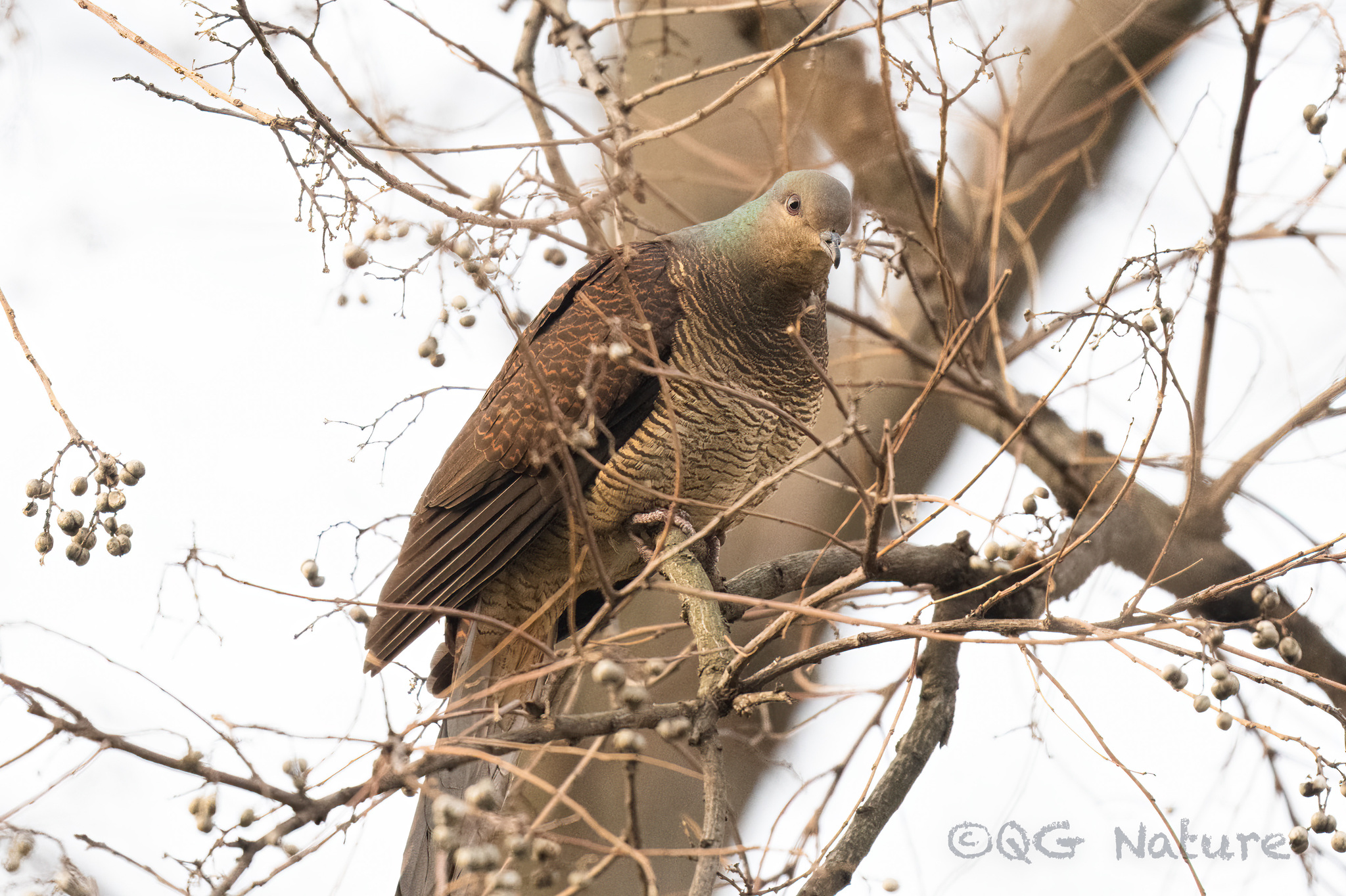
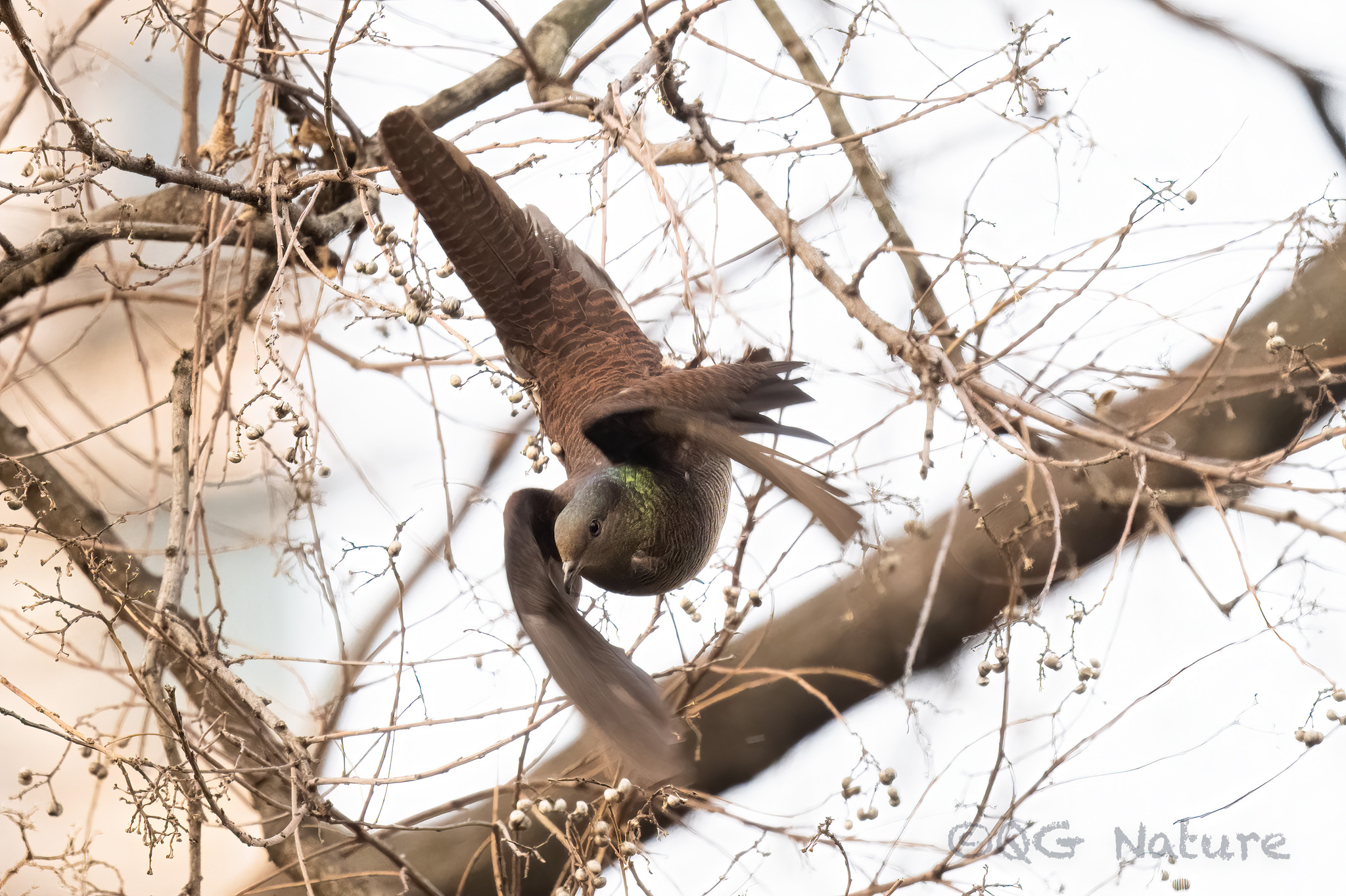
Columbiformes / Columbidae / Macropygia
Barred Cuckoo-Dove
Macropygia unchall · 斑尾鹃鸠
Introduction
A bird species in the family Columbidae native to South and Southeast Asia. It inhabits dense subtropical woodlands on montane slopes. Listed as Least Concern on the IUCN Red List.
Description
Measures 37 to 41 cm (15 to 16 in) in length and weighs 153 to 182 g (5.4 to 6.4 oz). Has a buff coloured throat and forehead, becoming pinkish grey at the crown. Iris is yellow or pale brown, beak is black and short, and feet are red. Upperparts are blackish brown with reddish brown fringes on the back, mantle, rump, wing coverts, and scapulars. The tail is blackish brown and heavily barred reddish brown.
Identification
Similar to the little cuckoo-dove but much larger and darker. Distinguished by black barring on the mantle, breast, coverts, and tail.
Distribution & Habitat
Occurs from the Himalayas to Southeast Asia. Inhabits dense subtropical woodlands at altitudes of 800 to 3,000 m (2,600 to 9,800 ft) on montane slopes. Prefers clearings and edges of old-growth forests and second growth forests.
Behavior & Ecology
Lives in small flocks. Vocalization is a loud kro-uum or u-va, with the second note louder than the first.
Conservation
Listed as Least Concern on the IUCN Red List since 1998. Has a large range of more than 20,000 km2 (7,700 mi2) and a stable population trend. Population is thought to comprise more than 10,000 individuals.
Culture
The Lepcha people of Sikkim call it ka ar fo. The Mizo people of Mizoram call it Ṭhumimeisei.
Source: Wikipedia · CC BY-SA 3.0
Taxonomy
- Order
- Columbiformes
- Family
- Columbidae
- Genus
- Macropygia
Subspecies (3)
-
Macropygia unchall minor
mountains of southeastern China to Vietnam, Laos, northern Thailand, and Hainan
Data Sources
Species description from Wikipedia, licensed under CC BY-SA 3.0.
Bird images and sounds sourced from GBIF, contributed by citizen scientists worldwide under Creative Commons licenses.
Taxonomy data from AviList 2025.