
Bluethroat
Luscinia svecica
蓝喉歌鸲
Introduction
The Red-throated Flycatcher (Ficedula albicilla) is a small passerine flycatcher. It breeds across Europe and the Palearctic, with an isolated population in western Alaska. During the breeding season, it inhabits birch woodlands, bushy swamps, and northern tundra. It winters in the Iberian Peninsula, northern Africa, and southern Asia, including the Indian subcontinent, where it occurs in reedbeds and thickets. Males measure 13-14 cm and have a breeding plumage featuring a blue throat bordered by black and brick-red bands. The species has a varied, imitative song.
Description
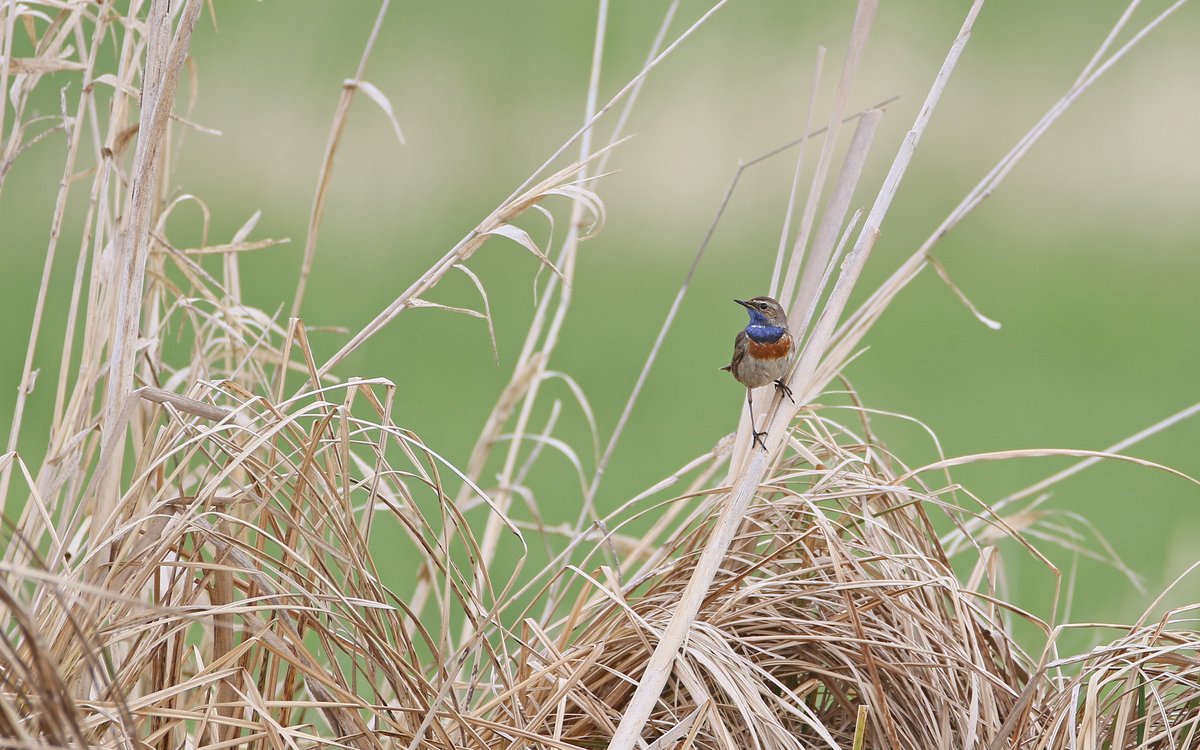
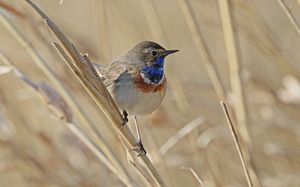
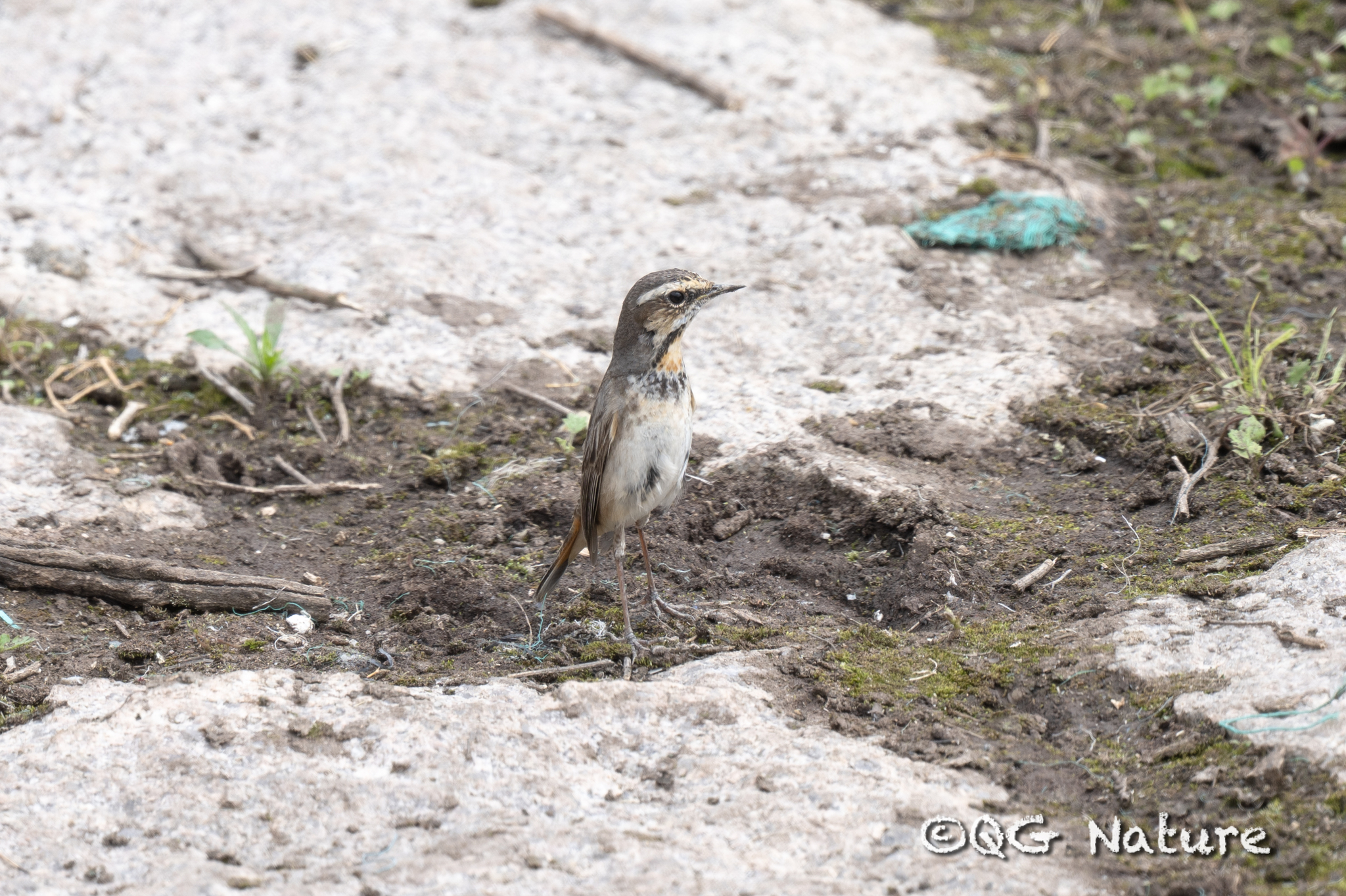
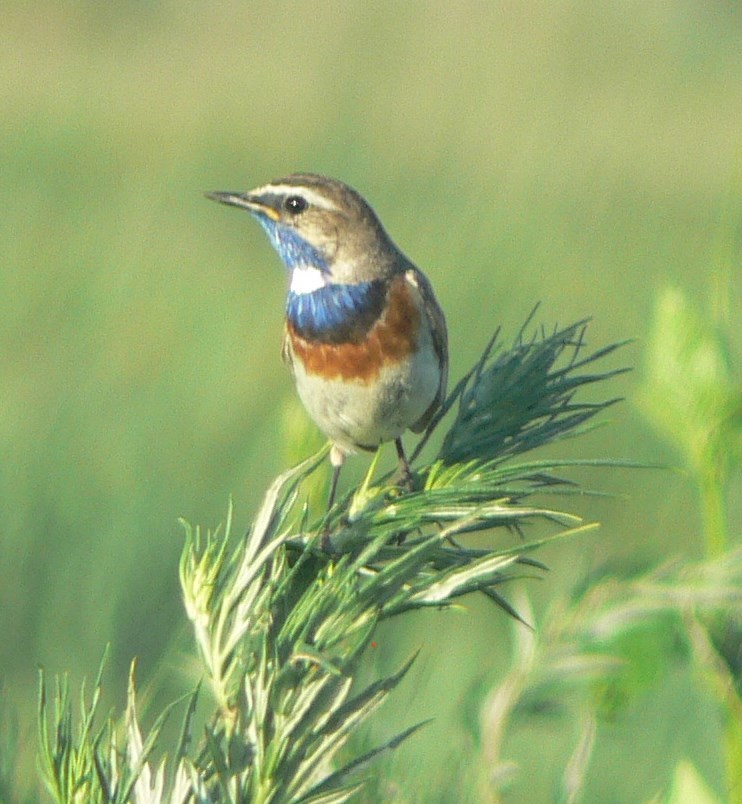
A compact, rob-sized bird measuring 13-14 cm with a plain brown upperbody and distinctive tail pattern. The tail shows brown feathers with black outer corners and conspicuous red patches at the base. A prominent white supercilium marks the face. Males boast an extraordinary throat: vivid glossy blue, typically bordered below by a narrow black band and a broad brick-red band. Most subspecies display a central throat spot, either red or white. After the post-breeding moult in July (completed in 40-45 days), fresh feathers conceal the throat pattern with pale tips that gradually wear away by spring. Females appear much plainer, showing mainly a blackish crescent and limited blue on cream underparts, though older females may develop more male-like coloration. Juveniles are heavily spotted and freckled dark brown above and below.
Identification
The combination of size (comparable to European robin), prominent white supercilium, and distinctive tail pattern (red basal patches with black corners) helps distinguish this species. Males in breeding plumage are unmistakable due to the blue-black-red throat pattern. Females can be identified by their brown upperparts, white eye-stripe, and cream underparts with a dark crescent on the throat. The tail pattern is often visible in flight or when the bird flicks its tail. From similar chats and flycatchers, this species differs in its tail coloration and the male's throat pattern. Subspecies identification is extremely difficult in the field and often impossible, requiring detailed study of plumage patterns and measurements.
Distribution & Habitat
Breeds across Europe and the Palearctic from Scandinavia east to western Alaska, with isolated populations in the northern Carpathian Mountains. Inhabits wet birch woodland, bushy swamps, and subarctic shrub tundra, with some subspecies preferring lowland reedbeds while others occupy mountain habitats. The species is migratory, with birds leaving breeding grounds after completing their moult. Wintering grounds include the Iberian Peninsula, northern Africa, and southern Asia (India, Pakistan, Middle East), with different subspecies showing distinct migration routes and wintering areas.
Behavior & Ecology
Primarily insectivorous, foraging in dense vegetation near ground level. The breeding season sees males establish territories in suitable wetland habitat, where they construct nests in tussocks or low dense bushes. Males deliver a varied and highly imitative song, incorporating sounds from their environment to create complex phrases. The typical call is a sharp 'chack' typical of chat species. After breeding, adults undergo a complete moult before migration. The species is largely solitary outside of the breeding season.
Conservation
The species is currently listed as Least Concern by the IUCN, indicating it is not considered globally threatened. However, population trends and local threats would require consultation of current conservation assessments. Like many wetland-dependent species, it may face pressures from habitat degradation and loss across its extensive range.
Culture
The species holds no significant cultural entries in the provided article. As an uncommon and sought-after bird for many birdwatchers, it may have informal appreciation within ornithological and birdwatching communities, but no specific folklore or cultural significance is documented.
Source: Wikipedia · CC BY-SA 3.0
Taxonomy
- Order
- Passeriformes
- Family
- Muscicapidae
- Genus
- Luscinia
- eBird Code
- blueth
Subspecies (11)
-
Luscinia svecica abbotti
breeds western Pakistan and northwestern India; winters to northern India
-
Luscinia svecica azuricollis
breeds northern Spain; probably winters sub-Saharan western Africa
-
Luscinia svecica cyanecula
breeds central Europe and Spain; winters to North Africa
-
Luscinia svecica kobdensis
breeds western China (Xinjiang); winters to southern and southeastern Asia
-
Luscinia svecica magna
breeds eastern Türkiye, the Caucasus, and northern Iran; winters to northeastern Africa
-
Luscinia svecica namnetum
breeds southwestern and central France; winters to northwestern Africa
-
Luscinia svecica pallidogularis
breeds southwestern Siberia to Turkmenistan, Altai Mountains, and upper Yenisey; winters to southern Asia
-
Luscinia svecica przevalskii
breeds central China (central and eastern Qinghai to Nan Shan and eastward to Ala Shan and Ordos Plateau); winters eastern China
-
Luscinia svecica saturatior
breeds Pamir Mountains and Tien Shan Mountains; winters to southern Asia
-
Luscinia svecica svecica
breeds Scandinavia across Siberia to western Alaska; winters to northern Africa and southern Asia
-
Luscinia svecica volgae
breeds northeastern Ukraine and central and eastern European Russia; winters to northeastern Africa and southwestern Asia
Data Sources
Species description from Wikipedia, licensed under CC BY-SA 3.0.
Bird images and sounds sourced from GBIF, contributed by citizen scientists worldwide under Creative Commons licenses.
Taxonomy data from AviList 2025.