Piciformes / Picidae / Jynx
Eurasian Wryneck
Jynx torquilla · 蚁鴷
Introduction
A species of wryneck in the woodpecker family, breeding mainly in temperate regions of Europe and Asia. Most populations are migratory, wintering in tropical Africa and southern Asia, while some are resident in northwestern Africa. It inhabits open countryside, woodland, and orchards. The species is listed as Least Concern by the IUCN.
Description
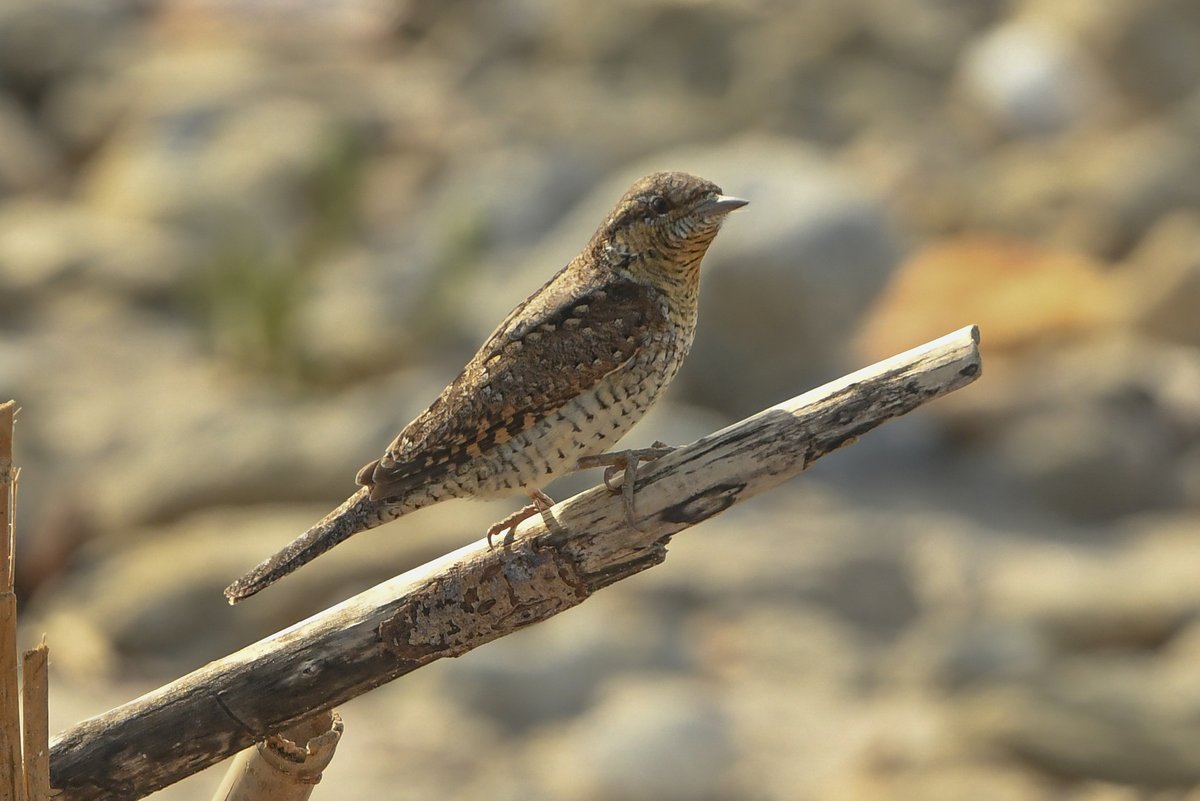
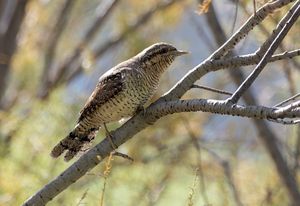
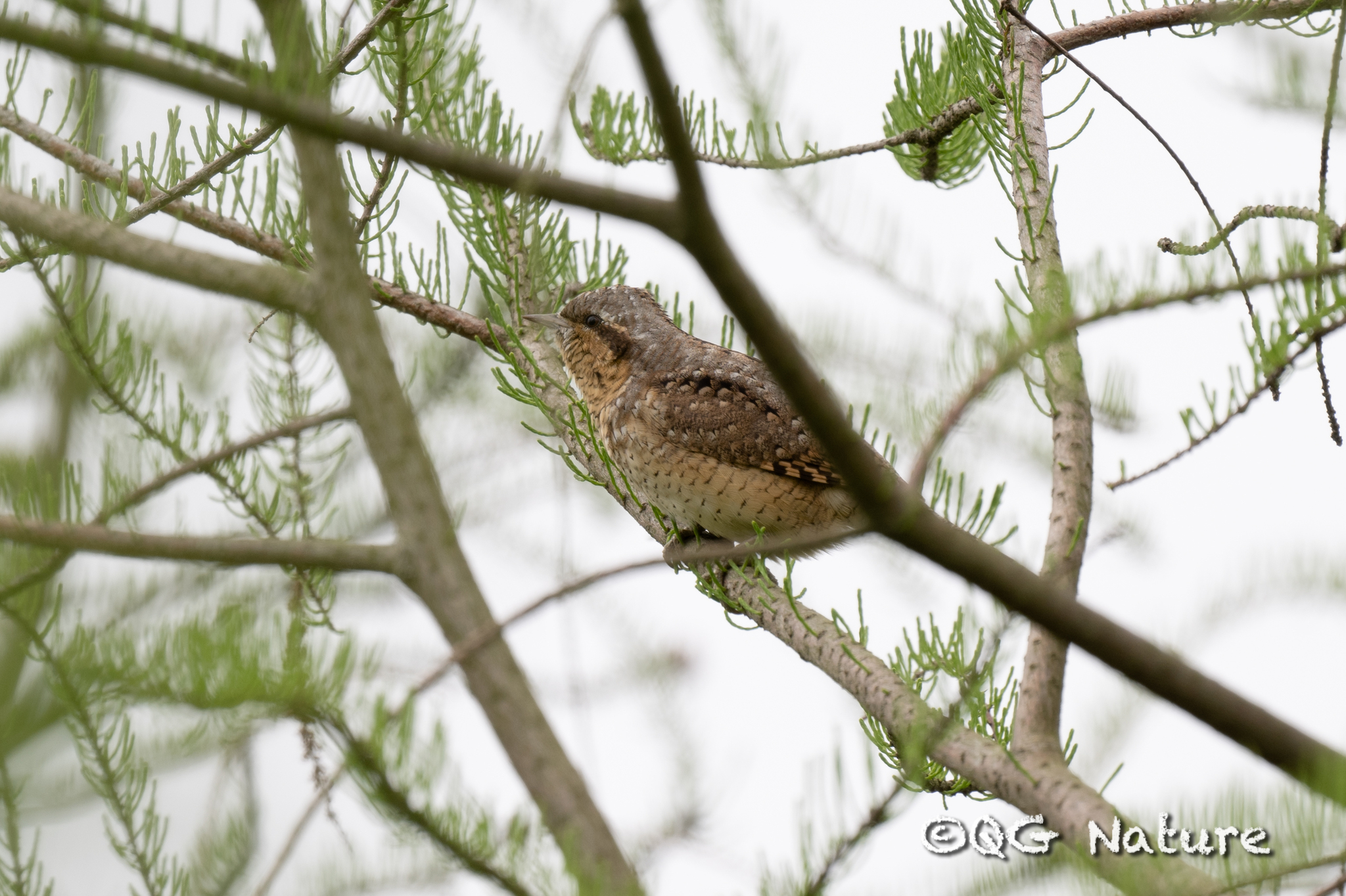
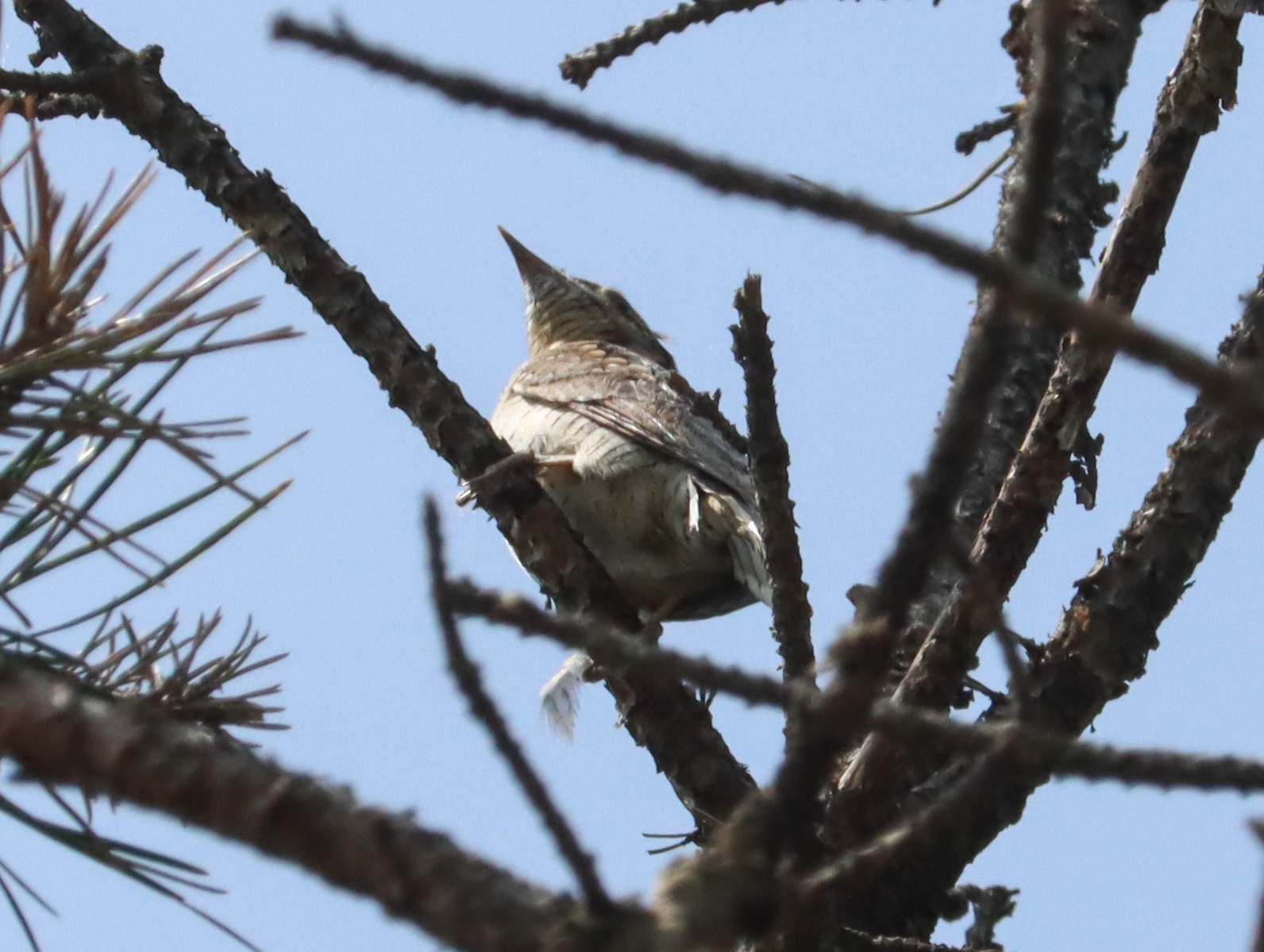
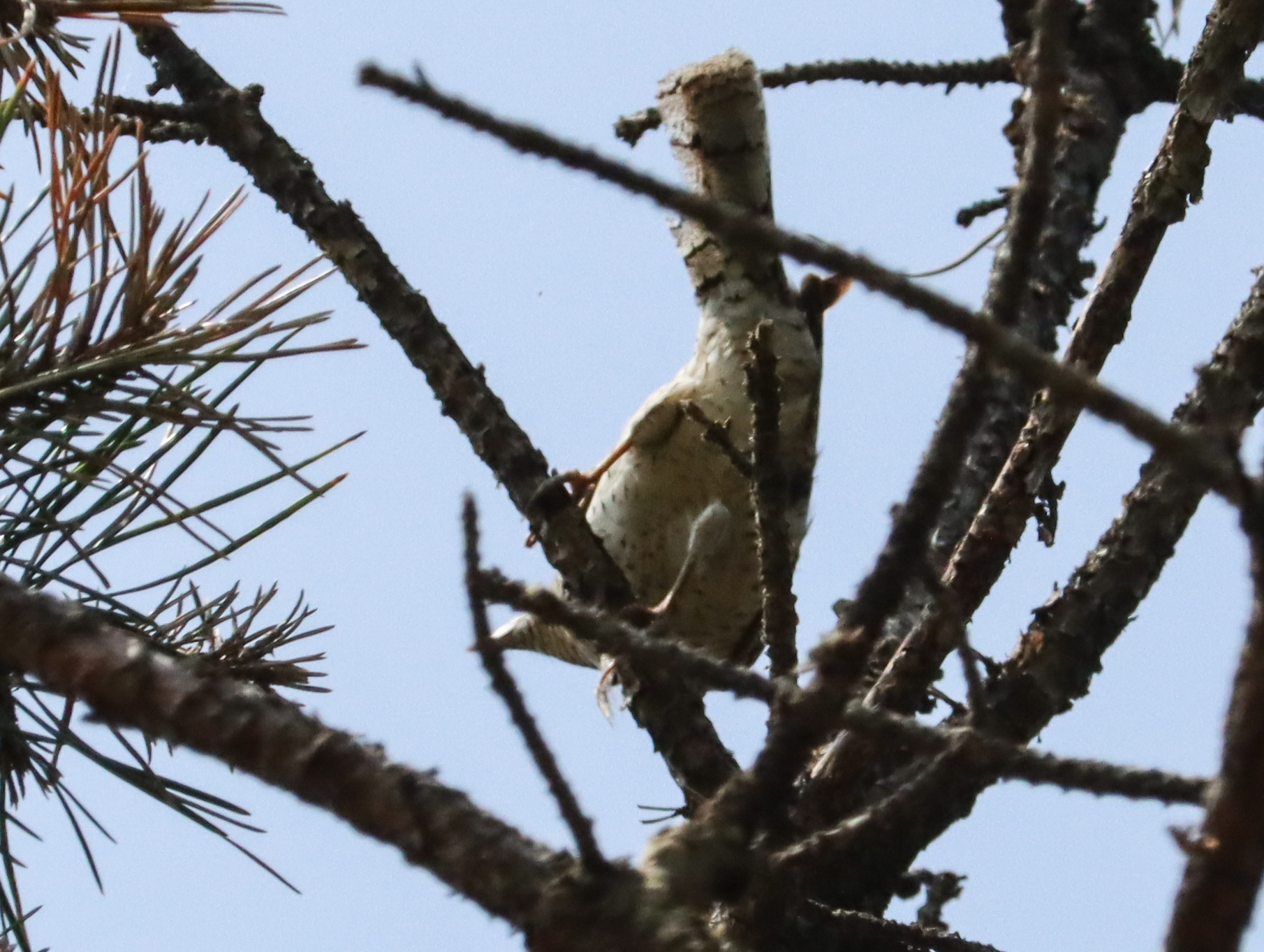
Measures 16–18 cm (6.3–7.1 in) in length. The nominate subspecies weighs 23 to 52 g (0.81 to 1.83 oz). It has a slim, elongated body shape resembling a thrush. Upperparts are barred and mottled in pale brown with rufous and blackish bars and wider black streaks. The rump and upper tail coverts are grey with speckles and irregular brown bands. The rounded tail is grey, speckled with brown, with faint greyish-brown bands and defined brownish-black bands. Cheeks and throat are buff barred with brown. Underparts are creamy white with brown arrow-head shaped markings, reducing to spots on the lower breast and belly. Flanks are buff with similar markings. The beak is brown, long, slender, with a broad base and sharp tip. Irises are hazel; legs and feet are pale brown.
Identification
Key field marks include the ability to twist the head through almost 180 degrees and a snake-like threat display with hissing when disturbed. The call is a series of repeated harsh, shrill notes 'quee-quee-quee-quee' lasting several seconds, reminiscent of a lesser spotted woodpecker or hobby. The alarm call is a short series of staccato 'tuck's. Flight is slow and undulating.
Distribution & Habitat
Breeds across the Palearctic, including most of Europe to the Urals, central and western Siberia, eastern Siberia to Sakhalin and Hokkaido, northern China, Mongolia, and the northwestern Himalayas. Six subspecies are recognized: J. t. torquilla (most of Europe), J. t. sarudnyi (central/western Siberia), J. t. chinensis (eastern Siberia/China), J. t. himalayana (northwestern Himalaya), J. t. tschusii (Italy, Sardinia, Corsica, Adriatic coast), and J. t. mauretanica (northwestern Africa, resident). European populations winter south of the Sahara in a wide strip from Senegal to Ethiopia. Asian populations winter in the Indian subcontinent and southern East Asia. Habitat includes open countryside, parkland, gardens, orchards, heaths, hedgerows, deciduous woodland, and coniferous forests in Scandinavia and Russia.
Behavior & Ecology
Diet consists chiefly of ants, also beetles, larvae, moths, spiders, and woodlice. Forages mostly on the ground with short hops, tail raised, or clings to tree trunks using its tail as a prop. Does not excavate wood but uses a rapid tongue extension to pick up prey. Breeding occurs in May and June. Nests in pre-existing holes in trees, wall crevices, banks, sand martin burrows, or nesting boxes, using no nesting material. Clutch size is normally seven to ten eggs (occasionally 5–12). Eggs are dull white, averaging 20.8 by 15.4 mm. Incubation lasts twelve days, shared by both sexes with the female doing more. Chicks fledge after about twenty days. Displays include head bobbing, slumping, and violent twisting.
Conservation
Listed as Least Concern by the IUCN with an estimated world population of up to fifteen million individuals. Populations are decreasing in the United Kingdom and Switzerland but increasing in Romania. Threats include modern farming practices such as hedge removal and pesticide use. Conservation measures like adding nestboxes in suitable habitats have shown positive results in Switzerland. Protected under Schedule 1 of the Wildlife and Countryside Act 1981 in the UK and Appendix II of the Bern Convention.
Culture
The English name refers to the bird's ability to twist its head. Historically, it was used as a charm to bring back an errant lover by tying the bird to a string and whirling it around.
Source: Wikipedia · CC BY-SA 3.0
Taxonomy
- Order
- Piciformes
- Family
- Picidae
- Genus
- Jynx
Subspecies (6)
-
Jynx torquilla chinensis
breeds eastern Siberia (east of the Yenisei River) eastward to Sakhalin and northern Japan (Hokkaido), southward to northern Mongolia and northeastern China; winters Nepal and northeastern India to southeastern China, Indochina, and southern Japan
Data Sources
Species description from Wikipedia, licensed under CC BY-SA 3.0.
Bird images and sounds sourced from GBIF, contributed by citizen scientists worldwide under Creative Commons licenses.
Taxonomy data from AviList 2025.