
Ibisbill
Ibidorhyncha struthersii
鹮嘴鹬
Introduction
Monotypic wading bird in family Ibidorhynchidae, order Charadriiformes. Inhabits shingle riverbanks and stony riverbeds of high plateaux across central Asia and the Himalayas, from Lake Issyk-Kul to the southern border of Manchuria, including the Altai Mountains and Tien Shan highlands. Distinguished by its crimson long down-curved bill reminiscent of an ibis, combined with grey plumage, white belly, black face, and black breast band. Breeds at elevations of 1,700–4,400 meters, descending to lower elevations outside the breeding season. Classified as Least Concern by the IUCN due to its large range (approximately 5 million square kilometers) and stable population, despite the exact number of individuals being unknown.
Description
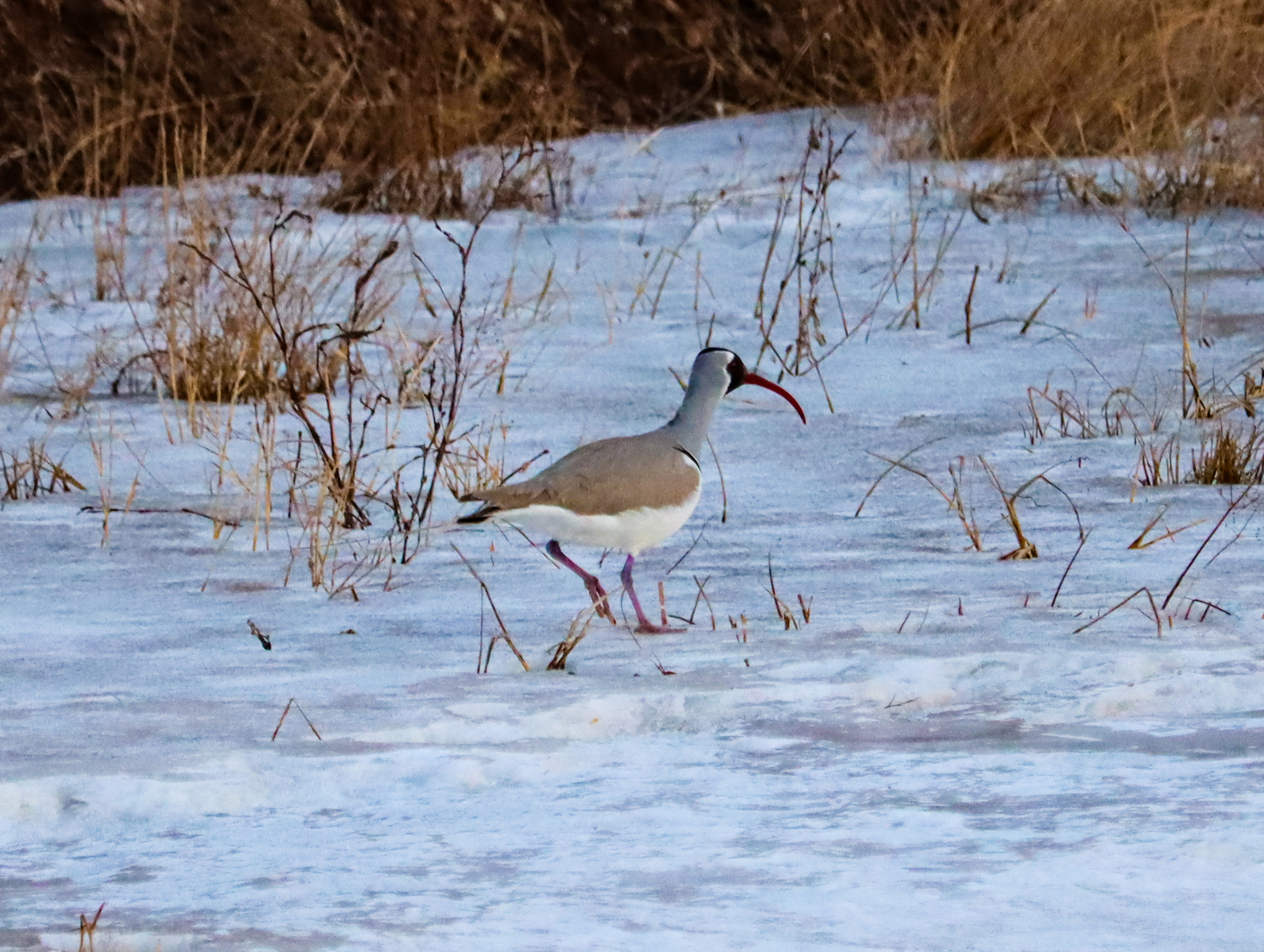
A medium-sized wader measuring 38–41 cm in length with a mass of 270–320 g. The plumage is predominantly grey with a white belly. The most distinctive feature is the long, down-curved crimson bill measuring 6.8–8.2 cm, slightly longer in females. The face and breast are black, forming a complete breast band. Sexes are similar in appearance. Juveniles lack the black facial and breast markings and have a duller bill. Legs are greyish purple in breeding adults, dull sepia in juveniles, and greenish in non-breeding adults. The species has three toes, lacking a hind toe, with webbing between the outer and middle toes.
Identification
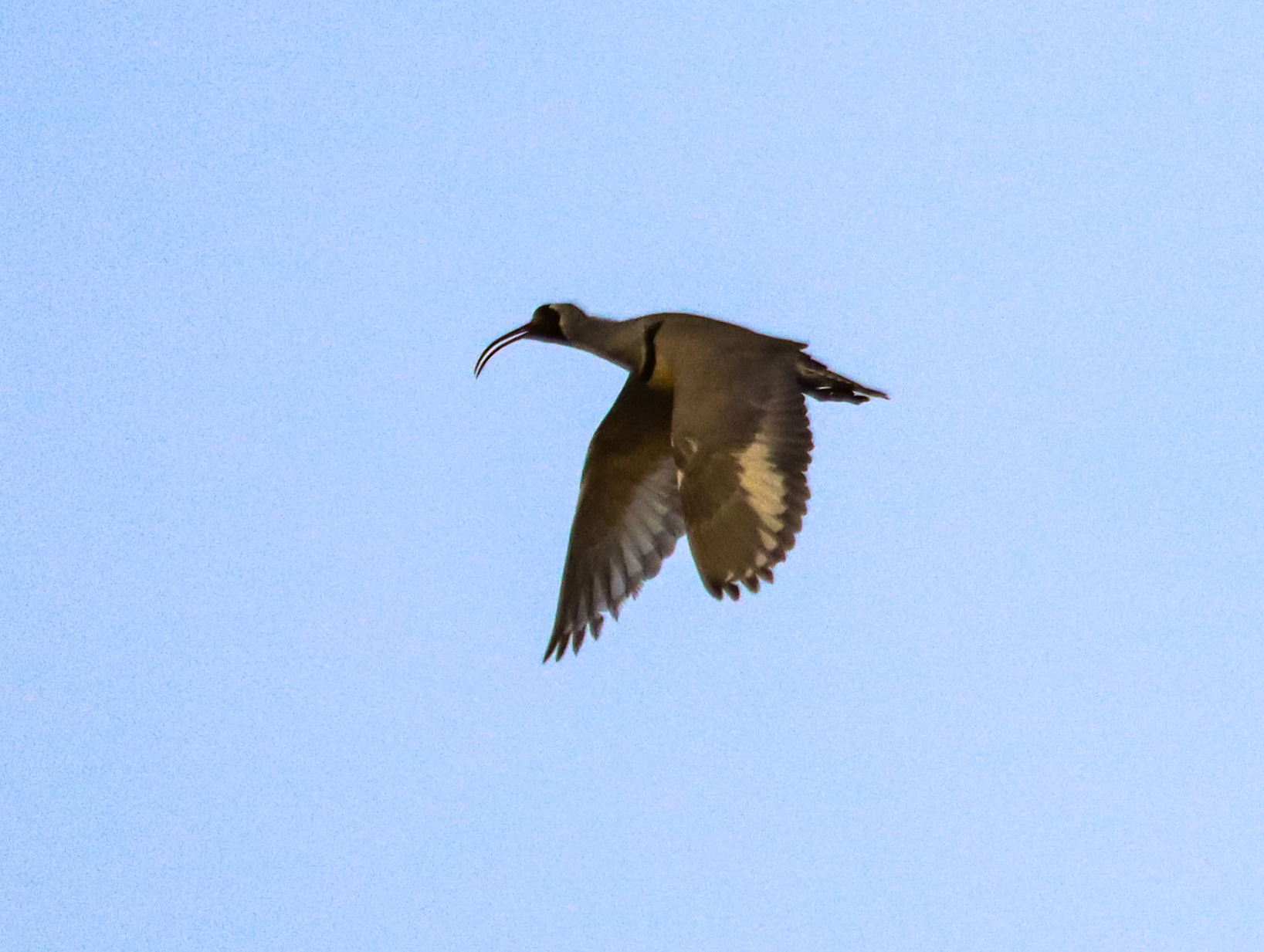
Unmistakable within its range due to the unique combination of grey plumage, white belly, black face, black breast band, and long down-curved crimson bill. The red legs and overall ibis-like profile in flight are distinctive field marks. Juveniles can be distinguished by the absence of black markings on the face and breast. No similar species occurs within its high-altitude river habitat, making identification straightforward when the bird is observed.
Distribution & Habitat
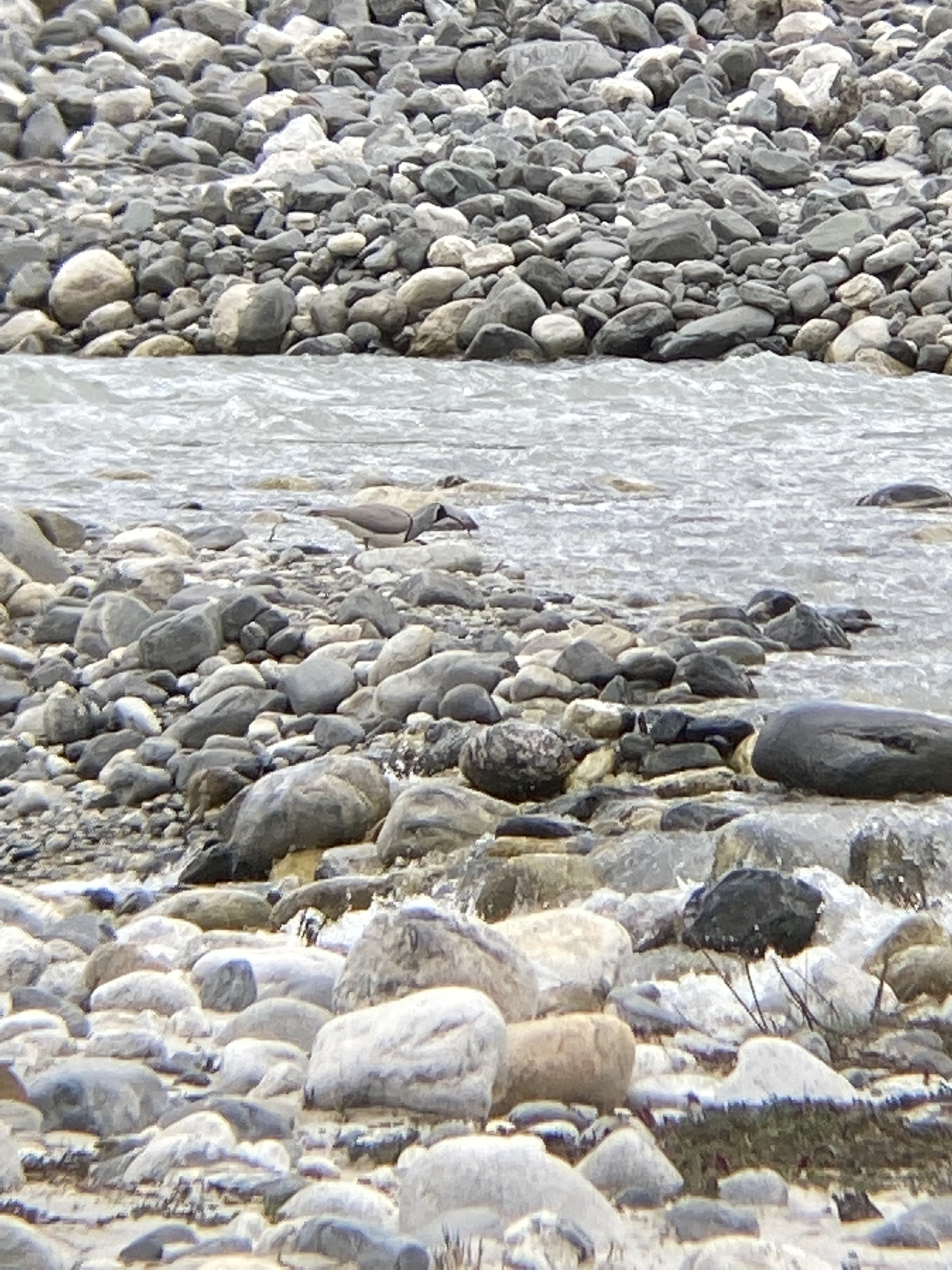
Occurs across central Asia and the Himalayas, from Lake Issyk-Kul and the Altai Mountains in Russia to the southern border of Manchuria. Inhabits the highlands of the Central and Northern Tien Shan and river valleys in Kazakhstan. Breeding habitat consists of stony riverbeds at elevations of 1,700–4,400 meters, occasionally as low as 500 meters. Outside the breeding season, individuals descend to elevations as low as 100 meters. Occupies shingle-bed river valleys with slow-flowing water, gentle slopes, and minimal vegetation, typically between 100–1,500 meters elevation.
Behavior & Ecology
Solitary outside the breeding season, though found in pairs or small flocks of up to eight birds; one group of 25 has been recorded. Monogamous and territorial during breeding. Not shy of humans. An excellent swimmer that prefers crossing rivers by swimming rather than flying. Becomes more active and vocal as the breeding season approaches. Feeds by probing under rocks and gravel in stream beds, consuming caddisfly and mayfly larvae, grasshoppers, and small fish. When preening the head, scratches from over the wings in an indirect pattern, similar to plovers and lapwings. During courtship, runs short distances with head held low.
Conservation
Evaluated as Least Concern by the IUCN. The species has an extremely large range of approximately 5 million square kilometers. Despite the population size being unknown, there is no evidence of population decline or habitat fragmentation. However, the species' dependence on specific riverine habitats with slow-flowing water makes it potentially vulnerable to water development and degradation of river systems within its range.
Culture
The species name honors Dr. Struthers, who collected specimens from the Himalayas. Originally described in 1831 by Vigors based on a painting by John Gould, though Brian Hodgson had prepared a manuscript describing the species two years earlier, published in 1835. Hodgson later suggested the genus name Clorhynchus, arguing that Gould's Ibidorhyncha was inaccurate, but this was not adopted.
Source: Wikipedia · CC BY-SA 3.0
Taxonomy
- Order
- Charadriiformes
- Family
- Ibidorhynchidae
- Genus
- Ibidorhyncha
- eBird Code
- ibisbi1
Distribution
montane rivers of western Tajikistan, southeastern Kazakhstan, northwestern Xinjiang and northeastern Afghanistan eastward through Himalayas and Tibetan Plateau to Hebei (northeastern China)
Data Sources
Species description from Wikipedia, licensed under CC BY-SA 3.0.
Bird images and sounds sourced from GBIF, contributed by citizen scientists worldwide under Creative Commons licenses.
Taxonomy data from AviList 2025.