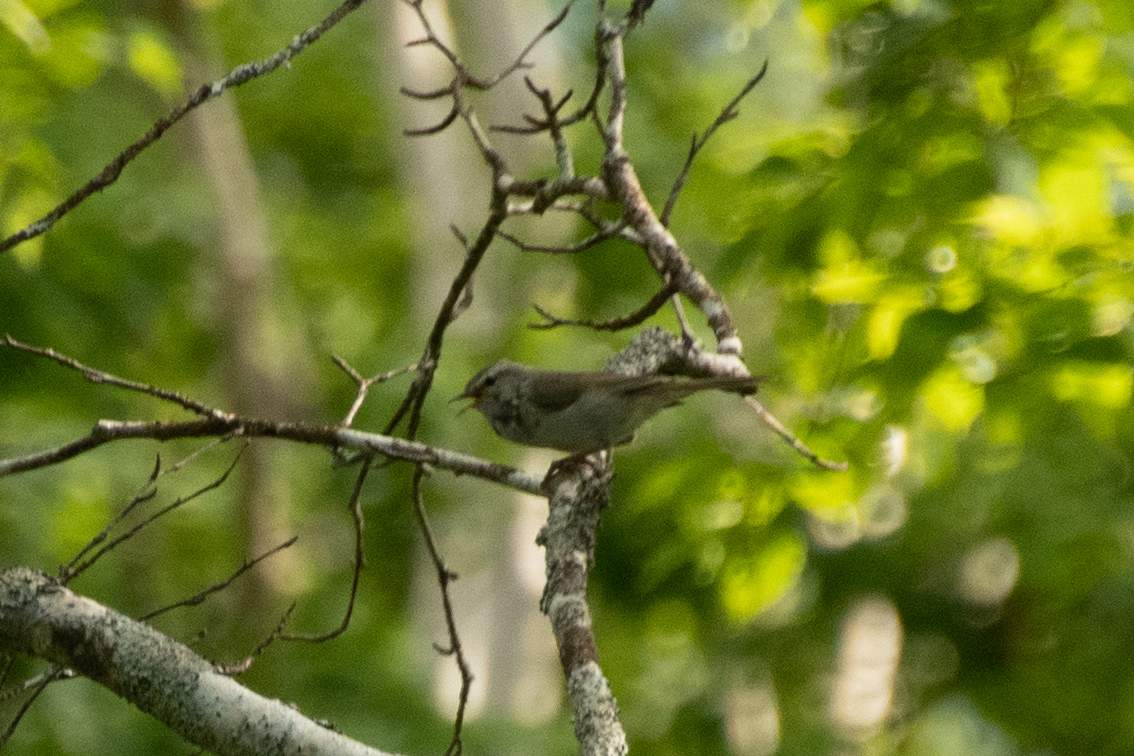
Japanese Bush Warbler
Horornis diphone
短翅树莺
Introduction
The species occurs across Japan, the Philippines, Korea, China, and surrounding regions. Introduced populations established in the Hawaiian Islands in the early 20th century. Habitat ranges from lowland thickets to mountainous bamboo forests. The male produces a loud, distinctive song during the breeding season. Distribution shifts seasonally across its range.
Description
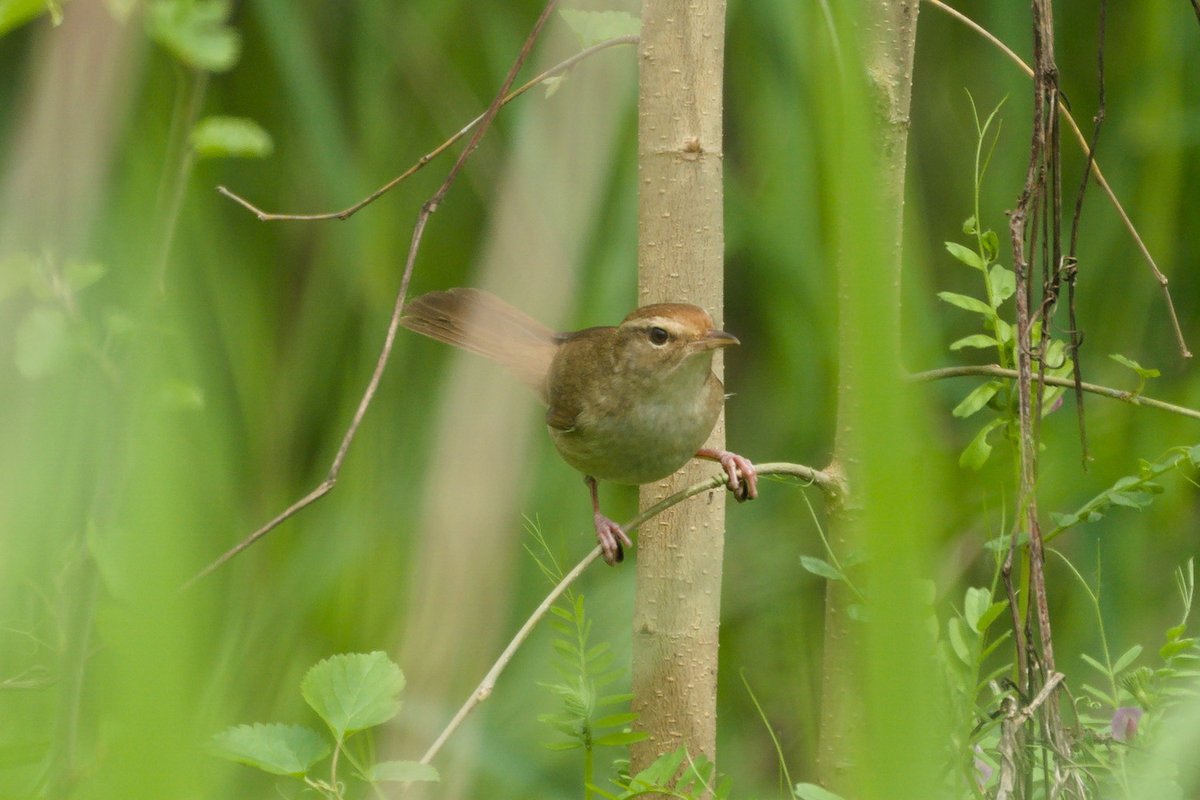
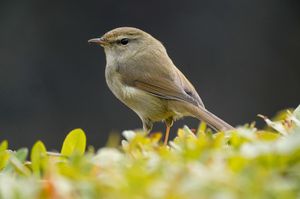
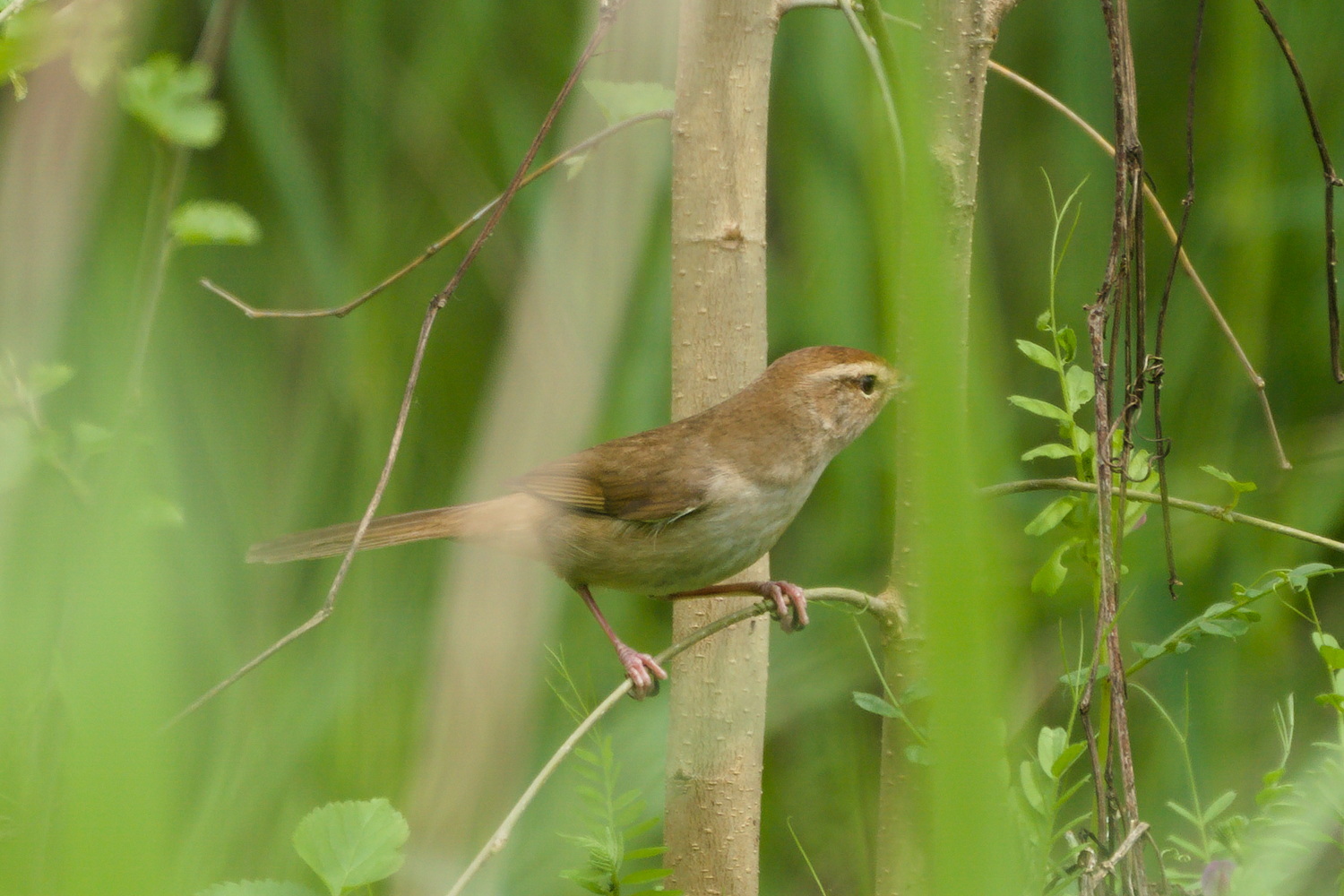
This small warbler measures 15.5 centimeters in length with predominantly olive-brown upperparts and duskier underparts. The most distinctive facial feature is a pale eyebrow stripe contrasting with the otherwise muted plumage. The beak exhibits a subtle upward curve that creates the impression of a permanent smile. Overall coloration provides excellent camouflage within its preferred dense thicket habitat, making visual identification challenging without clear, close-range views.
Identification
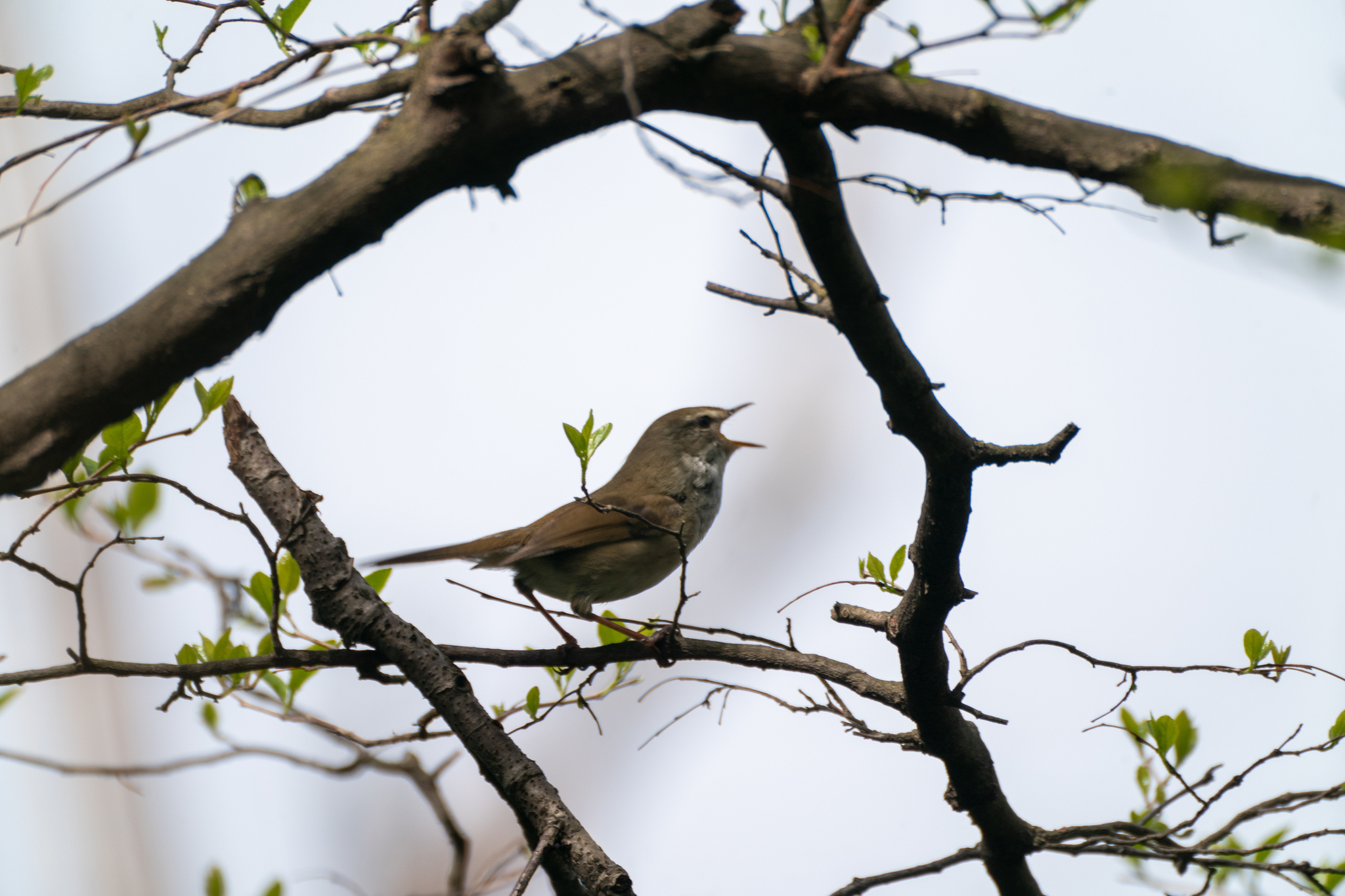
The pale eyebrow stripe and curved, smiling beak profile are the most reliable field marks. Within its range, it can be distinguished from other warblers by its combination of small size, olive-brown coloration, and preference for dense undergrowth. The song—described as 'hoohokekyo'—is often the primary detection method, as birds remain hidden in vegetation. Unlike the European nightingale, this species does not sing at night despite its former English name.
Distribution & Habitat
Year-round populations occur throughout Japan (excluding Hokkaidō) and the northern Philippines. Summer breeding range extends northward to Hokkaidō, Manchuria, Korea, and central China. Wintering populations expand to southern China and Taiwan. Introduced to Oahu between 1929 and 1941, the species has since colonized all main Hawaiian Islands. Summer habitat spans low hills to high mountains, favoring bamboo thickets and black pine forest understories. Birds descend to lower elevations during winter months.
Behavior & Ecology
Males sing prominently during breeding season to establish territories and attract mates. The characteristic song, rendered as 'hoohokekyo,' is delivered from concealed perches within dense vegetation. Young birds gradually learn the complex song by imitating nearby adults. Diet consists primarily of insects and small invertebrates gleaned from foliage and ground litter. The species maintains territories in dense understory vegetation where it forages methodically through leaf litter and low branches.
Conservation
The species maintains a large, stable population across its extensive range and is classified as Least Concern by the IUCN. Its adaptability to various habitat types and ability to exploit human-modified landscapes has contributed to its continued success. No significant population declines have been documented, though localized changes in habitat availability could affect specific populations.
Culture
In Japan, this bird's song heralds spring alongside returning barn swallows, holding a cherished place in cultural tradition. It appears frequently in classical poetry collections including the Man'yōshū and Kokin Wakashū, serving as a kigo (seasonal word) symbolizing early spring. The species associates with ume blossoms in poetry and imagery, appearing together on hanafuda playing cards. Its melodious voice inspired the English name 'Japanese Nightingale,' though it does not sing at night. Architectural 'nightingale floors' with squeaking boards were designed to mimic its call, supposedly alerting sleepers to approaching ninjas. The droppings contain enzymes traditionally used for skin whitening and kimono cleaning.
Source: Wikipedia · CC BY-SA 3.0
Taxonomy
- Order
- Passeriformes
- Family
- Cettiidae
- Genus
- Horornis
- eBird Code
- jabwar
Vocalizations
Subspecies (4)
-
Horornis diphone cantans
breeds main Japanese islands (Hokkaido south) and associated smaller islands southward to the northern Ryukyu Islands (Tanegashima, Yakushima, and Amami Ōshima, southern Japan) and northern Izu Islands (south to Aogashima), and in southern South Korea (including Jeju Island); northern populations migratory; introduced Hawaiian Islands
-
Horornis diphone diphone
Ogasawara (Bonin) and Iwo (Volcano) Islands
-
Horornis diphone restrictus
formerly Minami-daito-jima, where apparently now extirpated; populations in the southern Ryukyu Islands (from Okinawa and Kumejima southward to Ishigaki and Iriomote, southern Japan) possibly are restrictus, or may be a similar but undescribed population
-
Horornis diphone riukiuensis
breeds on southern Sakhalin Island and southernmost Kuril Islands; winters from central Honshu southward through Ryukyu Islands (southern Japan) and to Taiwan
Data Sources
Species description from Wikipedia, licensed under CC BY-SA 3.0.
Bird images and sounds sourced from GBIF, contributed by citizen scientists worldwide under Creative Commons licenses.
Taxonomy data from AviList 2025.