Red-headed Trogon
Harpactes erythrocephalus
红头咬鹃
Introduction
Species in the family Trogonidae, found from central Nepal through Southeast Asia to Sumatra. Inhabits dense broadleaved forests, tropical and subtropical zones in Himalayan foothills, and broadleaved evergreen forests at elevations from 300 to 2,600 meters. Uncommon to scarce throughout range, with habitat destruction causing rapid population declines in Nepal. Uniquely among trogons, males have a red head and breast. Often perches on shaded branches waiting for prey, alone or in pairs.
Description
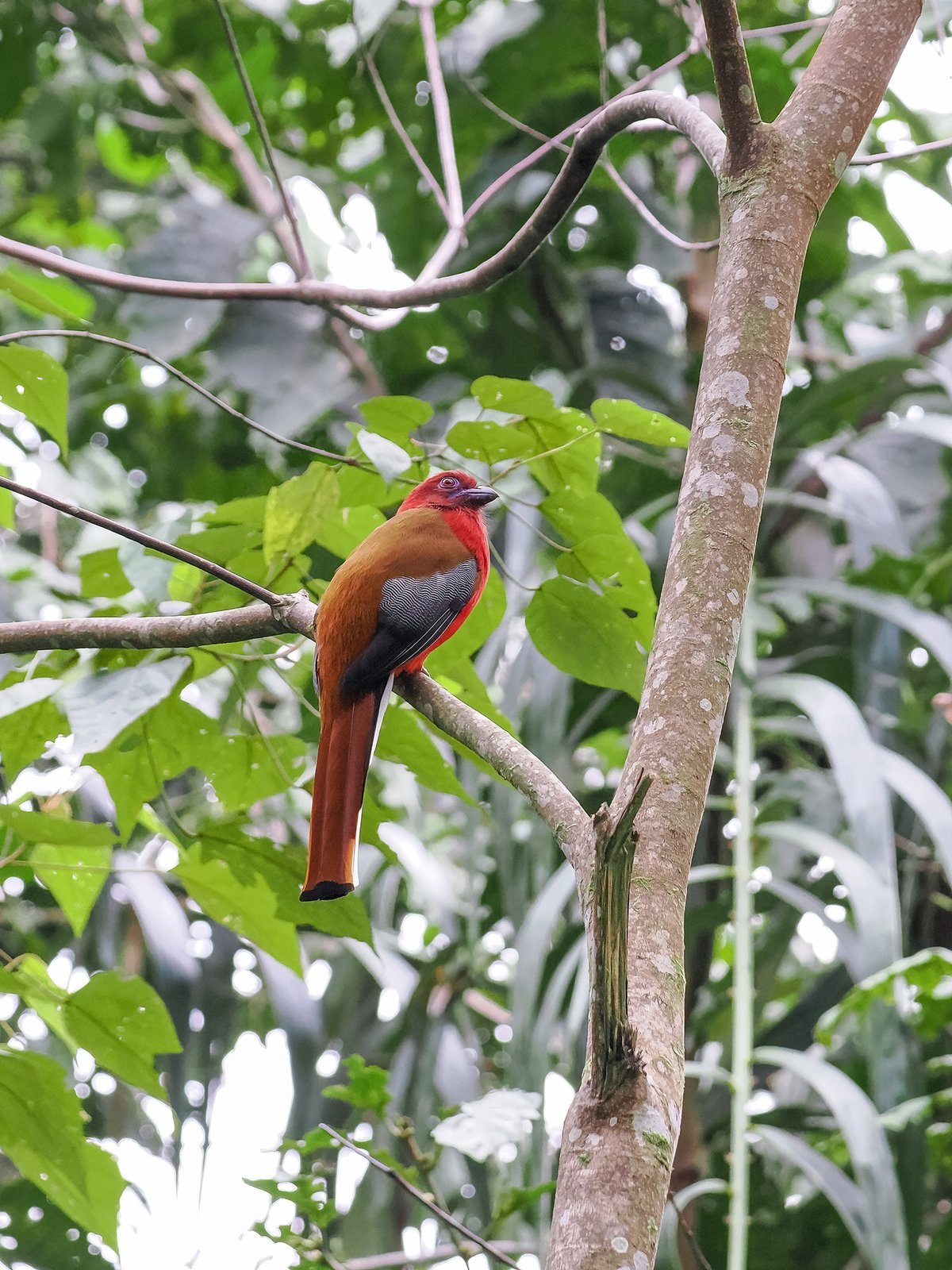
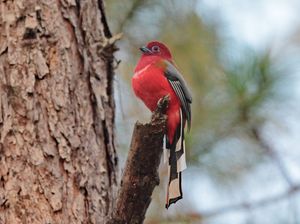
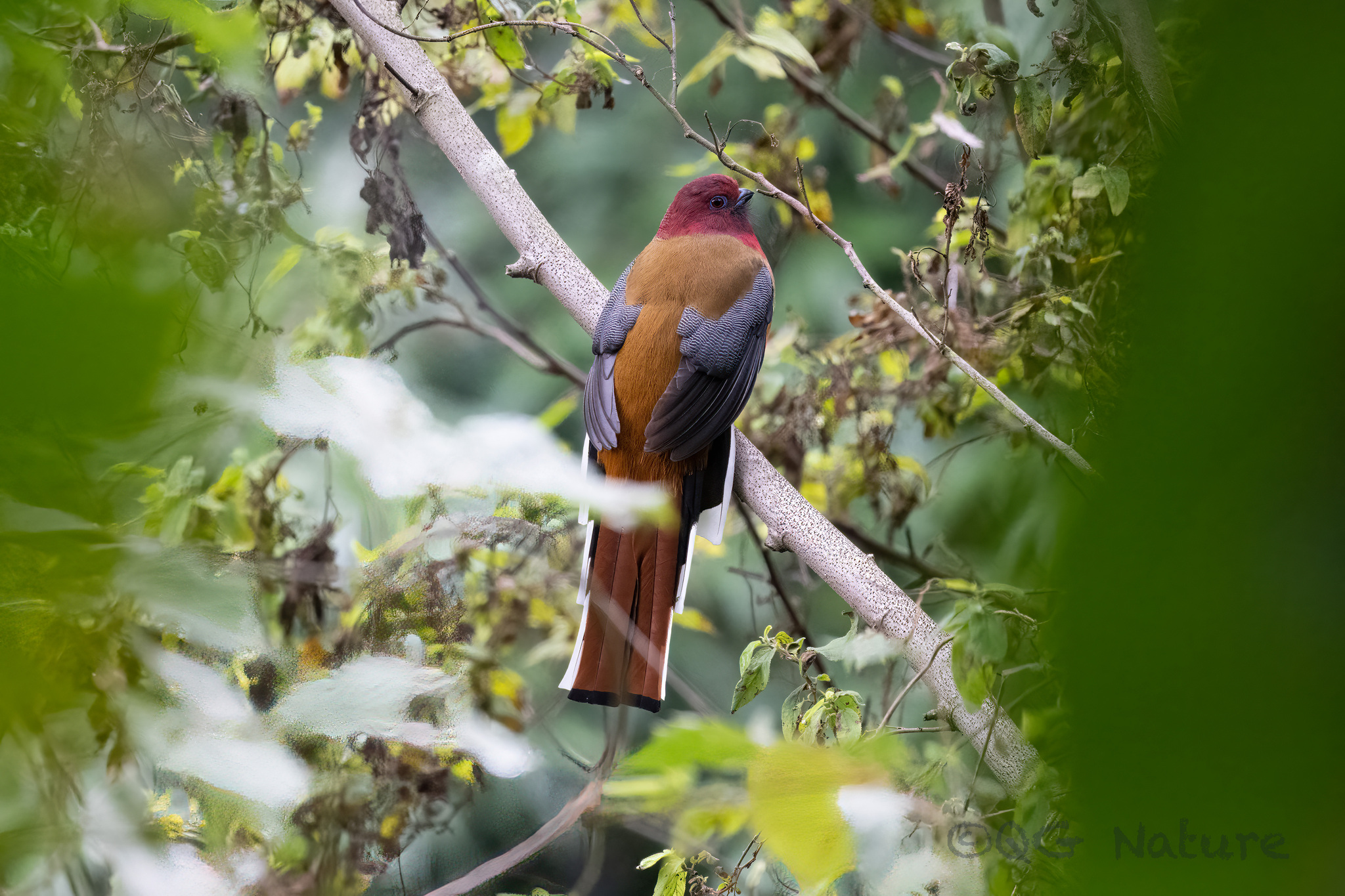
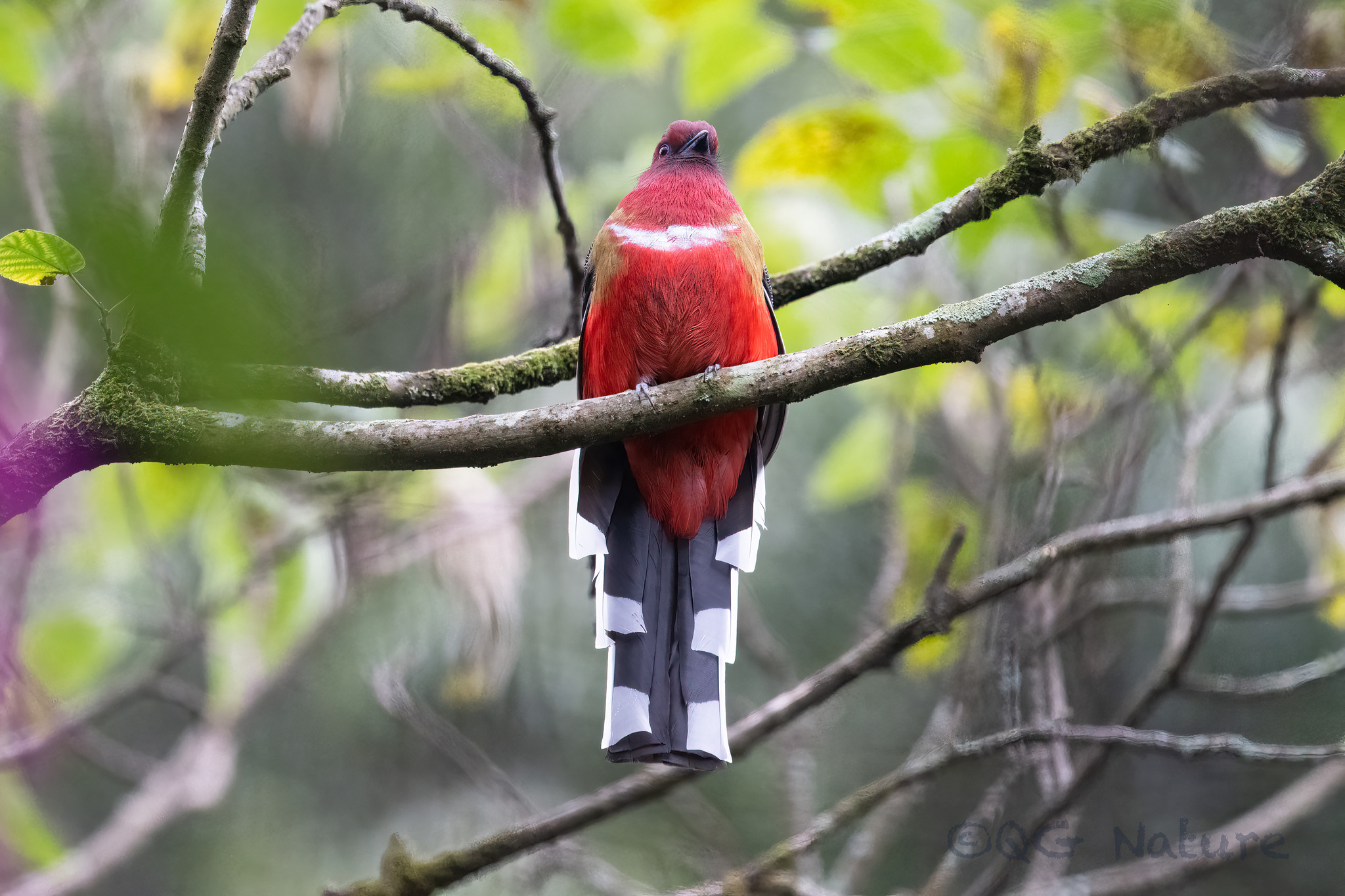
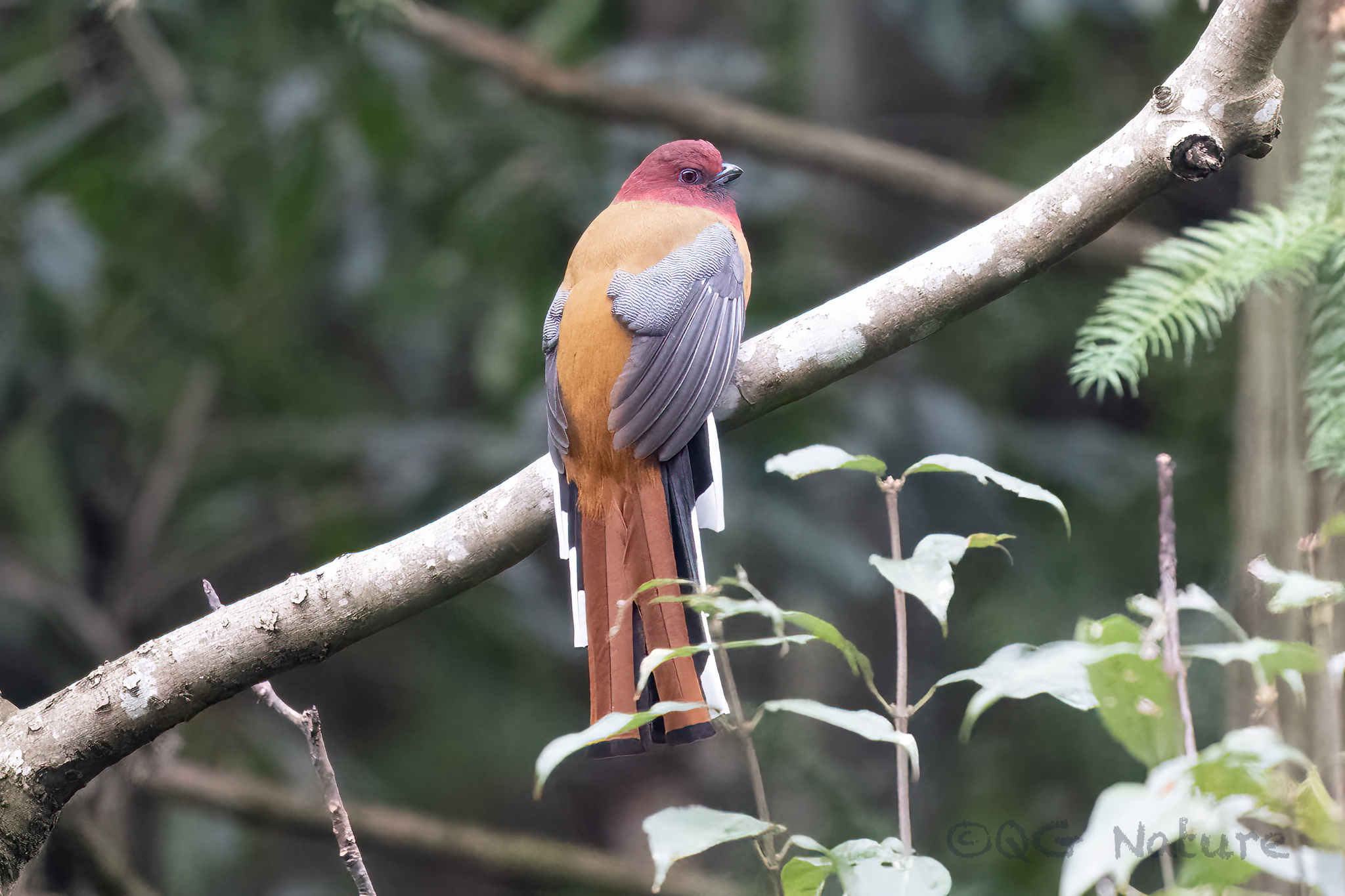
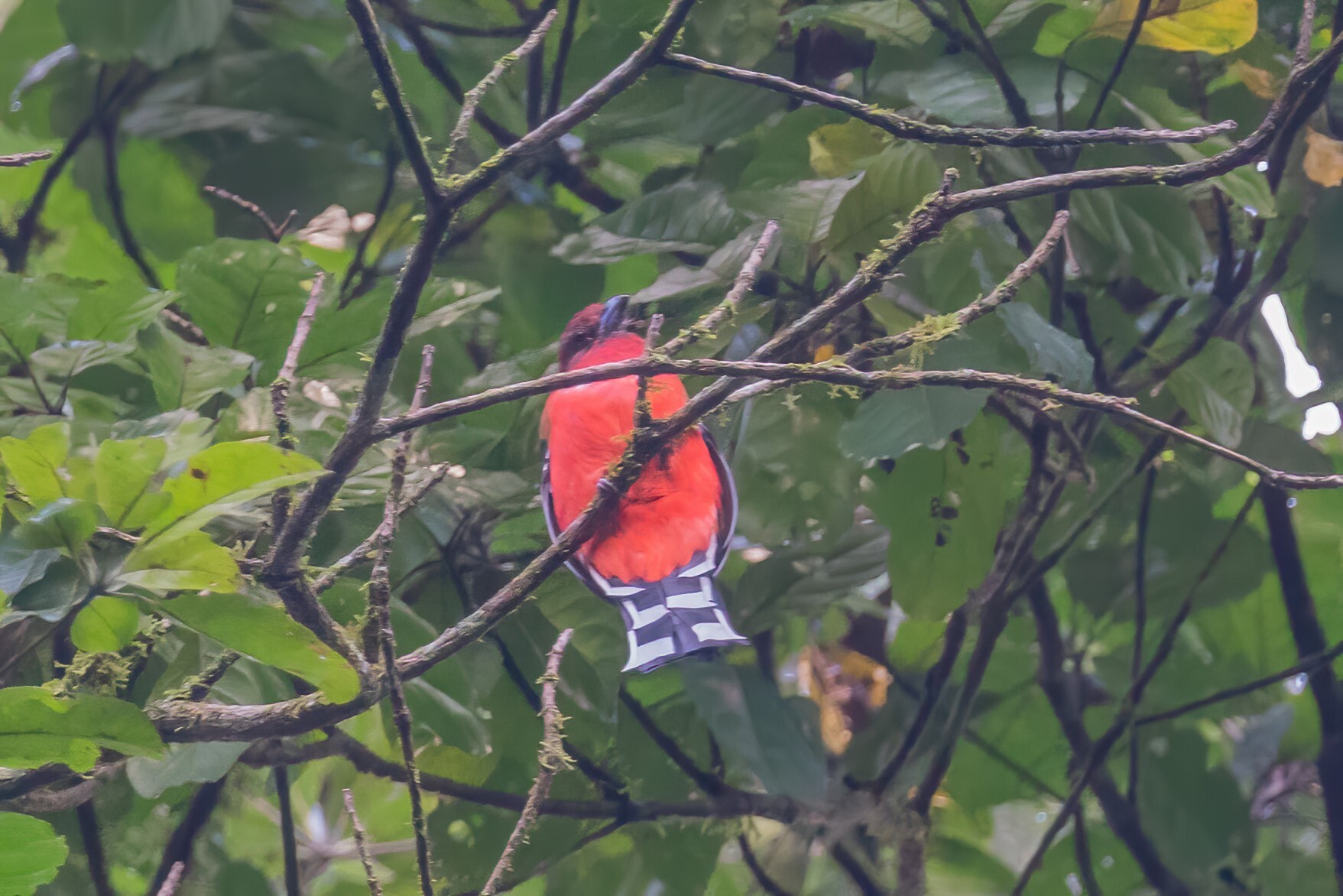
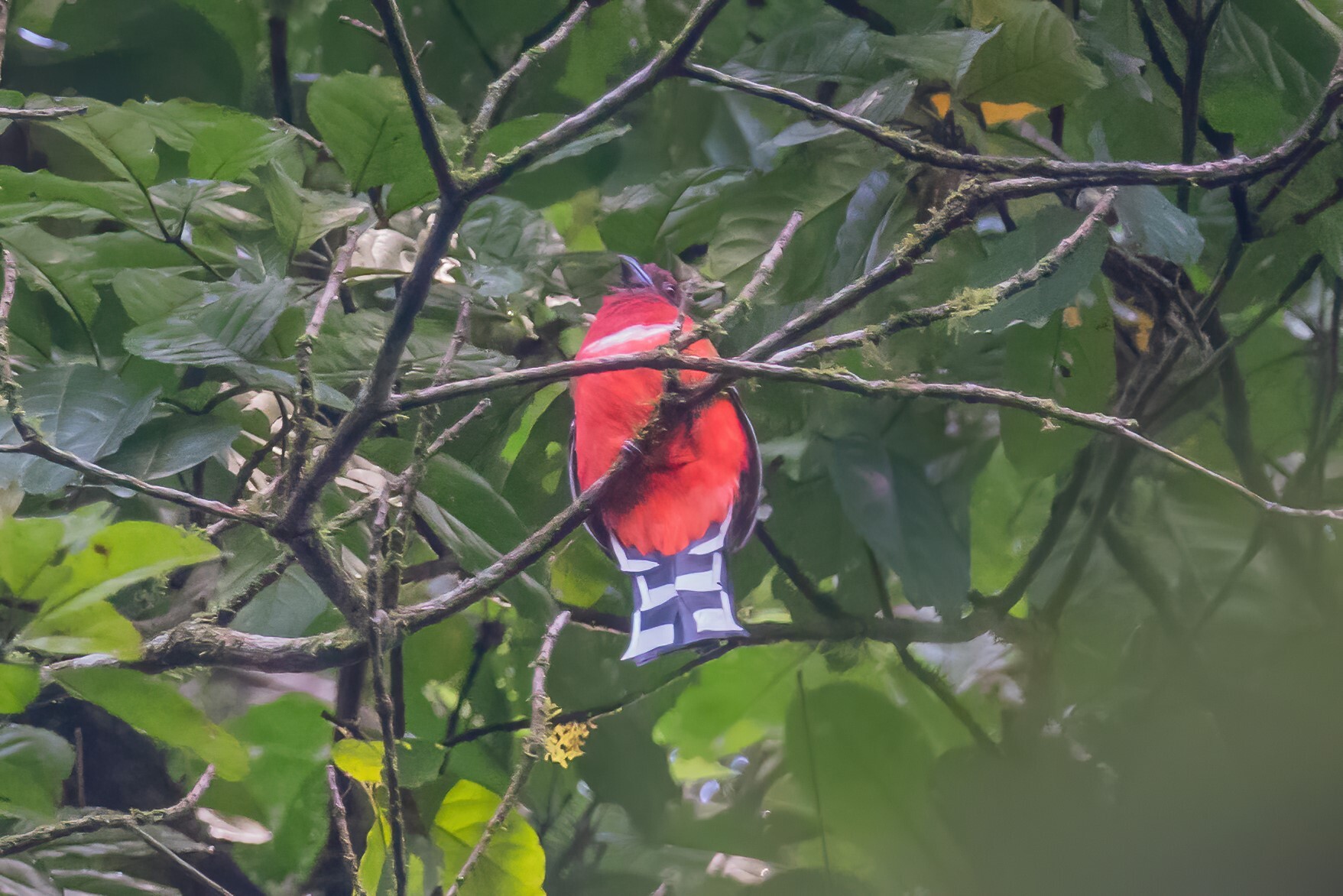
A medium-sized trogon averaging 34 cm in length. Adult males have a dull crimson head, neck, and upper breast with a narrow white breast band; the lower breast to abdomen is light red to pink, flanks pale red, and mantle and back rusty brown. Wings show vermiculated black and white patterning. The long tail has dark brown central feathers with black tips, black second and third pairs, and white outer feathers with black bases. The bill is black-tipped cobalt blue with a deep mauve-blue gape and eyering, and irises are reddish-brown. Adult females have olive-brown head, neck, and upper breast with the same white breast band and pink underparts. Wings are vermiculated dark brown and yellowish brown. Juveniles are buff brown above and buff white below without black tips on central tail feathers.
Identification
Males are unmistakable with their red head and breast, a unique feature among trogon species. Females resemble Diard's trogon but lack the speckled undertail characteristic of that species. The combination of red-headed male, vermiculated wing pattern, and specific tail markings distinguishes this species from similar trogons in its range.
Distribution & Habitat
Ranges from central Nepal through northeastern India, Bhutan, Bangladesh, Myanmar, Thailand, Laos, Vietnam, and the Malay Peninsula to Sumatra. Inhabits upland forests, dense broadleaved forests, and broadleaved evergreen forests from 300 to 2,600 meters elevation. In Myanmar, found in bamboo and oak forests at 2,500 meters; in Laos, in evergreen forests to 1,700 meters. Vietnam's forests appear to be a stronghold. Generally sedentary but observed to migrate between elevations in northern and southern Laos.
Behavior & Ecology
Feeds primarily on insects and larvae including orthopterans, stick-insects, cicadas, millipedes, flies, beetles, centipedes, woodlice, and moths, also consuming leaves and fruits. Perches on shaded branches waiting for prey, alone or in pairs. Flight is sluggish and low, just a few meters above ground. Active in early morning and at night when pursuing moths at forest clearing edges. Nests in natural tree cavities 1.5 to 5 meters high, sometimes using old woodpecker or barbet holes. Clutch size is 2 to 4 cream-colored eggs measuring approximately 26.5-27.5 mm × 23.5-24.0 mm. Both sexes excavate, incubate, brood, and feed chicks. Incubation period is 18 days; chicks fledge after 13.4 days. Male call is a sequence of 5-6 mellow 'tyaup' notes repeated every minute, or an extended 'pluu-du' note repeated every 3-6 seconds.
Conservation
No explicit IUCN assessment mentioned. Habitat destruction is causing rapid population declines in Nepal, where the species is uncommon to scarce. Vietnam appears to support stable populations in forest strongholds. Threats include deforestation and forest degradation throughout range.
Culture
No cultural information available.
Source: Wikipedia · CC BY-SA 3.0
Taxonomy
- Order
- Trogoniformes
- Family
- Trogonidae
- Genus
- Harpactes
- eBird Code
- rehtro1
Vocalizations
Subspecies (9)
-
Harpactes erythrocephalus annamensis
eastern Thailand, southern Laos, and Vietnam
-
Harpactes erythrocephalus chaseni
Malay Peninsula
-
Harpactes erythrocephalus erythrocephalus
central Himalayas and northeastern India to Myanmar and northwestern Thailand
-
Harpactes erythrocephalus flagrans
mountains of Sumatra
-
Harpactes erythrocephalus hainanus
Hainan (southern China)
-
Harpactes erythrocephalus helenae
southern China and northern Myanmar
-
Harpactes erythrocephalus intermedius
northern Laos, northern Vietnam, and southern China (Yunnan)
-
Harpactes erythrocephalus klossi
Banthat Mountains (western Cambodia and far southwestern Thailand)
-
Harpactes erythrocephalus yamakanensis
southeastern China (Sichuan, Fujian, and northern Guangdong)
Data Sources
Species description from Wikipedia, licensed under CC BY-SA 3.0.
Bird images and sounds sourced from GBIF, contributed by citizen scientists worldwide under Creative Commons licenses.
Taxonomy data from AviList 2025.