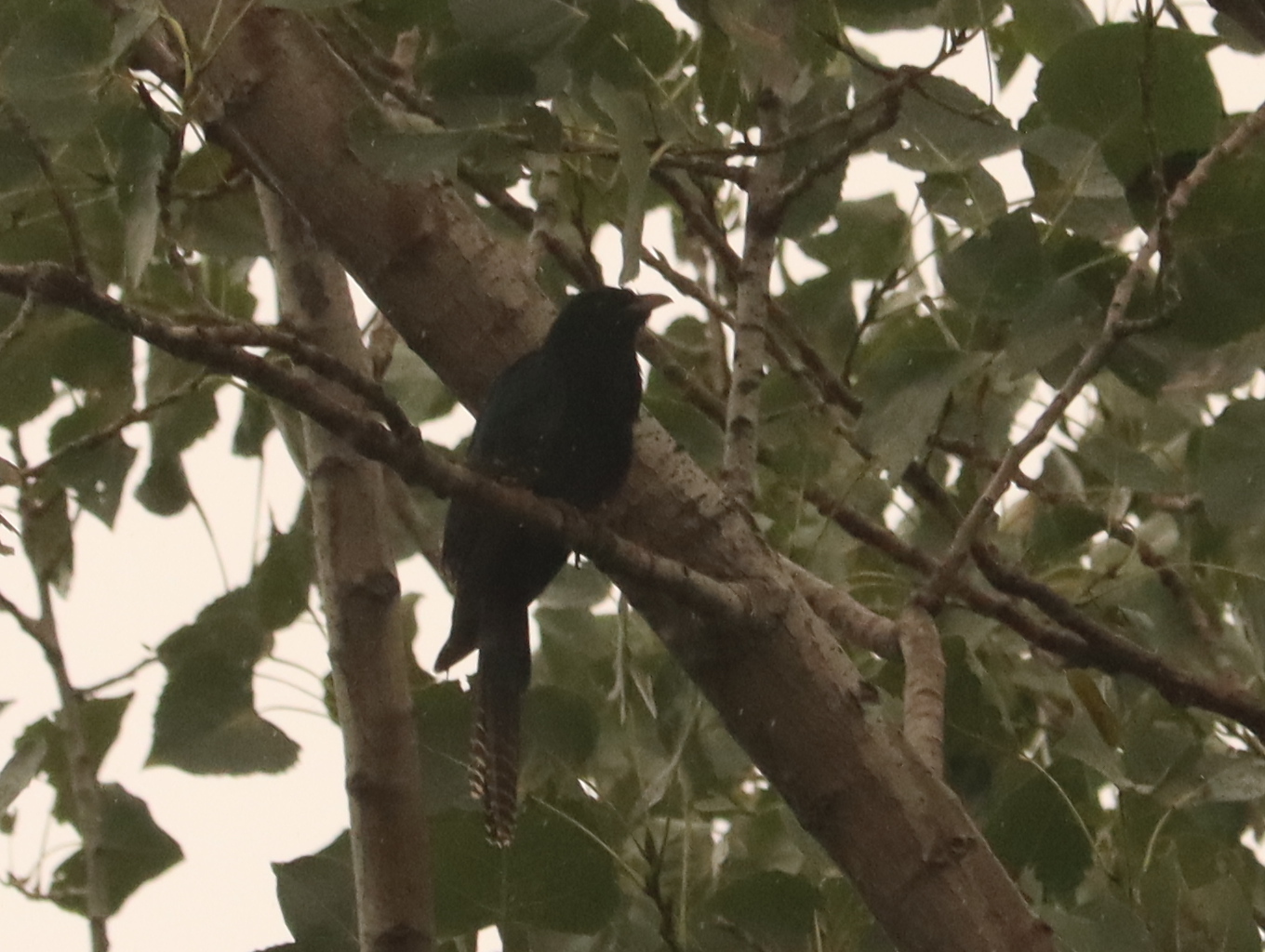
Asian Koel
Eudynamys scolopaceus
噪鹃
Introduction
This species occurs across tropical Asia. Adults feed primarily on fruit, serving as seed dispersers for trees including sandalwood. It is an obligate brood parasite, laying eggs in the nests of other bird species, primarily crows and mynas. Eggs hatch earlier than host chicks, though young typically do not evict nestmates. The male's call is a distinctive 'koo-Ooo' song, delivered during the breeding season. The species has colonized volcanic islands and urban environments.
Description
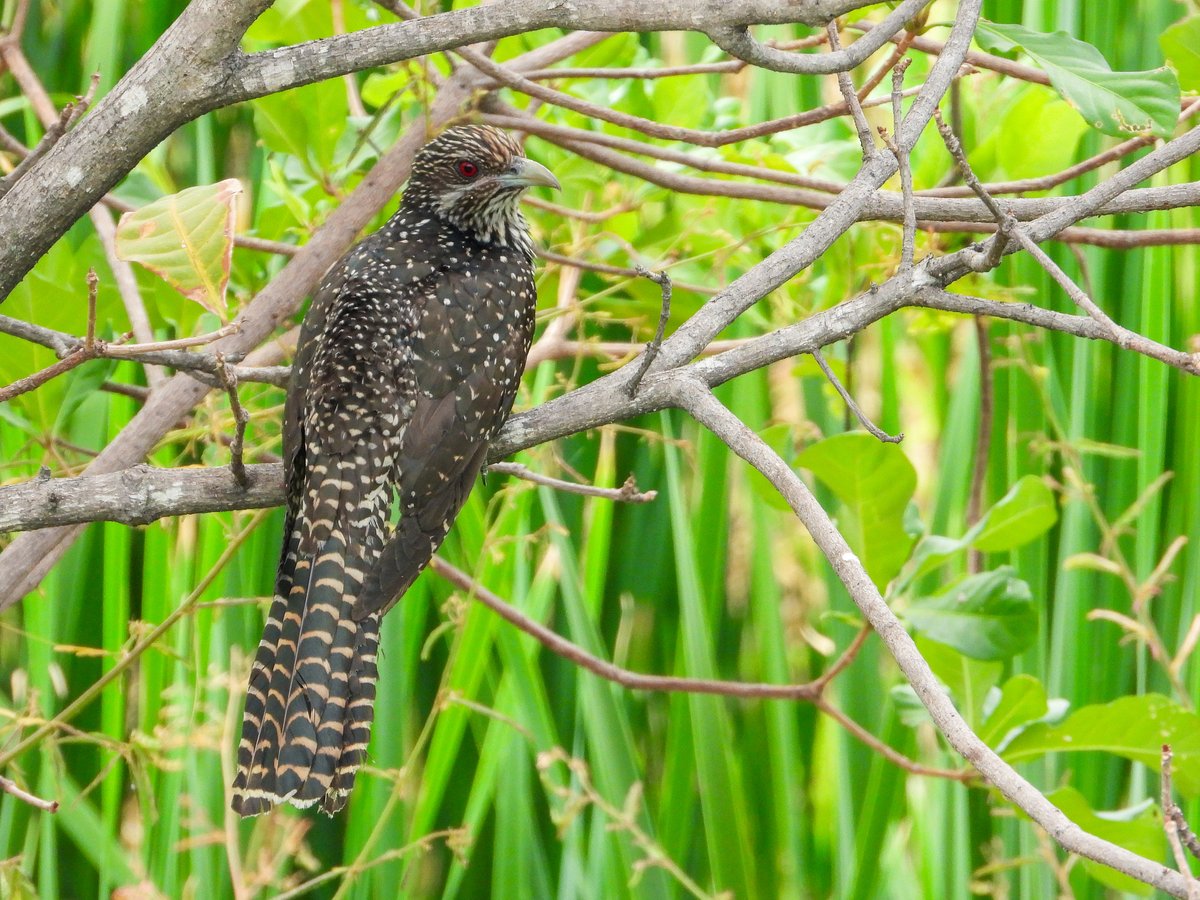
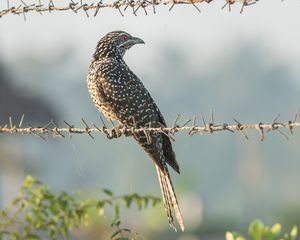
A substantial, long-tailed cuckoo measuring 39-46 cm in length and weighing 190-327 g. The male is striking with glossy bluish-black plumage, a pale greenish-grey bill, crimson iris, and grey legs and feet. The female is more cryptically colored with a brownish crown marked by rufous streaks, dark brown upperparts spotted with white and buff, and heavily streaked whitish underparts. Juveniles resemble males in their upper plumage but have a black beak. Subspecies vary in size and coloration, with some populations showing regional adaptations in their appearance. The species has a notably large gape, an adaptation for swallowing large fruits including hard palm seeds.
Identification
The combination of large size, very long tail, and distinctive plumage makes this species relatively easy to identify. Males are unmistakable—glossy black with crimson eyes, unlike any other cuckoo in the region. Females can be confused with other brown cuckoos but are distinguished by their heavily streaked underparts and the rufous-streaked head pattern. The crimson eye is a reliable field mark in both sexes. The species is often detected first by voice; the male's rolling 'koo-Ooo' call is quite different from the calls of other cuckoos. In flight, the long tail and broad wings give it a hawk-like silhouette.
Distribution & Habitat
This species breeds across tropical southern Asia from Iran, Pakistan, and India through Bangladesh and Sri Lanka to southern China and the Greater Sundas islands. Island populations occur throughout the Thai-Malay Peninsula, the Philippines, and the Lesser Sundas. It inhabits light woodland, cultivation, gardens, and increasingly urban areas. While primarily resident, some populations make long-distance movements, with individuals occasionally reaching Australia. The species has demonstrated remarkable colonizing ability, being among the first birds to establish on Krakatau after the eruption and having colonized Singapore only in the 1980s.
Behavior & Ecology
As a brood parasite, this species lays single eggs in the nests of various hosts, primarily crows and mynas. Females typically remove a host egg before laying and visit nests alone, though males may distract hosts. Eggs hatch after 12-14 days, about three days ahead of host chicks, and young fledge in 20-28 days. Unlike some parasitic cuckoos, young koels rarely evict host chicks. Adults are mainly frugivorous, feeding on a wide variety of fruits and playing a key role in seed dispersal, particularly for sandalwood. They will defend fruiting trees aggressively against other birds. During breeding season, males call repeatedly with a loud 'koo-Ooo' song, while females emit sharp 'kik-kik-kik' calls. Breeding occurs from March to August across most of the range.
Conservation
The species is not considered threatened and maintains a large, stable population across its extensive range. Its adaptability to human-modified landscapes and varied diet have contributed to its success. However, as a brood parasite, its populations are linked to the availability of suitable hosts, particularly crow species. Local populations may fluctuate based on host abundance, and habitat changes that reduce host numbers could affect koel populations. The species has benefited from urbanization in some areas, where house crows have increased.
Culture
The bird holds significant cultural importance across South Asia. Its name is onomatopoeic in origin, reflected in names like the Sanskrit 'Kokila.' References to this bird are common in folklore, myth, and poetry throughout the region. The Vedas, dating to around 2000 BC, contain early references to brood parasitism through the name 'Anya-Vapa,' meaning 'that which was raised by others.' The species is revered in the Manusmriti, with traditional protections against harm. It has been chosen as the state bird of Puducherry. In Sri Lanka, the koel's call is traditionally associated with the Sinhalese New Year in April. Historically popular as cagebirds in India, these hardy birds could survive in captivity for up to 14 years.
Source: Wikipedia · CC BY-SA 3.0
Taxonomy
- Order
- Cuculiformes
- Family
- Cuculidae
- Genus
- Eudynamys
- eBird Code
- asikoe2
Vocalizations
Subspecies (6)
-
Eudynamys scolopaceus chinensis
southern China and Indochina; winters to Borneo
-
Eudynamys scolopaceus corvinus
northern Moluccas (Morotai, Halmahera, Ternate, Tidore, Moti, and Bacan)
-
Eudynamys scolopaceus harterti
Hainan (southern China)
-
Eudynamys scolopaceus malayanus
northeastern India to Thailand, Malaya, Sumatra, Borneo, and Lesser Sundas
-
Eudynamys scolopaceus mindanensis
Philippines (including Palawan and Sulu Archipelago), and Sangihe and Talaud islands
-
Eudynamys scolopaceus scolopaceus
Nepal to Pakistan, India, Sri Lanka, Lakshadweep, and Maldives
Data Sources
Species description from Wikipedia, licensed under CC BY-SA 3.0.
Bird images and sounds sourced from GBIF, contributed by citizen scientists worldwide under Creative Commons licenses.
Taxonomy data from AviList 2025.