Japanese Grosbeak
Eophona personata
黑头蜡嘴雀
Introduction
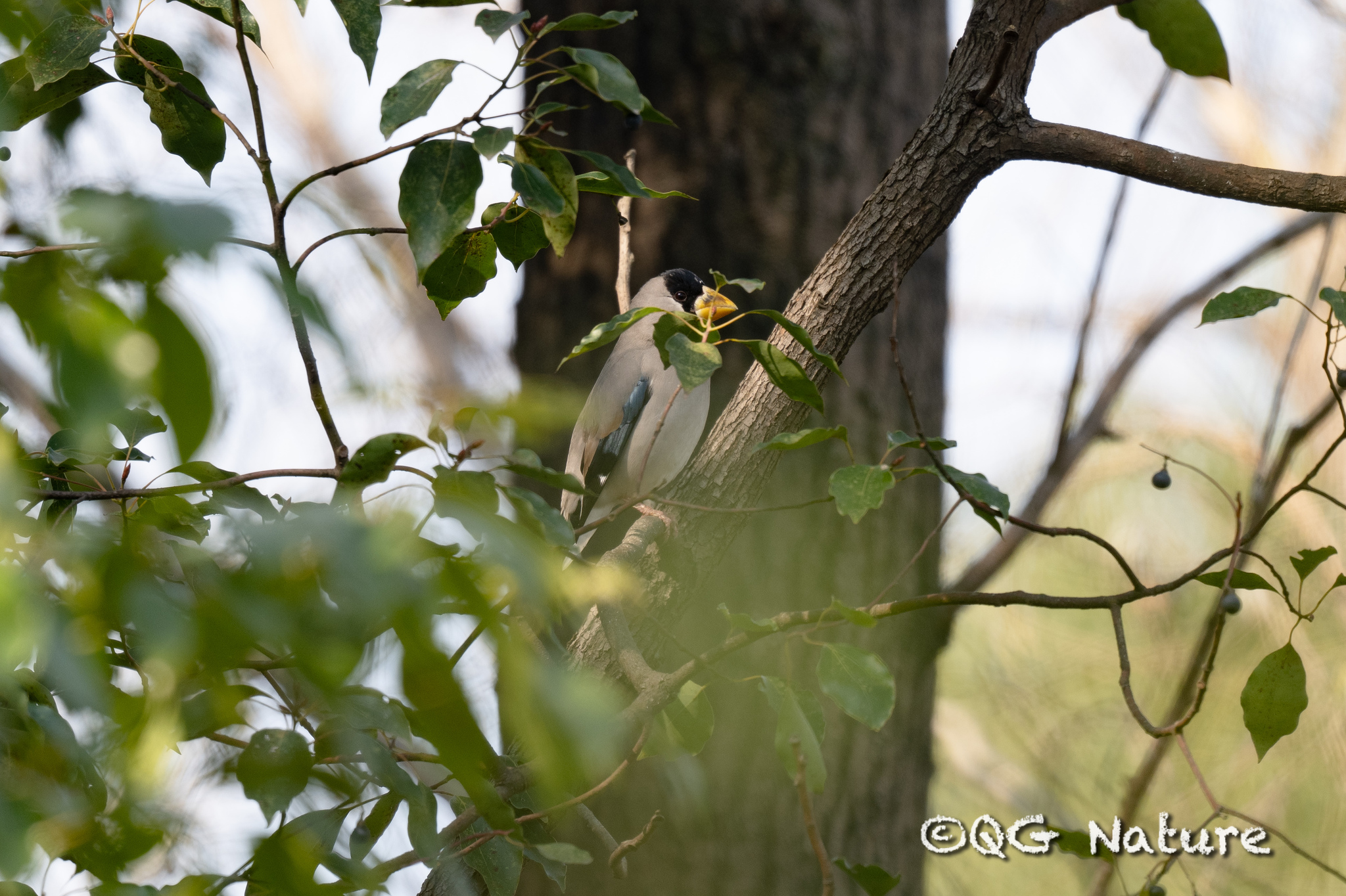
This large finch species occurs in the East Palearctic, including Japan and northeastern Asia. It inhabits forest and woodland habitats within a restricted range. The species is characterized by a massive yellow bill, gray-brown upperparts, black head markings, and a pale neck. It is locally common within its range. The bird is typically inconspicuous, remaining hidden in the canopy and often located by its distinctive calls. It engages in brief forays to feed and moves between trees.
Description
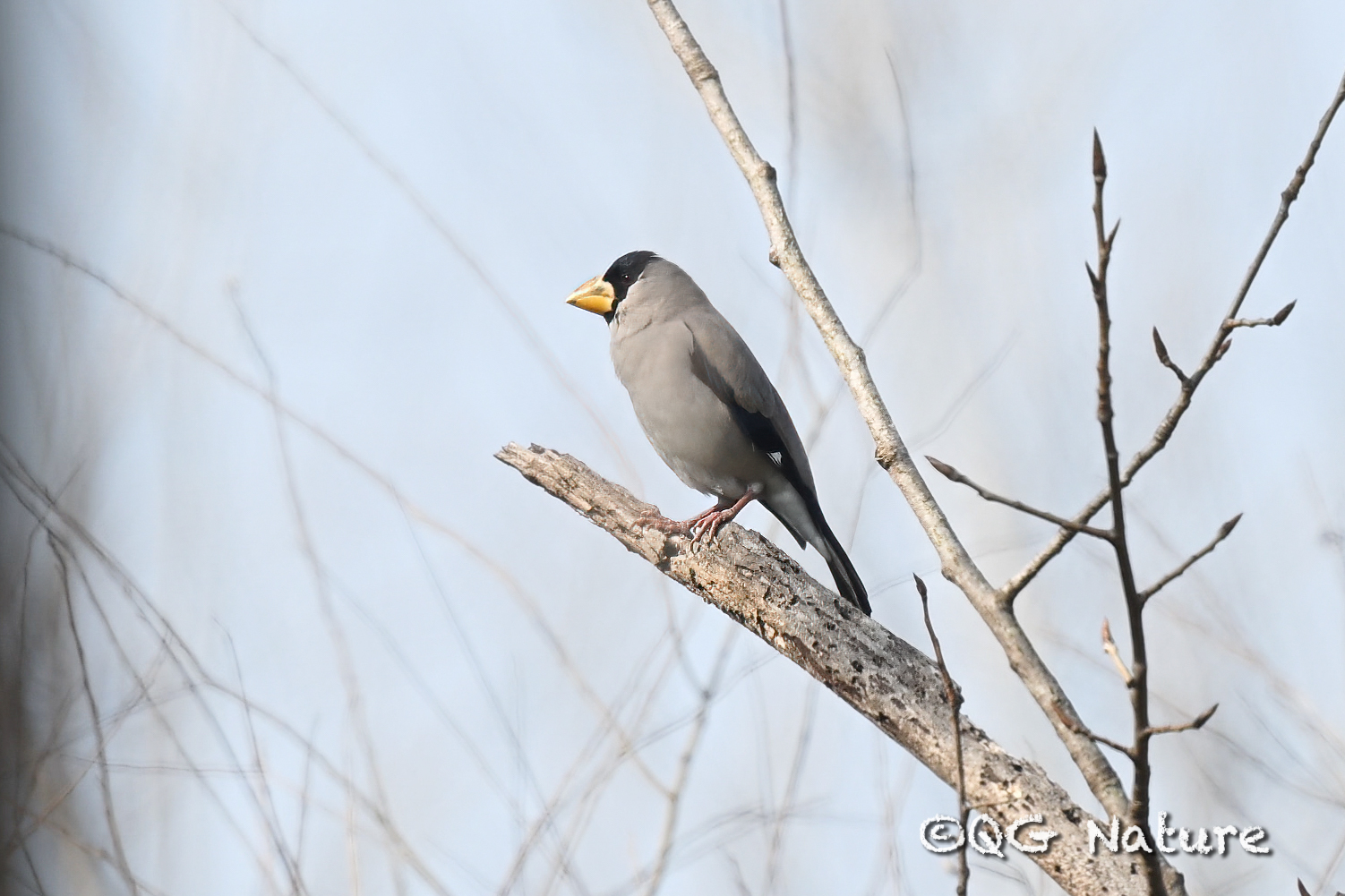
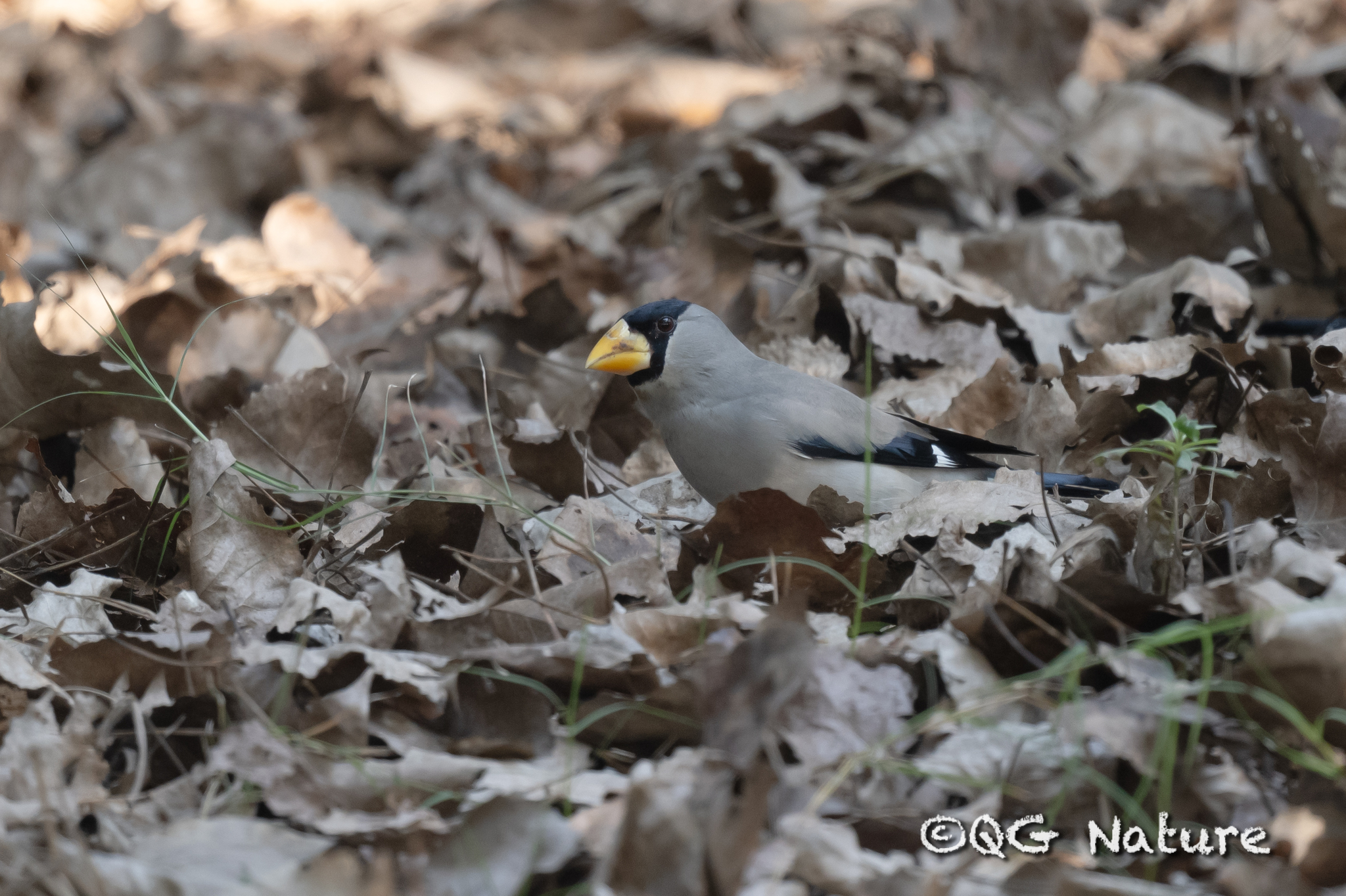
This is one of the larger finch species, with adults measuring 18-23 cm in length and weighing around 80 g. Its most distinctive feature is the massive, pointed bright yellow bill, which is disproportionately large for its head. Adults possess a bold black face mask extending from the nape through the ear-coverts to the chin and neck, contrasting sharply with pale whitish-grey on the sides of the neck. The underparts are a dull gray, while the back shows grayish-brown coloration with gingery or tawny-brown flanks. The wings and tail are black, marked with a white patch on the inner wing-coverts and a distinctive white band across the middle of the primaries, visible in flight. Juveniles are plainer, appearing overall dull gray with no black head markings. The eastern subspecies is slightly larger and paler overall with reduced white wing markings.
Identification
The massive bright yellow bill is the key identification feature, distinguishing it from other similar finches and hawfinches. The bold black head pattern with contrasting pale neck sides is also distinctive. In flight, the white wing band and patch are visible characters. It resembles the Eurasian hawfinch superficially but can be distinguished by its yellow rather than grayish bill and different head pattern. The Japanese race is resident while the eastern subspecies is migratory, but plumage differences are subtle.
Distribution & Habitat
The species occurs across the East Palearctic with two subspecies having different distributions. The nominate race is resident throughout Japan from Hokkaido to Kyushu. The eastern subspecies is completely migratory, breeding around the Amur, Ural, and Manchurian regions and wintering in Hebei and Beijing, occasionally ranging south to North Korea. Habitat includes deciduous and mixed forests, oak and birch woodlands, and well-wooded parks and gardens. It shows a preference for valley locations over hillsides and may winter near cultivated areas.
Behavior & Ecology
Typically occurs in pairs or small flocks, though may form larger groups at productive feeding sites. Despite its size, it can be surprisingly secretive, often remaining hidden within the tree canopy foliage. Most detections are made by voice rather than sight. The flight call is a hard, short 'tak tak' note, while the song consists of a series of four flutey whistles. Diet varies seasonally: winter diet centers on cedar nuts supplemented by birch seeds and berries, while summer diet is more insectivorous, featuring caterpillars and beetles.
Conservation
The species is described as locally common and occasionally abundant around prime feeding areas within its range. No specific conservation status or population figures are provided in available sources.
Culture
Known locally as 'Ikaru' in Japanese. No additional cultural significance, folklore, or mythological associations are documented for this species.
Source: Wikipedia · CC BY-SA 3.0
Taxonomy
- Order
- Passeriformes
- Family
- Fringillidae
- Genus
- Eophona
- eBird Code
- japgro1
Vocalizations
Subspecies (2)
-
Eophona personata magnirostris
eastern Manchuria to northeastern China (Shandong)
-
Eophona personata personata
breeds Japan (Hokkaido to Honshu); winters to southern Japan, eastern China, and Taiwan
Data Sources
Species description from Wikipedia, licensed under CC BY-SA 3.0.
Bird images and sounds sourced from GBIF, contributed by citizen scientists worldwide under Creative Commons licenses.
Taxonomy data from AviList 2025.