














Little Egret
Egretta garzetta
白鹭
Introduction
White heron species found throughout the Old World. Inhabits shallow waters, muddy margins, grasslands, lakes, rivers, marshes, lagoons, rice fields, and coastal mudflats. Feeds on small prey in small groups, employing various hunting techniques. Nests colonially with other water birds, constructing stick platforms in trees, shrubs, or reed beds. Suffered severe population declines in the 19th century due to plume hunting. Conservation measures introduced in the 1950s facilitated population recovery. Range subsequently expanded to northwestern Europe, with established breeding populations in the Caribbean and regular sightings along the Atlantic coast of North America.
Description
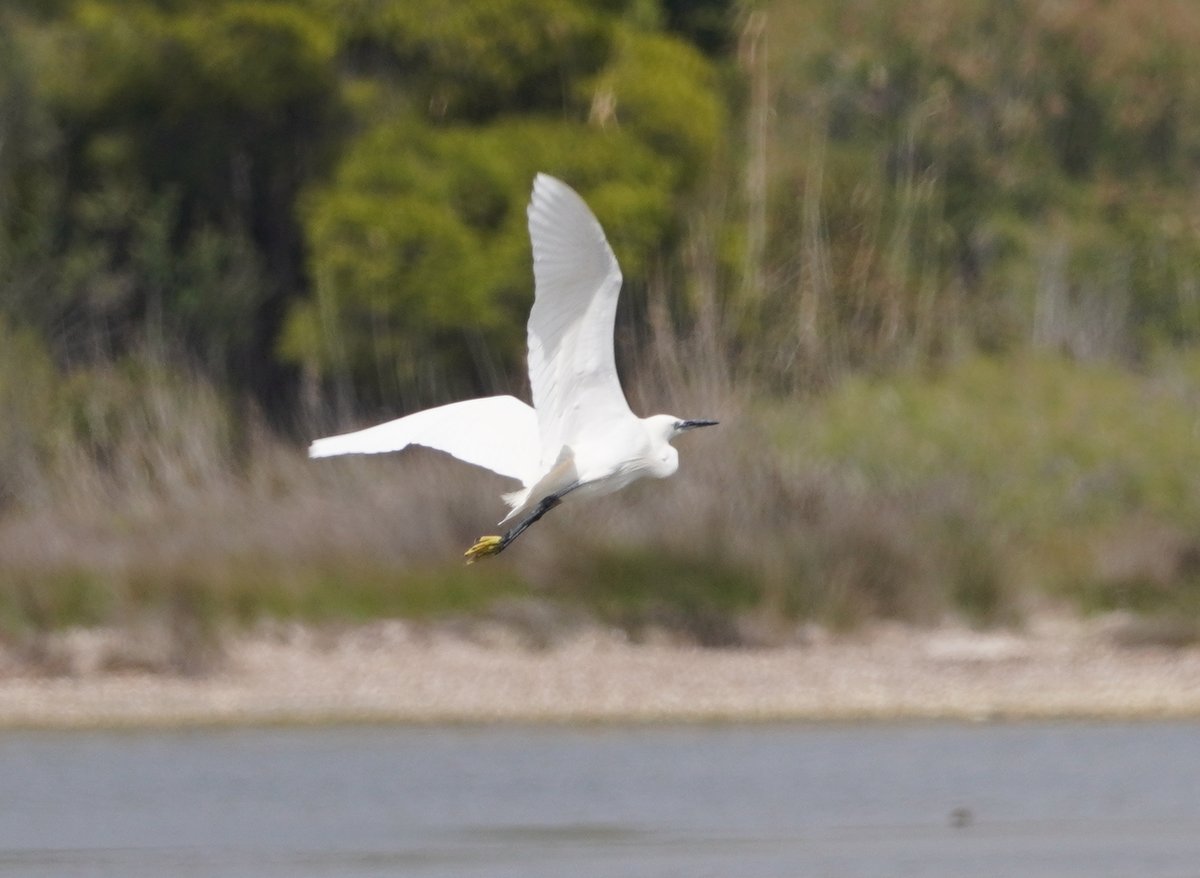
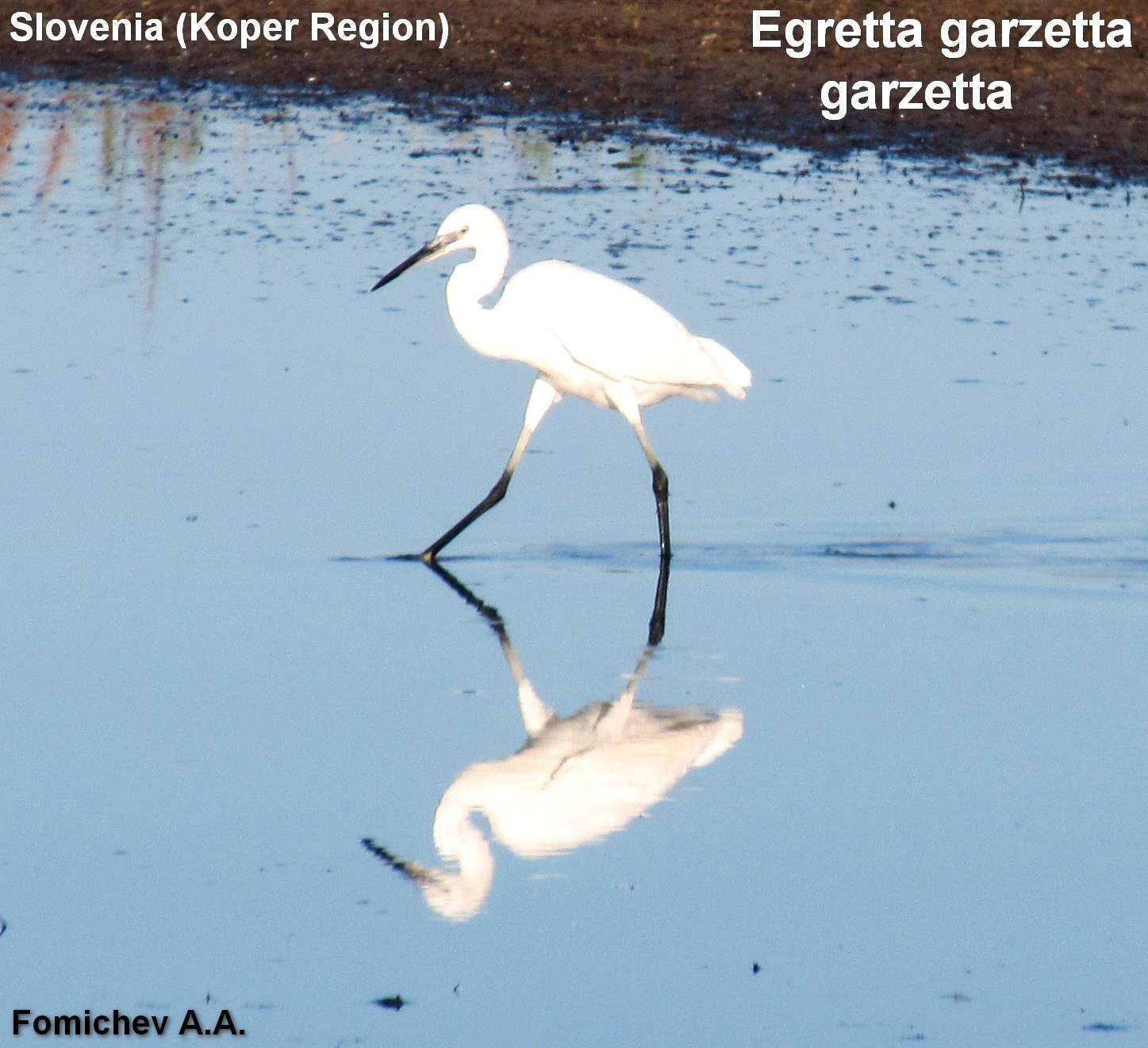
This is a small, pure white heron measuring 55-65 cm in length with an 88-106 cm wingspan and weighing 350-550 g. The plumage is entirely white in typical individuals, though dark morphs with bluish-grey plumage also occur. The most striking features are the long, slender black bill and the long black legs, with yellow feet in western populations. During the breeding season, adults develop two narrow, pointed plumes about 150 mm long on the nape, forming an elegant crest. Similar elongated feathers appear on the breast and back, with scapular feathers potentially reaching 200 mm. The face has a yellow iris, black lores, and greenish-grey bare skin around the eye and lower mandible. Juveniles resemble non-breeding adults but have greenish-black legs and duller yellow feet.
Identification
The combination of all-white plumage, black bill, black legs, and yellow feet makes this species distinctive. The yellow feet are particularly conspicuous in flight and when wading. The long nape plumes during breeding season are diagnostic. Snowy egrets are very similar but have entirely black feet; the larger great egret has a yellow bill and black legs without yellow feet. The species is larger and more variable in foraging strategies than the snowy egret, and tends to dominate feeding sites where they overlap. The vocalizations are indistinguishable from black-crowned night herons and cattle egrets, with which they sometimes associate.
Distribution & Habitat
The species breeds across southern Europe, the Middle East, most of Africa, southern Asia, Australia, and New Zealand. Northern European populations are migratory, traveling to Africa for winter, while resident populations exist in southern Europe, Africa, and tropical Asia. The range has expanded dramatically northward since the 1950s, with self-sustaining populations now established in Britain, France, the Netherlands, and Ireland. Colonization of the New World began in 1954, with the first breeding record on Barbados in 1994; the species has since spread through the Caribbean and to the Atlantic coast of North America. The preferred habitat includes the shores of lakes, rivers, ponds, marshes, lagoons, mudflats, and coastal areas, favoring open locations over dense cover.
Behavior & Ecology
These birds employ diverse feeding techniques: stalking prey in shallow water, running with raised wings to disturb fish, standing still to ambush prey, or following cormorants and humans to catch disturbed fish. On land, they walk or run while hunting, feed near grazing livestock, and even remove ticks from cattle. The diet is highly varied, including fish, amphibians, small reptiles, mammals, birds, crustaceans, molluscs, insects, spiders, and worms. They are social birds, usually seen in small flocks, and breed colonially with other wading birds such as cattle egrets, black-crowned night herons, and glossy ibises. Nests are stick platforms built in trees, shrubs, or reed beds, with pairs defending territories extending 3-4 meters from the nest. Clutches of 3-5 blue-green eggs are incubated by both parents for 21-25 days, and young fledge after 40-45 days. They are mostly silent but make croaking and bubbling calls at breeding colonies and harsh alarm calls when disturbed. The maximum recorded lifespan is 22.3 years.
Conservation
The global conservation status is Least Concern, reflecting the species' wide distribution and large population. It has actually expanded its range significantly over recent decades. European populations are stable or increasing in Spain, France, and Italy, with an estimated 22,700 breeding pairs across the continent, though Greek populations are declining. The species was once common in Britain and Ireland but became extinct by the 16th century due to hunting and climate change. After 19th-century plume hunting decimated European populations, conservation laws introduced in the 1950s allowed recovery. Britain was recolonized in 1996, and by 2008 supported over 750 breeding pairs. Severe winters in 2010-2012 caused temporary setbacks in Ireland but the species continues to spread. In Australia, it is listed as Threatened in Victoria, classified as Endangered on the state's advisory list.
Culture
Historical records reveal the species was once common in northern England and featured prominently in medieval feasts. It was served at the enthronement banquet of Archbishop George Neville at Cawood Castle in 1465 and at the coronation feast of King Henry VI in 1429, indicating a substantial population in medieval England. By the mid-16th century, however, the species had become scarce, with records showing that William Gowreley, a royal purveyor, had to source egrets from further south. The 19th-century plume trade posed the greatest threat: in just the first three months of 1885, 750,000 egret skins were sold in London, and in 1887 one dealer sold 2 million skins. This devastation helped stimulate the establishment of Britain's Royal Society for the Protection of Birds in 1889.
Source: Wikipedia · CC BY-SA 3.0
Taxonomy
- Order
- Pelecaniformes
- Family
- Ardeidae
- Genus
- Egretta
- eBird Code
- litegr
Vocalizations
Subspecies (3)
-
Egretta garzetta dimorpha
East African coast and locally inland; Europa Island (southern Mozambique Channel), Aldabra (southwestern Seychelles), and Madagascar
-
Egretta garzetta garzetta
widespread Eurasia, eastern and southern Africa
-
Egretta garzetta immaculata
Greater Sundas eastward to Australia (except western deserts) and North and South islands (New Zealand)
Data Sources
Species description from Wikipedia, licensed under CC BY-SA 3.0.
Bird images and sounds sourced from GBIF, contributed by citizen scientists worldwide under Creative Commons licenses.
Taxonomy data from AviList 2025.