Mountain Imperial Pigeon
Ducula badia
山皇鸠
Introduction
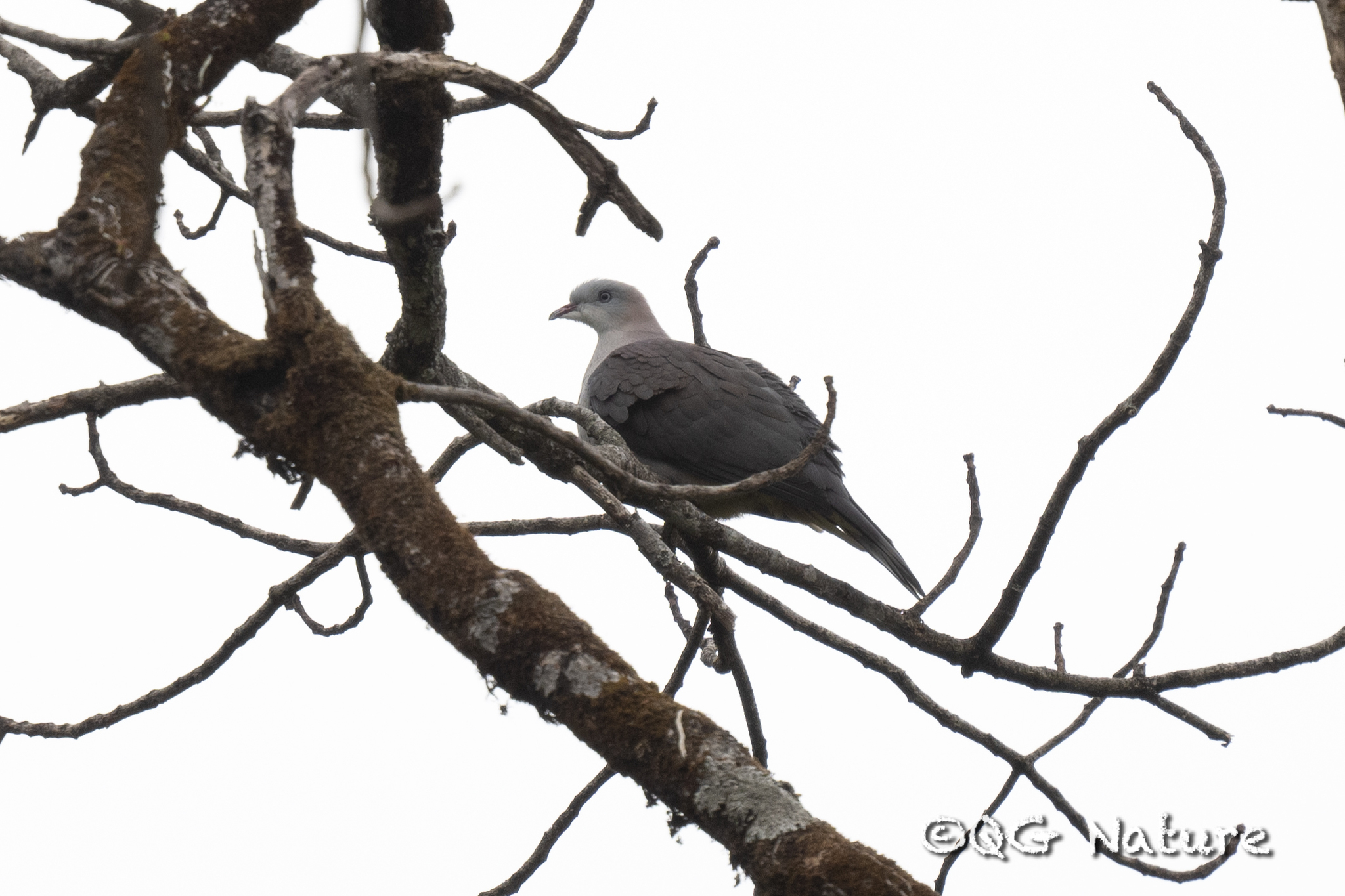
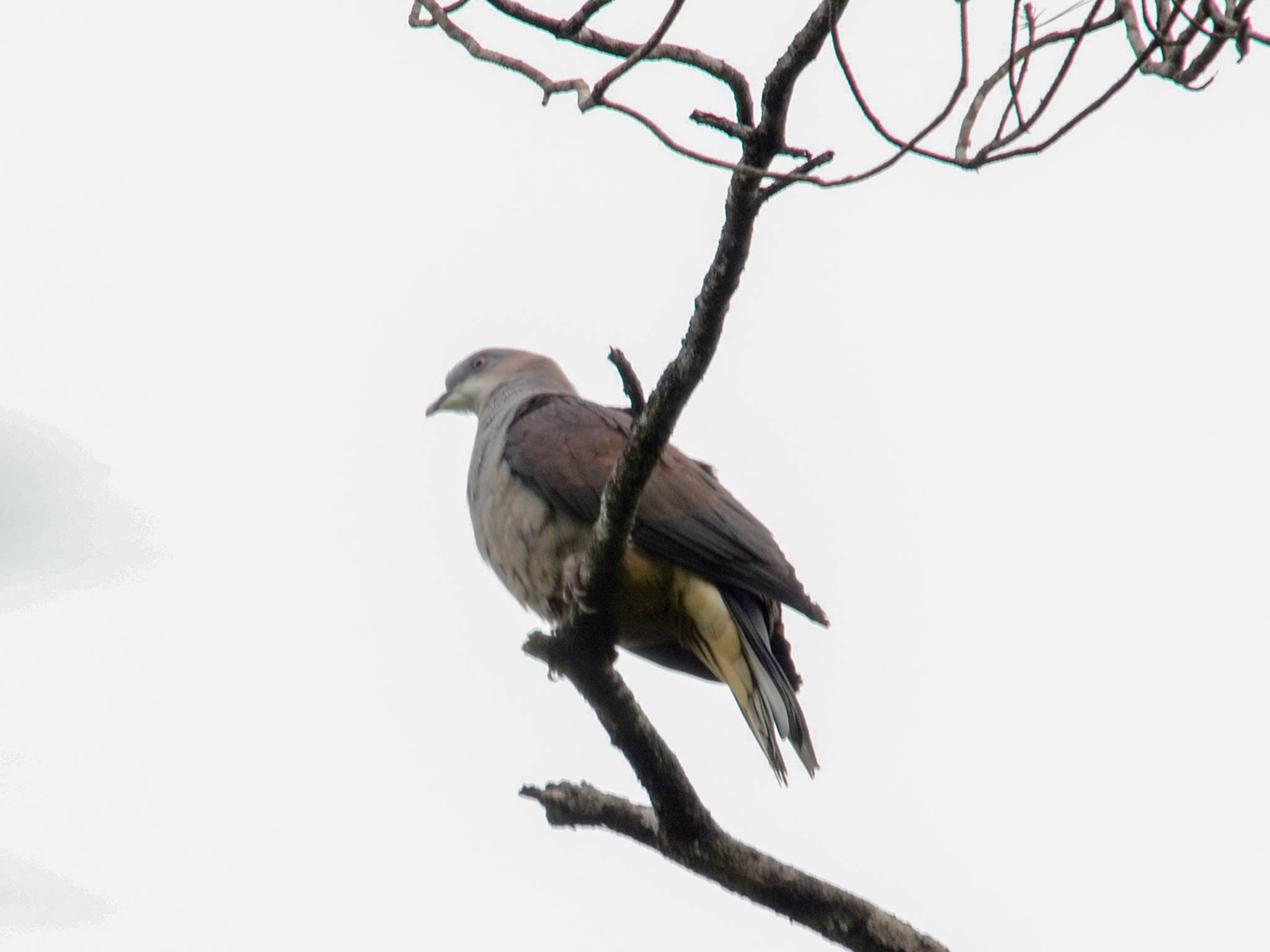
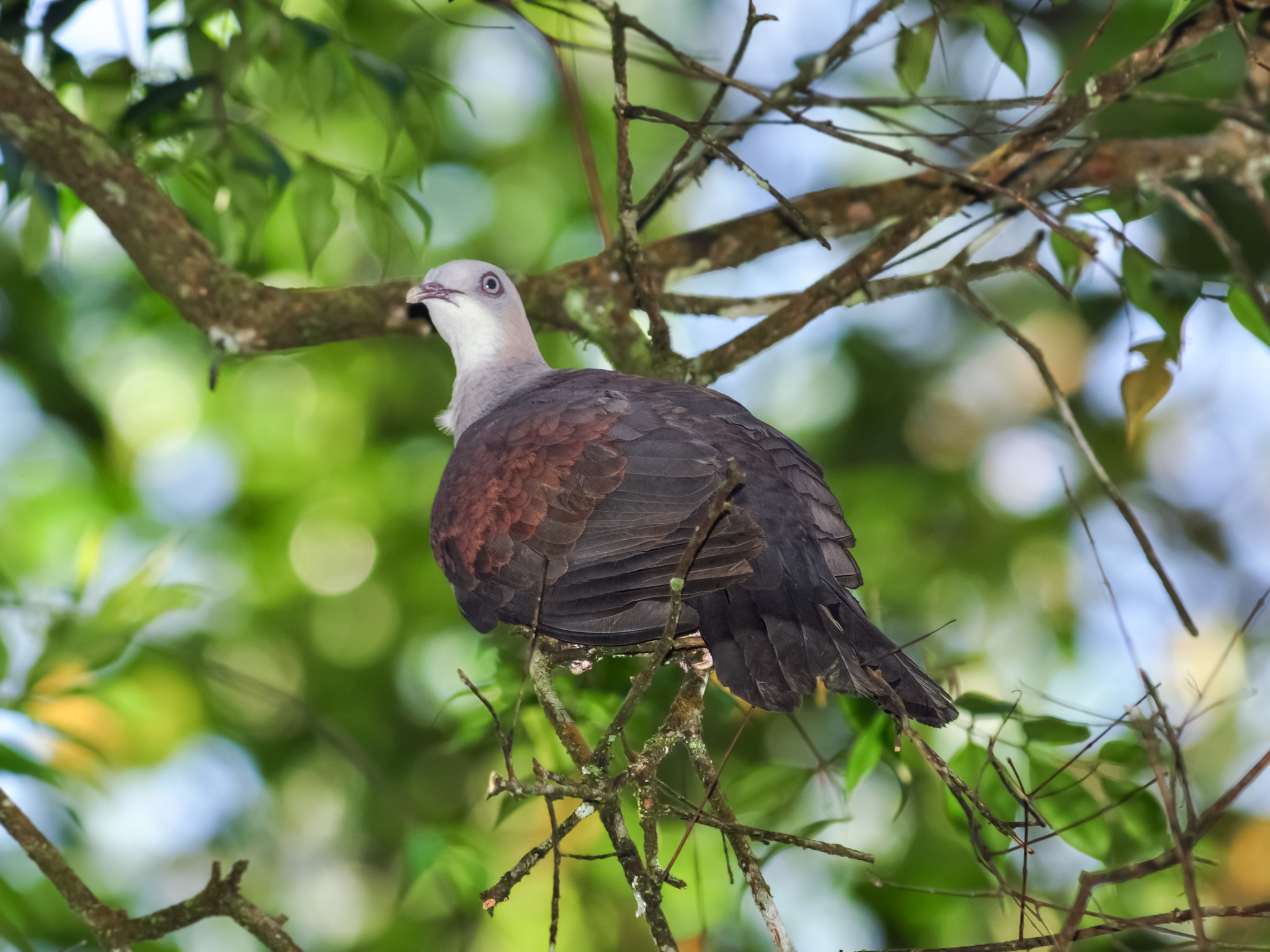
Largest pigeon species in Southeast Asia. Features maroon upperparts, vinous-grey underparts, white throat, and brownish-maroon back. Inhabits old-growth forests, typically staying in high canopy but coming to ground level at drinking spots in mangrove areas. Generally solitary but forms small groups of up to 20 individuals at roosts or during mountain flights. Flight is slow with powerful wingbeats. Call is a deep, resonant boom audible only at close range. Serves as an indicator species for healthy forest ecosystems.
Description
This is the largest pigeon species across its extensive range, measuring 43-51 cm in length. It has a fairly long tail, broad rounded wings, and characteristically slow wingbeats. The head, neck, and underparts are vinous-grey, contrasting sharply with a white throat. The upperparts and wings are brownish-maroon, sometimes appearing duller on the upper body. The underwing appears slate-grey, while the tail is blackish crossed by a grey horizontal line. The combination of the maroon back and large size creates a distinctive silhouette in flight and at rest.
Identification
The mountain imperial pigeon's large size and maroon-backed appearance make it relatively easy to identify within its range. The vinous-grey head and underparts with the contrasting white throat distinguish it from similar species. Its slow, deliberate wingbeats and deep resonant call, audible only at close range, are also characteristic field marks. When seen in flight, the slate-grey underwing and the grey band across the blackish tail provide additional identification features.
Distribution & Habitat
This species has a wide distribution across Southeast Asia, occurring in Bangladesh, Bhutan, Brunei, Cambodia, China, India, Indonesia, Laos, Malaysia, Myanmar, Nepal, Thailand, and Vietnam. It inhabits subtropical and tropical moist lowland forests, mangrove forests, and moist montane forests. It occurs from sea level to 2,550 m elevation in the Himalayas and 2,200 m on Sumatra. While mainly a foothill bird that probably breeds above 500 m, feeding flocks regularly occur at lower elevations. It requires old-growth forest habitats and remains fairly common only where extensive forest stands persist.
Behavior & Ecology
This species is usually solitary but gathers in groups of up to 20, especially when roosting or moving through mountains. It feeds on fruits and berries, particularly figs and nutmeg, which are plucked and swallowed whole. It occasionally descends to the ground to drink, sometimes in large numbers in Bornean mangroves. Partial altitudinal movements may occur in pursuit of feeding conditions. During breeding displays, birds puff their throats while calling and performing a vertical flight 6-8 m into the air before gliding back down with spread wings and tail. In northern parts of the range, breeding occurs from March to August, while southern populations breed from January to May. The flimsy platform nest is built in small trees 5-8 m high, and one or occasionally two eggs are laid.
Conservation
The species is generally fairly common where extensive stands of old-growth forest remain. However, its dependence on primary forest habitats makes it vulnerable to deforestation and habitat fragmentation throughout its range.
Source: Wikipedia · CC BY-SA 3.0
Taxonomy
- Order
- Columbiformes
- Family
- Columbidae
- Genus
- Ducula
- eBird Code
- moipig1
Subspecies (3)
-
Ducula badia badia
Malay Peninsula and Mergui Archipelago to Sumatra, Borneo, and western Java
-
Ducula badia griseicapilla
Myanmar to southwestern China, Hainan, Thailand, and Indochina
-
Ducula badia insignis
Himalayan foothills (western Nepal to Sikkim and Bhutan)
Data Sources
Species description from Wikipedia, licensed under CC BY-SA 3.0.
Bird images and sounds sourced from GBIF, contributed by citizen scientists worldwide under Creative Commons licenses.
Taxonomy data from AviList 2025.