Greater Racket-tailed Drongo
Dicrurus paradiseus
大盘尾
Introduction
Medium-sized drongo found in forested habitats throughout South and Southeast Asia. Perches openly on high branches. Produces varied vocalizations including imitations of other bird species. Joins mixed-species foraging flocks and exhibits kleptoparasitic behavior, stealing prey flushed or caught by other birds. Active from before dawn until late dusk. Regional variations demonstrate speciation through isolation and genetic drift.
Description
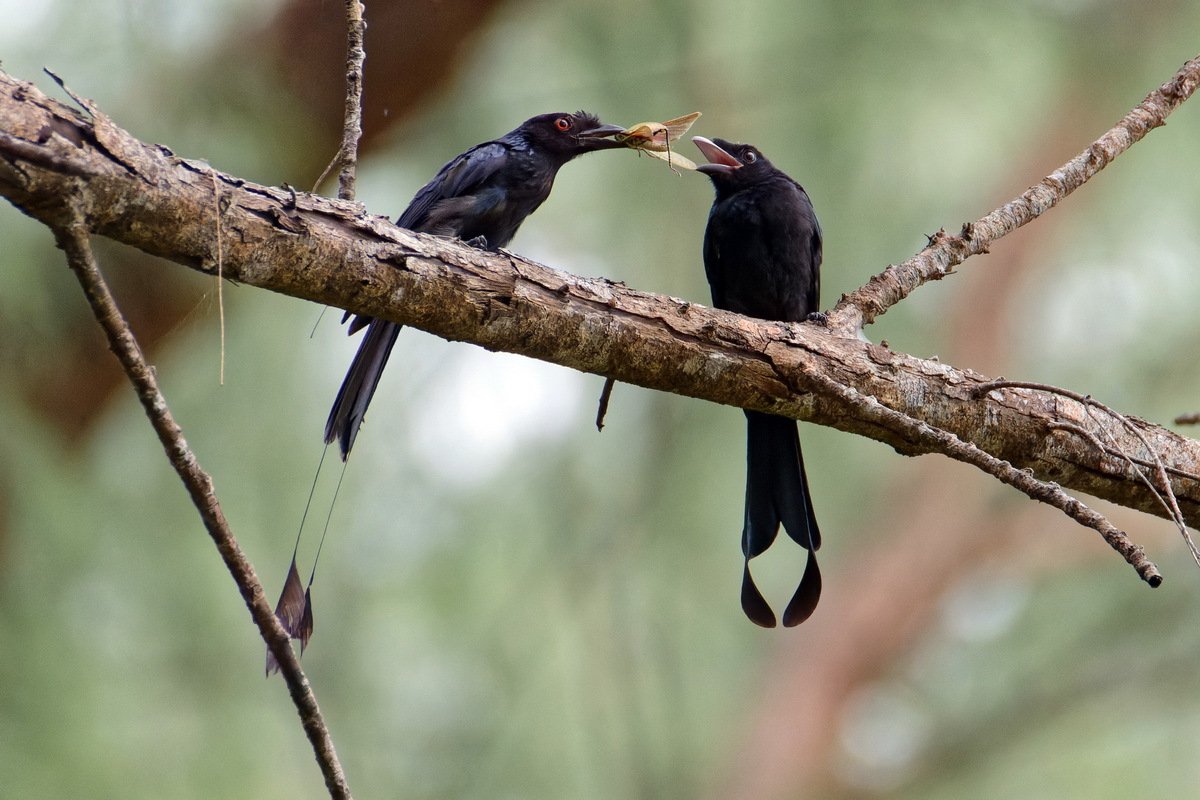
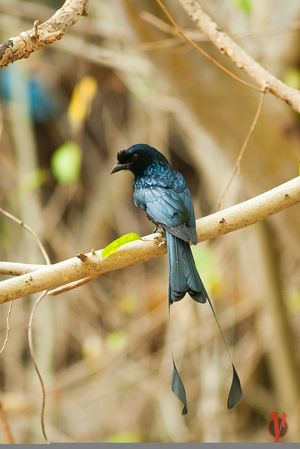
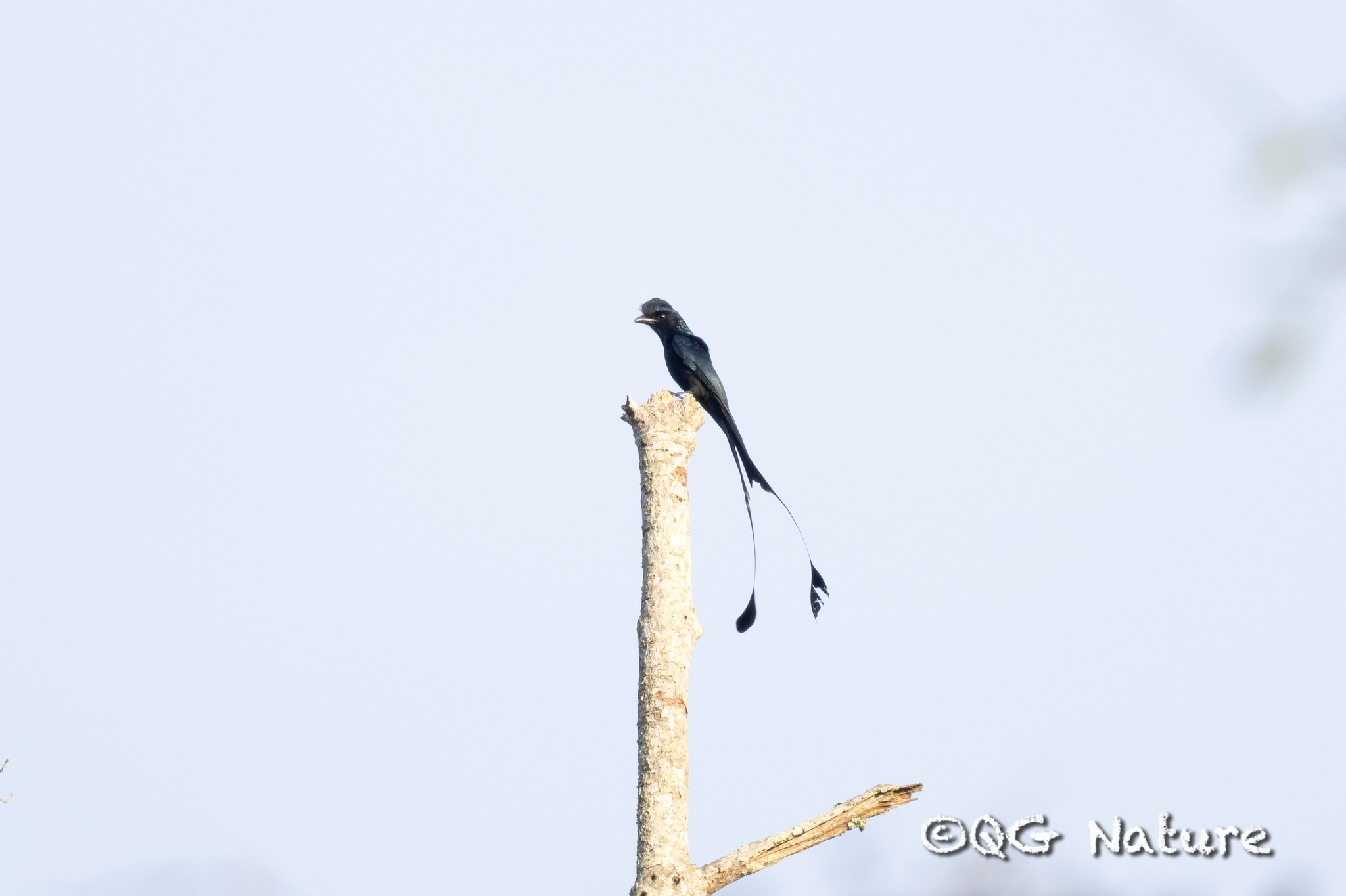
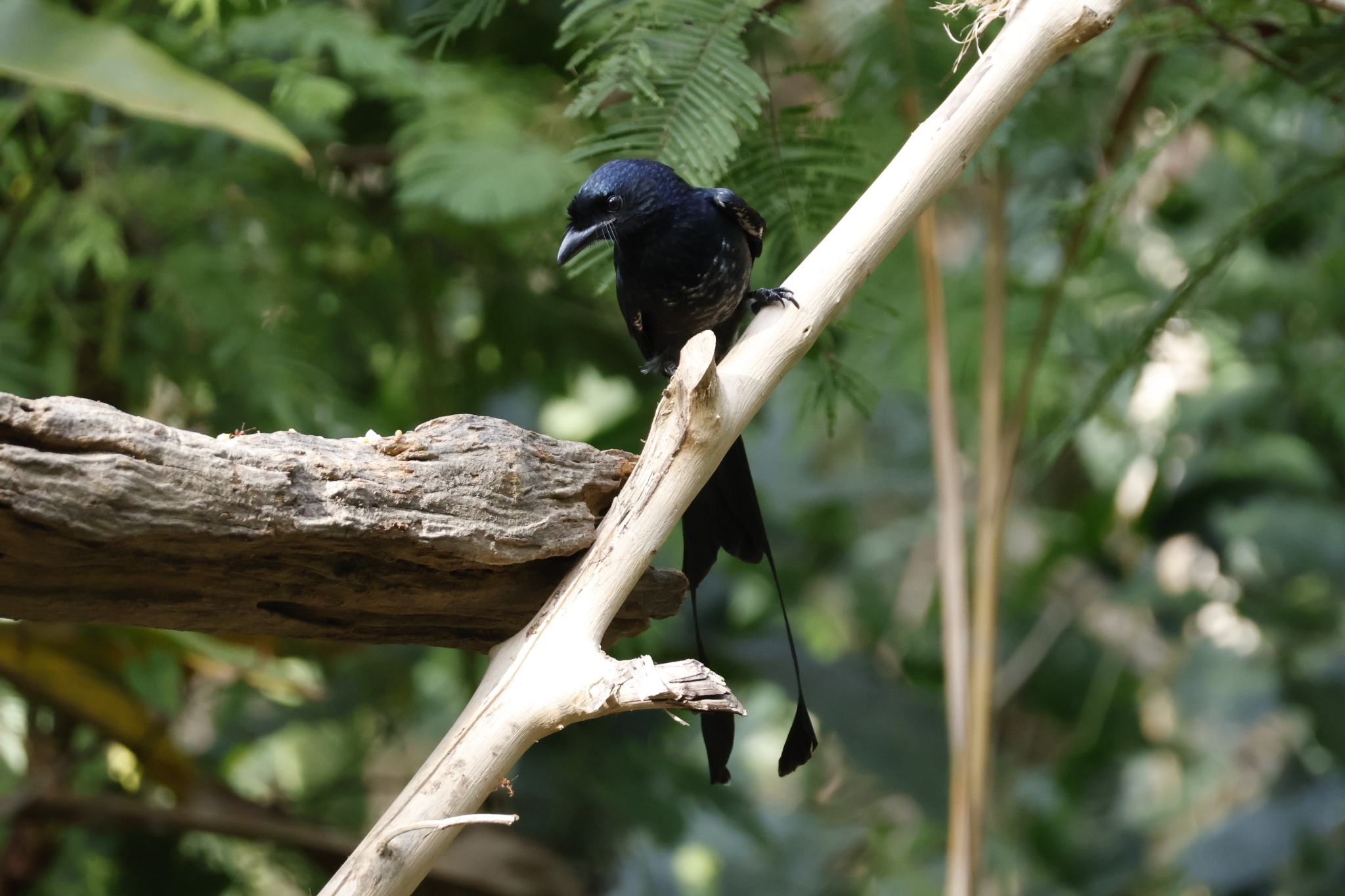
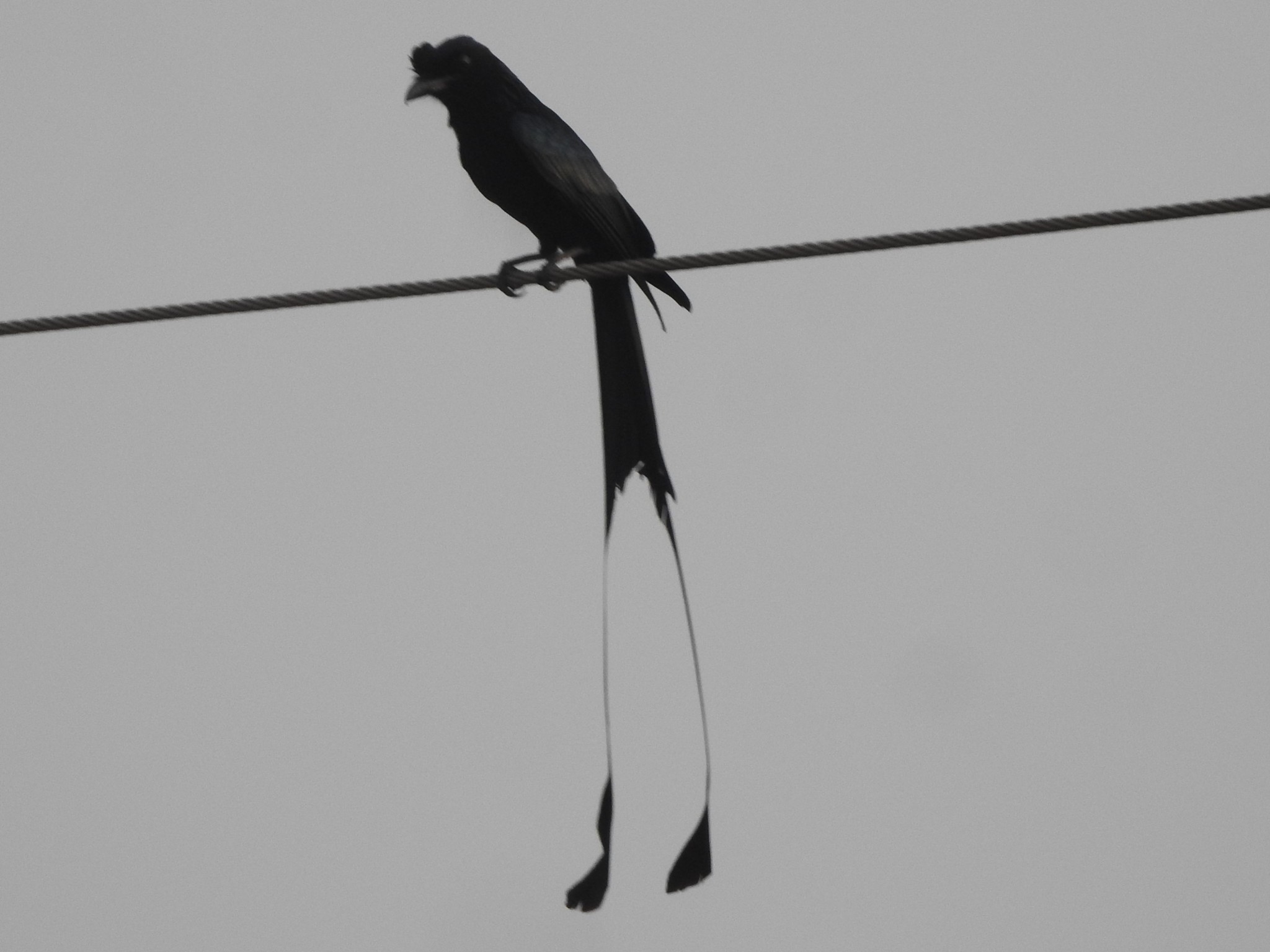
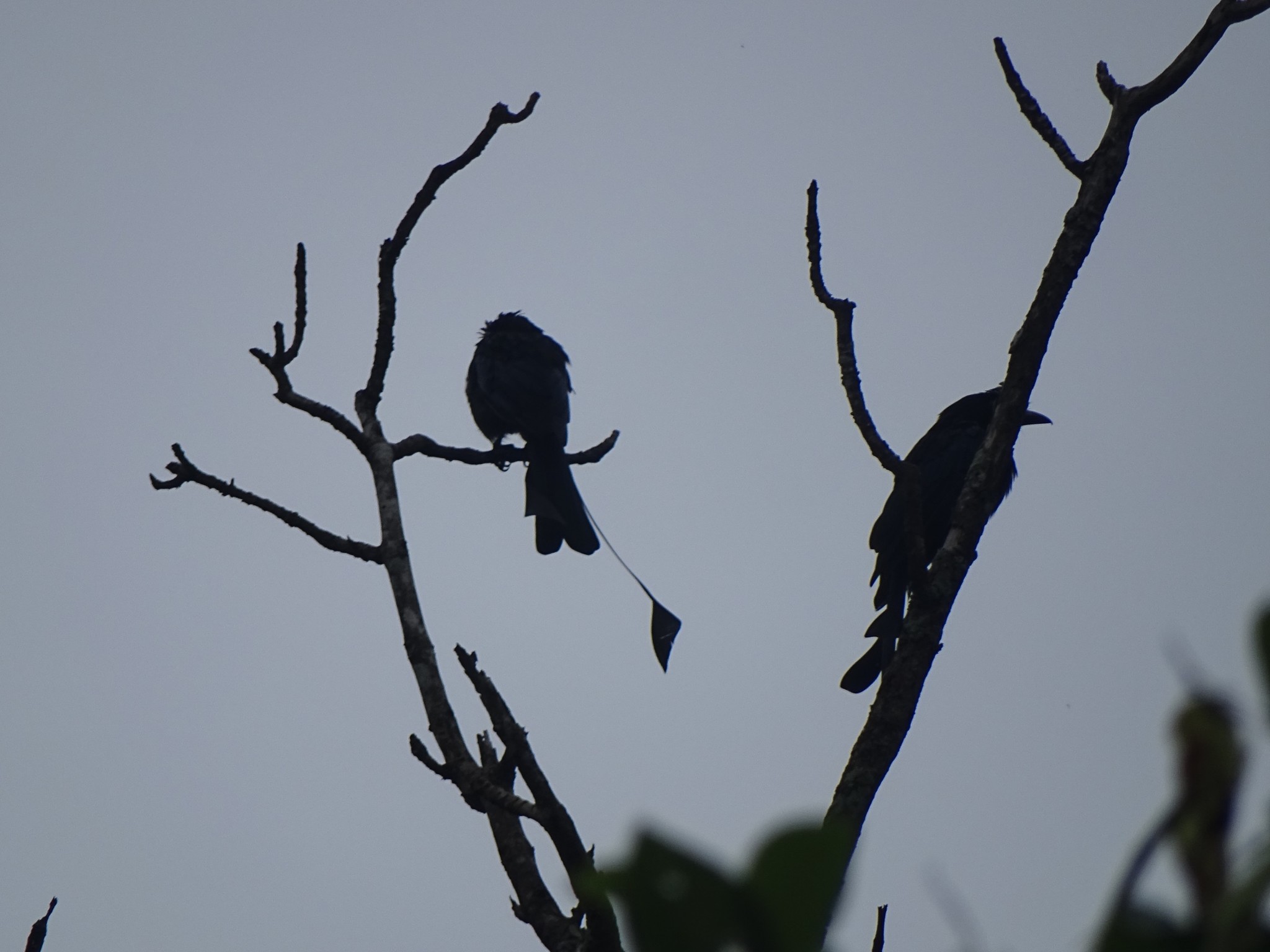
In most of its Asian range, this is the largest drongo species, with glossy black plumage and a commanding presence. Its most striking feature is the pair of elongated outer tail feathers that end in twisted, spatula-shaped rackets—structures formed by the inner web of the vane with a distinctive twist in the rachis. A prominent crest of curled feathers begins above the beak and extends along the crown to varying lengths depending on the subspecies. In flight, the whirring tail rackets can give the illusion of two large bees pursuing a black bird. The nominate subspecies found in southern India is slightly smaller than Himalayan populations, while island forms show considerable variation in bill shape, crest development, and racket size. Juveniles are duller and may lack the crest entirely while growing their tail streamers.
Identification
This species is unmistakable within its range due to its combination of large size, prominent crest, and distinctive tail rackets. The rackets appear twirled rather than flat, helping distinguish it from the similar lesser racket-tailed drongo found in the eastern Himalayas. That species has flatter rackets and an almost absent crest. Throughout its vast range, subspecies show clinal variation in crest length and body size, with Himalayan populations being the largest and featuring glossy neck hackles. The Andaman Island form has a much-reduced crest and shorter neck hackles, while some Bornean island populations lack crests entirely. In flight, the distinctive racket-shaped tail streamers are usually visible and diagnostic.
Distribution & Habitat
This species occupies a vast range across South and Southeast Asia, from the western Himalayas through the eastern Himalayas and Mishmi Hills at elevations below 1,200 meters. It inhabits the hills of peninsular India and the Western Ghats, extending eastward through mainland Southeast Asia to the islands of Borneo and Java. It is found throughout the Malay Peninsula and occurs on numerous offshore islands including Hainan, Sri Lanka, the Andaman Islands, Nicobar Islands, and various Indonesian archipelago islands. Island populations show distinct regional variations, with at least 13 recognized subspecies across this extensive range. It is a resident breeder throughout its distribution with no significant migratory movements.
Behavior & Ecology
These birds feed primarily on insects but also consume fruit and visit flowering trees for nectar. Perching upright on high, exposed branches with their short legs, they sally out to catch flying insects or hawk prey from foliage. They are aggressive and will mob larger birds, especially when nesting. Their vocalizations begin as early as 4 am on moonlit nights, often starting with a metallic tunk-tunk-tunk series. Beyond their varied calls, they possess an extraordinary ability to accurately mimic the alarm calls of other bird species—learned through interactions in mixed-species flocks—and use these imitations in context to panic other birds and steal their prey. They associate with woodpeckers, babblers, and have even been observed following troops of macaques. The breeding season in India runs from April to August. Courtship involves elaborate displays with hops, turns, and play behavior including dropping and catching objects mid-air. They build cup-shaped nests in tree forks, often selecting smooth-boled trees, and lay clutches of three to four creamy white eggs with reddish brown blotches.
Culture
This bird holds cultural significance across parts of India, where its common whistle-like note has earned it the local name kothwal, meaning 'policeman' or 'guard'—a reference to the whistle used by these figures that produces a similar sound. In the Mizo language of northeast India, it is called Vakul, and the Mizo people traditionally use its tail feathers in ceremonial practices. Prior to the 1950s, these birds were commonly kept in captivity throughout parts of India and were noted for being hardy and adaptable, accepting a varied diet similar to crows. Scholar Edward H. Schafer identified this species as the likely basis for the kalaviṅka birds—divine mythical creatures mentioned in Chinese and Japanese Buddhist texts that were described as having beautiful voices.
Source: Wikipedia · CC BY-SA 3.0
Taxonomy
- Order
- Passeriformes
- Family
- Dicruridae
- Genus
- Dicrurus
- eBird Code
- grtdro1
Vocalizations
Subspecies (13)
-
Dicrurus paradiseus banguey
islands off north Borneo
-
Dicrurus paradiseus brachyphorus
Borneo
-
Dicrurus paradiseus ceylonicus
Sri Lanka
-
Dicrurus paradiseus formosus
Java
-
Dicrurus paradiseus grandis
northern India to northern Myanmar and northern Vietnam
-
Dicrurus paradiseus hypoballus
northern Thai-Malay Peninsula; broadly intergrades with platurus
-
Dicrurus paradiseus johni
Hainan (southern China)
-
Dicrurus paradiseus microlophus
North Natuna Islands
-
Dicrurus paradiseus nicobariensis
Nicobar Islands
-
Dicrurus paradiseus otiosus
Andaman Islands
-
Dicrurus paradiseus paradiseus
southern India to southern Thailand and Indochina
-
Dicrurus paradiseus platurus
southern Thai-Malay Peninsula, Sumatra, and adjacent islands
-
Dicrurus paradiseus rangoonensis
central India to southern Myanmar, western Thailand, and Indochina
Data Sources
Species description from Wikipedia, licensed under CC BY-SA 3.0.
Bird images and sounds sourced from GBIF, contributed by citizen scientists worldwide under Creative Commons licenses.
Taxonomy data from AviList 2025.