White-backed Woodpecker
Dendrocopos leucotos
白背啄木鸟
Introduction
The white-backed woodpecker (Dendrocopos leucotos) is the largest species of spotted woodpecker in the western Palearctic. It occurs across much of Eurasia from the Atlantic coast to Japan, inhabiting mature deciduous and mixed forests with high densities of standing and fallen dead wood. This species is strongly associated with old-growth forest conditions and serves as an ecological indicator of properly functioning woodland communities. Key behaviors include powerful drilling into wood and loud, resonant drumming. Populations are never abundant across their range and have declined due to habitat loss of old-growth deciduous forests.
Description
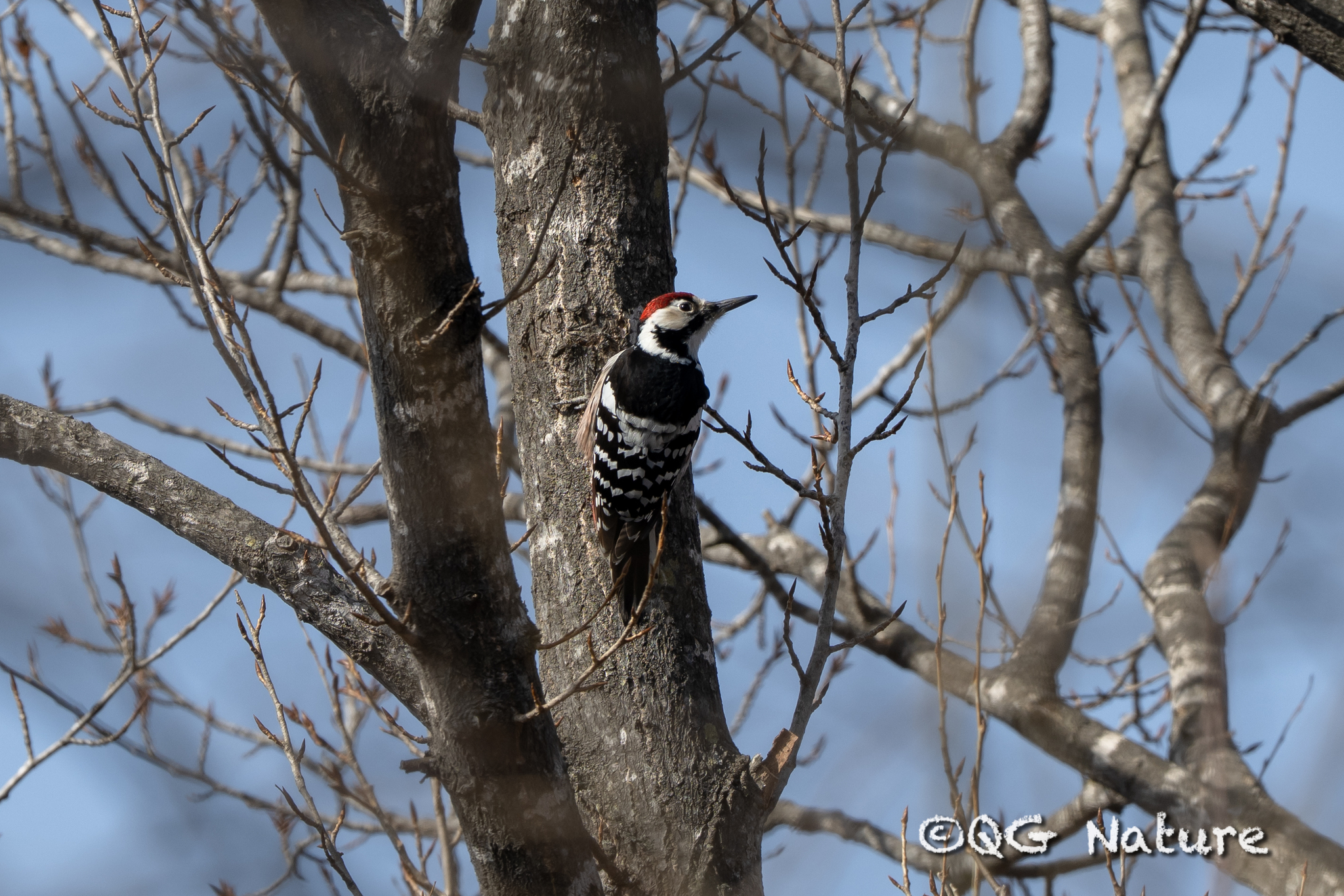
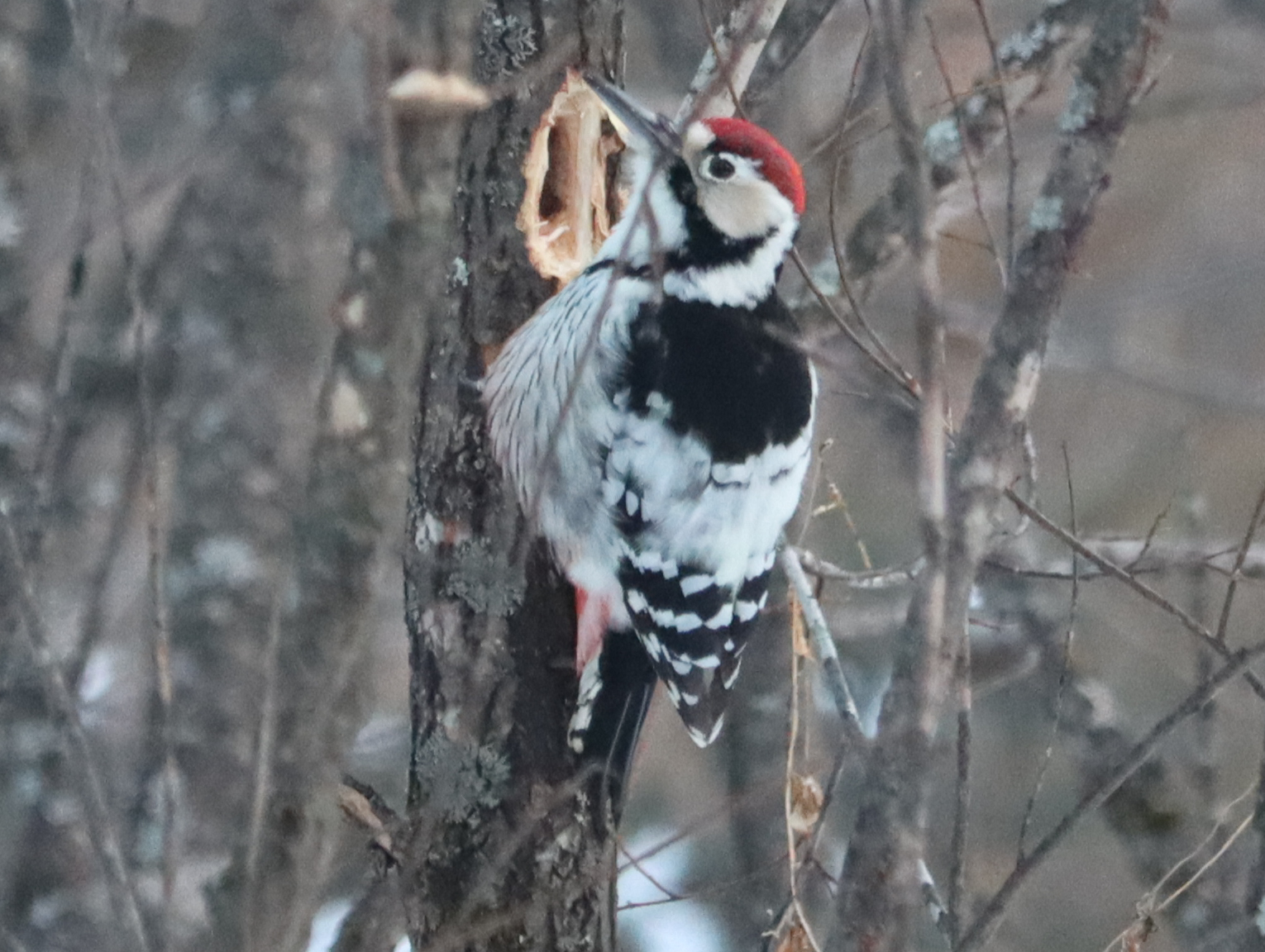
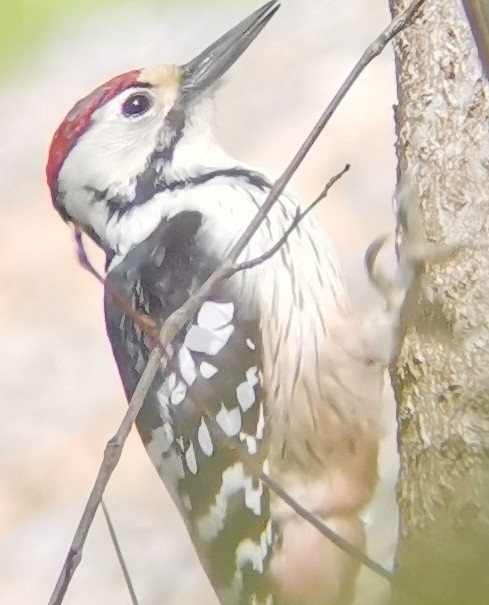
This is the largest spotted woodpecker species in the western Palearctic, measuring 24-26 cm in length with a wingspan of 38-40 cm. The plumage closely resembles the great spotted woodpecker but can be distinguished by the prominent white bars across the wings rather than spots, and notably by the pure white lower back that gives the species its name. The head pattern shows sexual dimorphism: males display a striking red crown, while females have a black crown. The underparts are generally pale with dark markings, and the bill is strong and chisel-like, typical of woodpeckers adapted for excavating wood.
Identification
The white lower back immediately distinguishes this species from the similar great spotted woodpecker, which lacks this feature entirely. The white bars across the wings provide another key识别 mark, as the great spotted shows round spots instead. The larger size compared to other Dendrocopos species helps with identification, as does the very loud, resonant drumming performed by males during the breeding season. The soft kiuk call and longer kweek are subtle but distinctive vocalizations that experienced observers learn to recognize.
Distribution & Habitat
The nominate race occurs across central and northern Europe, extending east through the Ural Mountains to northeast Asia, Korea, and Sakhalin. The lilfordi race occupies the Balkans and Turkey, with additional subspecies distributed through the Caucasus, Japan, Taiwan, and coastal islands including Jeju and Ulleungdo. This species requires large tracts of mature deciduous forest with significant amounts of both standing and lying dead wood, making it scarce and local throughout its extensive range.
Behavior & Ecology
During breeding season, this woodpecker excavates nest cavities approximately 7 cm wide and 30 cm deep in decaying tree trunks. The female lays three to five white eggs, incubated by both parents for 10-11 days. The diet consists primarily of wood-boring beetles and their larvae, supplemented by other insects, nuts, seeds, and berries. Males produce very loud drumming displays, and vocalizations include a soft kiuk and a longer kweek note.
Conservation
Numbers have decreased significantly in Nordic countries, prompting Sweden to enact specific protection measures through its national Biodiversity Action Plan. The species' dependence on large, undisturbed deciduous forest tracts makes it vulnerable to habitat fragmentation and forestry practices that remove dead wood. While not globally threatened, local populations face ongoing pressure from forest management practices that reduce suitable habitat availability.
Source: Wikipedia · CC BY-SA 3.0
Taxonomy
- Order
- Piciformes
- Family
- Picidae
- Genus
- Dendrocopos
- eBird Code
- whbwoo1
Vocalizations
Subspecies (12)
-
Dendrocopos leucotos fohkiensis
mountains of southeastern China (Fujian)
-
Dendrocopos leucotos insularis
Taiwan
-
Dendrocopos leucotos leucotos
northern Europe (Norway, Sweden, Finland, and Poland) south to eastern Switzerland, Austria, northern Serbia, and the Carpathian Mountains, and east through southern Russia to Kamchatka, Sakhalin, northeastern China, and Korea
-
Dendrocopos leucotos lilfordi
Pyrenees to Türkiye, Caucasus, and Transcaucasia
-
Dendrocopos leucotos namiyei
southern Honshu, Kyushu, Shikoku, and Cheju-Do Islands
-
Dendrocopos leucotos owstoni
Amami-O-Shima (northern Ryukyu Islands, southern Japan)
-
Dendrocopos leucotos quelpartensis
Jeju Island (Quelpart), off southern South Korea
-
Dendrocopos leucotos stejnegeri
Japan (northern Honshu)
-
Dendrocopos leucotos subcirris
northern Japan (Hokkaido)
-
Dendrocopos leucotos takahashii
Ullung Island (off eastern Korea)
-
Dendrocopos leucotos tangi
western China (Sichuan)
-
Dendrocopos leucotos uralensis
western Siberia from the Ural Mountains eastward to Lake Baikal
Data Sources
Species description from Wikipedia, licensed under CC BY-SA 3.0.
Bird images and sounds sourced from GBIF, contributed by citizen scientists worldwide under Creative Commons licenses.
Taxonomy data from AviList 2025.