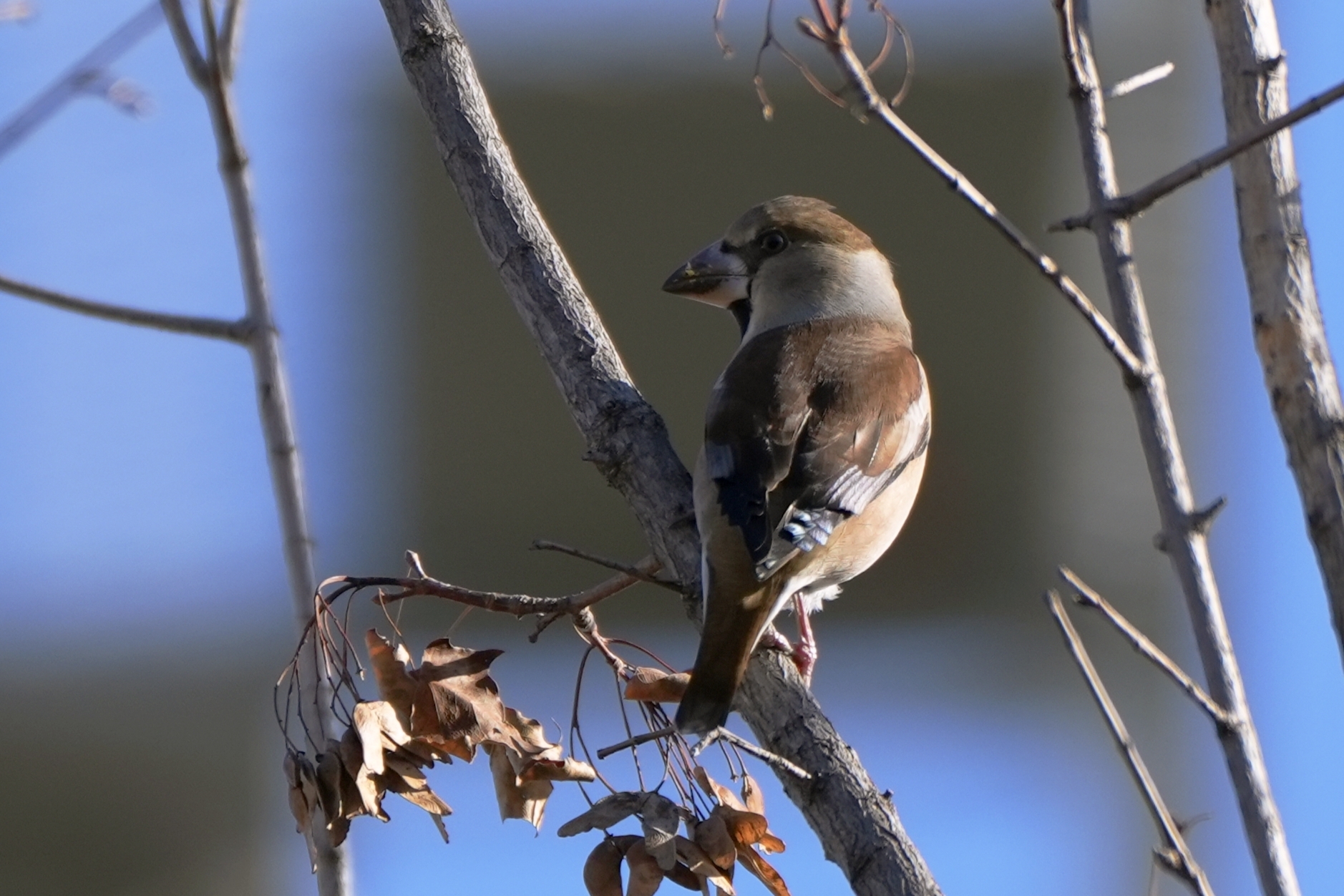
Hawfinch
Coccothraustes coccothraustes
锡嘴雀
Introduction
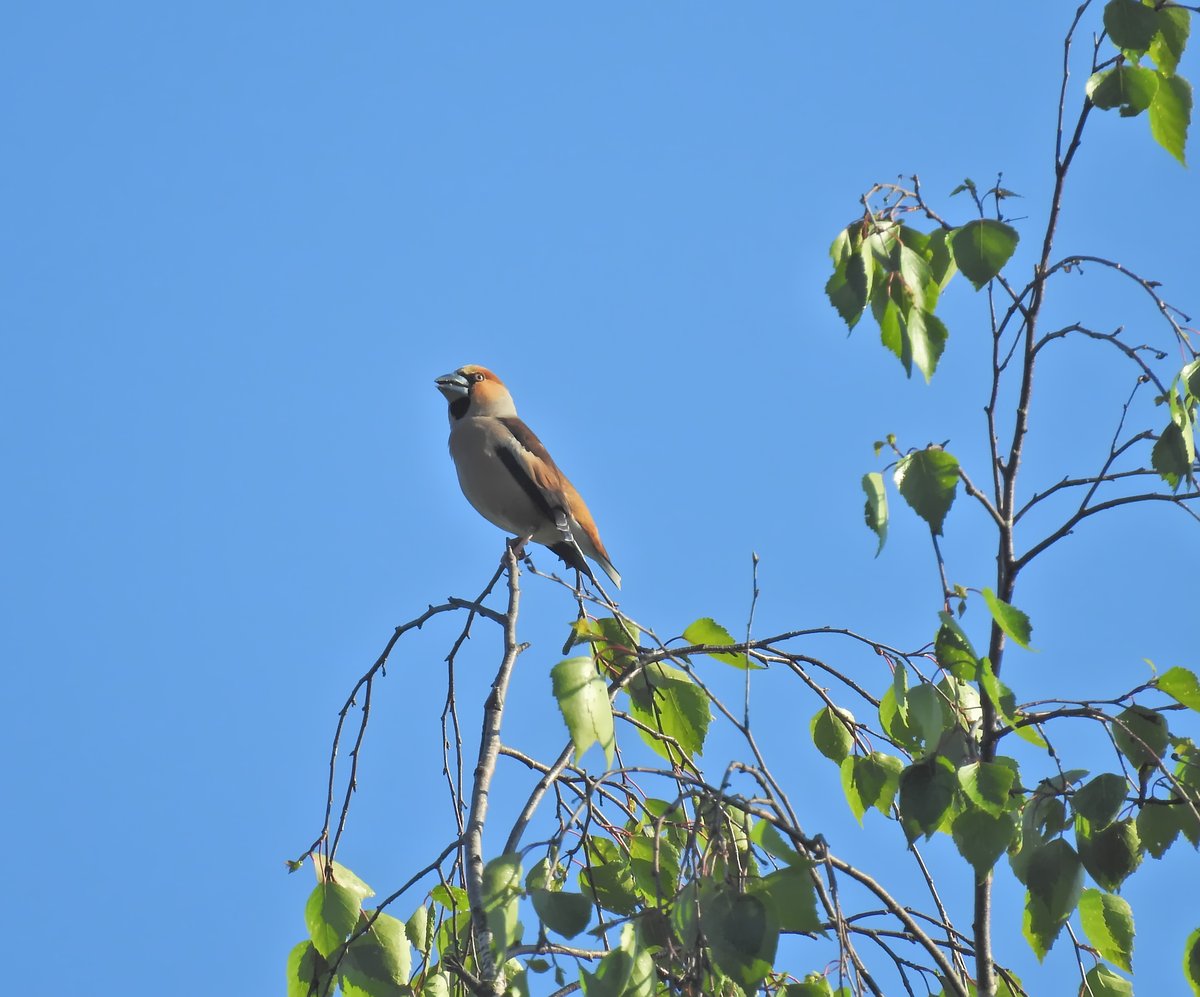
The hawfinch is a large finch found across the Palearctic from Britain to Japan. It inhabits mature deciduous and mixed woodlands with substantial trees, particularly hornbeam stands. Western European populations are mainly resident, while eastern populations migrate southward in winter. This species possesses a powerful bill capable of crushing cherry and plum pits. It gives a hard 'chick' call and typically occurs in pairs or small groups. The hawfinch is a rare vagrant to western Alaska, considered accidental.
Description
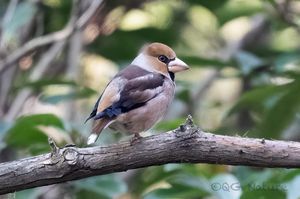
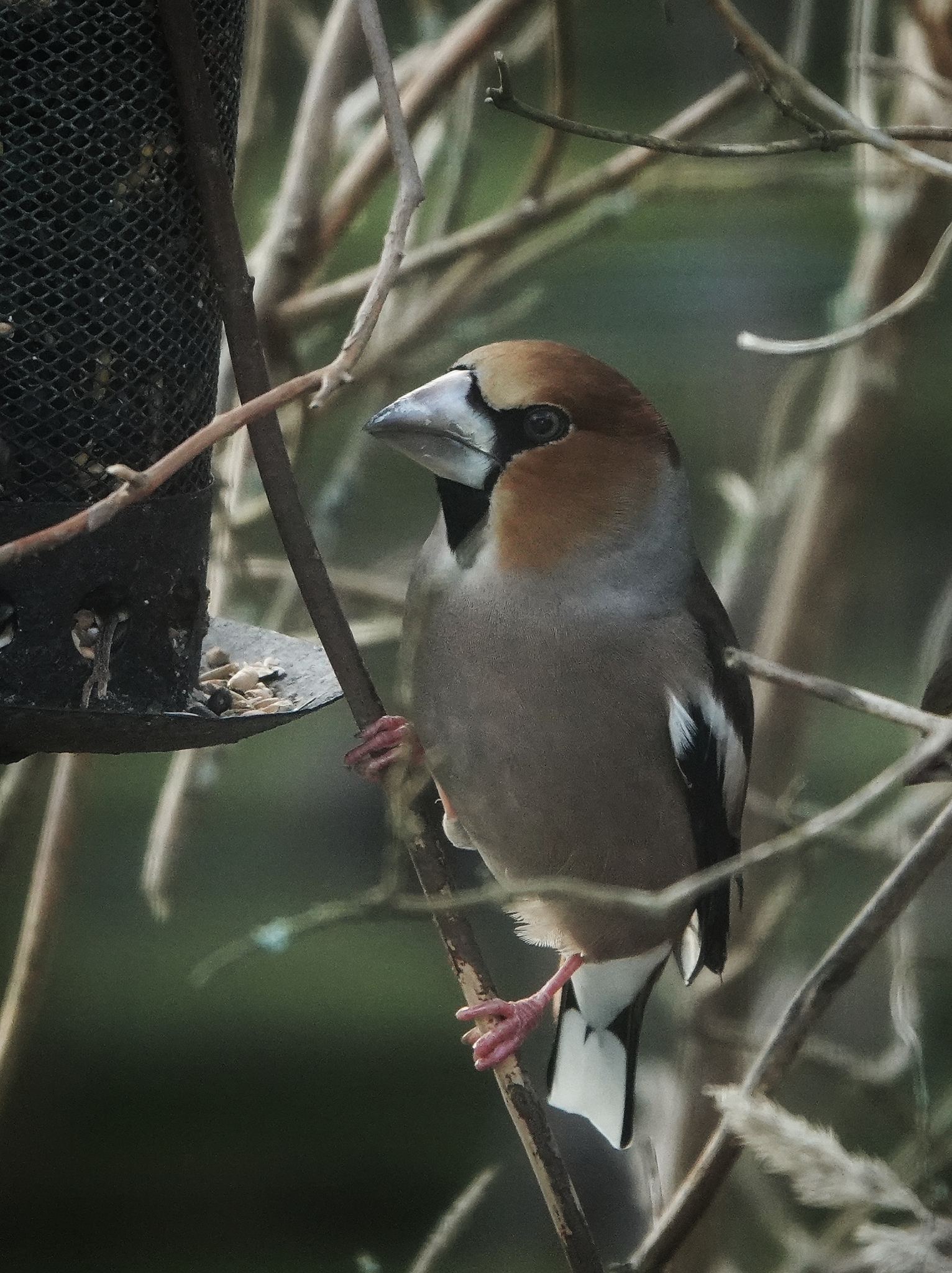
This is a notably robust finch measuring 16.5-18 cm in length with a wingspan of 29-33 cm and weighing 46-70 g. It has an unmistakable silhouette: a thick neck, large rounded head, and short tail creating a bulky appearance. The massive, conical bill is black in summer and paler in winter. The head shows orange-brown plumage with a striking black eyestripe and bib. Upperparts are dark brown, underparts orange. In flight, the white wing bars and tail tip become conspicuous markers. The sexes appear similar, though females are marginally paler. Additional distinguishing features include gray on the sides and back of neck, deep black upper wings with three stripes (white, brown, and blue), short pinkish legs, and brown eyes. Adults undergo a complete molt between July and September.
Identification
The hawfinch is unmistakable within its range when seen well, thanks to its unique combination of massive bill, bull-headed profile, and short tail. The black face pattern with orange-brown head coloration separates it from other finches. In flight, the white wing bars and tail tip are diagnostic. It may be confused with other grosbeaks, but its smaller size and distinctive head pattern help distinguish it. The powerful bill—larger and more conical than other European finches—is the best single identification feature. Birds appear short-tailed and bulky both at rest and in flight, giving a rather 'tailless' impression compared to other finches.
Distribution & Habitat
This species breeds across the entire Palearctic, from Britain and Portugal east through Europe, the Caucasus, and temperate Asia to Japan and Kamchatka. It also occurs in North Africa (Morocco, Tunisia, Algeria). Notable absences include Iceland and some Mediterranean islands. Northern range expansion since the 1950s now extends to Northern Norway. The favored habitat is deciduous forest during breeding season, particularly oak woodland, though it also uses parks, gardens, and pine woods near water. In autumn and winter, it seeks out cherry and plum woods. It occurs from lowland areas up to the tree line. British populations declined significantly from the 1990s onward, with southeastern England now the stronghold.
Behavior & Ecology
A shy and inconspicuous species that spends most time hidden in the canopy, emerging mainly to feed on seeds or drink. It feeds on hard seeds from trees—especially cherries, plums, and pines—using a bill capable of crushing pits with 30-48 kg of force. Breeding begins at one year, with monogamous pairs forming before winter flocks break up. Courtship involves elaborate displays: mutual bill-touching, male head-puffing, bowing, and wing-waving. The unusual male selects the nest site and begins construction. Clutches of 4-5 eggs (sometimes 2-7) are laid late April to late June in Europe. Eggs show purple-brown and pale gray squiggles on variable backgrounds. Both parents feed nestlings, which fledge after 12-14 days. The species is unusual among finches in removing fecal sacs throughout the nesting period. Flight is quick and direct over short distances, with longer flights showing undulations. Partial migration occurs in northern populations, with some birds reaching Britain in autumn.
Conservation
Classified as Least Concern globally due to high numbers (estimated 14.7-50.4 million individuals) and extensive range. The European population is 7.2-12.6 million pairs, with significant populations in Romania, Croatia, and Germany. However, the species faces severe local declines: UK numbers fell 76% between 1968 and 2011, with only 500-1,000 breeding pairs estimated by 2013. British breeding distribution has contracted dramatically since the 1990s. The reasons for these regional declines remain poorly understood, though habitat loss and changes in woodland management may be factors. The annual survival rate is unknown, though maximum recorded age is 12 years and 7 months.
Culture
The hawfinch has been recognized in European ornithology for centuries. It was described and illustrated by Conrad Gesner in his 1555 work Historiae animalium. Carl Linnaeus included it in the 10th edition of Systema Naturae (1758). The English name 'hawfinch' derives from 'haws,' the red berries of the common hawthorn, though the bird does not particularly favor hawthorn. The Latin genus name Coccothraustes comes from Greek: 'kokkos' (seed) and 'thrauō' (to break), referring to its powerful bill. Ornithologist Francis Willughby recorded the English name in 1676. No significant folklore or cultural traditions are associated with this species.
Source: Wikipedia · CC BY-SA 3.0
Taxonomy
- Order
- Passeriformes
- Family
- Fringillidae
- Genus
- Coccothraustes
- eBird Code
- hawfin
Subspecies (6)
-
Coccothraustes coccothraustes buvryi
mountains of Morocco, Algeria, and Tunisia
-
Coccothraustes coccothraustes coccothraustes
Europe to central Siberia and northern Mongolia
-
Coccothraustes coccothraustes humii
eastern Kazakhstan to Kyrgystan, Tajikistan, and western Afghanistan
-
Coccothraustes coccothraustes japonicus
breeds Sakhalin, Hokkaido, and northern Honshu; winters to eastern China and Bonin Islands
-
Coccothraustes coccothraustes nigricans
Ukraine to Crimean Peninsula, Caspian Sea, and northern Iran
-
Coccothraustes coccothraustes shulpini
southeastern Siberia, northeastern China, and Korean Peninsula
Data Sources
Species description from Wikipedia, licensed under CC BY-SA 3.0.
Bird images and sounds sourced from GBIF, contributed by citizen scientists worldwide under Creative Commons licenses.
Taxonomy data from AviList 2025.