Long-tailed Duck
Clangula hyemalis
长尾鸭
Introduction
The long-tailed duck (Clangula hyemalis) is a medium-sized sea duck. It inhabits Arctic and subarctic regions throughout the Northern Hemisphere. This species uses its wings for underwater propulsion, enabling dives to depths of 60 meters or more—deeper than other diving ducks. Winter flocks concentrate along northern coastlines, with the Baltic Sea hosting approximately 4.5 million individuals. The breeding range has expanded westward in recent decades to include parts of Western Europe. Males produce whistling calls during the breeding season. The species is highly gregarious, forming large, vocal flocks.
Description
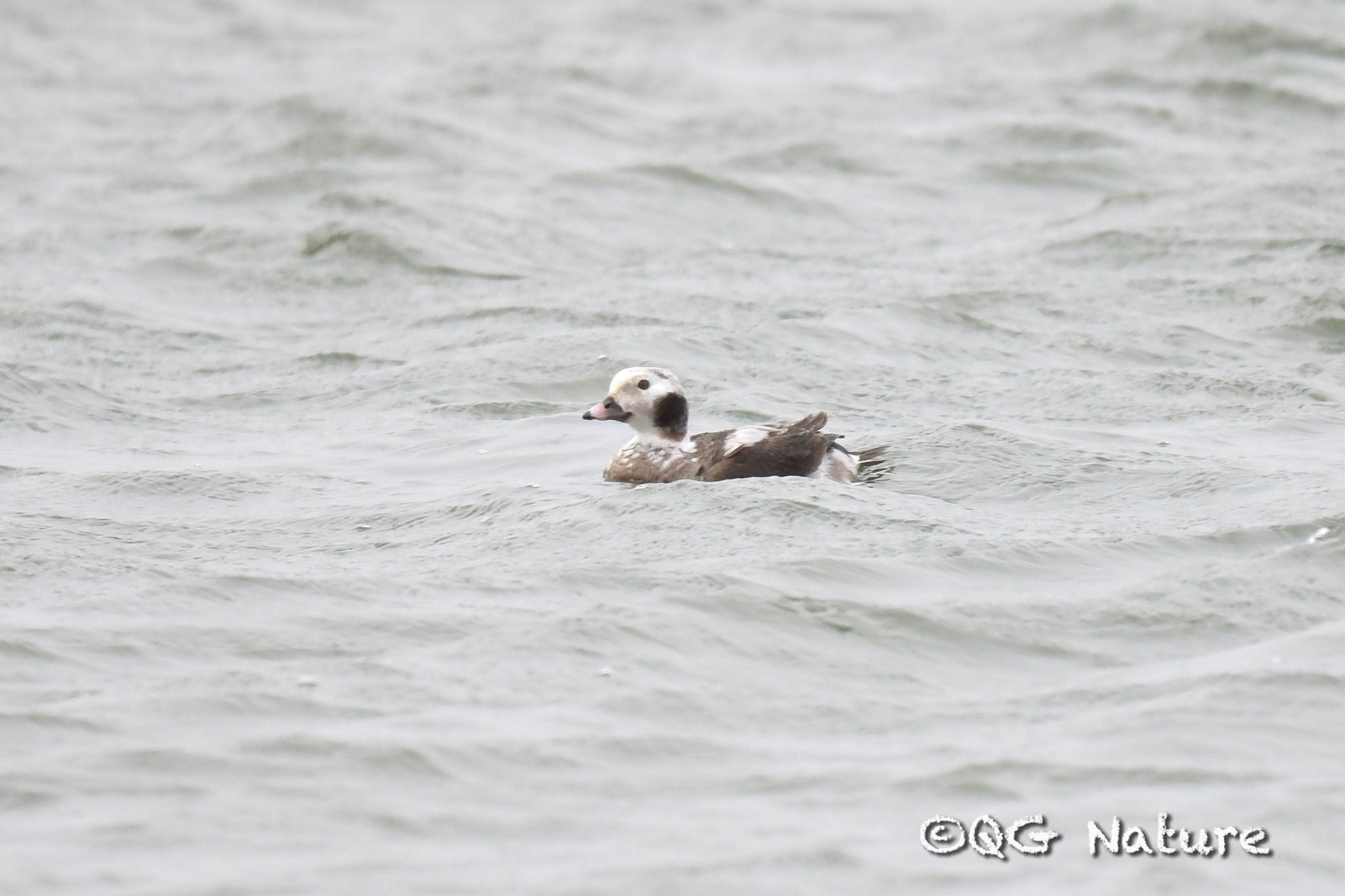
This medium-sized sea duck weighs approximately 500-900 grams and measures 41-67 cm in length, with males being larger. The most striking feature is the male's extraordinarily long pointed tail, measuring 10-15 cm. Adults have white underparts, though the rest of the plumage undergoes complex seasonal transformations. In winter plumage, males display a dark cheek patch on a predominantly white head and neck, a dark breast, and mostly white body, complemented by a dark grey bill crossed by a pink band. Summer males are darker overall, with blackish head, neck, and back, contrasting with a white cheek patch. Females have a brown back and shorter pointed tail; winter females show white head and neck with a dark crown, while summer females are dark-headed. Juveniles resemble adult females but with a lighter, less distinct cheek patch.
Identification
The male's exceptionally long tail, visible even in flight, is the most diagnostic feature and sets this species apart from all other sea ducks. In winter plumage, the combination of white head with a dark cheek patch on males and dark-crowned white head on females helps distinguish them from similarly sized scoters and goldeneyes. The pink band on the dark bill is also distinctive when visible. Unlike eiders and scoters, this species has a more slender profile and shows extensive white in the wings. The loud, yodelling calls of males are unmistakable and often help locate distant flocks on the water.
Distribution & Habitat
Breeding occurs across Arctic and subarctic regions of northern Eurasia, including Russian Siberia, Kamchatka, and Karelia, as well as the Faroe Islands, Finland, Iceland, Norway, and parts of southern Greenland. In North America, breeding ranges across Alaska and northern Canada. Winter distribution concentrates along northern coastlines of the Pacific and Atlantic Oceans, including Hudson Bay and the Great Lakes, with smaller numbers reaching the Missouri River. The Baltic Sea represents the most important wintering area globally. As of 2022, breeding has expanded into Western Europe, including the Marker Wadden in the Netherlands.
Behavior & Ecology
This species breeds near water in tundra pools, marshes, coastal areas, and northern mountain lakes. Nests are constructed on the ground using vegetation and lined with down. Highly gregarious, they form large flocks throughout winter and during migration. Feeding involves diving for mollusks, crustaceans, and small fish, typically close to the surface but capable of remarkable depths. Unlike other ducks, they use their wings to swim underwater. Males produce a distinctive, musical yodelling call—described as ow, ow, owal-ow—that carries across wintering waters and serves to locate dispersed flocks.
Conservation
The International Union for Conservation of Nature categorizes this species as vulnerable due to significant population declines, particularly in the Baltic Sea wintering grounds. Major threats include hunting across much of their range and mortality from entanglement in gillnets. The species is protected under the Agreement on the Conservation of African-Eurasian Migratory Waterbirds. Conservation efforts require collaboration with Native American tribes whose assistance has been essential for implementing protection measures in North America.
Culture
The species was formerly known as 'oldsquaw' in North America, though this name fell out of favour due to concerns about potential offensiveness to Native American communities. In 2000, the American Ornithologists' Union formally adopted 'long-tailed duck' following advocacy from conservation biologists who recognized the need for tribal cooperation in protection efforts. Alternative regional names include coween, south-southerly, and old wife, reflecting the species' prominence in coastal communities throughout its range.
Source: Wikipedia · CC BY-SA 3.0
Taxonomy
- Order
- Anseriformes
- Family
- Anatidae
- Genus
- Clangula
- eBird Code
- lotduc
Distribution
breeds coastal Greenland (except northern), Iceland, northern Fennoscandia, northern Russia to Chukotka Peninsula, Alaska and northern Canada; winters mostly in coastal bays of northwestern Europe, Japan and Korean Peninsula, and Aleutian Islands to southwestern Canada
Data Sources
Species description from Wikipedia, licensed under CC BY-SA 3.0.
Bird images and sounds sourced from GBIF, contributed by citizen scientists worldwide under Creative Commons licenses.
Taxonomy data from AviList 2025.