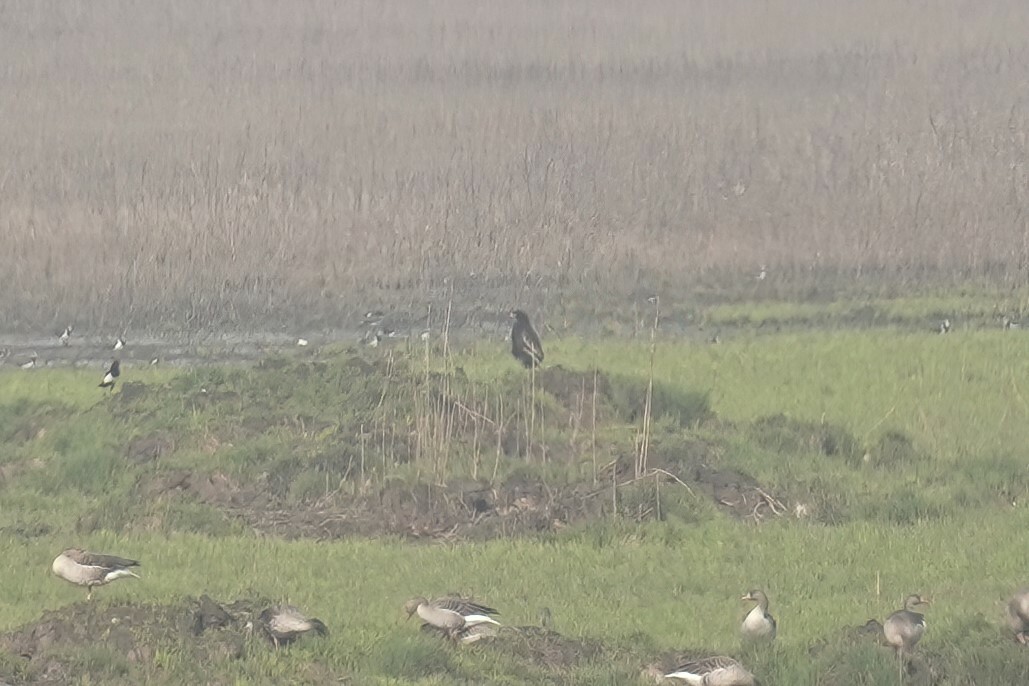
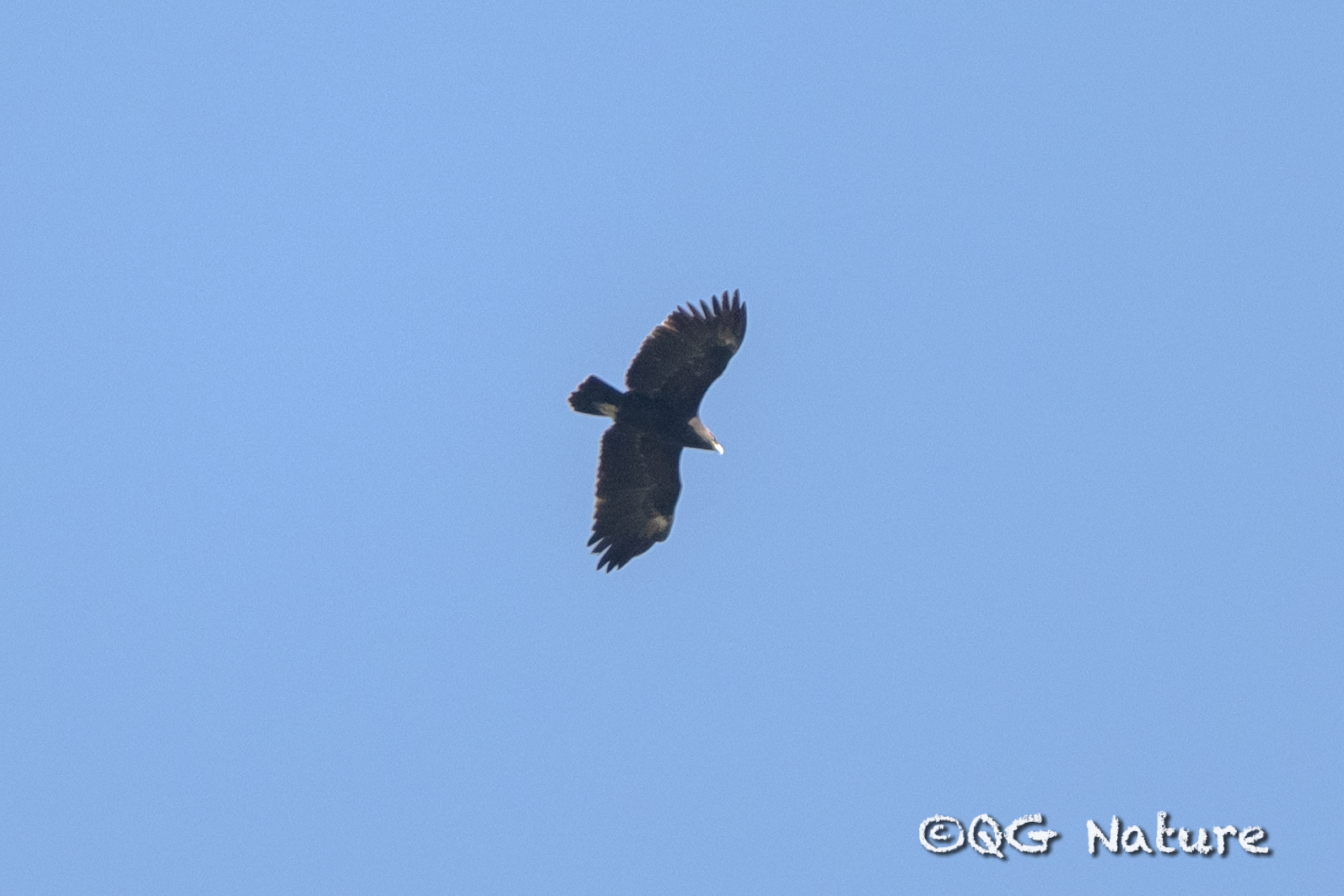
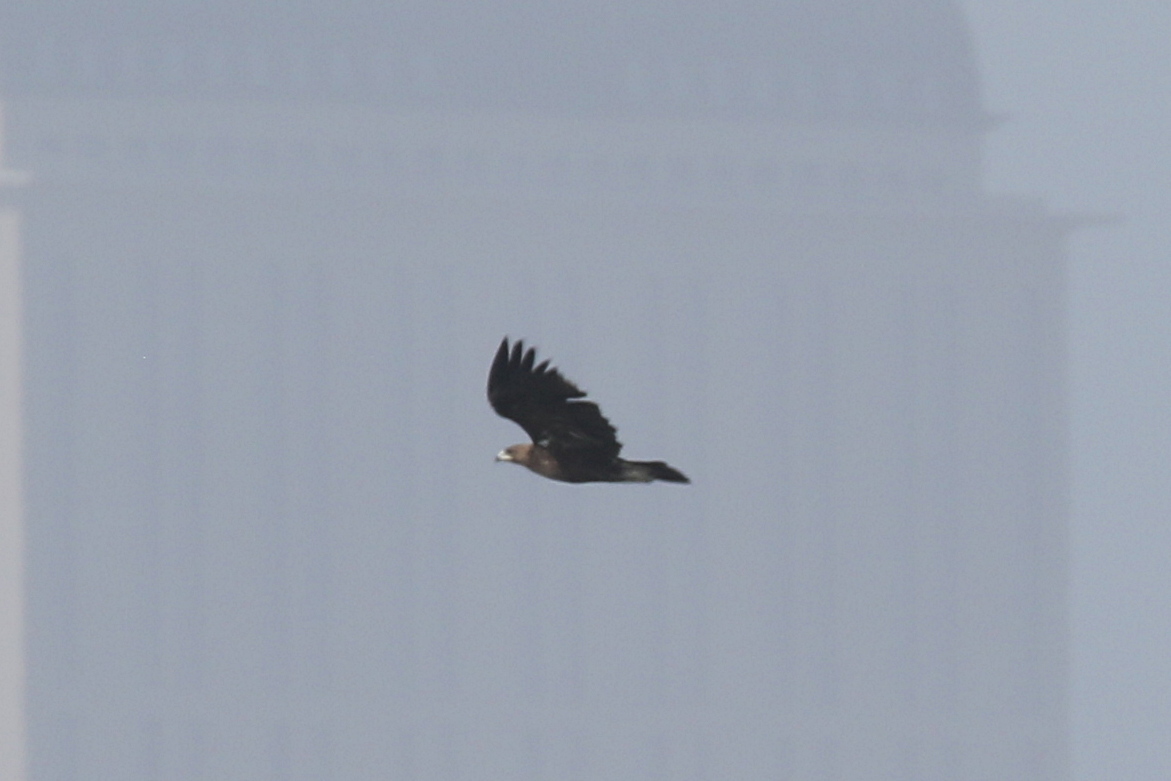
Greater Spotted Eagle
Clanga clanga
乌雕
Introduction
The greater spotted eagle is a large migratory raptor with dark brown plumage and a yellow beak. Its breeding range extends from Eastern Europe to the Pacific Ocean. It favors wetter habitats than other booted eagles, including floodplains, bogs, lakesides, and riparian woodlands. During winter, it disperses across the Mediterranean Basin, Middle East, South Asia, and Southeast Asia, where it frequents wetland habitats as well as paddy fields, garbage dumps, and sewage farms. It can be distinguished from the lesser spotted eagle by its broader wings, darker overall appearance, and more compact build. The species exhibits siblicide, where older chicks may kill their younger siblings.
Description
A large, compact eagle with dark brown to blackish plumage and a contrasting yellow beak. It has a short neck supporting a large, often shaggy-naped head with a strong beak and round nostrils. The wings are broad and long, reaching the tail tip, while the tail itself is relatively short and rounded—giving a vulture-like silhouette. Adults are uniformly dark with a pale beak and usually-concealed white U above the tail. Juveniles are black-brown with distinctive whitish to yellowish drop-shaped spots, particularly along the wing coverts. The species shows strong sexual dimorphism: females can be up to 26% larger linearly and twice as heavy as males. Body length ranges 59-74 cm, wingspan 155-185 cm, and body mass 1,537-3,250 g depending on sex. Eyes are dark brown across all ages, while beak and feet remain yellow throughout life.
Identification
Distinguishing from the lesser spotted eagle requires attention to structure and proportions. Adults appear broader-winged with a relatively smaller head, and are typically conspicuously darker with uniform dark upperwing coverts lacking the rusty tones of lesser spotteds. Females can effectively dwarf most lesser spotted eagles, though size overlap exists between small males and large females. Juveniles show stronger spotting and barring than lesser spotteds but lack the pale nape patch. Hybrids present significant identification challenges. Compared to steppe eagles, this species is smaller and bulkier with a shorter neck, smaller bill, and darker plumage. The fulvescens (pale) morph, with buffy wing coverts contrasting with dark flight feathers, can resemble other large eagles but shows a distinct carpal arc and dark, thinly barred quills. In flight, look for the single white crescent at the base of primaries and dark underwing with nine to eleven narrow bars.
Distribution & Habitat
Breeds across the Palearctic from Eastern Europe through central Russia to China, with isolated populations in Central Asia. Favors wet woodland habitats—floodplain forests, bogs, lakesides, and riparian zones—more than other booted eagles. Almost entirely migratory, moving between late August-October and returning February-April. Eastern European populations migrate through the Balkans and Central Europe to winter in southern France, Spain, Italy, and North Africa. Asian populations winter in the Arabian Peninsula, Indian subcontinent, Indochina, and southern China. During migration, they appear widely across the Middle East, Central Asia, and South Asia, occasionally reaching Southeast Asia. Wintering grounds focus on wetlands including coastal lagoons, mangroves, marshes, and large river systems from sea level to 300 m elevation, though recorded up to 4,370 m in the Himalayas.
Behavior & Ecology
An opportunistic predator and scavenger, this eagle takes small mammals (especially water voles), water birds, frogs, reptiles, and insects. Hunting occurs mainly on the wing, gliding from concealed perches over marshes or wet fields, though it also still-hunts from elevated positions and occasionally walks on the ground. During winter, it readily scavenges carrion and piratically steals food from other raptors. Breeding occurs from late April-August, with pairs building large stick nests (70-110 cm across) in tree forks, often using fresh branches with foliage still attached. Clutches contain one to three eggs, with females incubating while males hunt. Siblicide is common—the older, larger chick often kills its younger sibling. Parents rarely raise more than one fledgling annually. Vocalizations include a high-pitched penetrating whistle (kyack/kluh) and a three-syllable warning bark. During breeding and winter, they can be vocal, especially in small loose flocks around food sources.
Conservation
Classified as Vulnerable by the IUCN, this eagle occurs at extremely low densities across its vast range. Global population estimated at 3,800-13,200 mature individuals, with European Union populations at 810-1,110 breeding pairs. Strong declining trends have been detected throughout its range, with extirpation from Hungary, Romania, Bulgaria, and other countries. Primary threats include wetland drainage, agricultural intensification, and abandonment of floodplain management practices. Hybridization with lesser spotted eagles poses significant concern, with pure populations being replaced in some areas. Additional threats include human disturbance during breeding, poisonings (including secondary poisoning from pesticides), and collisions with electrical wires. Conservation efforts focus on protecting breeding sites in Belarus, Estonia, and Ukraine, where working groups have implemented restrictions on forestry activities near nests. An international project titled 'Above the borders' addresses conditions across breeding, wintering, and migratory areas.
Culture
The greater spotted eagle holds limited documented cultural significance compared to other raptors. As a relatively obscure species until recent decades, it lacks the rich folklore traditions associated with larger, more conspicuous eagles. Its reclassification from the genus Aquila to Clanga, reflecting modern understanding of eagle evolution, represents a significant taxonomic milestone rather than cultural heritage. The species' scientific name derives from Ancient Greek, possibly from 'klangge' meaning 'scream' or 'klangos' referring to a kind of eagle mentioned by Aristotle—though this etymology falls outside the scope of birdwatching-focused information. Conservation initiatives have created some cultural awareness in countries like Poland and Belarus, where the species serves as a flagship for wetland protection. The dramatic hybridization with lesser spotted eagles and resulting conservation challenges have also drawn attention from birdwatching communities and raptor specialists across Europe.
Source: Wikipedia · CC BY-SA 3.0
Taxonomy
- Order
- Accipitriformes
- Family
- Accipitridae
- Genus
- Clanga
- eBird Code
- grseag1
Distribution
breeds central Eurasia and southern Asia; winters to Africa, China, and Indochina
Vocalizations
Data Sources
Species description from Wikipedia, licensed under CC BY-SA 3.0.
Bird images and sounds sourced from GBIF, contributed by citizen scientists worldwide under Creative Commons licenses.
Taxonomy data from AviList 2025.