Zitting Cisticola
Cisticola juncidis
棕扇尾莺
Introduction
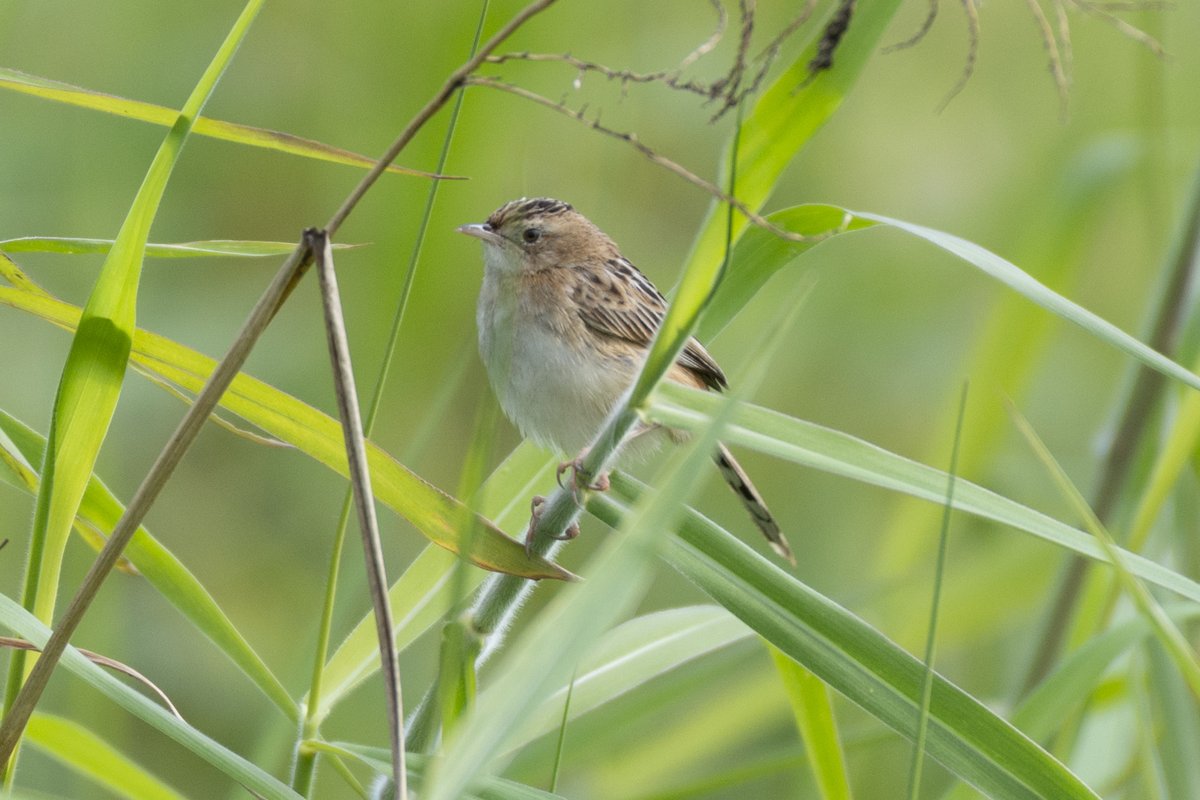
Old World warbler in the family Cisticolidae. Breeding range extends across western and southern Europe, Africa outside deserts and rainforest, and southern Asia to northern Australia. Inhabits grassland habitats, typically near water. Most distinctive traits are the rufous rump visible in flight and the male's zigzagging display flight accompanied by regular 'zit' calls, which give the species its English name. Builds a pouch nest suspended within a clump of grass. Range is generally expanding in Europe, with first British breeding recorded in 2025.
Description
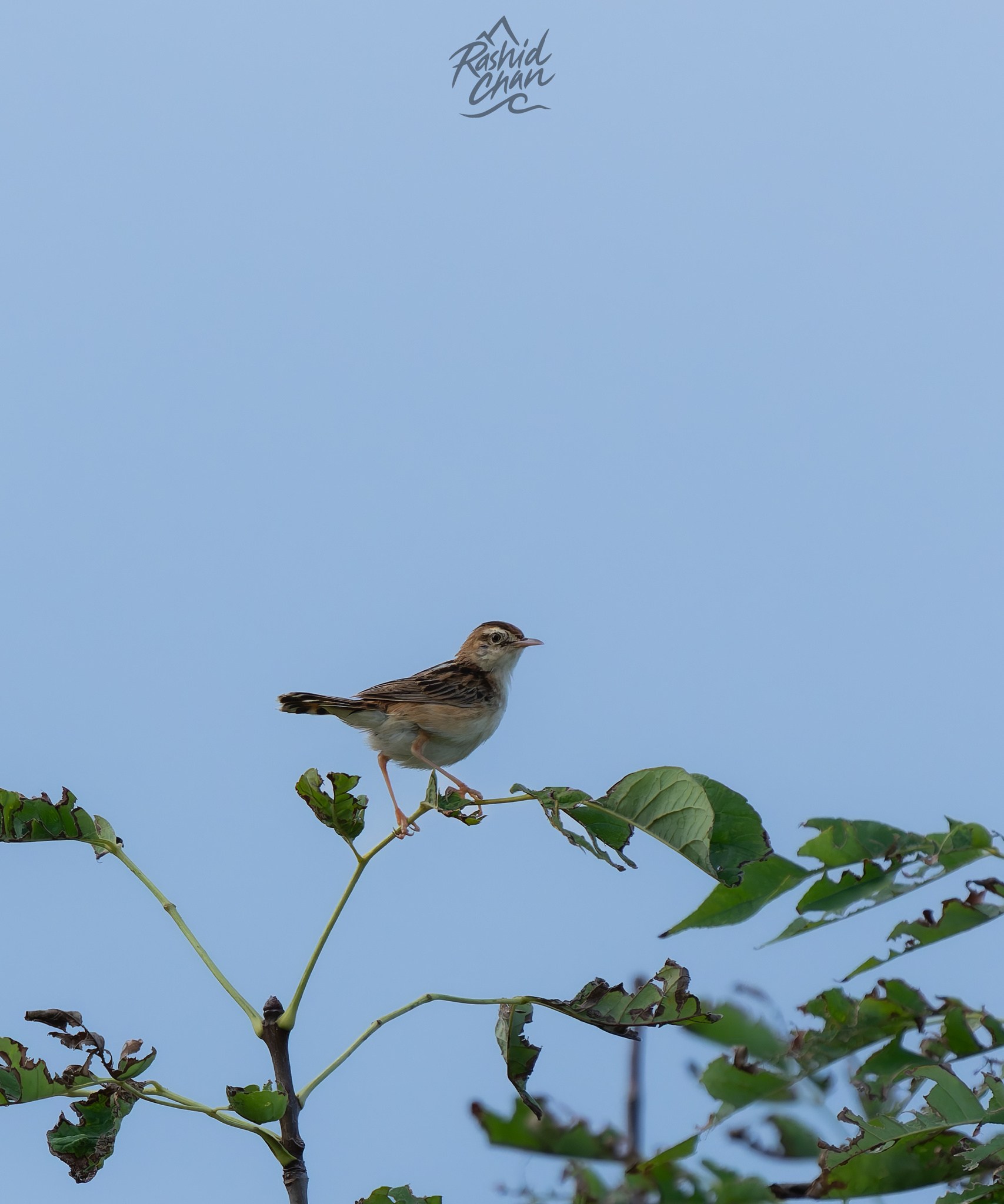
Small warbler measuring 10 to 12 cm (3.9 to 4.7 in) in length. Upperparts brown with heavy black streaking. Underparts whitish. Tail is broad and white-tipped, frequently flicked. Adult males show less crown streaking and more back marking than females, though differences between sexes and among the 17 subspecies are minor.
Identification
Best identified by the rufous rump visible during flight. Lacks any gold on the collar, distinguishing it from similar species. The brownish tail is conspicuously tipped with white. The absence of a nuchal collar separates this species from the golden-headed cisticola (Cisticola exilis). During the non-breeding season, individuals skulk within grass and can be difficult to observe.
Distribution & Habitat
Found mainly in grassland habitats, often near water. Range spans western and southern Europe, Africa outside deserts and rainforest, southern Asia to northern Australia, and the Australasian region. Most populations are resident, but some East Asian populations migrate south in winter. In the Himalayas, occurs at elevations around 1,900 m (6,200 ft) in summer but below 1,300 m (4,300 ft) in winter. A rare vagrant to northern Europe, mostly as a spring overshoot. European range is generally expanding northward.
Behavior & Ecology
Very small insectivorous birds, sometimes found in small groups. Breeding season coincides with rains, with two broods per year in many regions. Males are generally polygynous, though some are monogamous. Males construct the initial nest structure deep in grasses and use display flights to attract females. The cup-shaped nest features an overhead canopy of tied leaves for camouflage, constructed from bound living leaves, plant down, cobwebs, and grass. Females complete the nest and incubate 3-6 eggs, which hatch after about 10 days. Females change mates frequently and rarely remain in the same territory, while males maintain non-overlapping song-territories that shift daily. Some females breed in their first year.
Conservation
No specific IUCN assessment or conservation status mentioned in the available text. Northern populations are noted to be especially susceptible to hard winters.
Culture
Previously known as the fan-tailed warbler or streaked fantail warbler. The current name was adopted to provide consistency with the many tropical cisticola species and to avoid confusion with an American species also bearing the fan-tailed warbler name.
Source: Wikipedia · CC BY-SA 3.0
Taxonomy
- Order
- Passeriformes
- Family
- Cisticolidae
- Genus
- Cisticola
- eBird Code
- zitcis1
Vocalizations
Subspecies (17)
-
Cisticola juncidis brunniceps
southern Korea, Japan (Honshu and southward, including Ryukyu and Izu islands, southern Japan), and far northern Philippines (Batan Islands)
-
Cisticola juncidis cisticola
coastal western France to Iberian Peninsula, Balearic Islands, and northwestern Africa
-
Cisticola juncidis constans
Sulawesi region, including Togian and Peleng, in Banggai Islands (off eastern Sulawesi), and Muna and Tukangbesi islands (to southeast)
-
Cisticola juncidis cursitans
eastern Afghanistan to Pakistan, Nepal, northern Myanmar, India, and Sri Lanka
-
Cisticola juncidis fuscicapilla
eastern Java, Kangean Islands, and Lesser Sundas
-
Cisticola juncidis juncidis
southern France to Corsica, Sardinia, Balkans, Türkiye, Syria, and Israel
-
Cisticola juncidis laveryi
northeastern Australia (Ingham to Rockhampton, northeastern Queensland)
-
Cisticola juncidis leanyeri
north-central Australia (Tiwi Islands, northeastern Northern Territory, and southwestern Gulf of Carpentaria)
-
Cisticola juncidis malaya
Nicobar Islands, southern Myanmar, and Thailand through the Thai-Malay Peninsula to Sumatra and Java
-
Cisticola juncidis neuroticus
Cyprus, Levant, Iraq, and western Iran
-
Cisticola juncidis nigrostriatus
southwestern Philippines (Culion and Palawan)
-
Cisticola juncidis normani
coastal southern New Guinea and coastal northeastern Australia (southeastern Gulf of Carpentaria to Princess Charlotte Bay)
-
Cisticola juncidis omalurus
Sri Lanka
-
Cisticola juncidis salimalii
southwestern India (Kerala)
-
Cisticola juncidis terrestris
Equatorial Guinea (Río Muni), central Democratic Republic of the Congo, Burundi, and southern Tanzania southward to southern South Africa
-
Cisticola juncidis tinnabulans
southern China to Indochina, Hainan, Taiwan, and Philippines
-
Cisticola juncidis uropygialis
Senegal to southern Nigeria, Sudan, Rwanda, and northern Tanzania; Mafia Island
Data Sources
Species description from Wikipedia, licensed under CC BY-SA 3.0.
Bird images and sounds sourced from GBIF, contributed by citizen scientists worldwide under Creative Commons licenses.
Taxonomy data from AviList 2025.