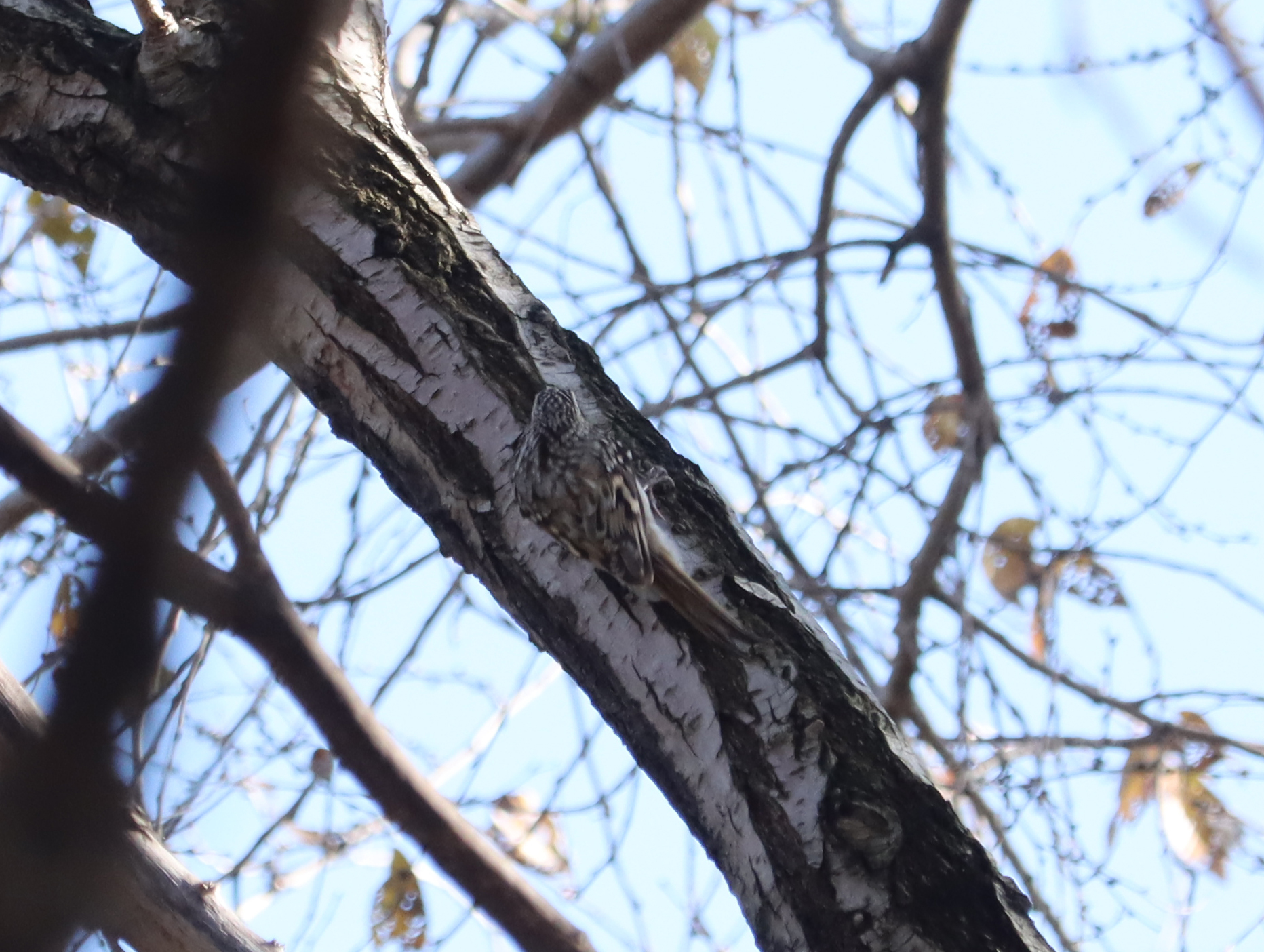
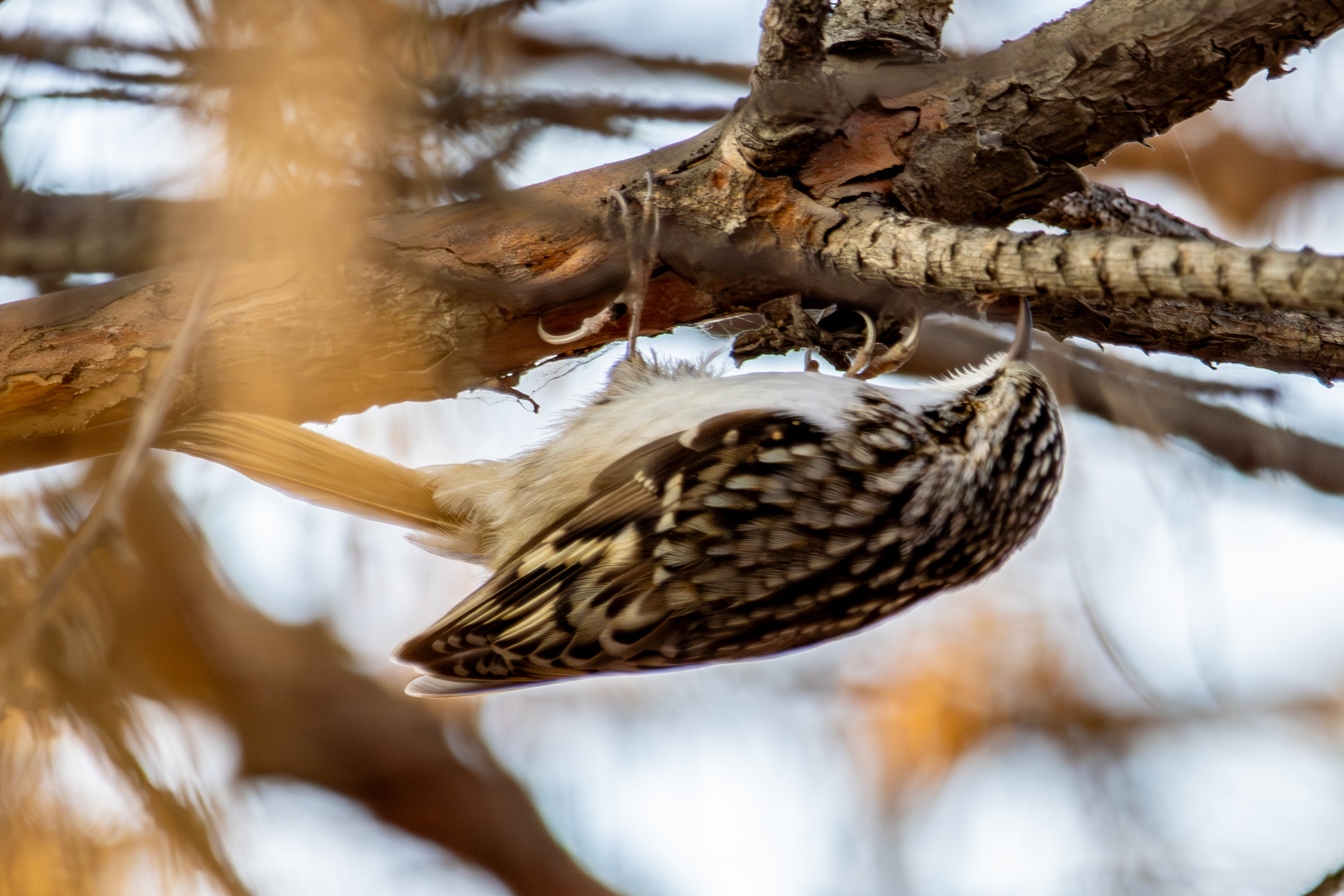
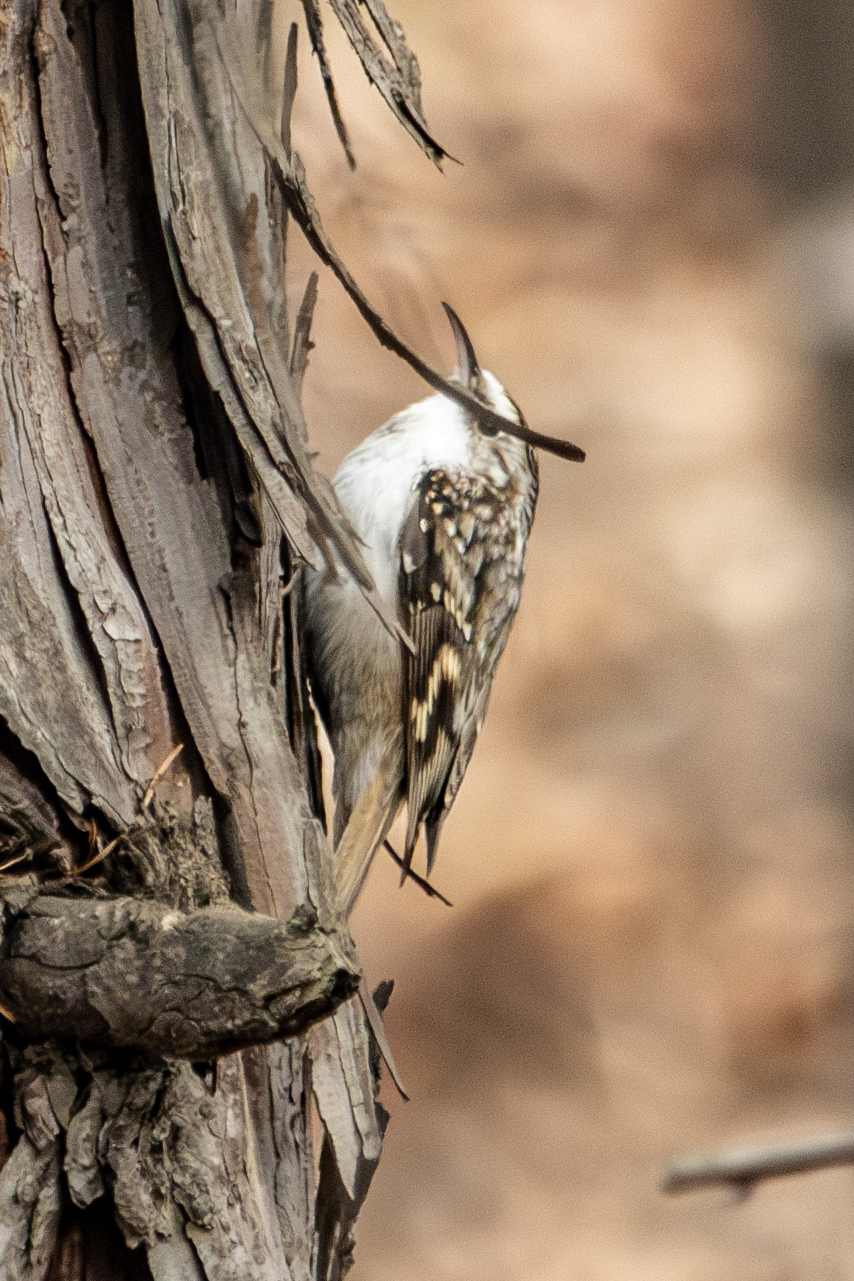
Eurasian Treecreeper
Certhia familiaris
欧亚旋木雀
Introduction
Small passerine. Climbing behavior: progresses upward in short hops along tree trunks using stiff tail feathers for support; probes bark crevices with long curved bill. Flight pattern undulating. Nests in tree crevices or behind loose bark flakes, including introduced giant sequoia. Clutch: 5-6 pink-speckled white eggs. Winter behavior: typically solitary; may form small communal roosts during severe cold. Range: Palearctic from Ireland to Japan. Habitat: woodlands of all types; in western Europe where co-occurring with short-toed treecreeper, prefers coniferous forests and higher elevations.
Description
A tiny woodland bird measuring 12.5 cm in length and weighing between 7.0 and 12.9 grams. The upperparts are warm brown, intricately patterned with black, buff and white markings that provide excellent camouflage against bark. The underparts are whitish with a buff tinge on the belly, flanks and vent area. It possesses a long, slender decurved bill perfectly adapted for extracting insects from narrow crevices. The tail is plain brown with long, stiff feathers that act as a prop while climbing. Sexes appear similar, though juveniles have duller upperparts and their underparts show fine dark spotting on the flanks.
Identification
The most reliable way to distinguish this species from the short-toed treecreeper in Europe is by voice. The song begins with srrih notes followed by twittering, a descending ripple and a rising whistle, quite different from the evenly spaced notes of short-toed. Visual identification can be challenging; this species appears whiter below and warmer with more spotting above than short-toed, with a whiter supercilium and slightly shorter bill. Plain brown tail distinguishes it from the bar-tailed treecreeper, and the white throat separates it from brown-throated treecreeper. The rusty-flanked treecreeper is best separated by its more contrasting cinnamon flanks versus this species' buff coloration. Even in hand, poorly marked birds may be impossible to identify to species.
Distribution & Habitat
The most widespread member of its genus, breeding across the Palearctic from Ireland to Japan. Throughout most of Europe where it coexists with short-toed treecreeper, it favors coniferous forest, particularly spruce and fir. Where it is the sole treecreeper, as in the British Isles, it prefers broadleaved or mixed woodland. It occurs from sea level in the north to high elevations in the south: above 1,370 m in the Pyrenees, 400-2,100 m in China, and 1,065-2,135 m in southern Japan. Mostly resident in mild western and southern areas, but northern birds move south in winter and mountain populations descend to lower elevations. Vagrants have reached Orkney, the Channel Islands, Majorca and the Faroe Islands.
Behavior & Ecology
Strictly insectivorous, this bird forages by creeping up tree trunks to extract insects and spiders from bark crevices with its fine curved bill. Unlike nuthatches, it never descends head-first, instead flying to the base of another tree to continue feeding. The sexes exploit different vertical zones: females typically forage on upper trunk sections while males use lower portions. Where wood ants have been active, arthropod prey is reduced and males spend less time on affected trunks. It may join mixed-species feeding flocks in winter but does not share discovered resources. About 20% of pairs, mainly in southern and western areas, raise a second brood. The typical lifespan is two years, though the maximum recorded age is eight years and ten months.
Conservation
Evaluated as Least Concern due to its extensive range of approximately 10 million square kilometers and large population. Europe alone holds an estimated 11-20 million individuals. Population trends have not been quantified but do not approach the thresholds for significant decline. The species is common through much of its range but remains rare in northernmost areas where it is vulnerable to hard winters, particularly when ice glaze or freezing rain disrupts feeding. It is also uncommon in Turkey and the Caucasus. The species has expanded its range westward, colonizing the Outer Hebrides, pushing further north in Norway, and first breeding in the Netherlands in 1993.
Culture
As a subtle and inconspicuous bird, it has played a minimal role in folklore compared to more prominent species. The scientific name derives from Ancient Greek kerthios, a small tree-dwelling bird mentioned by Aristotle, combined with Latin familiaris meaning familiar or common. In the British Isles, where it is the only treecreeper species, it is simply known as the treecreeper without any distinguishing prefix. Its unobtrusive nature and reliance on woodland habitat have made it primarily a subject of scientific study rather than cultural tradition.
Source: Wikipedia · CC BY-SA 3.0
Taxonomy
- Order
- Passeriformes
- Family
- Certhiidae
- Genus
- Certhia
- eBird Code
- eurtre1
Subspecies (10)
-
Certhia familiaris bianchii
west-central China (eastern Qinghai, Gansu, Shaanxi, and Shanxi)
-
Certhia familiaris britannica
Great Britain and Ireland
-
Certhia familiaris caucasica
northern Türkiye eastward through the Caucasus
-
Certhia familiaris corsa
Corsica
-
Certhia familiaris daurica
southern Siberia and northern Kazakhstan eastward to southeastern Siberia, northern Japan, Korean Peninsula, and northeastern China
-
Certhia familiaris familiaris
Scandinavia and eastern Europe to western Siberia
-
Certhia familiaris japonica
Japan (Honshu, Shikoku, and Kyushu)
-
Certhia familiaris macrodactyla
western Europe, eastward to Oder River, Hungary, and northwestern Balkans
-
Certhia familiaris persica
southeastern Azerbaijan and northern Iran
-
Certhia familiaris tianschanica
Tien Shan Mountains (Kazakhstan) to northwestern China
Data Sources
Species description from Wikipedia, licensed under CC BY-SA 3.0.
Bird images and sounds sourced from GBIF, contributed by citizen scientists worldwide under Creative Commons licenses.
Taxonomy data from AviList 2025.