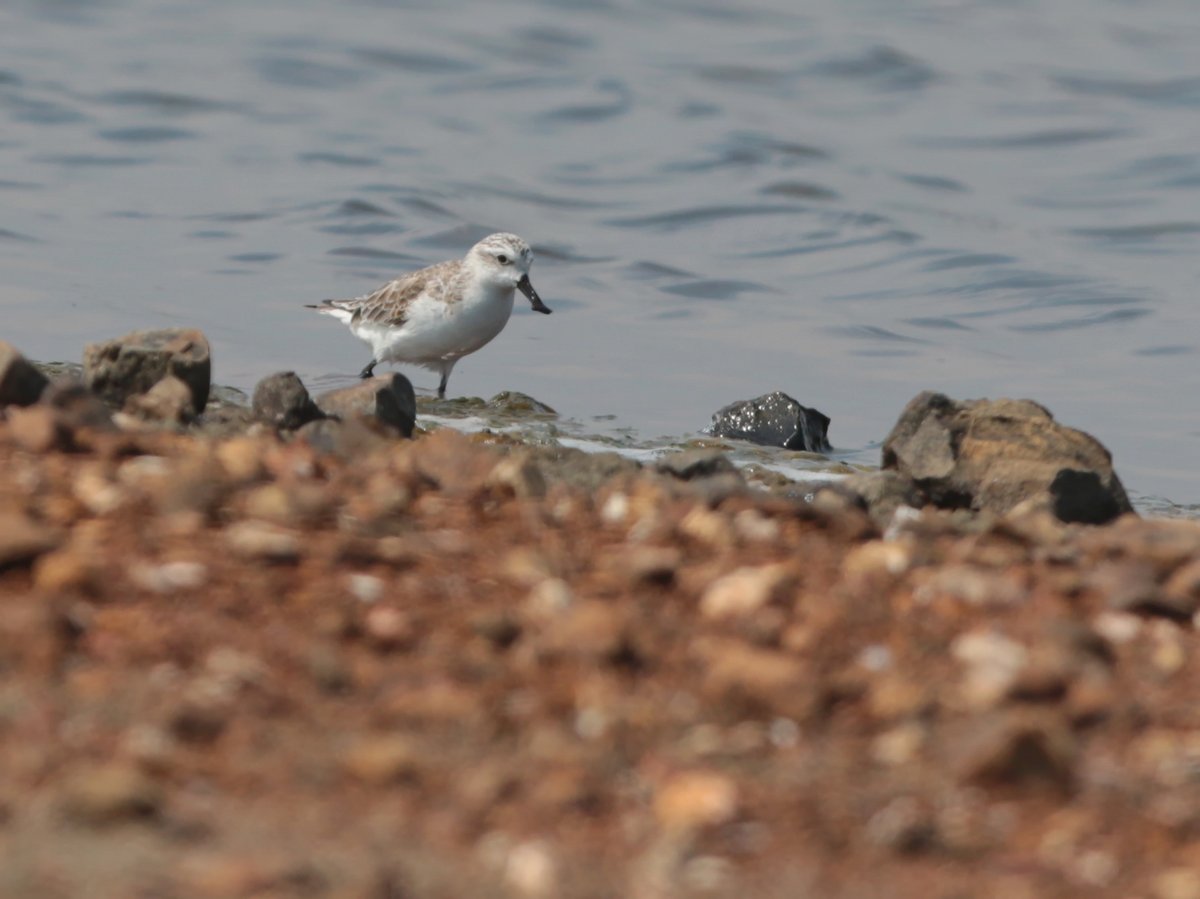













Charadriiformes / Scolopacidae / Calidris
Spoon-billed Sandpiper
Calidris pygmaea · 勺嘴鹬
Introduction
A small wader classified under calidrid sandpipers, most closely related to the red-necked stint. It breeds on the coasts of the Bering Sea and winters in Southeast Asia. The species is critically endangered, with a breeding population estimated at 240–456 mature individuals as of 2016.
Description
Length 14–16 cm (5.5–6.3 in). Distinctive spatulate bill with a tip breadth of 10–12 mm and total length of 19–24 mm. Wing measures 98–106 mm, tarsus 19–22 mm, and tail 37–39 mm. Breeding adults have a red-brown head, neck, and breast with dark brown streaks; blackish upperparts feature buff and pale rufous fringing. Non-breeding adults lack reddish coloration, displaying pale brownish-grey upperparts with whitish fringing to wing-coverts, white underparts, and black legs.
Identification
Key mark is the spatulate bill. Contact calls include a quiet 'preep' or shrill 'wheer'. Display song is an intermittent buzzing and descending trill 'preer-prr-prr'. Male display flight involves brief hovers, circling, and rapid diving while singing.
Distribution & Habitat
Breeds on sea coasts and adjacent hinterland of the Chukchi Peninsula and southwards along the Kamchatka Peninsula isthmus. Migrates down the Pacific coast through Japan, Korea, and China. Main wintering grounds are in South and Southeast Asia, including India, Bangladesh, Sri Lanka, Burma, Thailand, Vietnam, the Philippines, Peninsular Malaysia, and Singapore. Recorded in Balanga, Bataan mudflat, Philippines in March 2024.
Behavior & Ecology
Feeds by moving its bill side-to-side while walking forward with head down. Diet includes moss, mosquitoes, flies, beetles, spiders, shrimp, and worms. Nests in June–July on coastal tundra areas with grass near freshwater pools.
Conservation
Critically Endangered. Population estimated at fewer than 2500, likely fewer than 1000 mature individuals; 2016 estimate was 240–456 mature individuals. Threats include habitat loss on breeding grounds, reclamation of tidal flats in migratory and wintering ranges (up to 65% destroyed in China, South Korea, and North Korea), and hunting in Burma. Conservation measures include protected areas like Yancheng (China), Mai Po Marshes (Hong Kong), Point Calimere and Chilka lake (India), and a captive breeding program initiated in the UK in 2011 using headstarting techniques.
Culture
An education kit for teaching about the bird and environmental conservation is used in English, Traditional Chinese, Simplified Chinese, Japanese, and Burmese to aid wetland conservation.
Source: Wikipedia · CC BY-SA 3.0
Taxonomy
- Order
- Charadriiformes
- Family
- Scolopacidae
- Genus
- Calidris
Distribution
breeds coastal tundra of eastern Chukotskiy Peninsula to northern Kamchatka (norhteastern Russia); winters coastal mudflats from Taiwan and east-central China to Bangladesh; mainly Thailand, Myanmar, and Bangladesh; rare and local
Data Sources
Species description from Wikipedia, licensed under CC BY-SA 3.0.
Bird images and sounds sourced from GBIF, contributed by citizen scientists worldwide under Creative Commons licenses.
Taxonomy data from AviList 2025.