







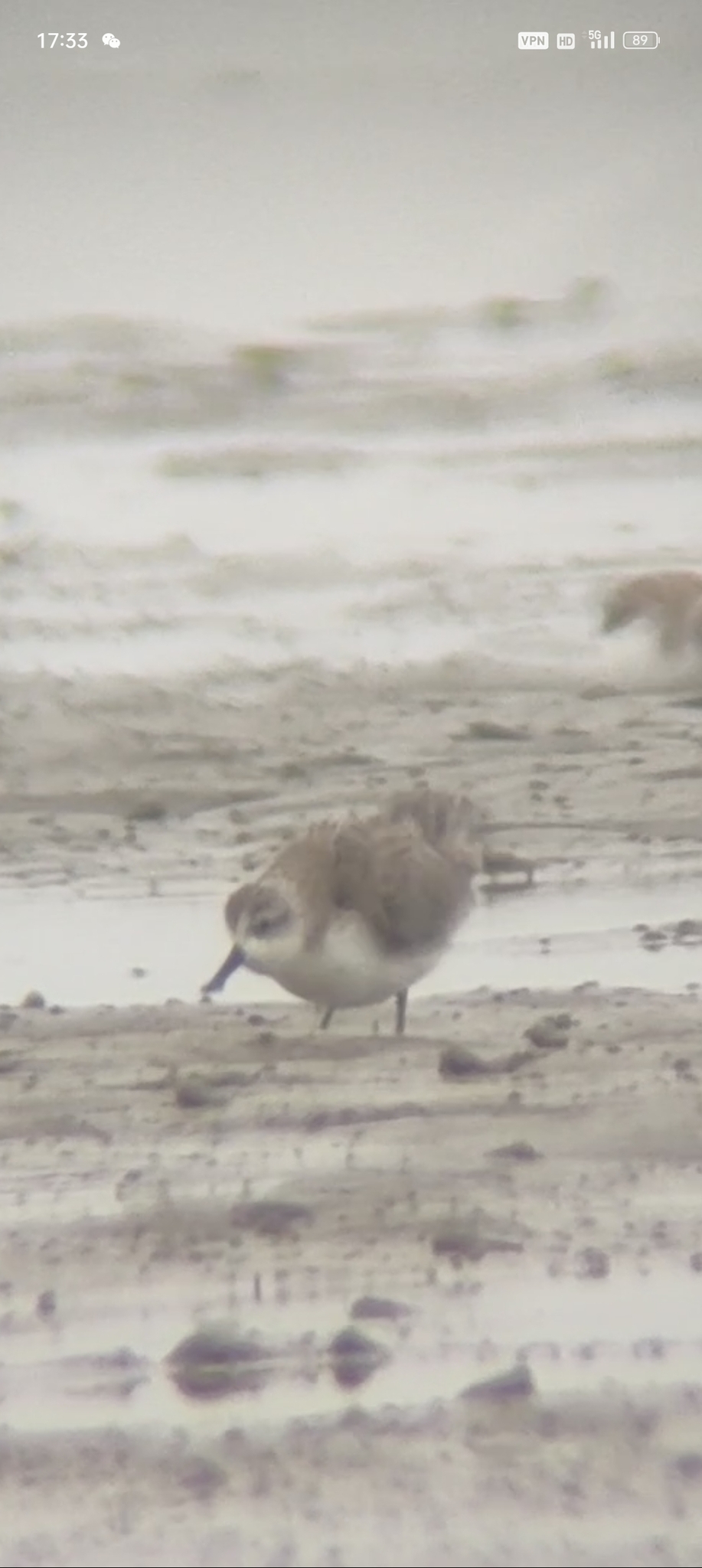





Spoon-billed Sandpiper
Calidris pygmaea
勺嘴鹬
Introduction
This small wader breeds in coastal areas of Northeast China and possibly North Korea, wintering in coastal wetlands from southern China to Australia and New Zealand. It migrates through East Asia, utilizing stopover sites along its route. Adults measure 14-16 cm in length with a wingspan of 34-38 cm. The primary diet consists of small invertebrates. Key threats include the loss and degradation of coastal wetlands throughout its range, particularly the reclamation of tidal flats for agriculture, aquaculture, and urban development. The global population is estimated at fewer than 1,000 mature individuals, representing a severe decline from approximately 2,500 birds recorded in the 1980s. Conservation measures include habitat protection at key sites, international cooperation along the flyway, and captive breeding programs. The species is listed as Critically Endangered on the IUCN Red List.
Description
This diminutive shorebird measures just 14-16 cm in length, making it one of the smaller sandpiper species. Its most unmistakable feature is the distinctive spoon-shaped bill, which measures 19-24 mm long with a notably broad tip of 10-12 mm. Breeding plumage presents a striking appearance with reddish-brown coloration on the head, neck, and breast, finely streaked with dark brown. The upperparts are blackish, edged with buff and pale rufous. Non-breeding birds are considerably plainer, showing pale brownish-grey upperparts with whitish fringing on the wing-coverts and completely white underparts. The legs are black. In flight, measurements reveal wings of 98-106 mm, a tail of 37-39 mm, and tarsi of 19-22 mm. The combination of tiny size, unique bill shape, and plumage characteristics makes this species unmistakable when seen well.
Identification
The spatula-like bill is the definitive field mark, setting this species apart from all other small sandpipers. At close range, the bill's distinctive shape—narrow at the base but expanding dramatically at the tip—is immediately apparent and cannot be confused with any similar species. The breeding plumage's reddish tones help distinguish it from the dunlin and other stint-type sandpipers, though non-breeding birds are more challenging and require careful attention to the unique bill shape combined with overall size and structure. The bird feeds with a characteristic side-to-side head movement as it walks forward, which can aid identification when observing feeding behavior.
Distribution & Habitat
This species breeds exclusively on the coastal regions of the Chukchi Peninsula and along the Kamchatka Peninsula in the Russian Far East, nesting on coastal tundra near freshwater pools. Its migration follows the Pacific coast through Japan, Korea, and China, connecting these breeding grounds to wintering areas throughout south and southeast Asia. Winter records come from India, Bangladesh, Sri Lanka, Burma, Thailand, Vietnam, the Philippines, Peninsular Malaysia, and Singapore. The species depends on a chain of wetlands along the East Asian-Australasian Flyway, making it vulnerable to habitat loss at multiple points along this route. A sighting in March 2024 in Balanga, Bataan, Philippines, demonstrates the species' continued presence in areas it frequents.
Behavior & Ecology
The feeding strategy is distinctive: birds walk forward with their heads down, sweeping the bill from side to side to detect prey in the mud. Their diet includes mosquitoes, flies, beetles, spiders, and other small invertebrates, along with marine invertebrates such as shrimp and worms when in coastal areas. Breeding occurs in June and July on coastal tundra areas, with nests placed in locations featuring grass growth near freshwater pools. The male performs a display flight involving brief hovers, circling, and rapid diving while singing. Vocalizations include a quiet preep or shrill wheer for contact calls, and a distinctive intermittent buzzing and descending trill preer-prr-prr given during courtship displays.
Conservation
Critically Endangered status reflects this species' desperate situation, with fewer than 2,500 mature individuals remaining—likely fewer than 1,000. Population estimates have fluctuated dramatically: 120-200 pairs in 2009-2010 represented an 88% decline since 2002, with current estimates at 240-456 mature individuals or approximately 228 pairs. The primary threats are habitat destruction: up to 65% of key habitat in China, South Korea, and North Korea has been lost to reclamation. The Saemangeum estuary in South Korea, a crucial staging area, has been partially reclaimed. Hunting in Burma represents an additional significant pressure. Conservation efforts include captive breeding programs, with chicks hatched in the UK and Chukotka, and protected areas at Yancheng, Mai Po Marshes, Point Calimere, and Chilka Lake. Without intervention, extinction could occur within 10-20 years.
Culture
While specific cultural or folklore traditions associated with this species are not well-documented, its status as an emblematic conservation symbol has grown significantly in recent years. The species has become a flagship for wetland conservation efforts across the East Asian-Australasian Flyway, with educational materials developed in multiple languages—English, Traditional Chinese, Simplified Chinese, Japanese, and Burmese—to raise awareness about both this bird and broader environmental conservation issues. The dramatic story of its decline and international rescue efforts, including the 2011 mission to bring birds to the Wildfowl and Wetlands Trust reserve in Slimbridge, has captured public attention and made it a poster species for shorebird conservation in Asia.
Source: Wikipedia · CC BY-SA 3.0
Taxonomy
- Order
- Charadriiformes
- Family
- Scolopacidae
- Genus
- Calidris
- eBird Code
- spbsan1
Distribution
breeds coastal tundra of eastern Chukotskiy Peninsula to northern Kamchatka (norhteastern Russia); winters coastal mudflats from Taiwan and east-central China to Bangladesh; mainly Thailand, Myanmar, and Bangladesh; rare and local
Data Sources
Species description from Wikipedia, licensed under CC BY-SA 3.0.
Bird images and sounds sourced from GBIF, contributed by citizen scientists worldwide under Creative Commons licenses.
Taxonomy data from AviList 2025.