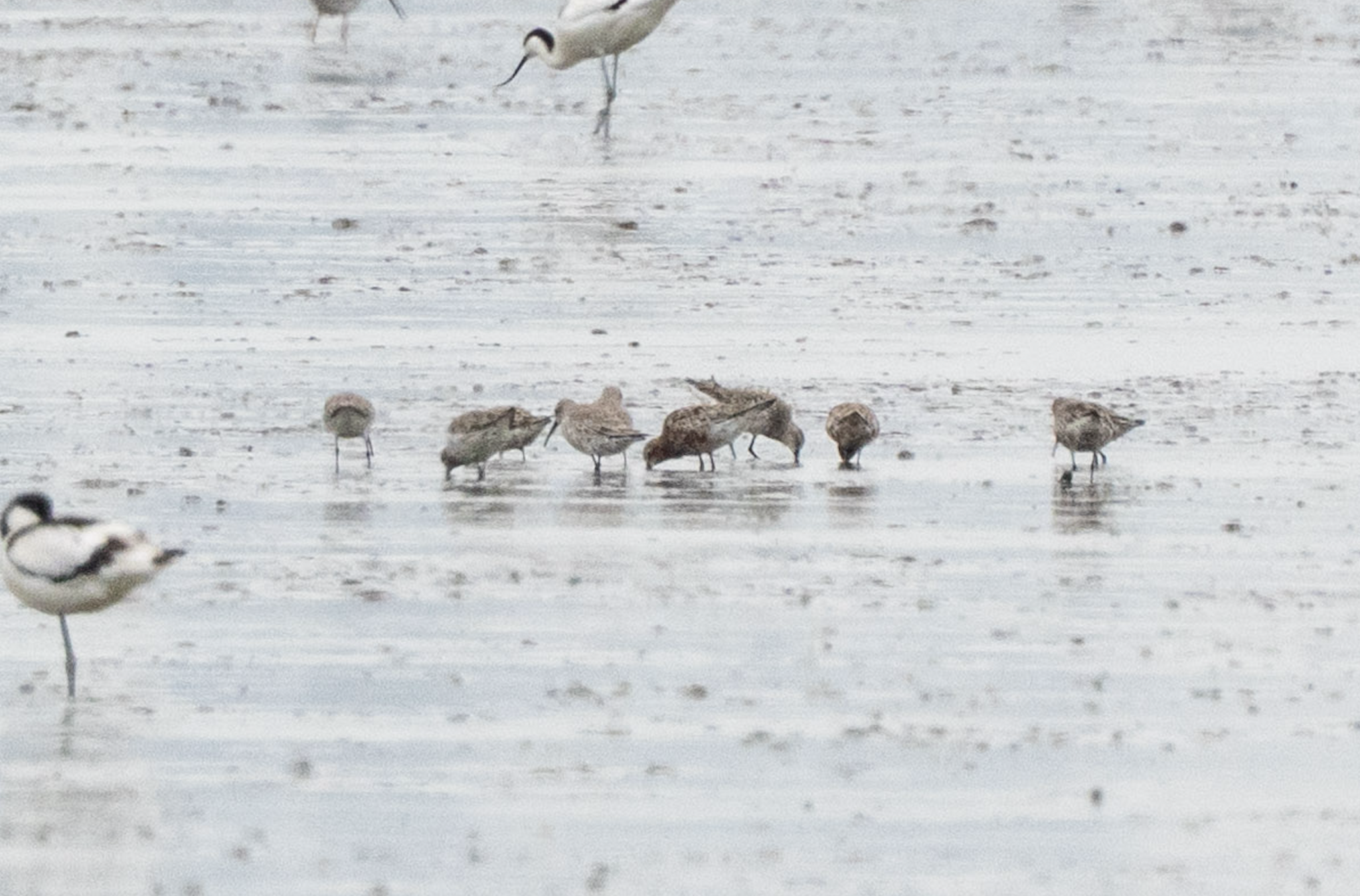
Charadriiformes / Scolopacidae / Calidris
Curlew Sandpiper
Calidris ferruginea · 弯嘴滨鹬
Introduction
A small wader in the genus Calidris, breeding in the Siberian Arctic and migrating to wintering grounds in Africa, South Asia, Southeast Asia, and Australasia. It is strongly migratory, omnivorous, and exhibits complex courtship displays. The species is assessed as Vulnerable by BirdLife International.
Description
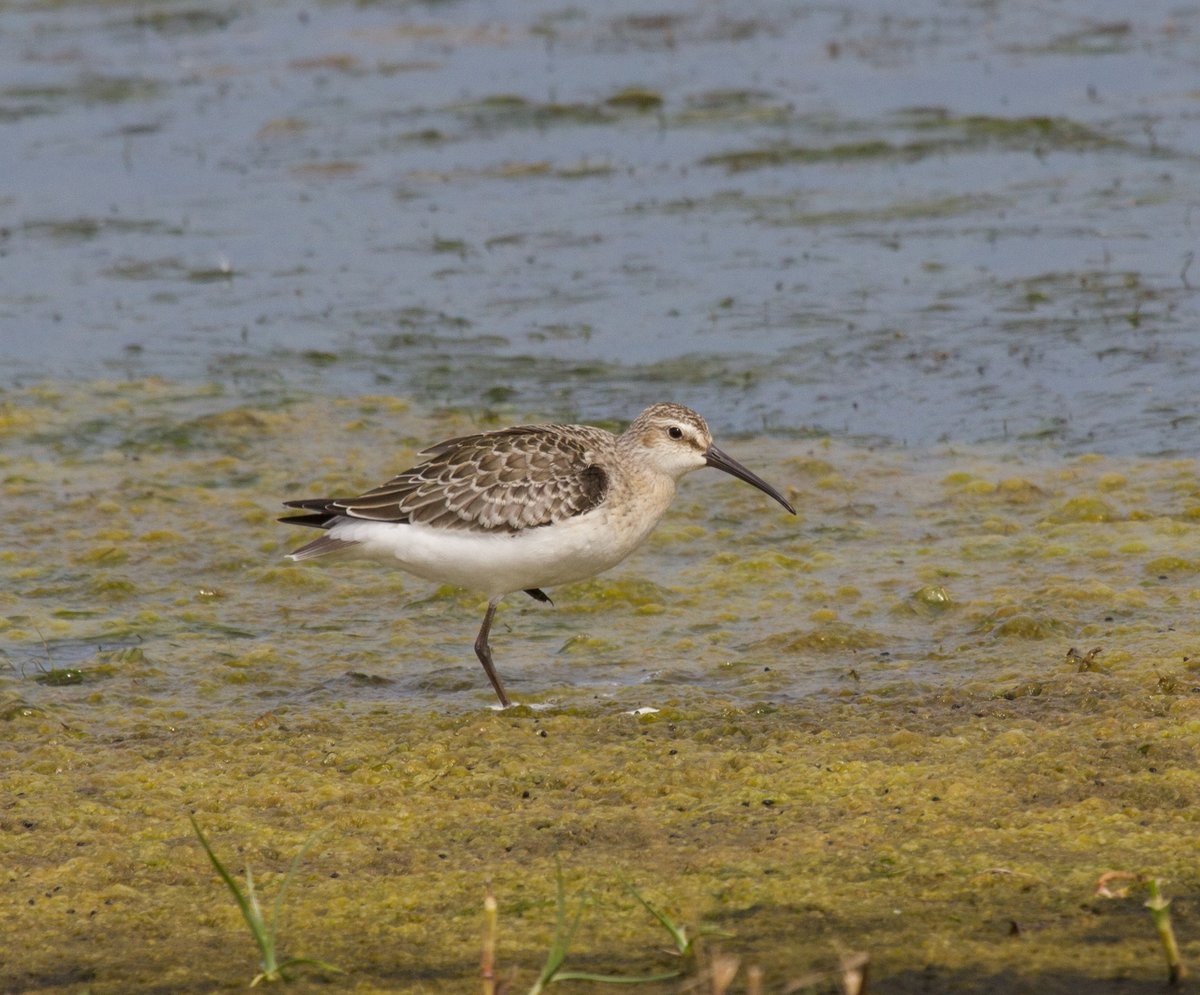
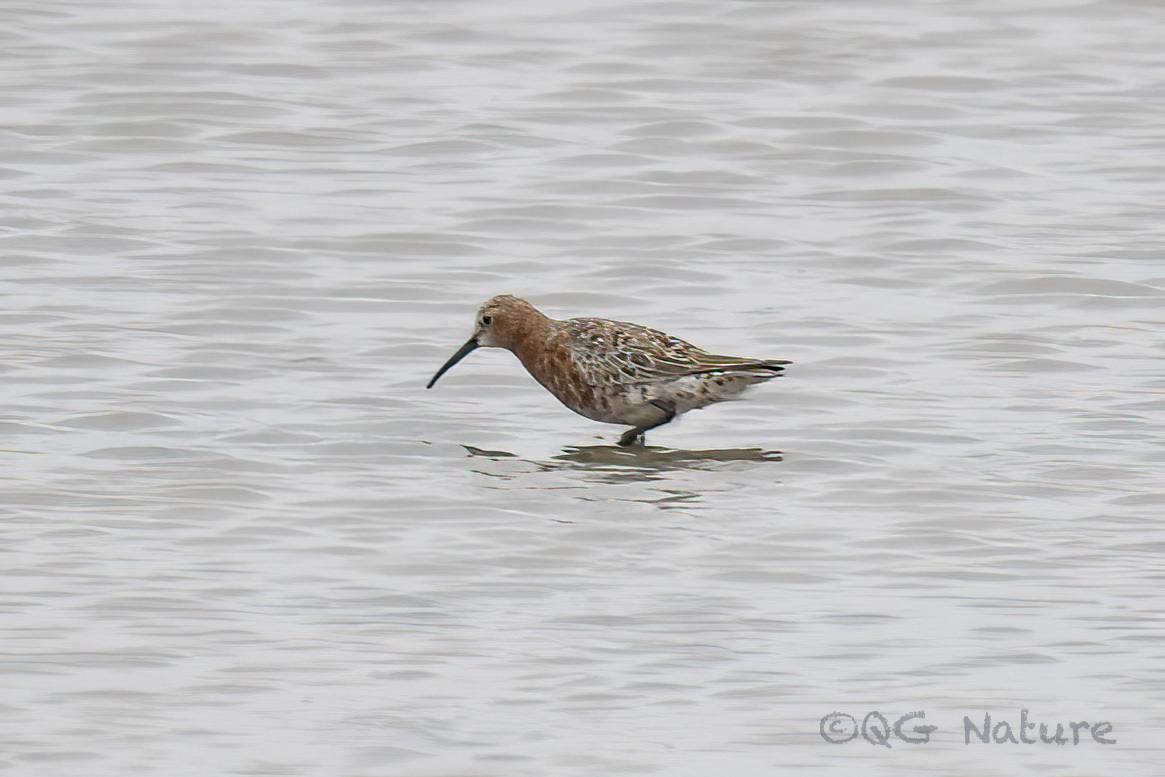
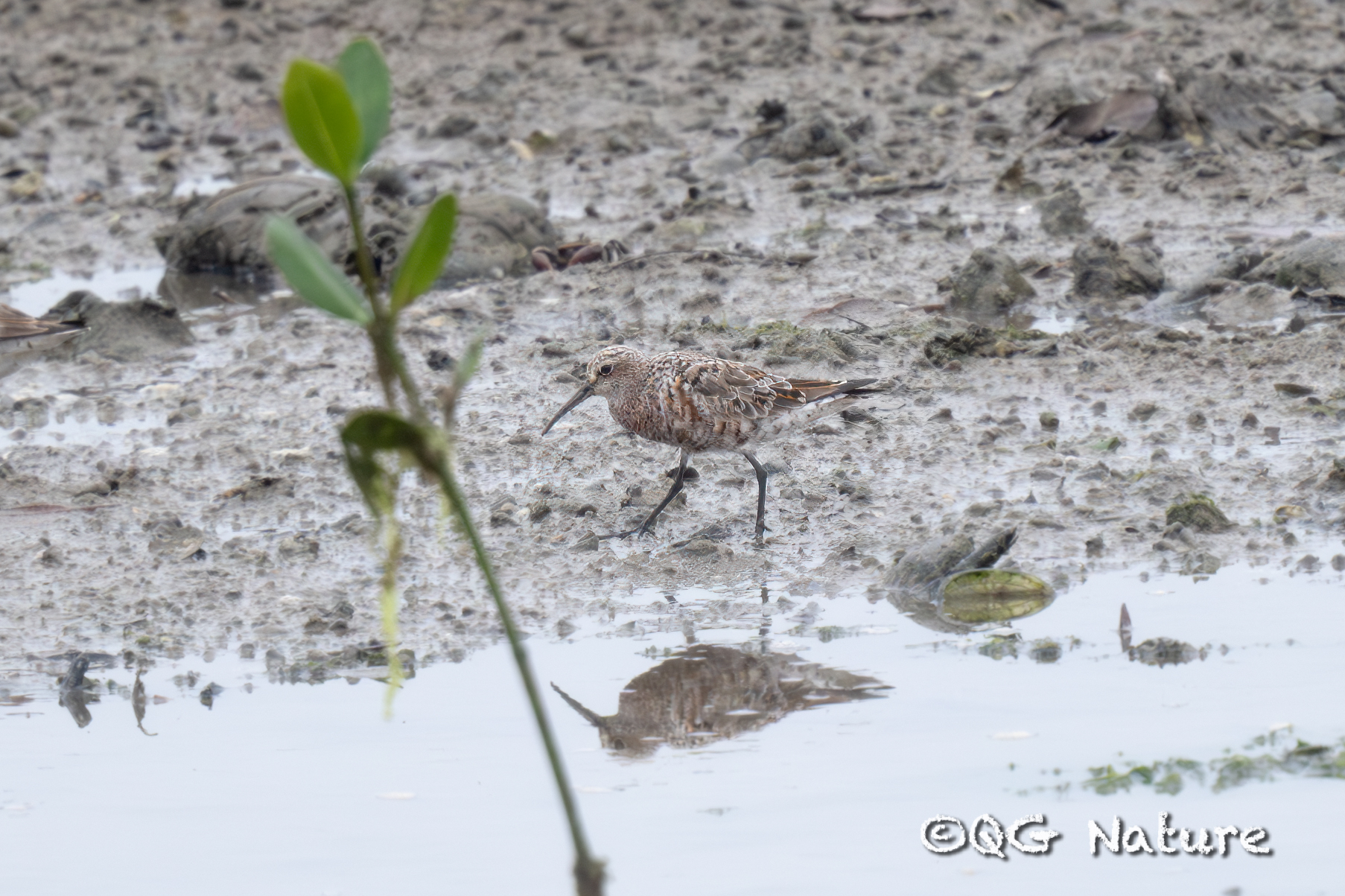
Length 21 cm (8.3 in), weight 57 g (2.0 oz), wingspan 38–46 cm (15–18 in). Bill length 32–44 mm (1.3–1.7 in); tarsus 26–34 mm (1.0–1.3 in). Bill is black; irises dark brown; toes and tarsi dark grey to black. Non-breeding adults have greyish upperparts that become brownish with wear, white underparts with occasional grey streaks, and a distinct white supercilium. Breeding plumage is sexually dimorphic: females show variable reddish tinting on the head, front, and upper back with grey-to-dark streaks; males have an almost completely opaque reddish tint with conspicuous spots above the eye and around the crown. Juveniles resemble non-breeding adults but have a scaly, buff-tinged appearance with pale creamy streaks on the dusky crown and nape. In flight, all plumages show a distinctive white wingstripe and a large white rump patch.
Identification
Distinguished from the similar stilt sandpiper by a distinctive white wingstripe (absent in stilt sandpiper), shorter green legs, and less flat head. Differs from the dunlin by a more distinct supercilium, longer decurved bill, and wingtips extending beyond the tail. Juvenile dunlins have distinctive brown or black spots on the sides of the upper belly, unlike juvenile curlew sandpipers. In breeding plumage, differs from the red phalarope by lacking a black crown, white face patch, straight yellow beak, and fully brick-red underparts. Distinguished from the red knot by longer legs, less stocky bill, and unspotted white rump (red knot has a spotted, greyish rump).
Distribution & Habitat
Breeds exclusively in the Siberian Arctic from the Yamal Peninsula to Kolyuchin Bay, occupying lowland tundra near bogs and pools. Migrates through Afro-Eurasia, notably absent east of the Verkhoyansk Range and in southern inland Asia. Winters mainly in coastal West Africa (Gabon to Mauritania, including Cabo Verde) and Southern Africa (Mozambique to Namibia, South Africa, north to Uganda and Kenya), with rarer inland records. Also winters in coastal South Asia, Southeast Asia, and Australasia (coastal New Zealand, southeastern Australia). Common migratory vagrant in North America, particularly along the Atlantic coast. Habitats include sheltered mudflats, saltpans, wetland edges, and sewage ponds during non-breeding seasons.
Behavior & Ecology
Omnivorous, foraging in large flocks on tidal flats and marshes for insects, crabs, molluscs, worms, and seeds. Active day and night, though night foraging decreases before northward migration. Flight speed estimated at 70–75 km/h (43–47 mph). Monogamous; pairs form during migration. Courtship includes aerial chases, ground nest-cup displays, and elaborate precopulatory displays. Females incubate 3-4 olive-colored eggs for 20 days; chicks are precocial and independent at 14-20 days. Males depart breeding grounds when incubation begins. Annual survival rate is 75-80%; maximum recorded age is 19 years. Reproductive success is linked to lemming populations, as predators like Arctic foxes switch to waders in poor lemming years.
Conservation
Assessed as Vulnerable by BirdLife International. Counts at Langebaan Lagoon, South Africa, indicate a 40% decline between 1975 and 2009, with similar trends noted in Australia, potentially linked to global warming effects at breeding grounds. The population appears to be decreasing. The species is covered by the Agreement on the Conservation of African-Eurasian Migratory Waterbirds (AEWA).
Source: Wikipedia · CC BY-SA 3.0
Taxonomy
- Order
- Charadriiformes
- Family
- Scolopacidae
- Genus
- Calidris
Distribution
breeds drier tundra from Yamal Peninsula to northwestern Chukotskiy Peninsula (northwestern to northeastern Siberia), including New Siberian Islands; winters southern Europe and Africa eastward through southern Asia to Taiwan and Philippines and southward to Melanesia; prone to extreme vagrancy
Data Sources
CBR Notes: IUCN红色名录等级由NT升为VU
Species description from Wikipedia, licensed under CC BY-SA 3.0.
Bird images and sounds sourced from GBIF, contributed by citizen scientists worldwide under Creative Commons licenses.
Taxonomy data from AviList 2025.