Rough-legged Buzzard
Buteo lagopus
毛脚鵟
Introduction
This medium-large raptor breeds across the northern hemisphere's tundra and taiga. Its migratory pattern consists of two phases: an initial rapid two-week journey covering approximately 1,500 kilometers, followed by a gradual progression of about 10 kilometers per day during winter. The species possesses the unique ability to hover while hunting—a trait shared with kestrels, kites, and ospreys. During winter, it inhabits open farmland and marshland and is identified by its white tail. Its adaptation to cold climates includes fully feathered legs, reflected in its scientific name lagopus, meaning 'hare-foot'.
Description
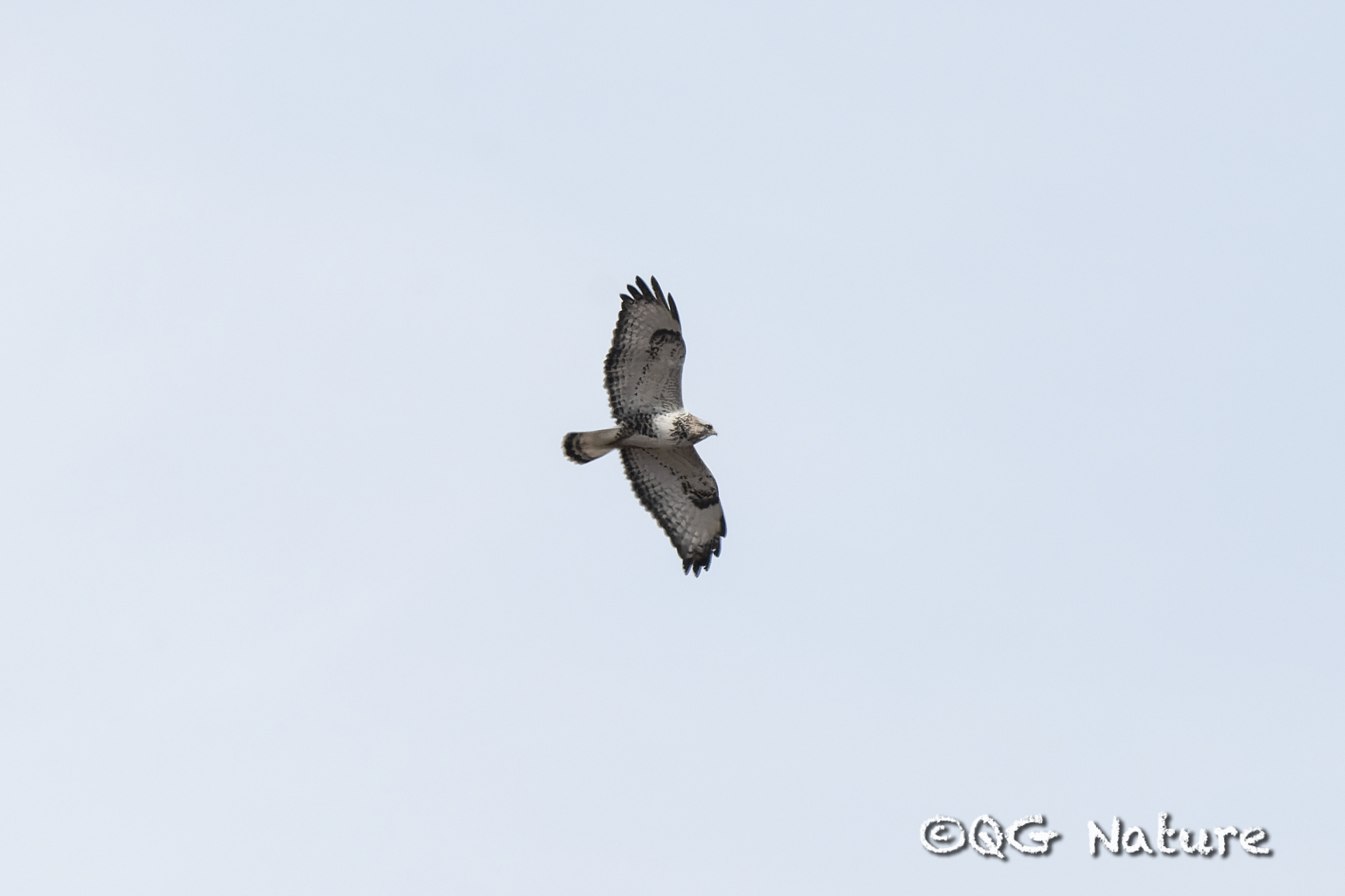
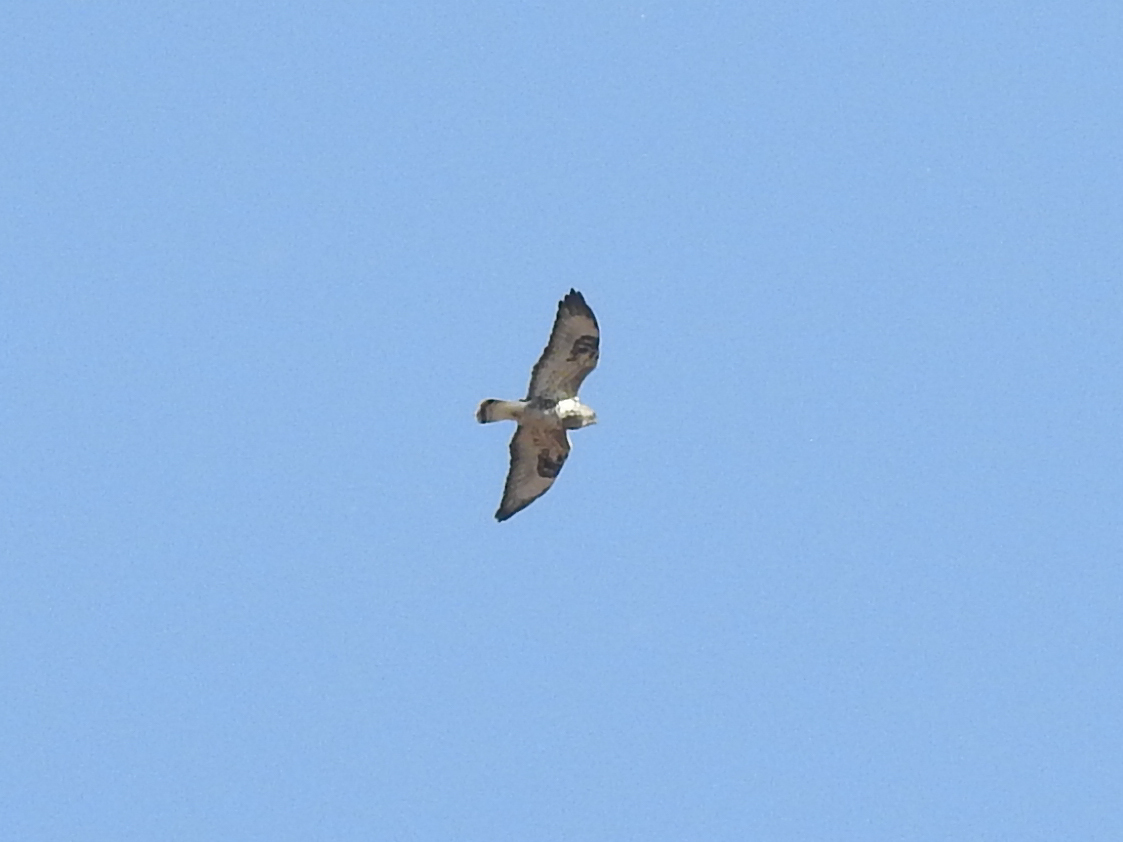
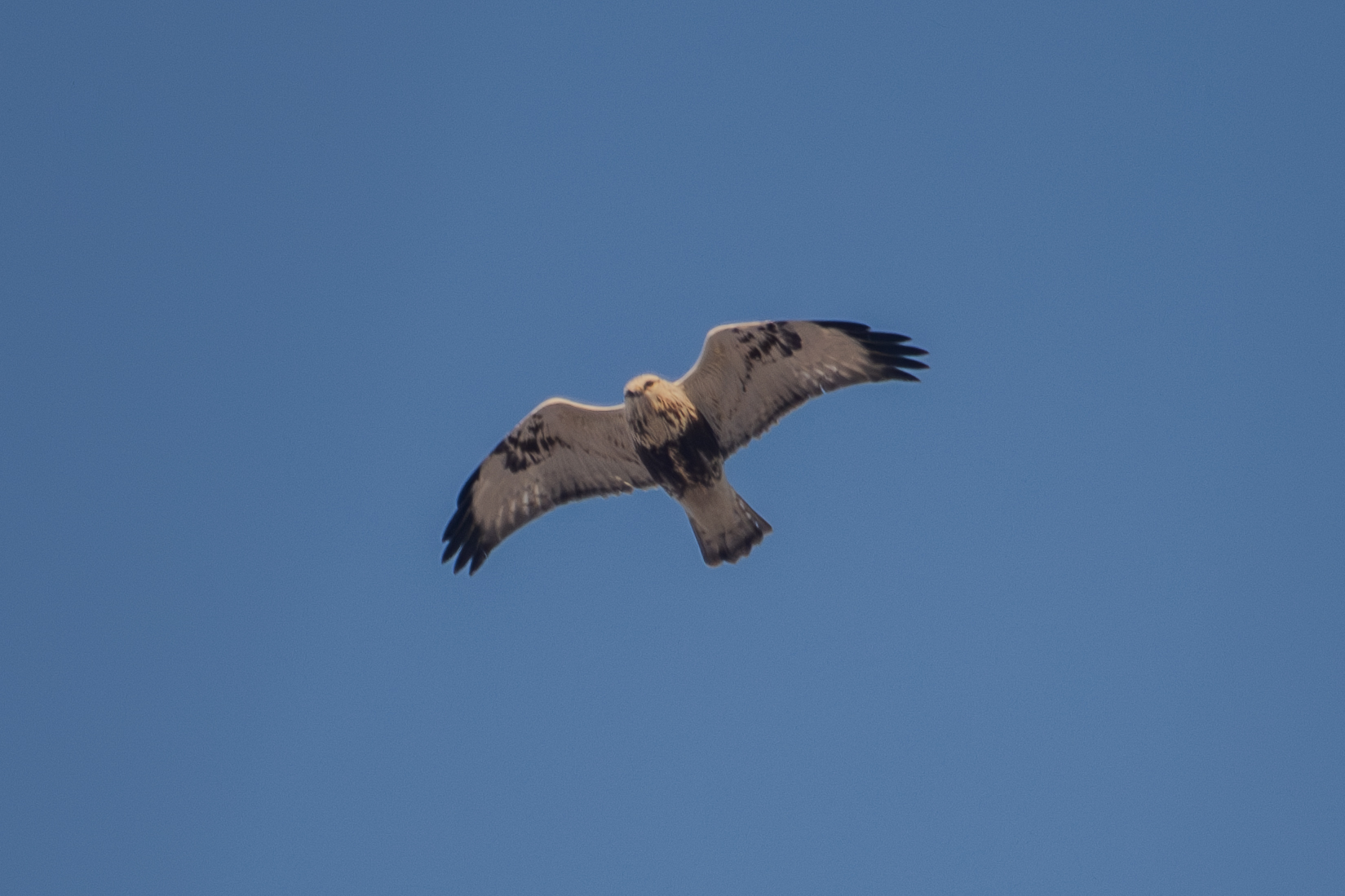
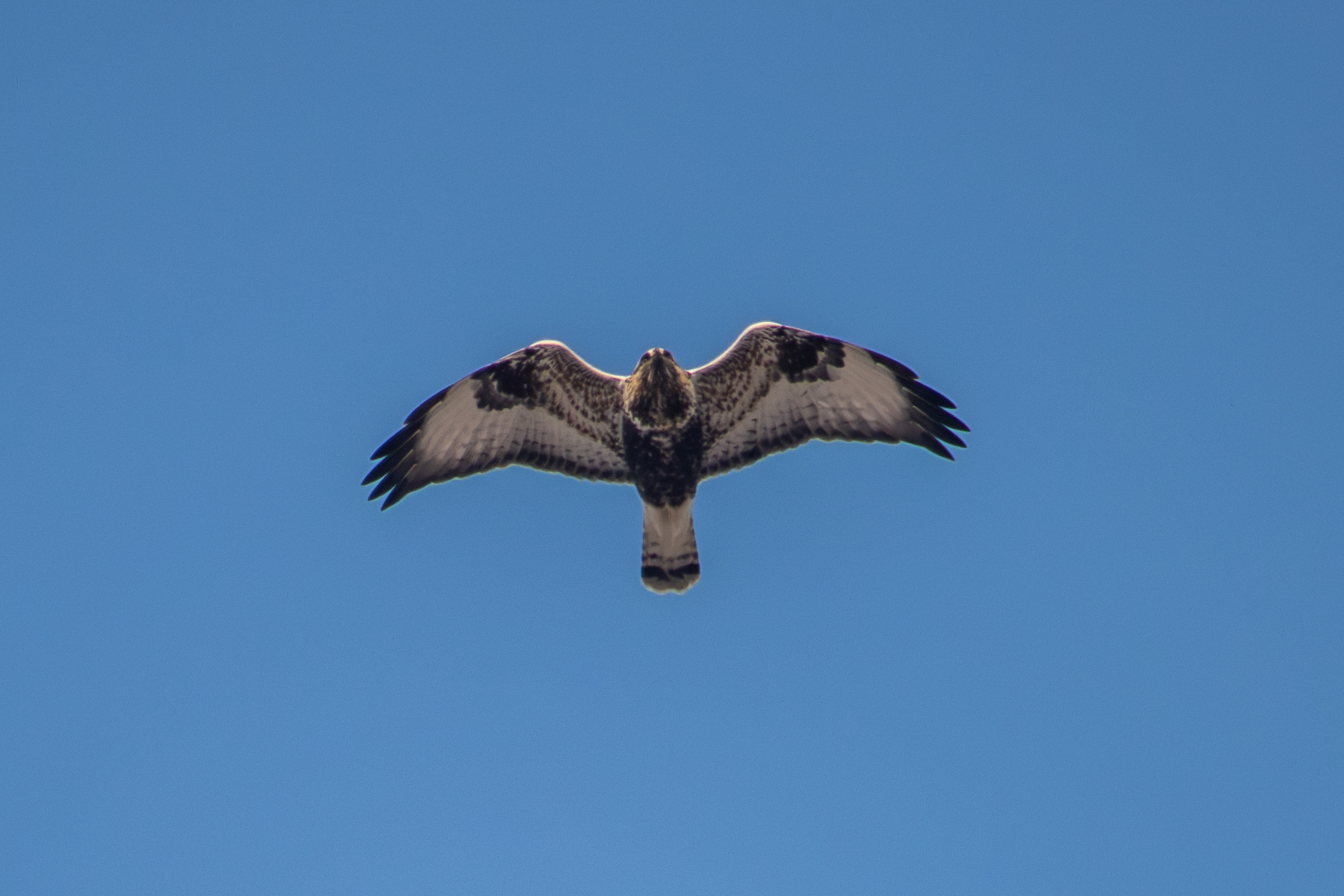
This fairly large raptor measures 46-68 cm in length with an impressive wingspan of 120-153 cm. Adults weigh between 600-1,660 grams, with females noticeably larger than males. Weights increase seasonally from summer to winter, ranging from 822-1,027 g in males and 1,080-1,278 g in females. The plumage is predominantly brown and white, typically showing extensive speckling. A broad brown chest-band is a consistent feature across most plumages, while light morph individuals show a contrasting square dark carpal patch against white under-wings. Among the Buteo genus, it ranks as the sixth heaviest, fifth longest, and fourth longest-winged species. Standard measurements include a wing chord of 37.2-48.3 cm, tail length of 18.6-25.5 cm, culmen of 3.2-4.5 cm, and tarsus of 5.8-7.8 cm. The legs are feathered to the toes as an adaptation to arctic cold, though the toes themselves remain bare.
Identification
The most reliable identifying feature across all plumages is the long white tail feathers with one or more dark subterminal bands. When perched, the wing tips reach or extend past the tail. Compared to the common buzzard, this species is longer-winged and more eagle-like in appearance. Unlike the red-tailed hawk, which is chunkier with a darker head, shorter broader wings, and barring on both wings and tail, this species lacks the dark leading wing edge and has a white-based tail. The ferruginous hawk is larger with a more prominent bill and distinctive whitish comma marking at the wrist. Light morph individuals show a conspicuous square dark carpal patch contrasting against white under-wings. The species exhibits considerable plumage variation between light and dark morphs, sexes, and age classes, requiring extensive field experience to confidently identify certain variations.
Distribution & Habitat
This species breeds across arctic and subarctic regions of North America, Europe, and Asia, being the only Buteo found on all three northern continents with a complete circumpolar distribution. Breeding occurs in tundra and taiga habitats between 48° and 76° N latitude. North American populations migrate to southern Canada and the central United States for winter, while Eurasian birds move to central Europe and Asia, with small numbers reaching eastern Britain. Wintering grounds span latitudes 43-58° N, where the species prefers marshes, moorland, prairies, and agricultural regions with abundant rodents. Migrants arrive at breeding grounds during April and May, depending on snow conditions. Home ranges during winter typically measure 10-15 km², though breeding season ranges remain poorly studied.
Behavior & Ecology
This species is highly specialized in its diet, with small mammals comprising 62-98% of food intake. Lemmings and voles are primary prey, seasonally accounting for 80-90% of the diet. When rodent populations crash, the species shifts to alternative prey including ptarmigan, hares, and waterfowl. Avian prey consists mainly of small passerines like snow buntings and Lapland longspurs, though larger prey such as ptarmigan and waterfowl are also taken. Hunting occurs during daylight hours, employing both still-hunting from perches and active flight-search techniques. Unique among large raptors, it regularly engages in hovering flight. Breeding begins around age two, with pairs monogamous for multiple years. Nests are built on cliff ledges and rocky outcroppings using twigs, sedges, and feathers, measuring 60-90 cm in diameter. Clutch size is typically 3-5 eggs, incubated by the female for at least 31 days. Fledglings leave the nest after 4-6 weeks but depend on parents for 2-4 weeks afterward. Vocalizations include a downward-slurring whistle described as 'kiu wiyuk' or a descending 'kee-eer', given as alarm calls every 15-30 seconds at nesting sites.
Conservation
This species holds a status of Least Concern on the IUCN Red List, with an estimated global population of 200,000-500,000 breeding pairs. Numbers fluctuate significantly in response to prey population cycles, particularly lemming and vole abundance. Primary threats include human-induced mortality from collisions with power lines, buildings, and vehicles, as well as incidental ingestion of poison or lead from contaminated prey. Illegal hunting and trapping occur in some regions. Nest predation by arctic foxes, brown bears, wolverines, ravens, and skuas affects breeding success. Fledglings face additional mortality risks from starvation during prey scarcity and exposure during harsh weather. Conservation efforts focus on habitat protection across both breeding and wintering ranges, particularly in agricultural areas where wintering birds concentrate.
Culture
This species has minimal cultural significance in folklore or tradition. Historically, it was referred to as 'rough-legged falcon' in John James Audubon's seminal work The Birds of America, reflecting early ornithological naming conventions that have since been revised. No substantial mythology, cultural symbolism, or traditional uses are documented in the available sources, making this a species of primarily ornithological rather than cultural interest.
Source: Wikipedia · CC BY-SA 3.0
Taxonomy
- Order
- Accipitriformes
- Family
- Accipitridae
- Genus
- Buteo
- eBird Code
- rolhaw
Subspecies (4)
-
Buteo lagopus kamtschatkensis
breeds Kamchatka Peninsula; winters in east-central Asia
-
Buteo lagopus lagopus
breeds tundra and grassland of northern Eurasia; winters central Eurasia
-
Buteo lagopus menzbieri
breeds northeastern Asia; winters to central Asia, northern China, and Japan
-
Buteo lagopus sanctijohannis
breeds Alaska and northern Canada; winters to southern USA
Data Sources
Species description from Wikipedia, licensed under CC BY-SA 3.0.
Bird images and sounds sourced from GBIF, contributed by citizen scientists worldwide under Creative Commons licenses.
Taxonomy data from AviList 2025.