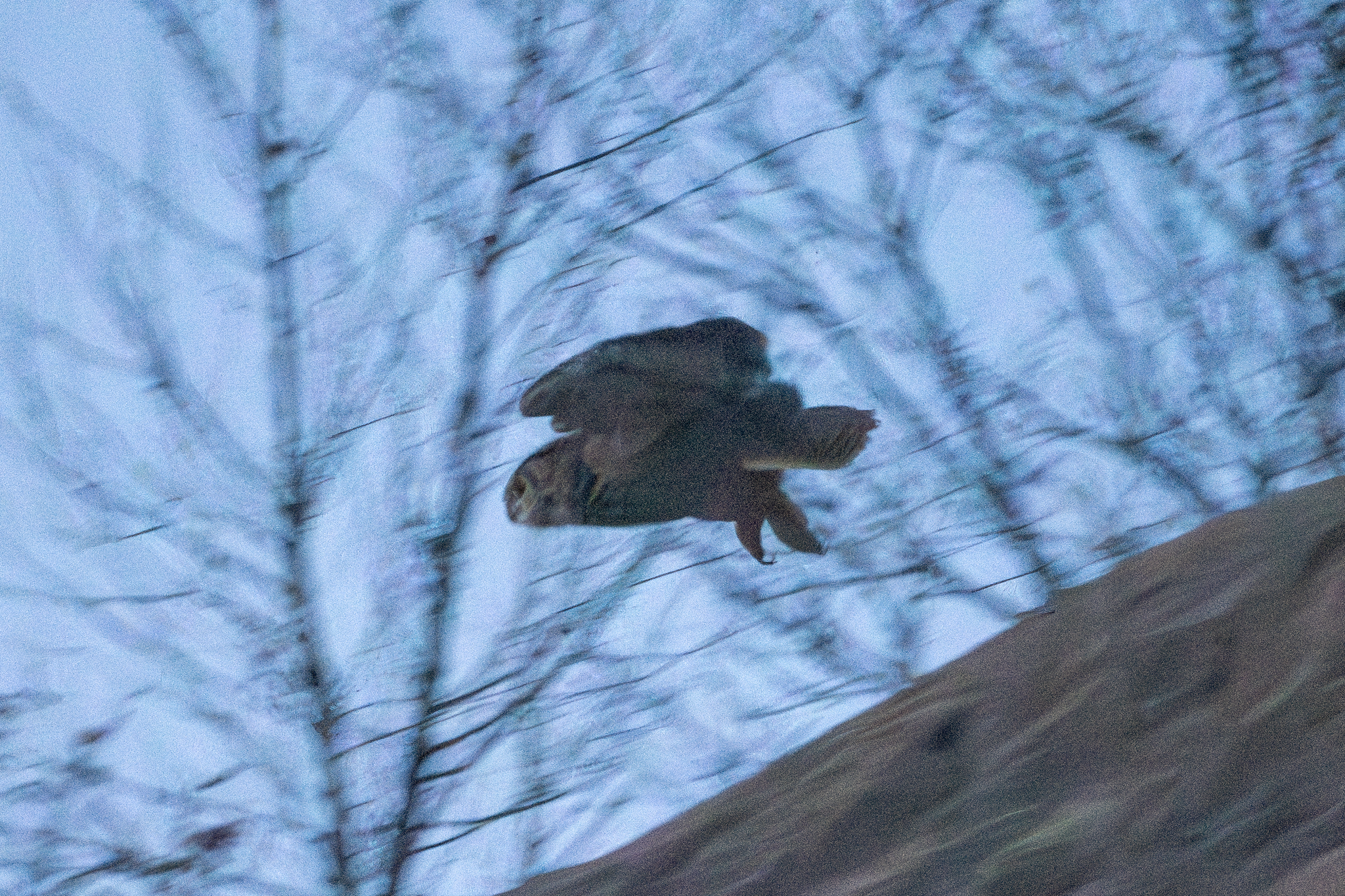
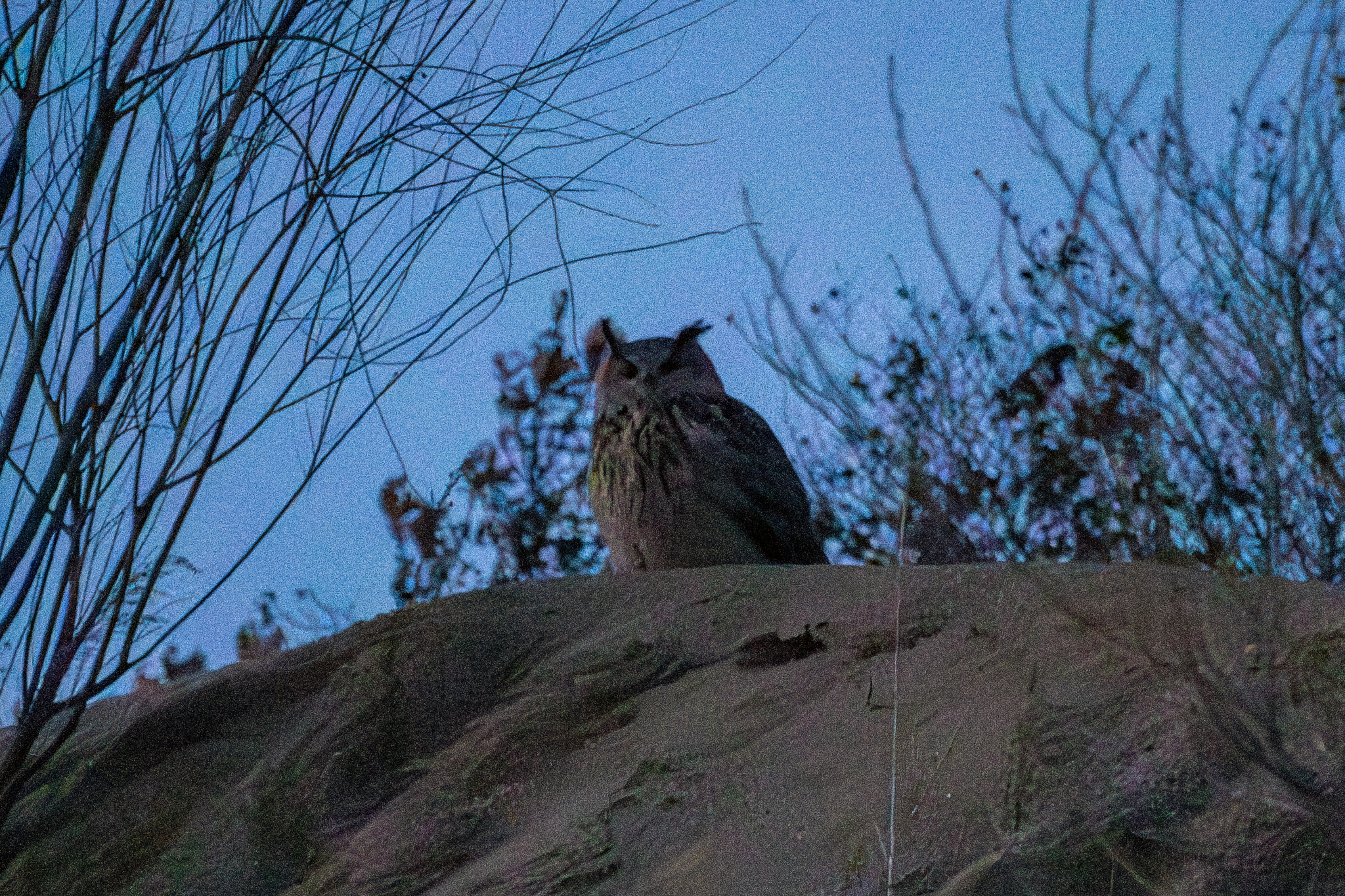
Eurasian Eagle-Owl
Bubo bubo
雕鸮
Introduction
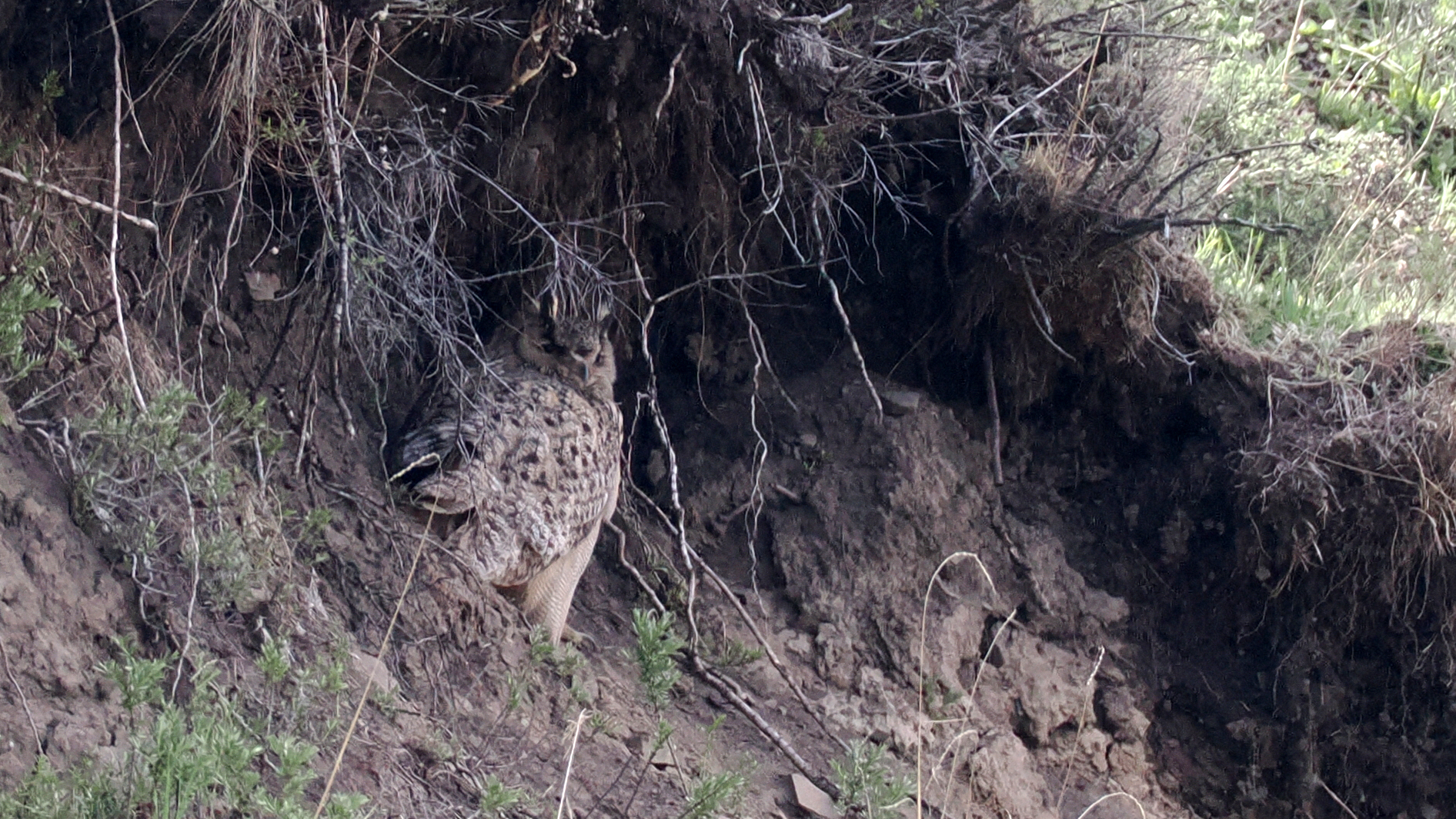
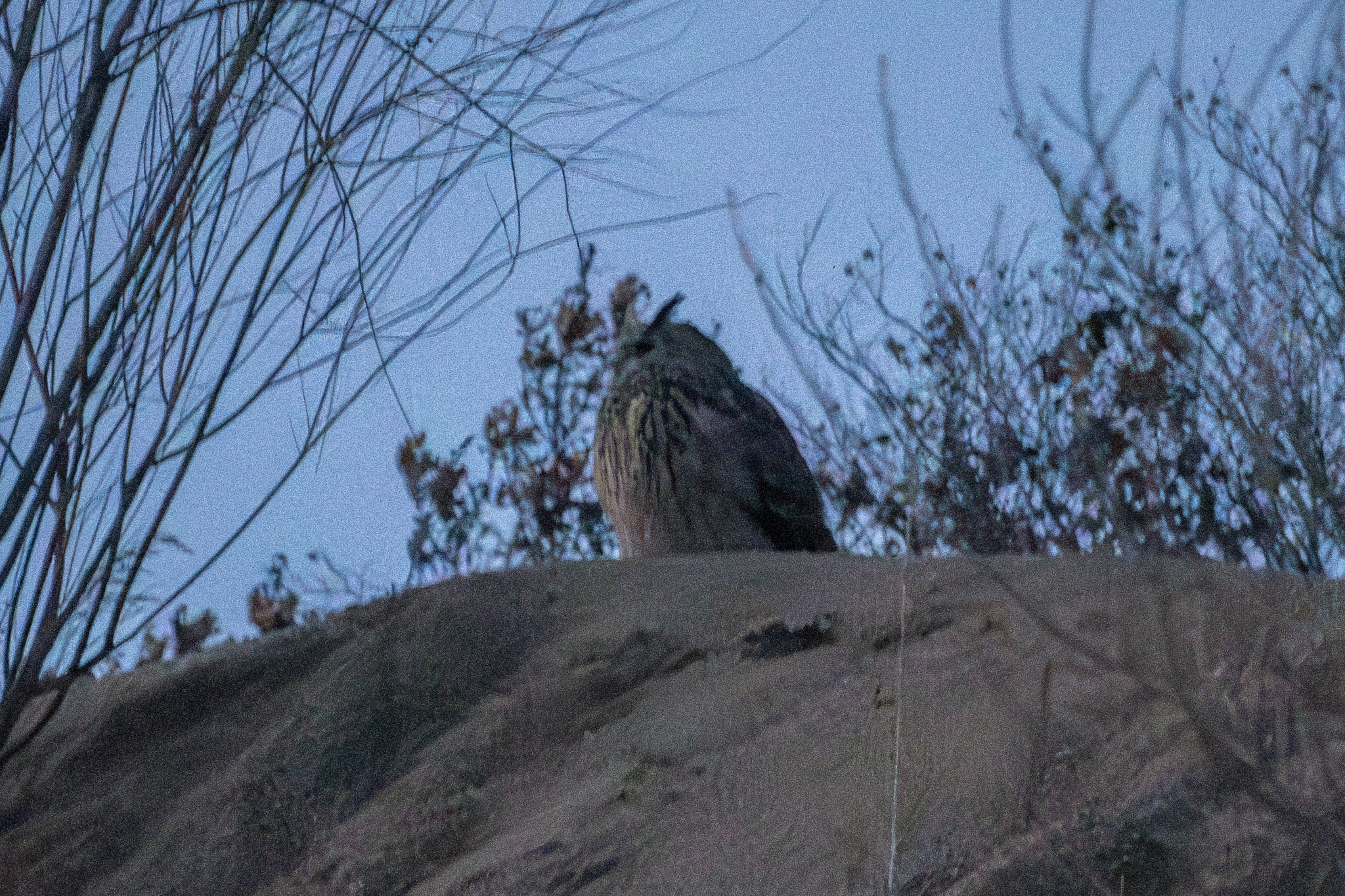
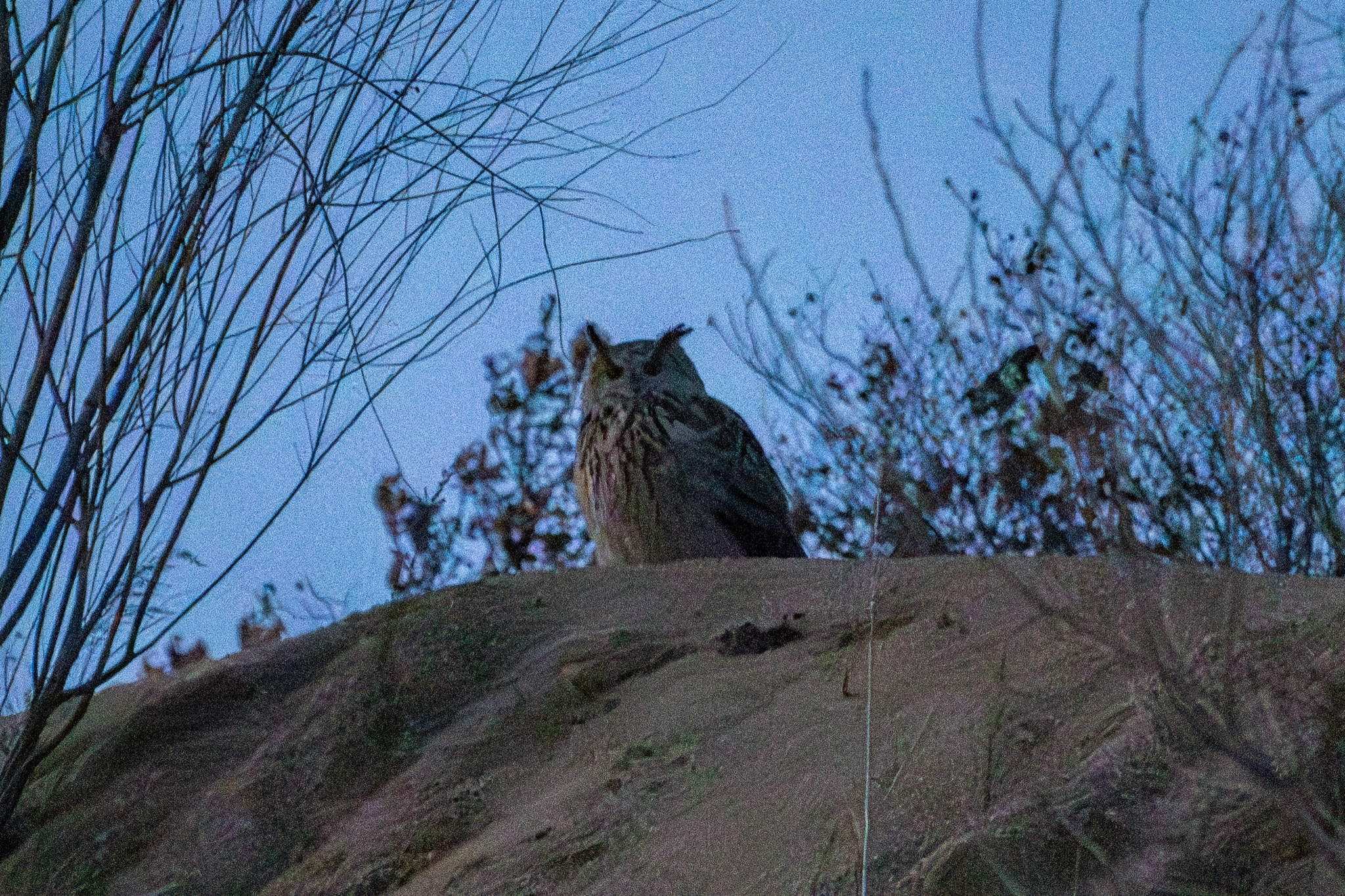
The Eurasian Eagle-Owl (Bubo bubo) is among the largest owl species in Eurasia. Females reach approximately 75 cm in length with a wingspan of up to 188 cm; males are smaller. The species displays prominent ear tufts, a barrel-shaped body, and orange irises. Plumage varies across its range: upperparts are mottled blackish on tawny ground color, while underparts show buff coloration with darker streaking. The facial disc is relatively undefined. This species inhabits woodland and mountainous habitats across Europe and Asia, maintaining year-round territories as a sedentary population.
Description
This is an exceptionally large owl, with total length ranging from 56 to 75 centimeters and wingspan measuring 131 to 188 centimeters. Females typically weigh between 1.75 and 4.6 kilograms, while the smaller males range from 1.2 to 3.2 kilograms. The species presents a bulky, barrel-shaped silhouette with prominent erect ear tufts being one of its most recognizable features. The upperparts are mottled with darker blackish coloring on a tawny base, while wings and tail display distinctive barring. Underparts show variable buff hues heavily streaked with darker markings. The facial disc is relatively undefined compared to other owls, and the striking orange iris provides immediate identification. Plumage coloration varies considerably among at least 13 recognized subspecies, ranging from brown-black to pale creamy gray, with dense freckling on the head and neck, and dark splotches on the back and wings. The legs and feet are feathered almost to the talons, and the bill and feet are black.
Identification
The combination of great size, bulky barrel-shaped build, prominent erect ear tufts, and bright orange eyes makes this species distinctive. It differs markedly from the great grey owl and Ural owl, both of which lack ear tufts and have distinctly rounded heads. The snowy owl, while paler, is smaller and has relatively tiny, vestigial ear tufts. The long-eared owl shares a somewhat similar plumage pattern but is considerably smaller—females may be twice as long and ten times heavier. Fish owls that overlap in Asian ranges possess scraggy ear tufts that hang to the side rather than standing erect, and generally show more uniform brownish plumage without the contrasting darker streaking. The Indian eagle-owl, which overlaps in the Himalayas, is smaller with a bolder blackish facial disc border and partially unfeathered toes.
Distribution & Habitat
This owl occupies an enormous range across Europe and Asia, covering approximately 51.4 million square kilometers. It inhabits diverse habitats including mountainous and rocky areas, coniferous forests, steppes, and remote wilderness. It shows a preference for irregular topography with cliff ledges, ravines, and rocky slopes surrounded by scattered trees and bushes. The species also occurs in shrubby areas with openings and wetlands, and occasionally ventures into farmland and park-like settings within cities. The vast majority of populations occur in Continental Europe, Scandinavia, Russia, and Central Asia, with additional populations in Anatolia, the northern Middle East, the Himalayan region, China, Korea, and Japan. A small population of 12 to 40 breeding pairs exists in the United Kingdom as of 2016, with breeding confirmed since at least 1996.
Behavior & Ecology
Predominantly nocturnal, this owl concentrates its hunting activity in the first hours after sunset and last hours before sunrise, though partial daytime activity occurs in northern latitudes during summer's endless days. As an opportunistic predator, it hunts small mammals such as rodents and rabbits, along with birds and larger mammals. Secondary prey includes reptiles, amphibians, fish, large insects, and invertebrates. The species breeds on cliff ledges, in gullies, among rocks, and other concealed locations, typically laying a clutch of 2 to 4 eggs at intervals. The female incubates the eggs and broods the young while the male provides food. Both adults continue parental care for approximately five months. Vocalizations include a deep resonant territorial song described as 'ooh-hu' for males and a higher-pitched 'uh-hu' for females, with pairs sometimes performing antiphonal duets. The species is highly sedentary, maintaining territories throughout adult life.
Conservation
The IUCN lists this species as being of Least Concern, though the population trend is decreasing. Global population estimates range between 100,000 and 500,000 individuals. In Europe, the breeding population is estimated at 19,000 to 38,000 pairs. Major anthropogenic threats include electrocution from power lines, which accounts for the greatest mortality in many studies, collisions with vehicles and trains, and direct persecution. The species has experienced local extinctions in parts of Western and Central Europe due to historical persecution. Reintroduction programs have been undertaken in Germany since the 1970s to restore populations. Conservation recommendations focus on insulating electrical pylons and reducing persecution through education programs. Electrocution remains the primary cause of mortality across much of its European range.
Culture
The species has notable cultural significance in Finland, where the national football team bears the nickname 'Huuhkajat,' meaning eagle-owl. A famous individual named 'Bubi' landed at Helsinki's Olympic Stadium during a 2007 football match, temporarily interrupting play and subsequently being named 'Helsinki Citizen of the Year.' In parts of Europe, the species is known locally as 'uhu,' derived from its characteristic call. Tame individuals have occasionally been used in falconry for pest control, specifically to deter large birds such as gulls from nesting areas. The species' imposing appearance and dramatic vocalizations have made it a prominent figure in the regions where it occurs, though notably, its absence from British folklore and writings in recent millennia may reflect its long-term absence from that region.
Source: Wikipedia · CC BY-SA 3.0
Taxonomy
- Order
- Strigiformes
- Family
- Strigidae
- Genus
- Bubo
- eBird Code
- eueowl1
Subspecies (16)
-
Bubo bubo borissowi
Sakhalin and the southern Kuril Islands (south from Urup), and northern Japan (northern Hokkaido)
-
Bubo bubo bubo
Scandinavia and Spain through western Europe to western Russia
-
Bubo bubo hemachalanus
Pamir Mountains and the northern Tien Shan southward to the Himalayas
-
Bubo bubo hispanus
Iberian Peninsula; formerly also Atlas mountains of northern Africa, where likely extirpated
-
Bubo bubo interpositus
Türkiye and northwestern Iran to southern Ukraine, Romania, and Bulgaria
-
Bubo bubo jakutensis
northeastern Siberia (Lena River to Sea of Okhotsk)
-
Bubo bubo kiautschensis
central and southern China (south to Yunnan and Guangdong) eastward to Korea
-
Bubo bubo nikolskii
eastern Iraq to Iran, Afghanistan, and western Pakistan
-
Bubo bubo omissus
Turkmenistan to far western China
-
Bubo bubo ruthenus
central European Russia to Ural Mountains and lower Volga basin
-
Bubo bubo sibiricus
western foothills of Ural Mountains to Ob River and western Altai
-
Bubo bubo tarimensis
far northwestern China (Tarim Basin in western Xinjiang)
-
Bubo bubo tibetanus
central and eastern Tibet and adjacent regions of southern China
-
Bubo bubo turcomanus
central Asia between the lower Volga River and the Ural River, eastward to Transbaikalia, and southward to Kazakhstan and western Mongolia
-
Bubo bubo ussuriensis
southeastern Siberia to northeastern China
-
Bubo bubo yenisseensis
central Siberia to northern Mongolia
Data Sources
Species description from Wikipedia, licensed under CC BY-SA 3.0.
Bird images and sounds sourced from GBIF, contributed by citizen scientists worldwide under Creative Commons licenses.
Taxonomy data from AviList 2025.