Little Owl
Athene noctua
纵纹腹小鸮
Introduction
The Little Owl (Athene noctua) occurs across temperate and southern Europe through the Palearctic to Korea and into North Africa. Introduced populations established in Britain during the 19th century and in New Zealand's South Island in 1906. This species inhabits varied open countryside including farmland with hedgerows, woodland edges, orchards, parks, and semi-desert regions. It measures approximately 22 centimeters in length. As a cavity nester, it uses tree holes, old buildings, cliff crevices, and rabbit burrows. It exhibits daytime perching habits and bounding, woodpecker-like flight. Its diet consists of insects, small mammals, and other prey.
Description
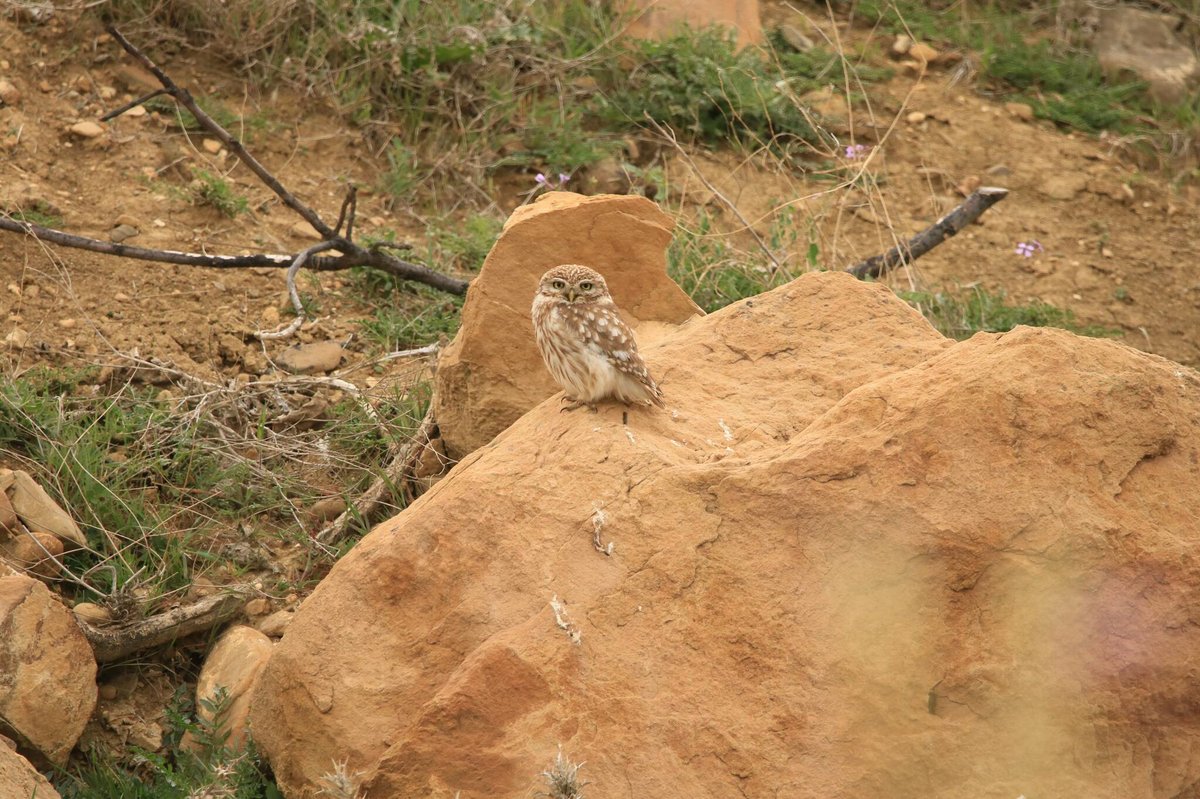
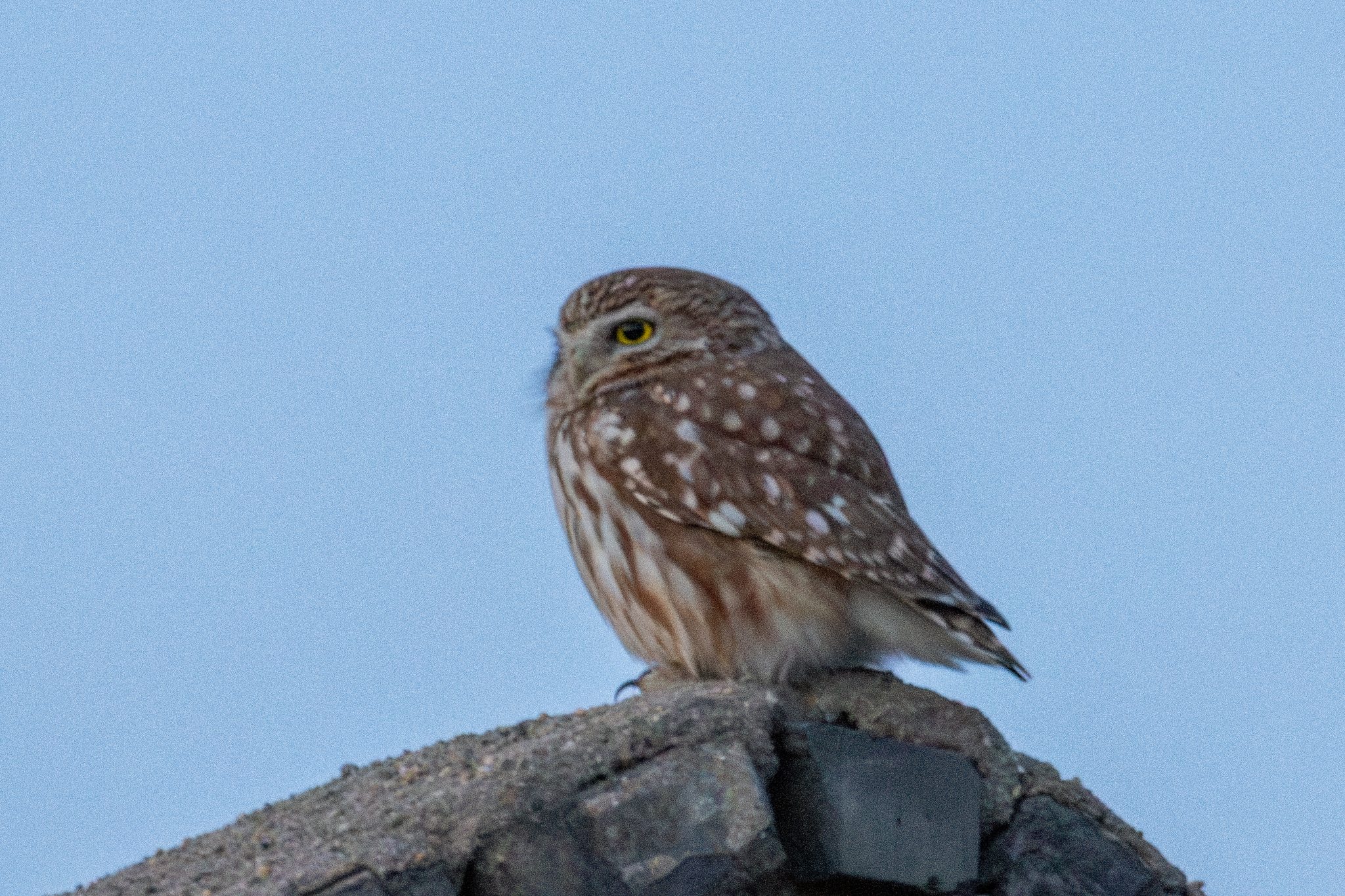
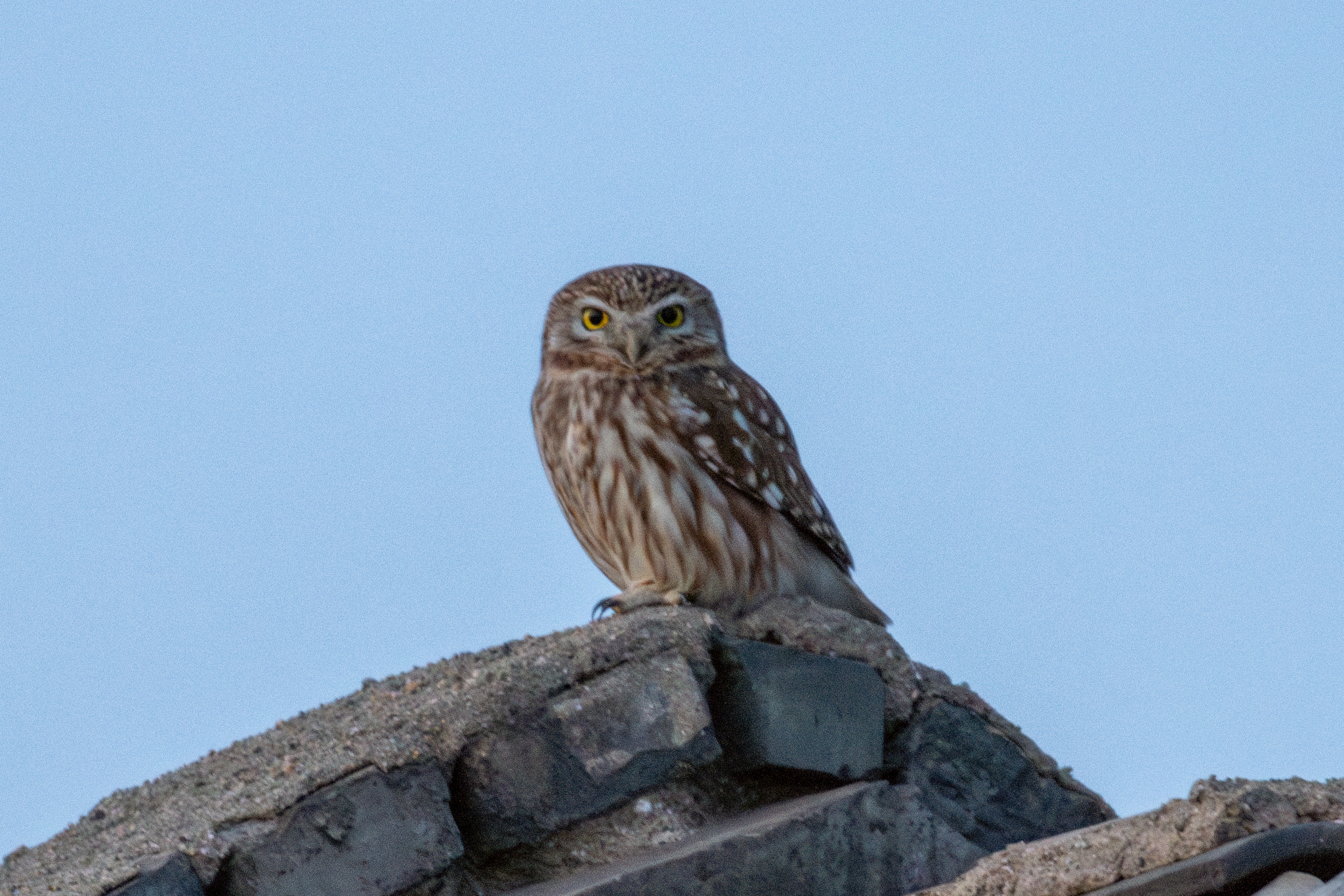
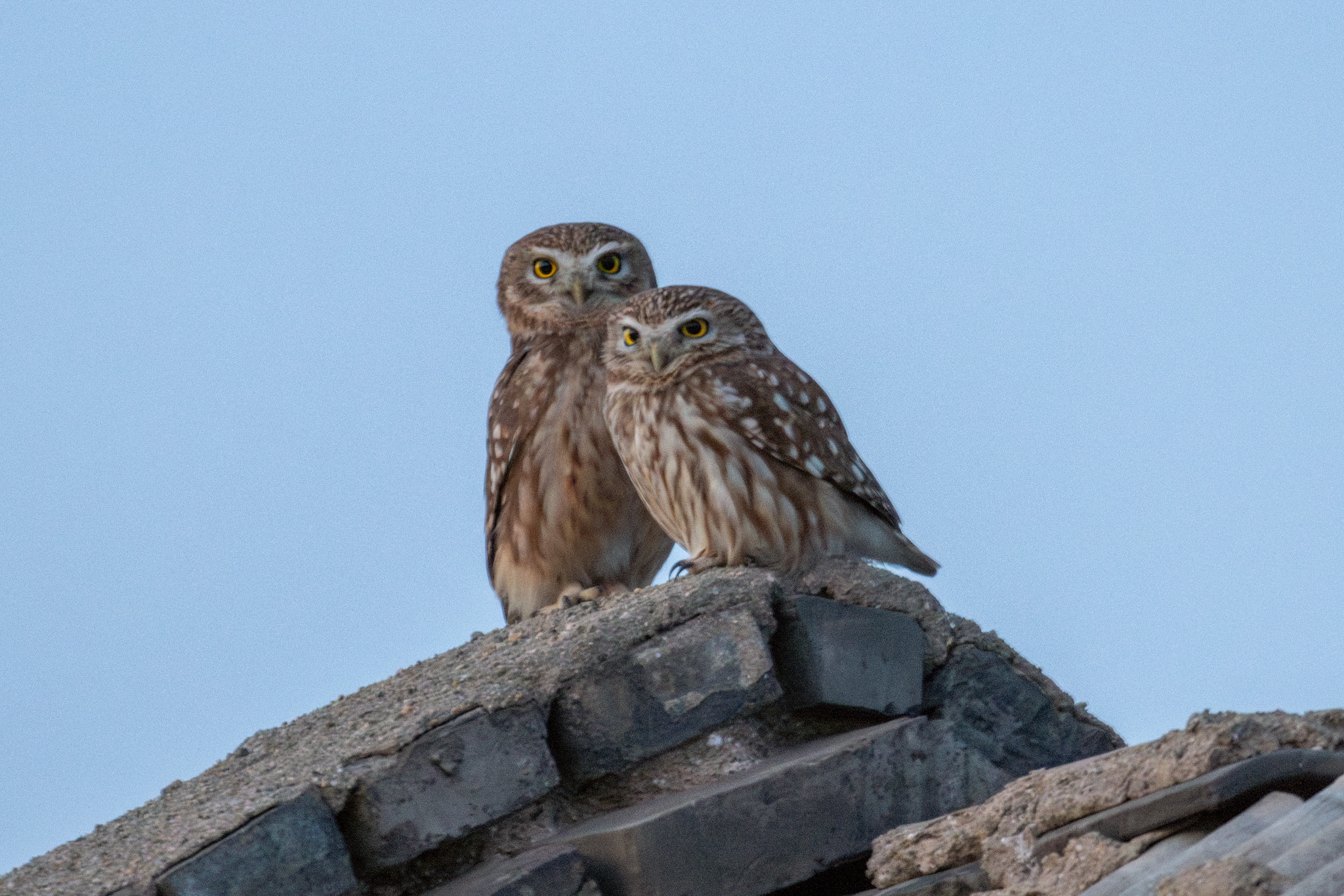
This is a compact, small owl with distinctive proportions that set it apart from larger relatives. The flat-topped head and frowning facial disc give it a remarkably stern expression, enhanced by prominent white eyebrows. The plumage is greyish-brown overall, covered with a complex pattern of white spots, streaks, and bars that provide excellent camouflage against tree bark and rocky terrain. Underparts are pale with darker streaking. Adults typically measure 22 centimeters in length with a 56-centimeter wingspan and weigh around 180 grams. The large head, relatively long legs, and striking yellow eyes are key identification features. Juveniles appear duller overall and lack the adult's distinctive white crown spots. Molt occurs from July through November, with males typically beginning before females.
Identification
The little owl's combination of small size, flat-topped head with frowning expression, and distinctive white eyebrows make it relatively straightforward to identify within its range. The bounding, undulating flight resembles that of a woodpecker and helps distinguish it from other owls in flight. Unlike many owl species, this bird often perches prominently during daylight hours, making visual identification easier. The pale, streaked underparts and white-speckled brown upperparts separate it from darker owl species. The Syrian race (A. n. lilith) is notably paler and greyer than the nominate form. Confusion is most possible with spotted owlet, but the little owl's larger size, different facial expression, and lack of complete facial disc help distinguish them.
Distribution & Habitat
This species occupies an enormous range spanning most of Europe from Iberia and Denmark eastward across Asia to China and Korea, extending southward to the Himalayas and across North Africa from Mauritania to Egypt and Arabia. In Britain, introduced populations have spread across England and Wales since the late 1800s, while New Zealand populations are confined to the eastern and northern South Island following early 20th-century releases. The owl occupies diverse open habitats including agricultural land with trees and hedgerows, orchards, woodland verges, parks, gardens, steppes, stony semi-deserts, and even treeless areas such as dunes. It often frequents quarries, ruins, and rocky outcrops, and ventures into villages and suburbs. In Britain it occurs mainly below 500 meters, but in continental Europe and Asia it reaches much higher elevations, with records up to 3,600 meters in Tibet. It is sedentary throughout its range.
Behavior & Ecology
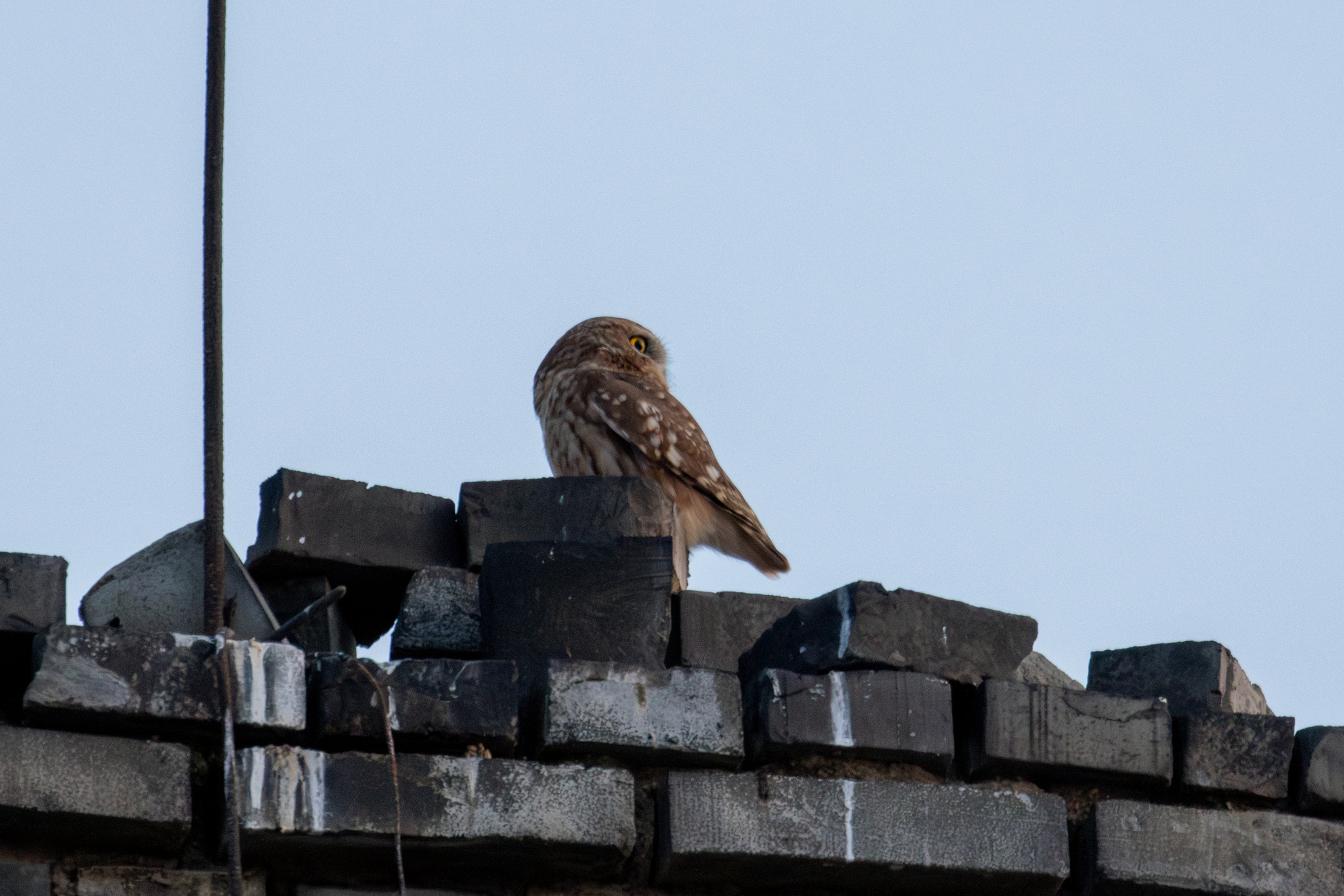
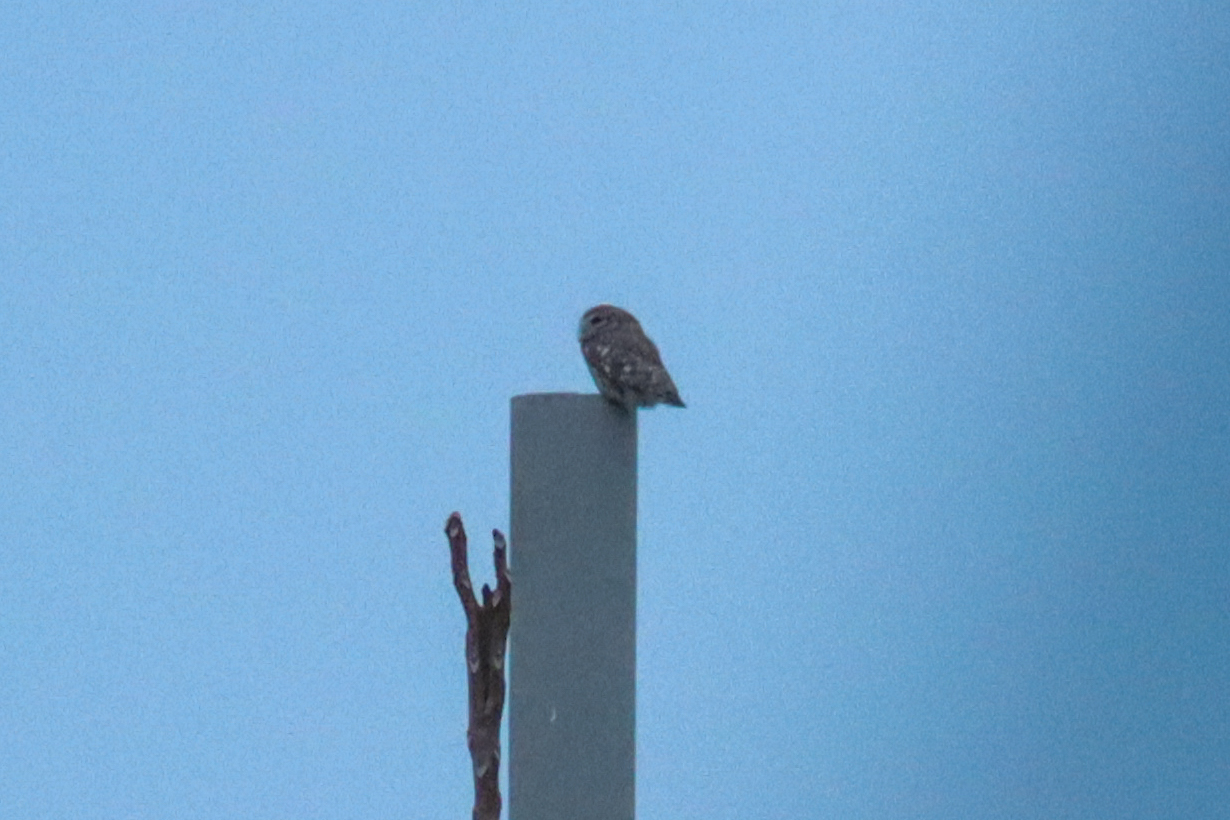
Birdwatchers often observe this species perching boldly on elevated posts, walls, or trees during daylight hours, watching for movement below before swooping to capture prey. Its diet is remarkably varied, encompassing insects, earthworms, amphibians, reptiles, small mammals, and even small birds—especially during the breeding season when protein demands increase. Caching behavior has been observed, with surplus food stored in holes and other hiding places. The species is territorial, with males maintaining territories throughout their lives and defending them aggressively against intruders through vocal displays and, if necessary, physical attacks. The characteristic call is a querulous 'kiew, kiew,' while breeding season brings more varied vocalizations including whistles, trills, and duetting between pairs. Breeding begins in spring, with three to five eggs incubated by the female for 28-29 days. Both parents feed the young, which fledge at around seven weeks. Pairs typically remain together year-round, sometimes for life.
Conservation
With an extremely large range covering millions of square kilometers and an estimated global population between 5 and 15 million birds, this species thrives across its extensive distribution. European populations number between 560,000 and 1.3 million breeding pairs, and numbers appear stable throughout the species' range. Consequently, the International Union for Conservation of Nature has assessed its conservation status as Least Concern. Despite this favorable assessment, individual birds face mortality risks from severe winters and road vehicle collisions. Life expectancy is considerably lower than the maximum recorded 16 years, with many birds dying before reaching maturity and average lifespans around three years. In New Zealand, where it is introduced, the species receives partial protection under Schedule 2 of the Wildlife Act 1953.
Culture
Throughout history, this owl has been closely associated with wisdom and knowledge through its ancient connection to the Greek goddess Athena and Roman goddess Minerva. Its image appears prominently on Greek coinage, including the famous Athenian tetradrachm and the modern Greek one-euro coin, where it typically accompanies an olive branch. Fifth-century BC bronze statues of Athena often depict her with the owl held in her hand. The species has been kept for practical purposes, including rodent control in Italian homes and gardens, and was historically used in 'cottage hunting'—a practice where hunters exploited other birds' mobbing behavior toward owls to capture species like skylarks. This practice continued in Italy from ancient times until the 1990s, when official bans were enacted, though exemptions for cultural traditions still exist near Crespina, where a breeding center maintains the practice. In Britain, introduced populations established following releases by naturalists in the late 19th century, and the species has appeared on Dutch currency as a watermark on the 100 guilder banknote.
Source: Wikipedia · CC BY-SA 3.0
Taxonomy
- Order
- Strigiformes
- Family
- Strigidae
- Genus
- Athene
- eBird Code
- litowl1
Subspecies (13)
-
Athene noctua bactriana
Azerbaijan to Iraq, Iran, Afghanistan, and Lake Balkhash
-
Athene noctua glaux
northern Africa and coastal Israel (north to Haifa)
-
Athene noctua impasta
west-central China (Kokonor and western Gansu)
-
Athene noctua indigena
Balkans to Türkiye, southern Russia, Transcaucasia, and southwestern Siberia
-
Athene noctua lilith
Cyprus; inland Middle East from southeastern Türkiye to southern Sinai
-
Athene noctua ludlowi
south-central China and Tibet to northern Himalayas
-
Athene noctua noctua
Sardinia, Corsica, Italy, northwestern Balkans, southeastern Austria, Slovakia, Hungary, and Romania
-
Athene noctua orientalis
far northwestern China and adjacent Siberia
-
Athene noctua plumipes
northeastern China, Mongolia, and Ussuriland
-
Athene noctua saharae
Morocco to Tunisia south of Atlas, Libya coast, western Egypt, and Arabia
-
Athene noctua somaliensis
eastern Ethiopia and Somalia
-
Athene noctua spilogastra
Red Sea coast of eastern Sudan and northern Ethiopia
-
Athene noctua vidalii
southern Baltic to Iberian Peninsula, Balearic Islands, Poland, and northwestern Russia
Data Sources
Species description from Wikipedia, licensed under CC BY-SA 3.0.
Bird images and sounds sourced from GBIF, contributed by citizen scientists worldwide under Creative Commons licenses.
Taxonomy data from AviList 2025.