
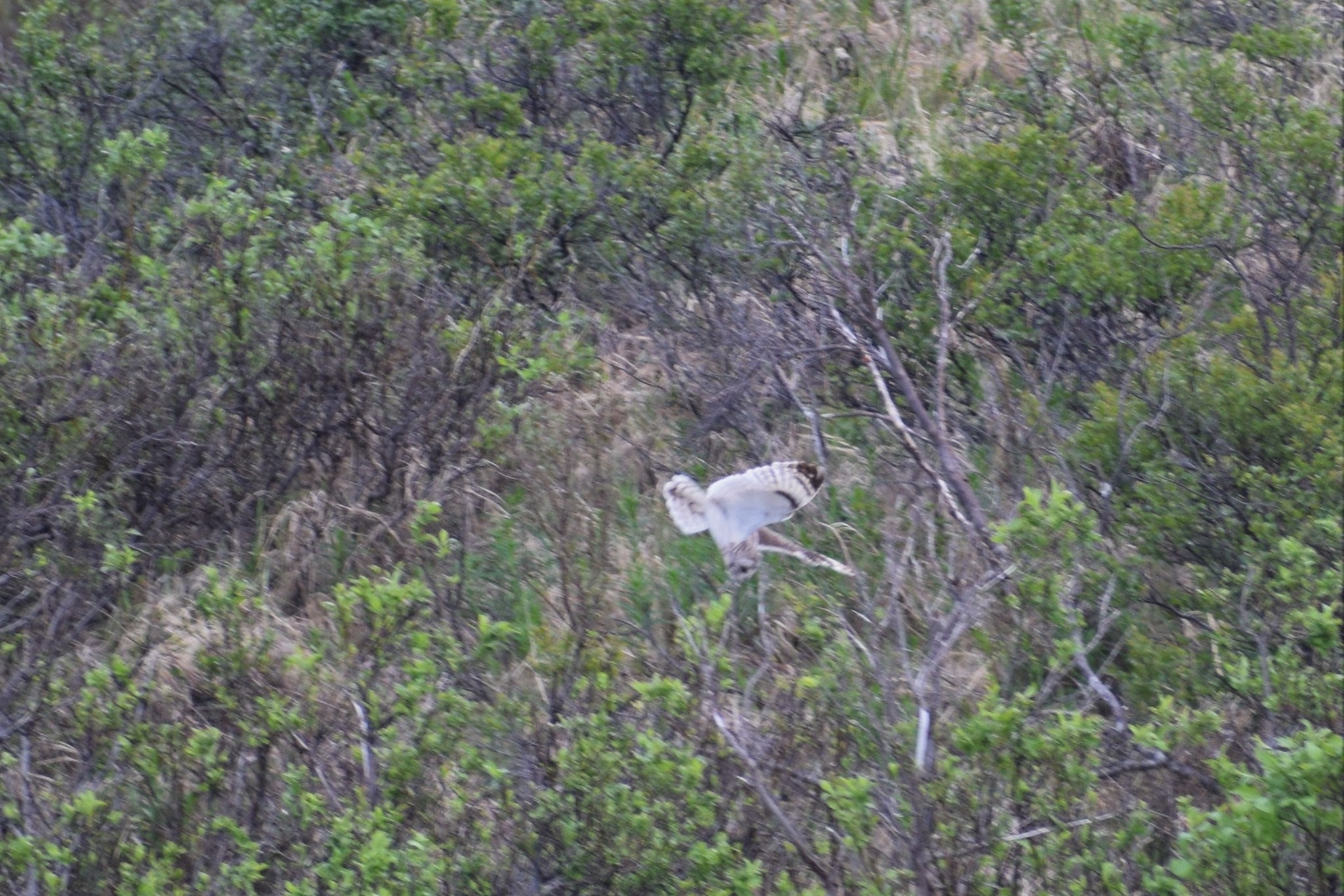
Short-eared Owl
Asio flammeus
短耳鸮
Introduction
This medium-sized owl occurs across grasslands, prairies, tundra, and open meadows throughout much of the world. It has a low, moth-like flight style as it quarters over open fields hunting for rodents. Unlike many owls, it is frequently active during daylight hours, particularly at dawn and dusk. It nests on the ground in concealed locations. The species is partially migratory, with northern populations moving south in winter, and exhibits nomadic movements in response to rodent population cycles.
Description
A medium-sized owl measuring 34-43 cm in length with a substantial wingspan of 85-110 cm. Adults weigh between 206-475 g, with females being slightly larger than males. The most striking features are the large, yellow-orange eyes dramatically ringed with black, giving a mascaraed appearance, surrounded by conspicuous whitish facial disks. The plumage is mottled tawny to brown throughout, with significant streaking on the upper breast and barring on the tail and wings. The bill is short, strong, and black. The broad wings and large head give the bird a distinctive silhouette, though the ear tufts for which the genus is named are extremely short and usually invisible. In flight, the wingbeats appear irregular and somewhat floppy, creating an unmistakable profile.
Identification
This species overlaps in range with the long-eared owl but can be distinguished through several key characteristics. The eye color provides an immediate clue: yellow versus the long-eared's orange iris. The black markings around the eyes run horizontally rather than vertically as seen in the long-eared. Overall coloration tends to be paler and sandier. In flight, look for a broad white band along the rear edge of the wing, a feature absent in the long-eared. The upperwing primary patches are paler and more conspicuous, and the tail bands are bolder. Underwing streaking ends at the breast rather than continuing throughout the underparts. The wings are longer and slimmer compared to the long-eared's more tawny-owl-like wing shape. This species prefers open habitats and is often observed hunting in early morning or late afternoon, while the long-eared favors dense thickets.
Distribution & Habitat
This species has one of the broadest distributions of any bird, occurring on all continents except Antarctica and Australia. Breeding populations span Europe, Asia, North and South America, the Caribbean, Hawaii, and the Galápagos Islands. The species is partially migratory, with northern populations moving south for winter. It demonstrates a remarkable ability to relocate to areas with higher rodent populations and exhibits nomadic wandering during years of low vole abundance. Habitat consists of open grasslands, prairies, tundra, savannas, and meadows. The species' distribution follows prey availability rather than fixed territorial boundaries.
Behavior & Ecology
Breeding occurs from March through June, peaking in April. Males perform elaborate courtship displays involving dramatic aerial maneuvers over the nest site. These owls are generally monogamous and nest on the ground, concealing their clutch of 4-7 white eggs (up to 12 in vole-rich years) among low vegetation. The female incubates for 21-37 days, and young fledge at just over four weeks. Hunting takes place primarily at night but also during daylight and twilight, especially when voles are active. The owl flies just above the ground, feet-first, before swooping on prey. The diet is dominated by rodents, particularly voles, but includes rabbits, mice, ground squirrels, shrews, bats, insects, and occasionally small birds. The species is known to distract predators from nests by feigning injury. Vocalizations include a scratchy bark-like call: raspy waowk sounds and a loud eeee-yerp on breeding grounds, though they are largely silent on wintering grounds.
Conservation
The global population is estimated at 1,200,000 to 2,100,000 individuals with an extremely large range, leading the IUCN to evaluate this species as of Least Concern. However, populations in the southern portion of its United States range are declining, and it is listed as endangered in New Mexico. The primary threats include habitat loss from agricultural intensification, urbanization, and grassland degradation. Conversion of native prairie to cropland has reduced available nesting habitat across many parts of its range. Conservation efforts focus on protecting grassland habitats and monitoring population trends in sensitive areas.
Culture
The Hawaiian subspecies, known locally as the Pueo, holds significant cultural importance in Hawaiian tradition and is recognized as a symbol of Hawaiian heritage. This subspecies has inhabited the Hawaiian Islands for an estimated 400,000 years and is deeply woven into the cultural fabric of the islands. The species has also been referenced in various ecological and conservation contexts due to its global distribution and adaptability to different environments.
Source: Wikipedia · CC BY-SA 3.0
Taxonomy
- Order
- Strigiformes
- Family
- Strigidae
- Genus
- Asio
- eBird Code
- sheowl
Vocalizations
Subspecies (11)
-
Asio flammeus bogotensis
Andes of Colombia, Ecuador, and northwestern Peru
-
Asio flammeus cubensis
Cuba
-
Asio flammeus domingensis
Hispaniola
-
Asio flammeus flammeus
North America, Europe, northern Asia, and North Africa
-
Asio flammeus galapagoensis
Galapagos
-
Asio flammeus pallidicaudus
northern Venezuela and Guyana
-
Asio flammeus ponapensis
Pohnpei (eastern Caroline Islands)
-
Asio flammeus portoricensis
Puerto Rico
-
Asio flammeus sandwichensis
Hawaiian Islands
-
Asio flammeus sanfordi
Falkland Islands
-
Asio flammeus suinda
southern Peru to Bolivia, southeastern Brazil, and Tierra del Fuego
Data Sources
Species description from Wikipedia, licensed under CC BY-SA 3.0.
Bird images and sounds sourced from GBIF, contributed by citizen scientists worldwide under Creative Commons licenses.
Taxonomy data from AviList 2025.