Ruddy Turnstone
Arenaria interpres
翻石鹬
Introduction
The ruddy turnstone (Arenaria interpres) is a small shorebird in the sandpiper family Scolopacidae. It has a global distribution, occurring on coastlines worldwide. Its common name derives from its distinctive foraging behavior of flipping stones, shells, and seaweed to uncover hidden invertebrates. This species inhabits rocky coastlines, pebbled beaches, and human-made structures such as breakwaters and jetties. During migration and winter, it forms loose flocks. Individuals regularly live 9 years, with records of up to 20 years, and demonstrate strong site fidelity to specific locations.
Description
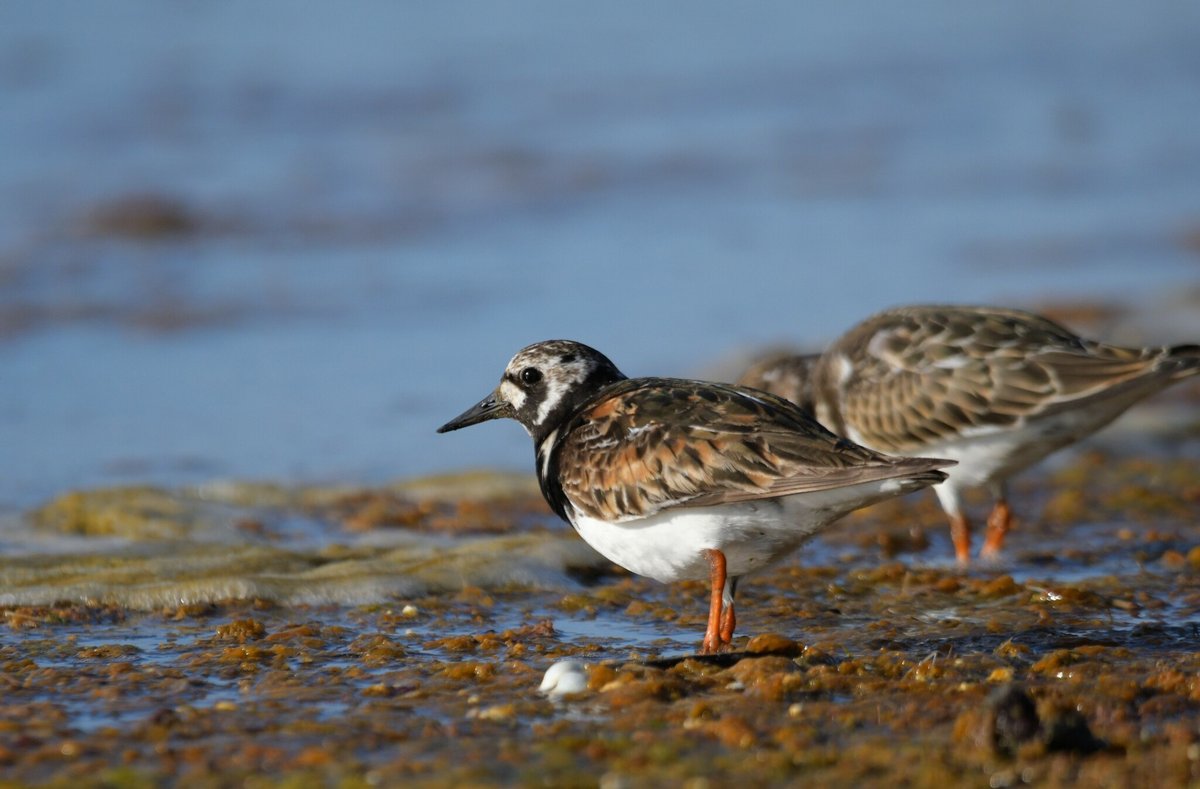
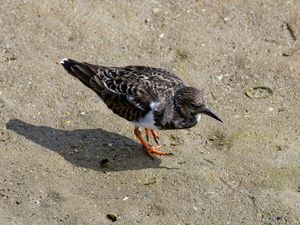
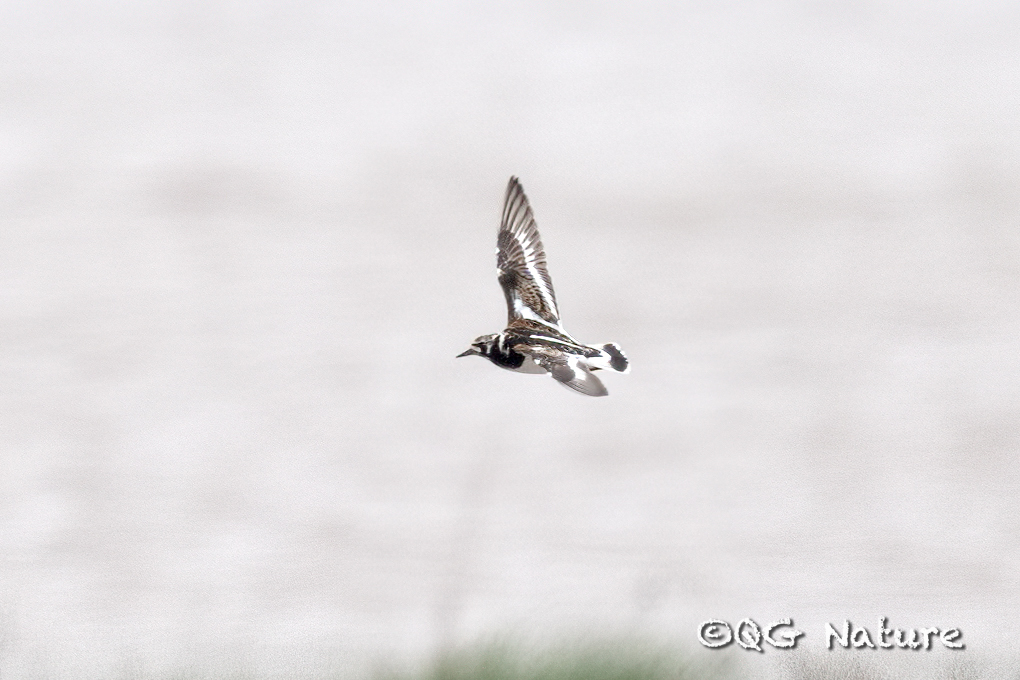
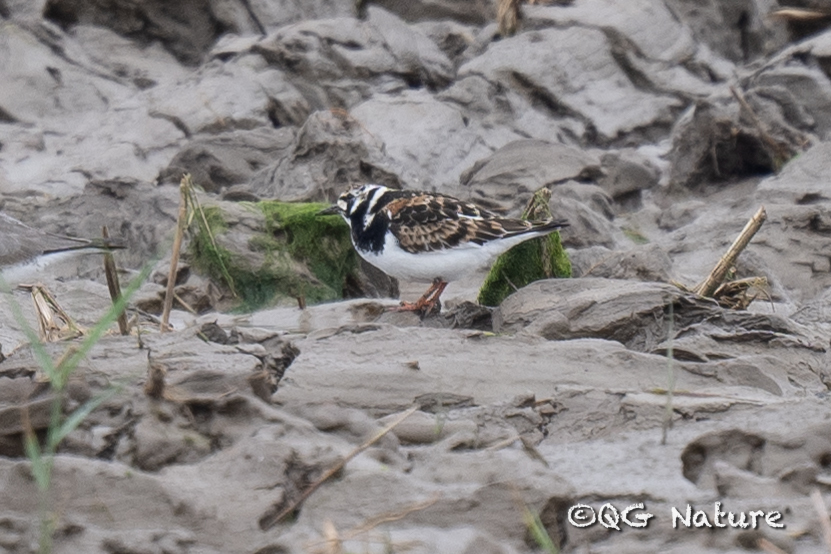
This is a compact, sturdy shorebird measuring 22-24 cm in length with a wingspan of 50-57 cm and weighing 85-150 g. Its dark, wedge-shaped bill is slightly upturned and measures 2-2.5 cm, complemented by bright orange legs that are relatively short at 3.5 cm. The plumage displays a striking harlequin pattern of brown, black, and white in all seasons. Breeding adults show reddish-brown upperparts marked with black, a predominantly white head with black streaking on the crown and a distinctive facial pattern, and a black breast with white patches on the sides. The underparts are white. In flight, the bird reveals a white wingbar, a white patch at the wing base, and white on the lower back, rump, and tail. Females appear slightly duller with a browner head and more extensive streaking. Non-breeding adults have darker, grey-brown upperparts with mottling and a darker head with minimal white. Juveniles display pale brown heads with scaly-looking pale-fringed upperpart feathers.
Identification
The ruddy turnstone's bold black, white, and reddish-brown plumage pattern makes it unmistakable in its range, where it is typically the only turnstone species present. The bright orange legs and slightly upturned dark bill are key field marks. Its distinctive foraging behavior—actively flipping stones and objects along the shoreline—separates it from most other shorebirds. In flight, the white wingbar and white rump patch distinguish it from larger sandpipers. The only similar species is the black turnstone, which is restricted to the Pacific coast of North America and lacks the reddish-brown tones and white wingbar of its ruddy cousin. The ruddy turnstone's stocky build and distinctive feeding action, combined with its bold facial pattern, eliminate confusion with other small shorebirds.
Distribution & Habitat
This highly migratory species breeds throughout Arctic and subarctic regions of the Northern Hemisphere, typically within a few kilometers of the coast. Populations from northeast Canada, Greenland, northern Europe through Siberia, and western Alaska migrate to winter on coastlines worldwide. In the Americas, it winters from Washington and Massachusetts southward to the tip of South America, though scarce in southern Chile and Argentina. European populations winter from Iceland and Norway southward, with fewer birds on Mediterranean coasts. African wintering grounds extend to South Africa with strong island populations. Asian birds winter as far north as southern China and Japan, south through the Ryukyu Islands to Tasmania, New Zealand, and across the Pacific islands. Some non-breeding birds remain year-round in wintering areas, with remarkable site fidelity—studies show 95% return rates to specific wintering sites. Outside breeding season, it favors rocky and stony coastlines, often appearing on man-made structures.
Behavior & Ecology
The ruddy turnstone's varied diet centers on invertebrates but includes insects, crustaceans, spiders, molluscs, worms, carrion, eggs, fish, and plant material depending on season. Its six specialized feeding behaviors—routing through seaweed, turning stones, digging, probing, hammer-probing, and surface pecking—reveal remarkable adaptability. Socially, dominance hierarchies develop at feeding sites, with dominant individuals controlling preferred areas like routing zones through seaweed piles. Age-related aggression determines territory defense, while unique individual plumage patterns help birds recognize neighbors versus intruders. The species is monogamous, with pairs often remaining together across multiple seasons. The nest is a shallow scrape typically holding 2-5 eggs, incubated mainly by the female for 22-24 days. Chicks are precocial, fledging at 19-21 days while receiving protection from both parents, especially the male. Vocalizations include a staccato rattling call and chattering alarm notes during breeding season.
Conservation
The ruddy turnstone maintains a very stable global population classified as Least Concern by the IUCN, with an estimated worldwide population of 449,000 individuals including approximately 235,000 breeding in North America. Environment Canada surveys, however, indicate concerning population declines of up to 50% since the 1970s within Canadian range. The Canadian population is estimated at 100,000-500,000 adults. Threats during migration and wintering periods include habitat degradation, pollution, human disturbance at coastal sites, and potential climate impacts on coastal ecosystems. Despite these pressures, the species benefits from its vast and remote breeding range across the Arctic, combined with extensive wintering distribution spanning global coastlines. Its remarkable longevity and high annual adult survival rate (under 15% mortality) provide some buffer against environmental pressures.
Culture
The ruddy turnstone's common name derives from its distinctive feeding behavior of turning stones and other objects to uncover prey, a trait that has fascinated observers for centuries. While the article does not include extensive cultural or folklore references, this species has served as a model organism in behavioral ecology studies examining foraging strategies, dominance hierarchies, and individual recognition. Its ubiquity on coastlines worldwide has made it a familiar sight to generations of coastal communities, beachgoers, and birdwatchers, contributing to public engagement with shorebird conservation. Scientific interest in its navigation abilities, site fidelity, and extreme longevity continues to provide insights into avian biology, making this common species important for both research and education about coastal ecosystem health.
Source: Wikipedia · CC BY-SA 3.0
Taxonomy
- Order
- Charadriiformes
- Family
- Scolopacidae
- Genus
- Arenaria
- eBird Code
- rudtur
Subspecies (2)
-
Arenaria interpres interpres
breeds coastal tundra of northern Greenland, northern Scandinavia, Baltic states, White Sea, southern Novaya Zemlya and New Siberian Islands eastward to northeastern Siberia and western Alaska, also Ellesmere Island (northeastern Canada); winters coastal western and southern Europe and Africa eastward through southern Asia to eastern Polynesia, also western USA and western Mexico
-
Arenaria interpres morinella
breeds northeastern Alaska and Arctic Canada; winters coastal southeastern USA to central Chile and central Argentina
Data Sources
CBR Notes: IUCN红色名录等级由LC升为NT
Species description from Wikipedia, licensed under CC BY-SA 3.0.
Bird images and sounds sourced from GBIF, contributed by citizen scientists worldwide under Creative Commons licenses.
Taxonomy data from AviList 2025.