
Barred Buttonquail
Turnix suscitator
棕三趾鹑
Introduction
The barred buttonquail (Turnix suscitator) is a buttonquail, a small family of birds that resemble but are not closely related to true quails. This species is resident across tropical Asia from India through Southeast Asia to south China, Indonesia, and the Philippines. It inhabits scrub jungle, light deciduous forest, and farmlands, generally avoiding dense forest and desert. Notable traits include extreme sexual dimorphism, with females being larger and more brightly colored than males, and a polyandrous breeding system where females maintain multiple male mates sequentially. Sixteen subspecies are recognized across its range. The species is evaluated as Least Concern on the IUCN Red List due to its large range and stable populations.
Description
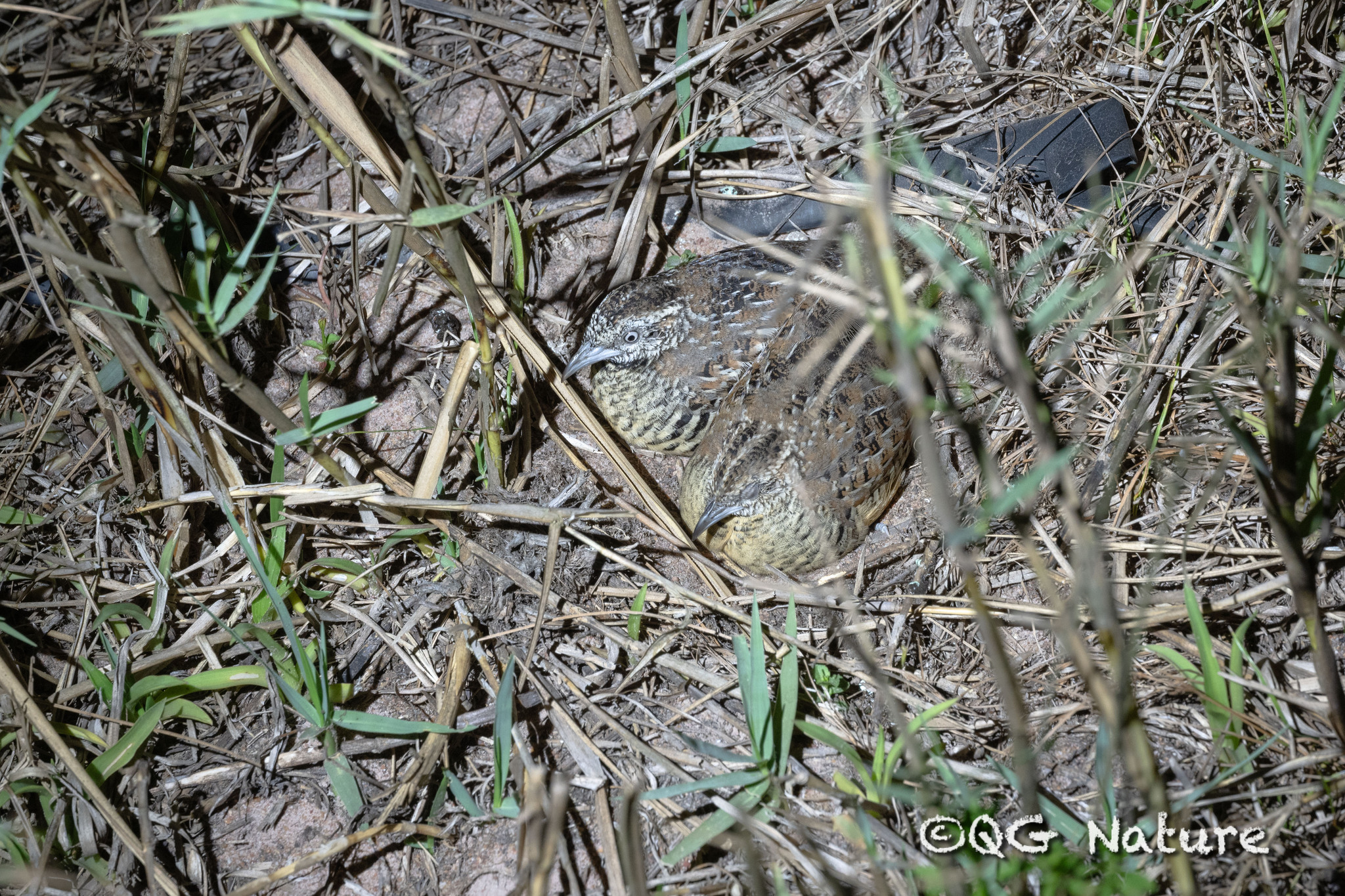
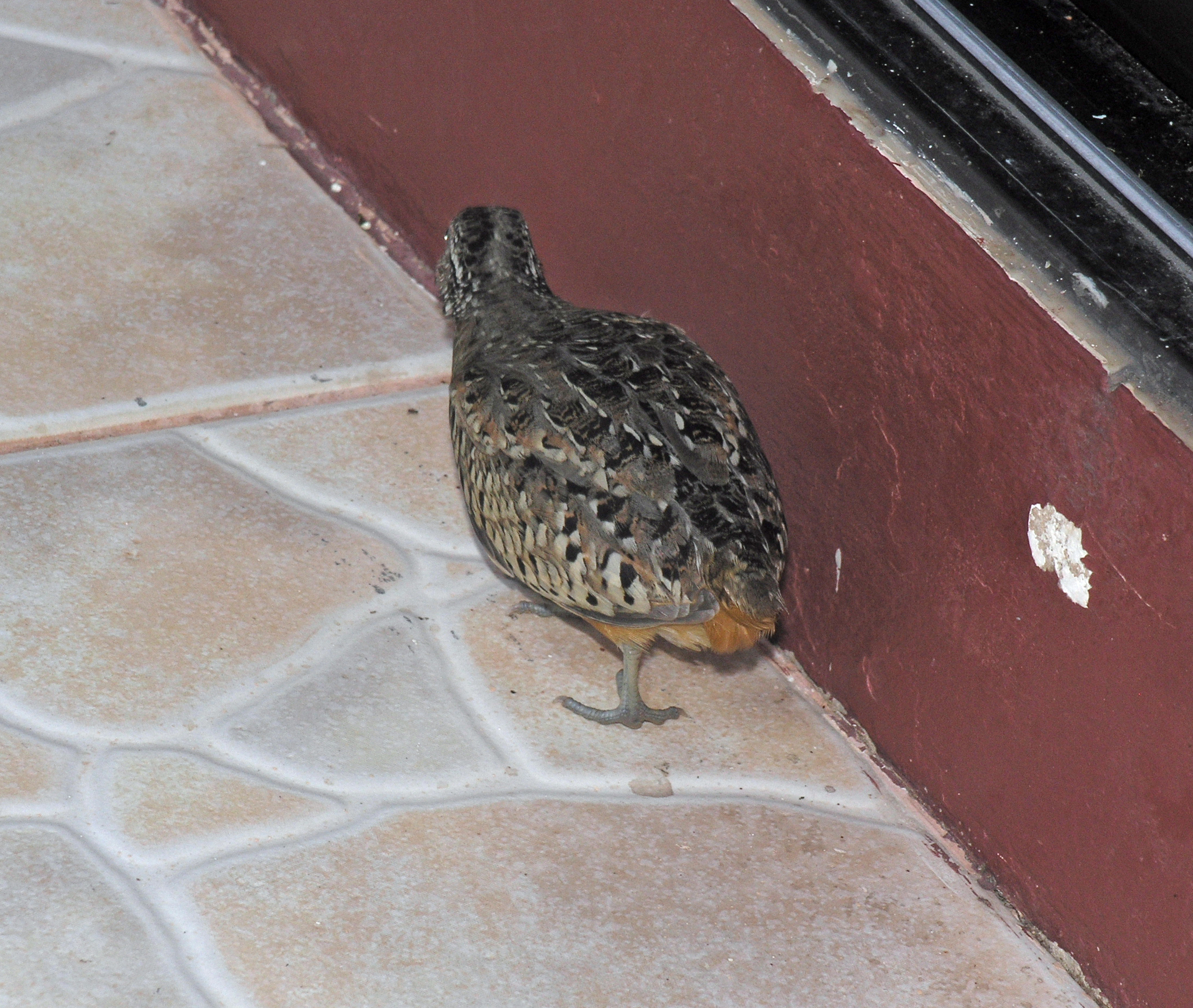
A small, compact buttonquail with rufous-brown upperparts and rusty-buff underparts. The chin, throat, and breast are closely barred with black. Females are larger and more richly colored, with a black throat and center of breast. Diagnostic features include blue-grey legs and bill, and yellowish-white eyes. In flight, pale buff shoulder patches become visible. The species lacks a hind toe, distinguishing it from true quails.
Identification
Key identifying features are the blue-grey legs and bill combined with yellowish-white eyes. The pale buff shoulder patches visible in flight are also diagnostic. The absence of a hind toe distinguishes buttonquails and bustard-quails from true quails. Females are more boldly marked with black on the throat and breast, while males are duller overall.
Distribution & Habitat
The species occurs throughout India up to approximately 2,500 meters elevation in the Himalayas, extending east through Bangladesh, Burma, and most of Southeast Asia to south China, Indonesia, and the Philippines. Four geographical races differ somewhat in coloration. It occupies most habitat types except dense forest and desert, preferring scrub jungle, light deciduous forest, and cultivated farmlands.
Behavior & Ecology
The diet consists of small invertebrates and seeds. Breeding exhibits a reversed sexual roles: females are brighter, initiate courtship, and fight with other females for male possession, producing a loud drumming call. Females build the ground nest and may mate with multiple males sequentially, leaving eggs for males to incubate and tend young. The nest is a grass-lined scrape in scrub or crops, often arched over with vegetation. Clutches contain 3-4 greyish-white eggs speckled with reddish-brown. Breeding occurs nearly year-round, varying locally. Calls include a motorcycle-like drr-r-r-r-r and a loud hoon-hoon-hoon.
Conservation
Evaluated as Least Concern on the IUCN Red List. The species is widespread and common throughout its large range, with no major threats identified. Population trends are currently stable.
Culture
No cultural information provided in source material.
Source: Wikipedia · CC BY-SA 3.0
Taxonomy
- Order
- Charadriiformes
- Family
- Turnicidae
- Genus
- Turnix
- eBird Code
- barbut1
Subspecies (16)
-
Turnix suscitator atrogularis
Thai-Malay Peninsula
-
Turnix suscitator bengalensis
northeastern India (lower West Bengal)
-
Turnix suscitator blakistoni
Myanmar to southern China, northern Indochina, and Hainan
-
Turnix suscitator fasciatus
northern Philippines (Luzon to Mindoro, Sibuyan, and Masbate)
-
Turnix suscitator haynaldi
southwestern Philippines (Palawan and Calamian Islands)
-
Turnix suscitator leggei
Sri Lanka
-
Turnix suscitator nigrescens
Philippines (Negros, Cebu, and Panay)
-
Turnix suscitator okinavensis
southern Kyushu Island and Makenoshima Island southward to Ryukyu Islands (southern Japan)
-
Turnix suscitator pallescens
south-central Myanmar
-
Turnix suscitator plumbipes
Nepal, Sikkim, and Bangladesh to northern Myanmar
-
Turnix suscitator powelli
Lesser Sundas
-
Turnix suscitator rostratus
Taiwan
-
Turnix suscitator rufilatus
Sulawesi
-
Turnix suscitator suscitator
Sumatra including Belitung and Bangka, Java including Bawean, and Bali
-
Turnix suscitator taigoor
India
-
Turnix suscitator thai
central Thailand
Data Sources
Species description from Wikipedia, licensed under CC BY-SA 3.0.
Bird images and sounds sourced from GBIF, contributed by citizen scientists worldwide under Creative Commons licenses.
Taxonomy data from AviList 2025.