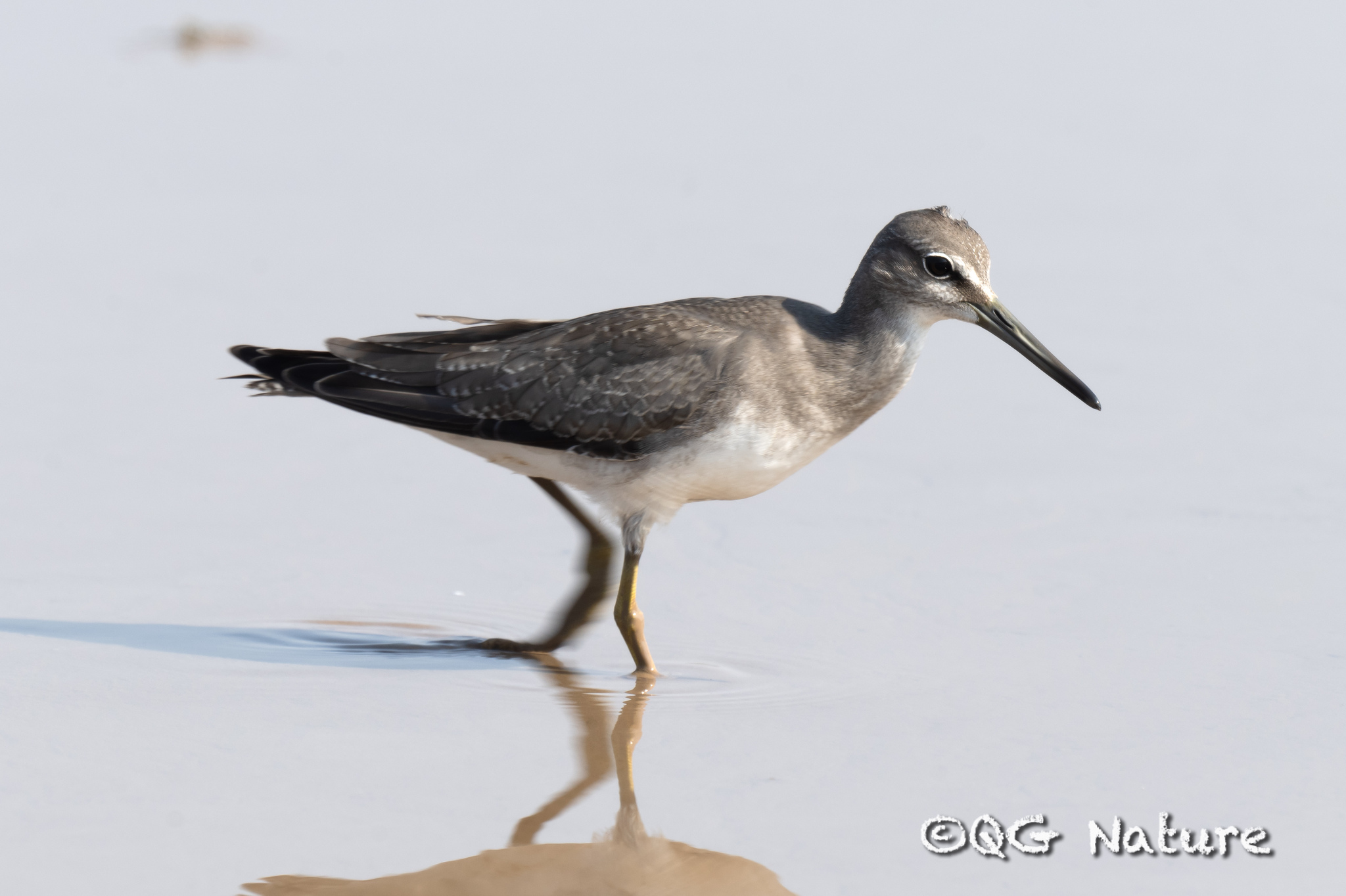
Grey-tailed Tattler
Tringa brevipes
灰尾漂鹬
Introduction
The grey-tailed tattler (Tringa brevipes) is a shorebird in the Tringa genus, which includes redshanks and sandpipers. It breeds in Siberia and migrates to the coasts of Australia and Southeast Asia for the non-breeding season, arriving in the austral summer. It can be distinguished from its relatives by its uniformly grey upperparts, contrasting with the more patterned plumage typical of other Tringa species. It produces a distinctive whistle and feeds along water edges with deliberate steps. When approached, it typically freezes briefly before calling, then continues working along the shoreline. It overlaps in range with the wandering tattler (Tringa incana), from which it is distinguished by plumage and call.
Description
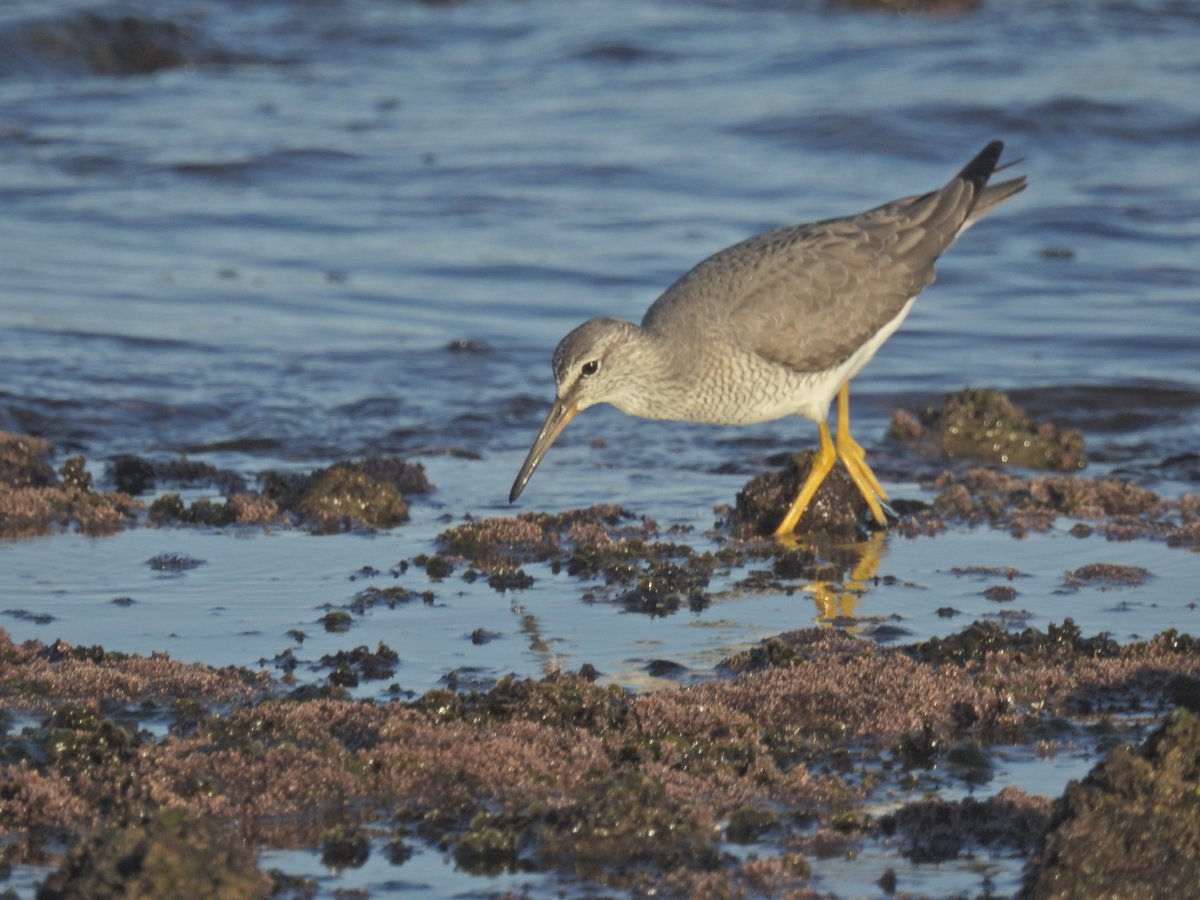
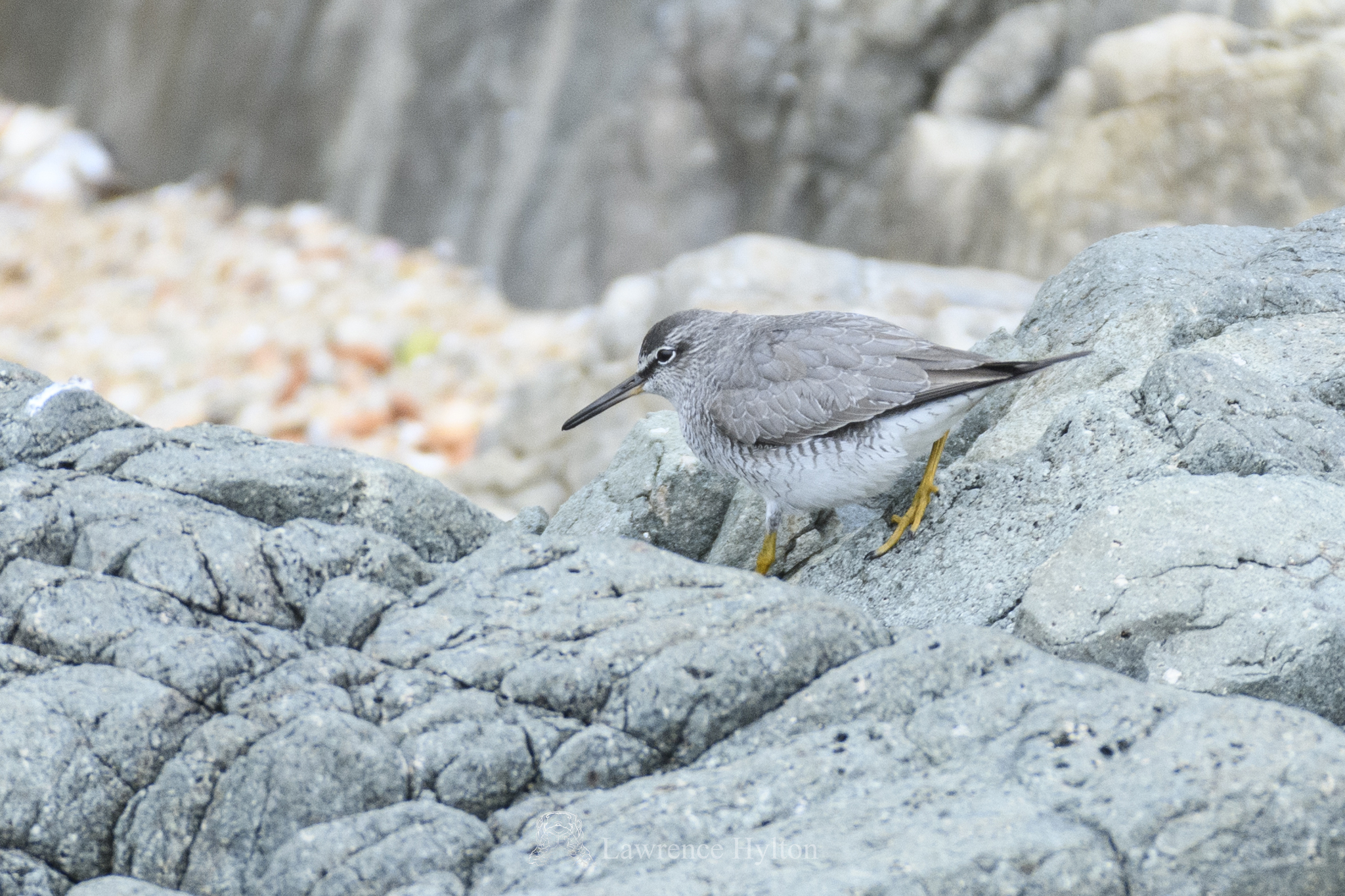
This compact shorebird measures approximately 25-27 cm in length and closely resembles the common redshank in overall size and proportions. The upperparts, including the wings, back, face and neck, are uniformly grey in all plumages—a distinctive feature that sets it apart from most other Tringa species. The underparts are white, though breeding birds display a characteristic scaly pattern on the breast that extends variably onto the belly. A prominent supercilium adorns the breeding plumage, becoming weaker in non-breeding birds. The legs are short and yellowish, while the bill is medium-length with a notably pale base graduating to a dark tip. In flight, the grey underwings provide another useful identification feature. The species shares its general appearance with the wandering tattler, though subtle differences in leg scaling and nasal groove length require close observation to discern.
Identification
The grey-tailed tattler presents a genuine identification challenge, being nearly indistinguishable from its close relative, the wandering tattler, based on plumage alone. The most reliable field mark is the vocalization: the grey-tailed produces a clear, disyllabic whistle, whereas the wandering tattler gives a rippling trill. Structural differences exist but require experience to detect; the grey-tailed typically shows a slightly shorter nasal groove and different scaling pattern on the tarsi. In breeding plumage, both species share the scaly breast pattern and prominent supercilium, while non-breeding birds are plainer overall. When observing these birds in Australia, where only the grey-tailed tattler occurs regularly, identification is straightforward by range alone. However, vagrants to western North America and Europe require careful examination, as wandering tattlers may also occasionally appear in these regions.
Distribution & Habitat
This species breeds exclusively in the remote river valleys of northeast Siberia, where it nests on stony riverbeds surrounded by taiga woodland. After the breeding season concludes, these birds undertake a substantial migration southward, spreading across an impressive wintering range from Southeast Asia through Papua New Guinea to Australia. They show a strong preference for muddy and sandy coastlines, favoring estuaries, mangrove edges, and tidal flats. Within Australia, they occur along both the northern and eastern coastlines, with important populations recorded in Queensland, New South Wales, and Victoria. Some individuals venture further south during their Australian sojourn. While primarily a species of coastal habitats, they occasionally appear at inland water bodies during migration. Reports from western North America and western Europe are rare but considered genuine vagrancy rather than regular occurrence.
Behavior & Ecology
Grey-tailed tattlers arrive on their Siberian breeding grounds in late spring, when males establish territories along gravelly riverbeds where the stony substrate provides camouflage for their ground-level nests. Both parents share incubation duties and chick-rearing, though the species will readily adopt abandoned nests of other birds—a behavioral flexibility that may prove advantageous in their demanding environment. Interestingly, despite being ground-nesters, these birds readily perch in trees, a behavior frequently observed at roost sites. During the non-breeding season, they are not particularly social, typically occurring in small numbers or as isolated individuals rather than in large flocks. However, they do congregate at traditional roost sites, where dozens may gather at high tide. Their foraging strategy involves patient observation followed by deliberate movement, picking prey items by sight from wet sand, mud, or shallow water. The diet consists primarily of insects, crustaceans, and other small invertebrates found in their coastal habitat.
Conservation
The grey-tailed tattler holds a status of Least Concern globally according to the IUCN Red List, indicating that the worldwide population remains relatively stable. However, this masks concerning regional trends, particularly in southeastern Australia. In Victoria, the species faces heightened vulnerability and has been listed as threatened under the Flora and Fauna Guarantee Act (1988). The 2007 advisory list of threatened vertebrate fauna in Victoria classifies it as critically endangered, reflecting the severe pressure on its coastal habitats in this region. Nationally, under Australia's Environment Protection and Biodiversity Conservation Act 1999, the species is not currently listed as threatened, though this may change as habitat pressures intensify. The primary threats involve coastal development, disturbance at roost and foraging sites, and the degradation of estuarine habitats throughout its Australian range. Wetland conservation and the protection of staging areas during migration will be crucial for ensuring this species' long-term security.
Culture
The grey-tailed tattler has not acquired significant cultural associations in Australian Indigenous traditions or broader cultural contexts, likely due to its relatively inconspicuous nature and remote breeding grounds. However, within the birdwatching community, this species holds particular interest as part of the broader tattler group—birds whose name derives from their distinctive, vocal calls that early naturalists considered 'tattling' or chattering. The association with the remote Siberian wilderness lends the species a certain mystique among Australian birders, who view its annual return as a tangible connection to one of the planet's last great wilderness areas. For dedicated shorebird enthusiasts, encountering a grey-tailed tattler represents a meaningful moment, tying local birdwatching to global migratory pathways and the remarkable journeys these small birds undertake twice yearly.
Source: Wikipedia · CC BY-SA 3.0
Taxonomy
- Order
- Charadriiformes
- Family
- Scolopacidae
- Genus
- Tringa
- eBird Code
- gyttat1
Distribution
breeds montane tundra of Krasnoyarsk (west-central Siberia) and Yana River eastward to Kamchatka (eastern Siberia); winters muddy to sandy Pacific coasts from Malay Peninsula eastward through Micronesia and western Polynesia and southward to northern Australia
Data Sources
CBR Notes: IUCN红色名录等级由NT降为LC
Species description from Wikipedia, licensed under CC BY-SA 3.0.
Bird images and sounds sourced from GBIF, contributed by citizen scientists worldwide under Creative Commons licenses.
Taxonomy data from AviList 2025.