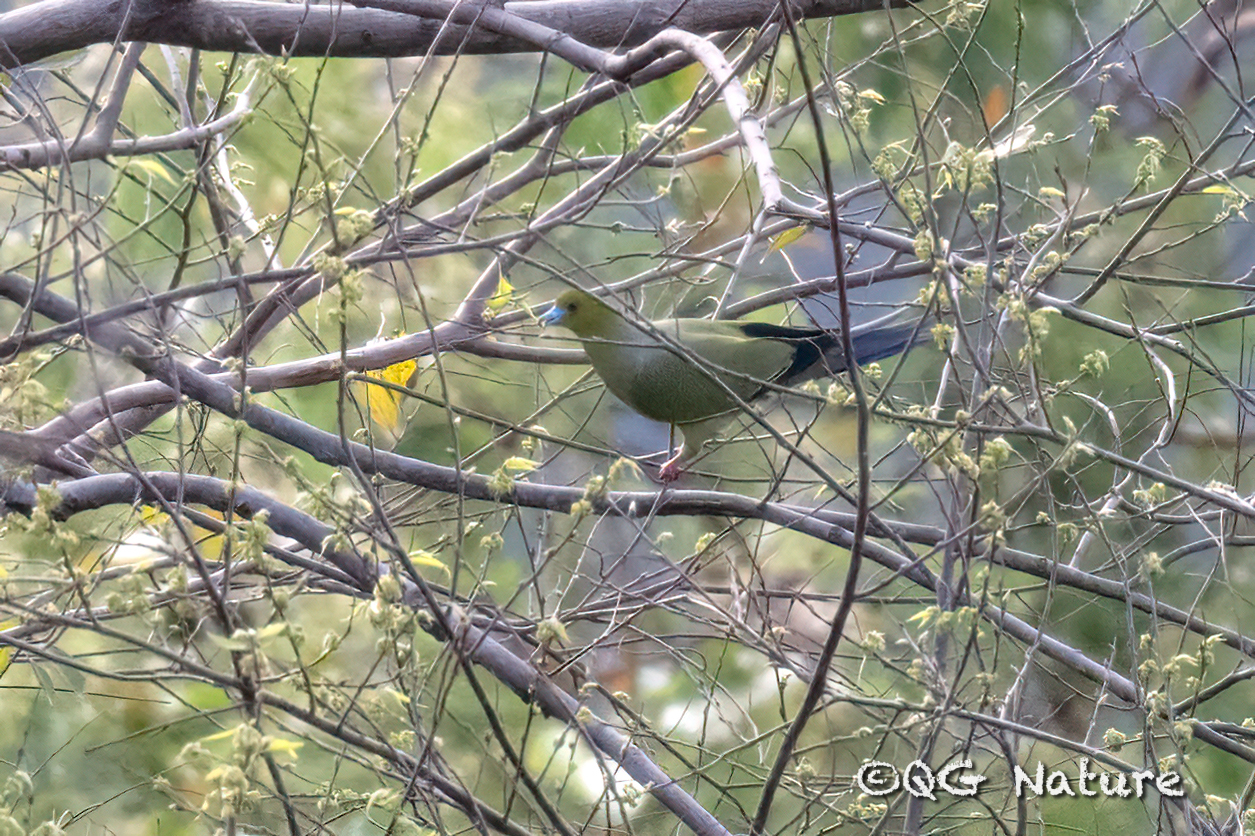
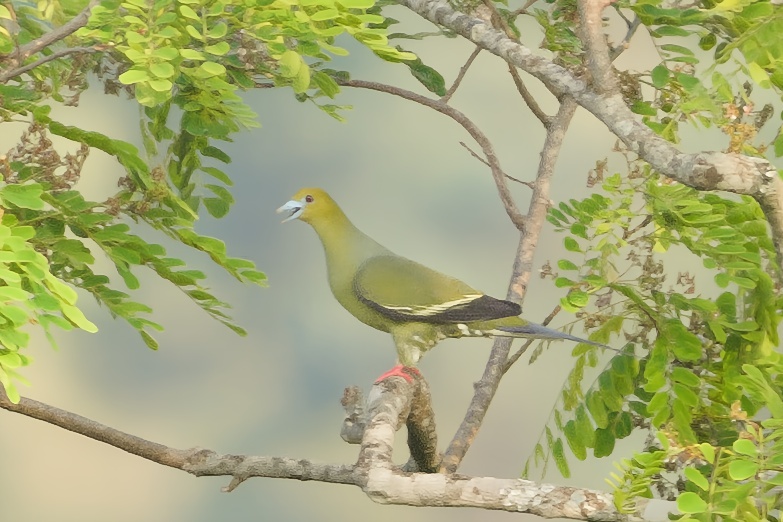
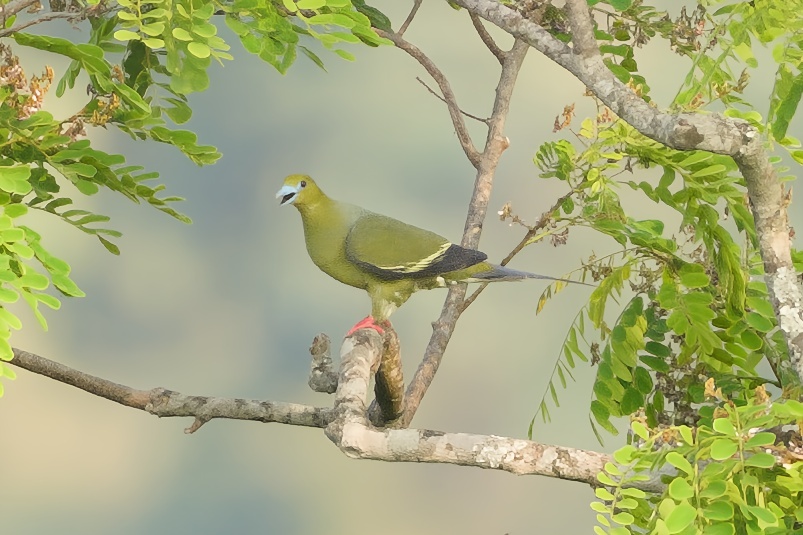
Pin-tailed Green Pigeon
Treron apicauda
针尾绿鸠
Introduction
Species of bird in the family Columbidae native to Southeast Asia. Inhabits secondary growth and forest habitats including foothill forests, subtropical and tropical dry forest, and evergreen rainforest from 0 to 1800 meters elevation. Notable for acrobatic frugivory and gregarious behavior, forming feeding flocks of 10-30 birds that occasionally visit salt licks. Assessed as Least Concern by the IUCN in 2018, though population trend is decreasing. Common across much of its range but scarce in Thailand and very rare in Bangladesh.
Description
Medium-sized dove with average weight of 185-255 grams. Males measure 32-36 cm in length, while females are typically 28 cm. Plumage is yellow-green overall with darker green wing-coverts and scapulars, and black outer secondaries and primaries. Males display a golden breast with pinkish hues, bluish-gray central tail feathers, and chestnut undertail-coverts. Both sexes have a blue orbital ring and blue bill with a lighter green or yellow tip. Legs and feet are bright reddish-pink. Females are duller yellow overall with much shorter central tail feathers and duller undertail-coverts. Vocalizations include a soft whistling ku-koo song, usually given in pairs, and a high-pitched doo! call. Flight produces a whirring sound.
Identification
Key distinguishing features include the long, pointed central tail feathers that give the species its name, and the combination of yellow-green plumage with chestnut undertail-coverts in males. The bright reddish-pink legs and blue orbital ring are helpful field marks. Differs from similar green pigeon species in its more elongated tail structure and specific coloration patterns. Females are notably duller than males with reduced tail length.
Distribution & Habitat
Ranges across Bangladesh, Bhutan, Cambodia, China, India, Laos, Myanmar, Nepal, Thailand, and Vietnam. Inhabits secondary growth, foothill forests, subtropical and tropical dry forest, and evergreen rainforest from sea level to 1800 meters elevation. Behavior varies by region: resident in some areas, nomadic in others following food resources. In central Vietnam, descends to lower elevations during the dry season when many trees are fruiting.
Behavior & Ecology
Frugivorous diet consisting mainly of fruits and berries, consumed in an acrobatic fashion. Gregarious species forming feeding flocks of 10-30 birds, which have been observed descending to ground level to visit salt licks. Breeding occurs year-round in parts of Southeast Asia, with nesting activity documented in April, June in Himalayan foothills. Female lays two white eggs in a platform twig nest 5-6 meters high, typically in bamboo thickets, trees, or shrubs. Both parents share incubation and feeding duties. Generational length approximately 4.2 years.
Conservation
IUCN Least Concern assessment (2018) with decreasing population trend. Considered common across much of its range, though sightings are generally limited. Population status varies regionally: scarce in Thailand and reported as very rare in Bangladesh. No specific threats identified in the source text.
Culture
No cultural significance or folklore information available for this species.
Source: Wikipedia · CC BY-SA 3.0
Taxonomy
- Order
- Columbiformes
- Family
- Columbidae
- Genus
- Treron
- eBird Code
- pitpig1
Subspecies (3)
-
Treron apicauda apicauda
foothills of northeastern India to southwestern China and southern Myanmar (Tenasserim)
-
Treron apicauda laotianus
mountains of Laos and northern Vietnam
-
Treron apicauda lowei
mountains of Thailand, central Laos, and central Vietnam
Data Sources
Species description from Wikipedia, licensed under CC BY-SA 3.0.
Bird images and sounds sourced from GBIF, contributed by citizen scientists worldwide under Creative Commons licenses.
Taxonomy data from AviList 2025.