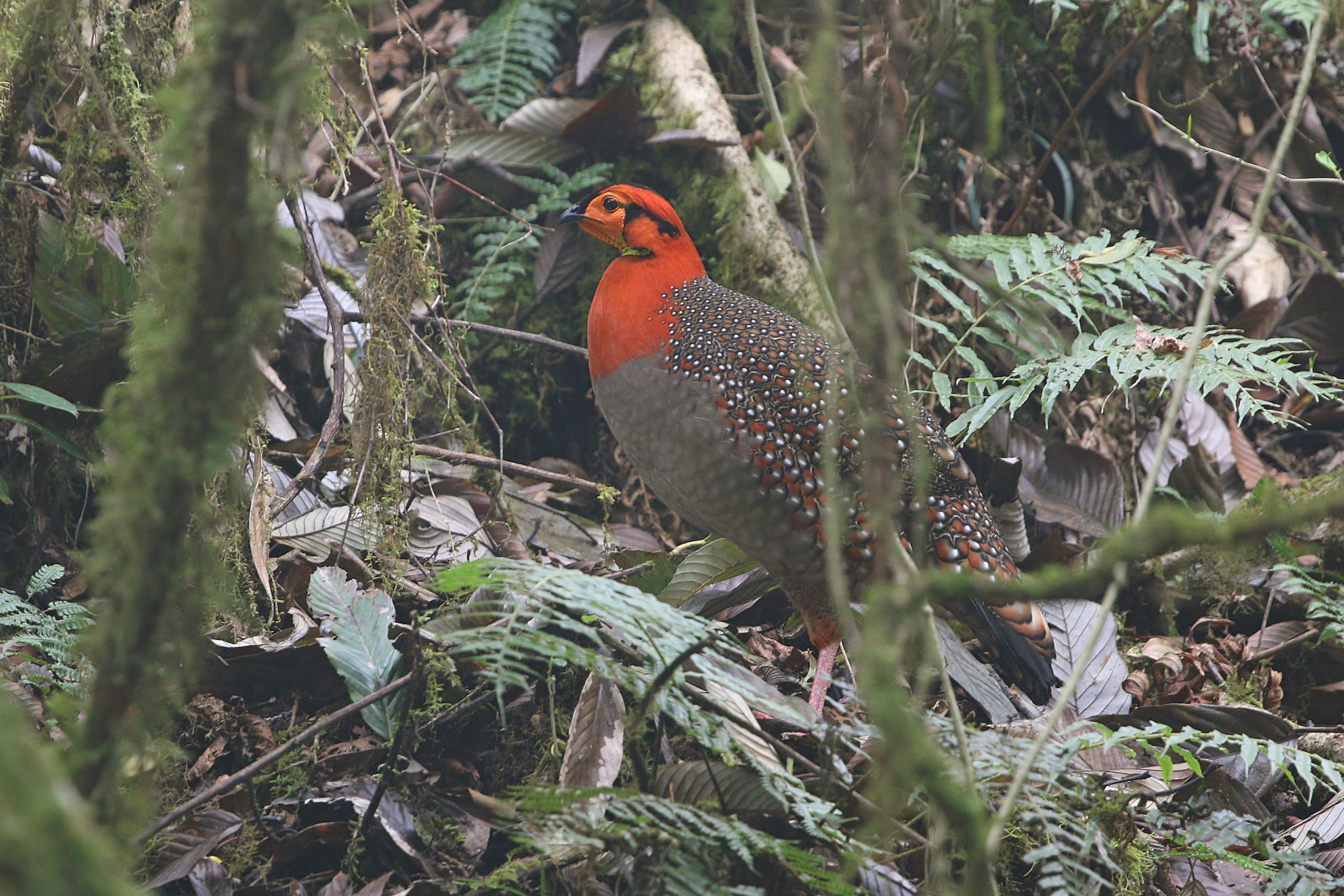
Blyth's Tragopan
Tragopan blythii
灰腹角雉
Introduction
Tragopan blythii is a pheasant and a vulnerable species. It is the largest member of the genus Tragopan. Geographic range extends from Bhutan through northeast India, north Myanmar to southeast Tibet, and China. The species inhabits high-elevation evergreen oak and rhododendron forests, preferring the undergrowth of dark, quiet wooded areas. Population is estimated at 2,500 to 9,999 individuals and is believed to be decreasing rapidly. It is the state bird of Nagaland.
Description
This is the largest tragopan species. Males display a rusty red head with yellow facial skin and small white ocelli (spots) on the back. Two black bands ornament the head: one extending from the base of the bill to the crown and another behind the eyes. During courtship, two pale blue horns become erect. A brightly colored lappet (decorated flap) hangs from the throat and can be expanded during mating displays. Females are dark brown with black, buff and white mottling, providing camouflage.
Identification
The largest tragopan species. Males are unmistakable with their rusty red heads, yellow facial skin, pale blue horns, and expandable throat lappet. The black head markings distinguish them from similar pheasant species. Females are cryptically colored brown with mottled patterning. No other tragopan in its range reaches this size.
Distribution & Habitat
Range extends from Bhutan through northeast India, north Myanmar to southeast Tibet, and China. Inhabits high-elevation evergreen oak and rhododendron forests. Birds move up and down slopes seasonally in search of food, though they rarely travel far due to mild winters that are tolerable for extended periods. Travels in small groups of four to five individuals.
Behavior & Ecology
Generalist diet includes seeds, berries, fruits, and buds; captive birds also consume insects, worms, and small frogs. Mating season runs from April to May. Males perform elaborate courtship displays with bowing, ground-scraping, raised wings, and dilated horns while strutting around females. Females lay two to five eggs with a 28-day incubation period. Nests are reportedly built 6-20 feet above ground in trees, stumps, and bushes to avoid seasonal flooding.
Conservation
IUCN status: Vulnerable. Population is declining due to deforestation, hunting, high grazing levels, and slash-and-burn agriculture. In Nagaland and Arunachal Pradesh, the species is hunted for food using snaring, guns, and slingshots. Habitat fragmentation isolates populations and reduces genetic diversity. Protected in all range countries with two wildlife sanctuaries and a small reserve in Nagaland. Blue Mountain National Park in Mizoram conducted surveys estimating 500-5,000 individuals.
Culture
State bird of Nagaland, India. Local tribes report the species has become locally extinct in many forests where it was once common.
Source: Wikipedia · CC BY-SA 3.0
Taxonomy
- Order
- Galliformes
- Family
- Phasianidae
- Genus
- Tragopan
- eBird Code
- blytra1
Subspecies (2)
-
Tragopan blythii blythii
Himalayas of northeastern India to southwestern China and adjacent Myanmar
-
Tragopan blythii molesworthi
eastern Himalayas (eastern Bhutan, adjacent Tibet, and northeastern India in Arunachal Pradesh)
Data Sources
Species description from Wikipedia, licensed under CC BY-SA 3.0.
Bird images and sounds sourced from GBIF, contributed by citizen scientists worldwide under Creative Commons licenses.
Taxonomy data from AviList 2025.