

Tibetan Snowcock
Tetraogallus tibetanus
藏雪鸡
Introduction
A bird in the pheasant family Phasianidae of the order Galliformes. Found in high-altitude regions of the Western Himalayas and the Tibetan Plateau, with some range overlap with the larger Himalayan snowcock. Characterized by a greyish head with a white crescent patch behind the eye and white underparts with black stripes. In flight, the secondaries show a broad white trailing edge. Classified as a species of 'least concern' by the IUCN due to its large distribution range and no visible population declines.
Description
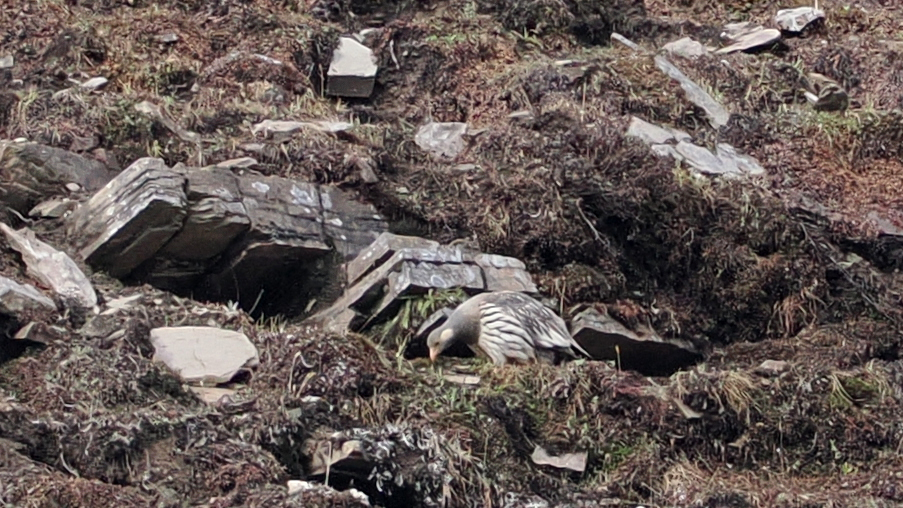
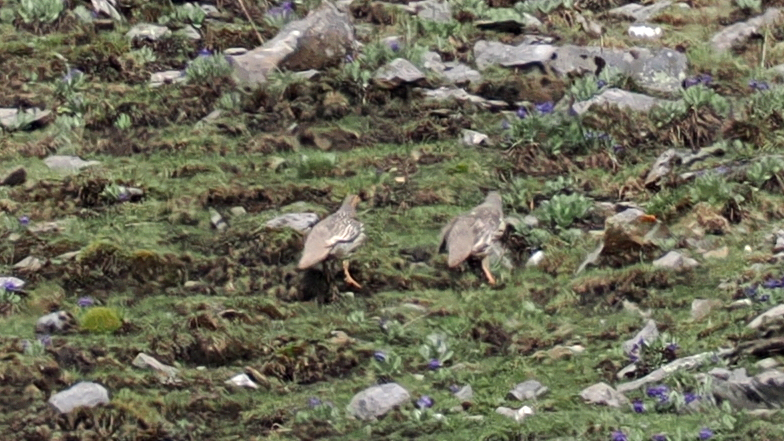
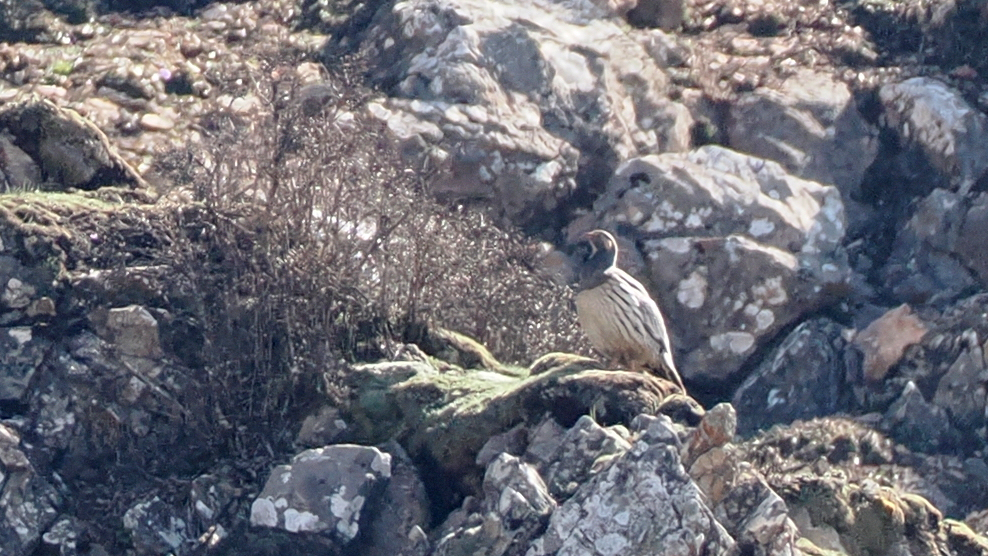
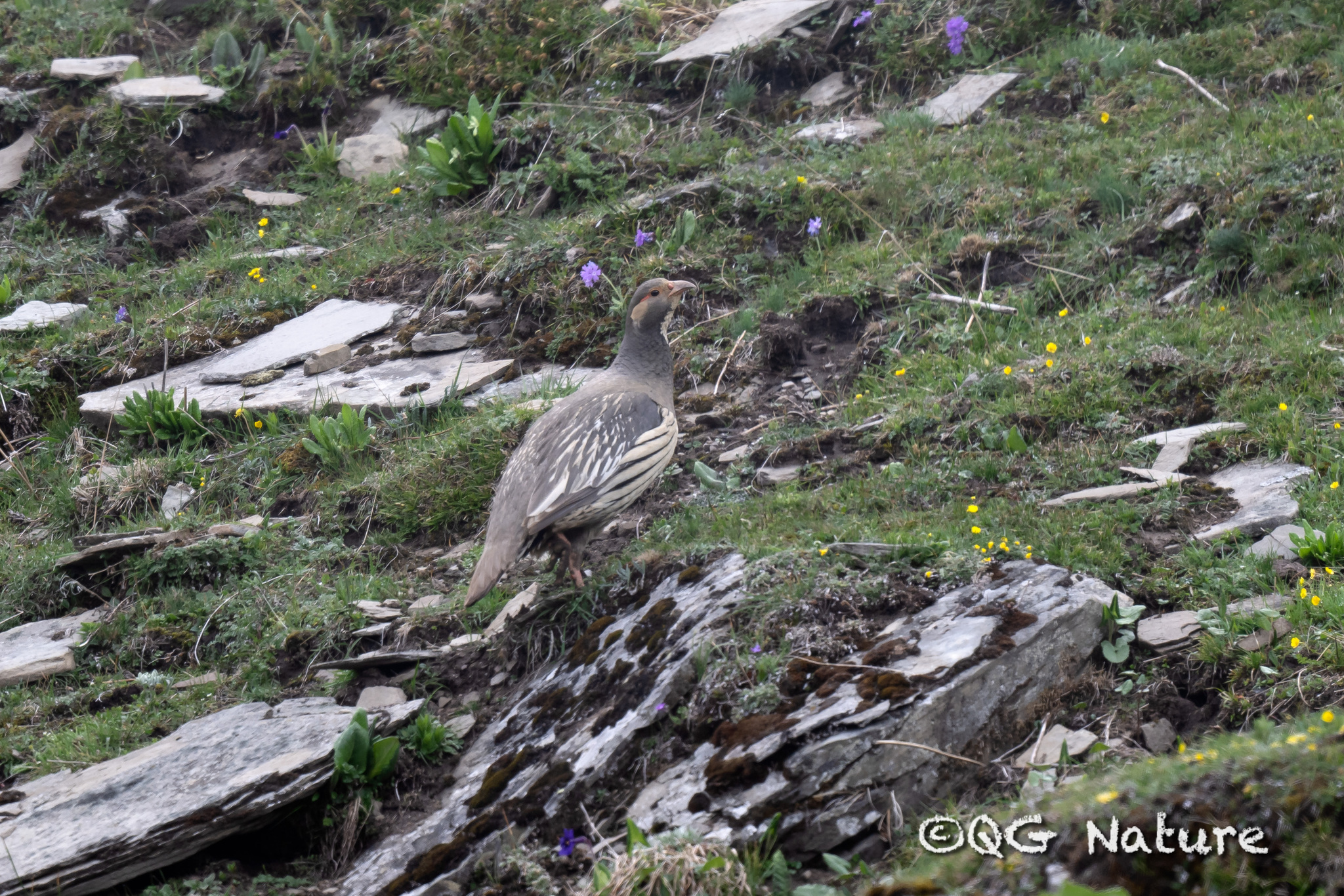
Smaller than the Himalayan snowcock, this species has a grey head and neck with a white patch behind the eye and above the dark cheek. The chin, throat, and breast are white, crossed by two grey breast bands. The grey wing coverts and tertials have white trim. The secondaries display a broad white trailing edge forming a wing band visible in flight. Underparts are white with black streaks on the flanks and belly. The tail is rufous brown and the undertail coverts are black. Legs and beaks are reddish. Sexes are similar, though the female has buff in the postocular patch, blackish and buff marks on the sides of the head, neck, and breast-band, and lacks the male's tarsal spurs.
Identification
Smaller than the Himalayan snowcock with which it overlaps in parts of its range. The grey head with prominent white patch behind the eye helps distinguish it. The white underparts with black stripes and the broad white trailing edge on the secondaries are visible in flight. Females lack the male's tarsal spurs and show more buff coloration in the head markings.
Distribution & Habitat
Inhabits alpine pastures and stony ridges above the tree line across the Pamirs of Tajikistan, the Himalayas from Ladakh to Arunachal Pradesh, Tibet, Pakistan, and China. Descends to lower altitudes during winter or when heavy snowfall occurs. In some parts of its range, distribution clearly separates from the Himalayan snowcock, while in others the two species overlap.
Behavior & Ecology
During winter, descends to lower altitudes and moves in coveys. When approached from below, moves uphill while periodically stopping to watch the intruder, but flies away downhill when alarmed. Flight is swift and often accompanied by a whistling call. Individuals call several times upon landing and shake their tails after settling, reminiscent of willow ptarmigan behavior. Calls are most frequent in morning and evening, becoming quiet at midday. Maintains sentinel watch from high boulders during midday rest periods. Vocalizations include a chuckling call that gradually increases in volume, whistles, and curlew-like sounds. In summer, forms monogamous pairs. The nest is a sparsely lined scrape sheltered under a stone or bush on bare hill slopes. Lays 4 to 6 eggs. Males stand sentinel while females incubate. Both parents accompany the brood and perform distraction displays when chicks are threatened; chicks crouch or hide between stones. Broods from multiple females may form single foraging groups.
Conservation
Classified as Least Concern by the IUCN. The species has a large distribution range and no visible population declines have been observed.
Culture
No cultural information provided.
Source: Wikipedia · CC BY-SA 3.0
Taxonomy
- Order
- Galliformes
- Family
- Phasianidae
- Genus
- Tetraogallus
- eBird Code
- tibsno1
Subspecies (6)
-
Tetraogallus tibetanus aquilonifer
mountains of western Nepal to Bhutan
-
Tetraogallus tibetanus henrici
mountains of eastern Tibet to northwestern Sichuan
-
Tetraogallus tibetanus przewalskii
mountains of northeastern India to west-central China and northwestern Sichuan
-
Tetraogallus tibetanus tibetanus
Pamir Mountains to western Tibet and Ladakh
-
Tetraogallus tibetanus tschimenensis
Kunlun and Altun mountains (northern Tibet, northwestern China)
-
Tetraogallus tibetanus yunnanensis
mountains of northern Yunnan (south-central China)
Data Sources
Species description from Wikipedia, licensed under CC BY-SA 3.0.
Bird images and sounds sourced from GBIF, contributed by citizen scientists worldwide under Creative Commons licenses.
Taxonomy data from AviList 2025.