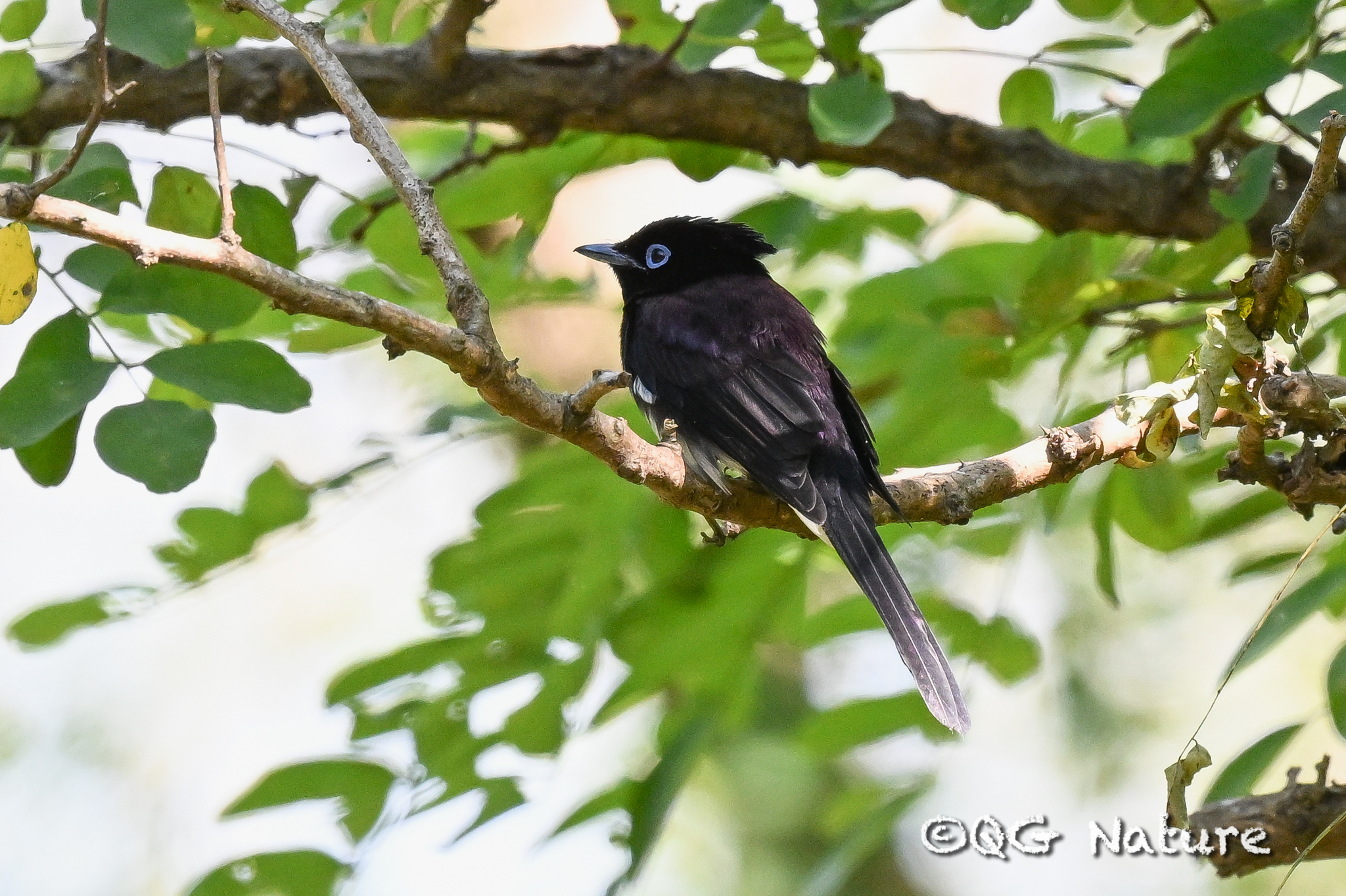
Black Paradise Flycatcher
Terpsiphone atrocaudata
紫寿带
Introduction
This medium-sized passerine is found in East and Southeast Asia. It inhabits wooded habitats and exhibits active flycatching behavior with distinctive calls. It is smaller than the Amur and Blyth's paradise flycatchers and lacks the white morph that occurs in the Asian paradise flycatcher.
Description
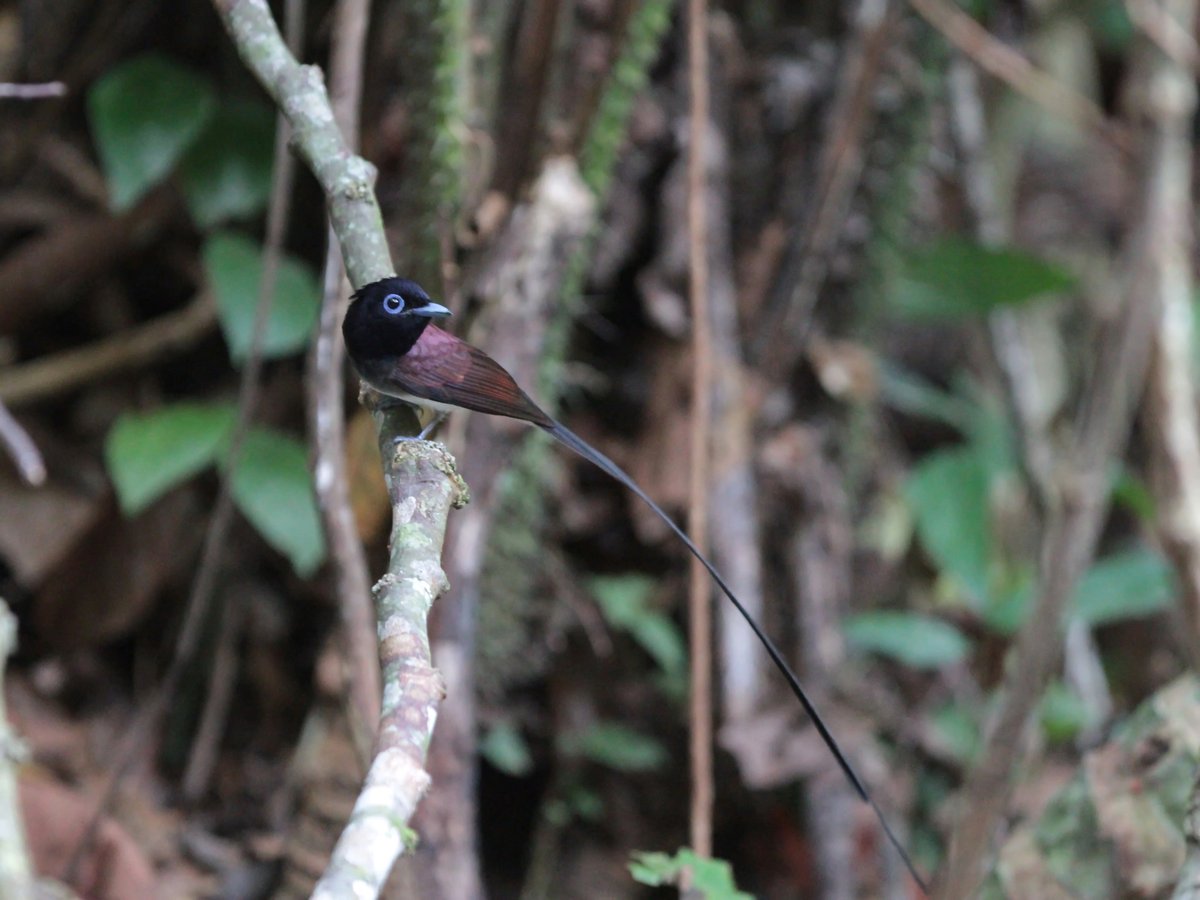
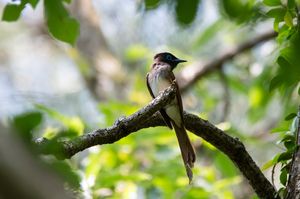
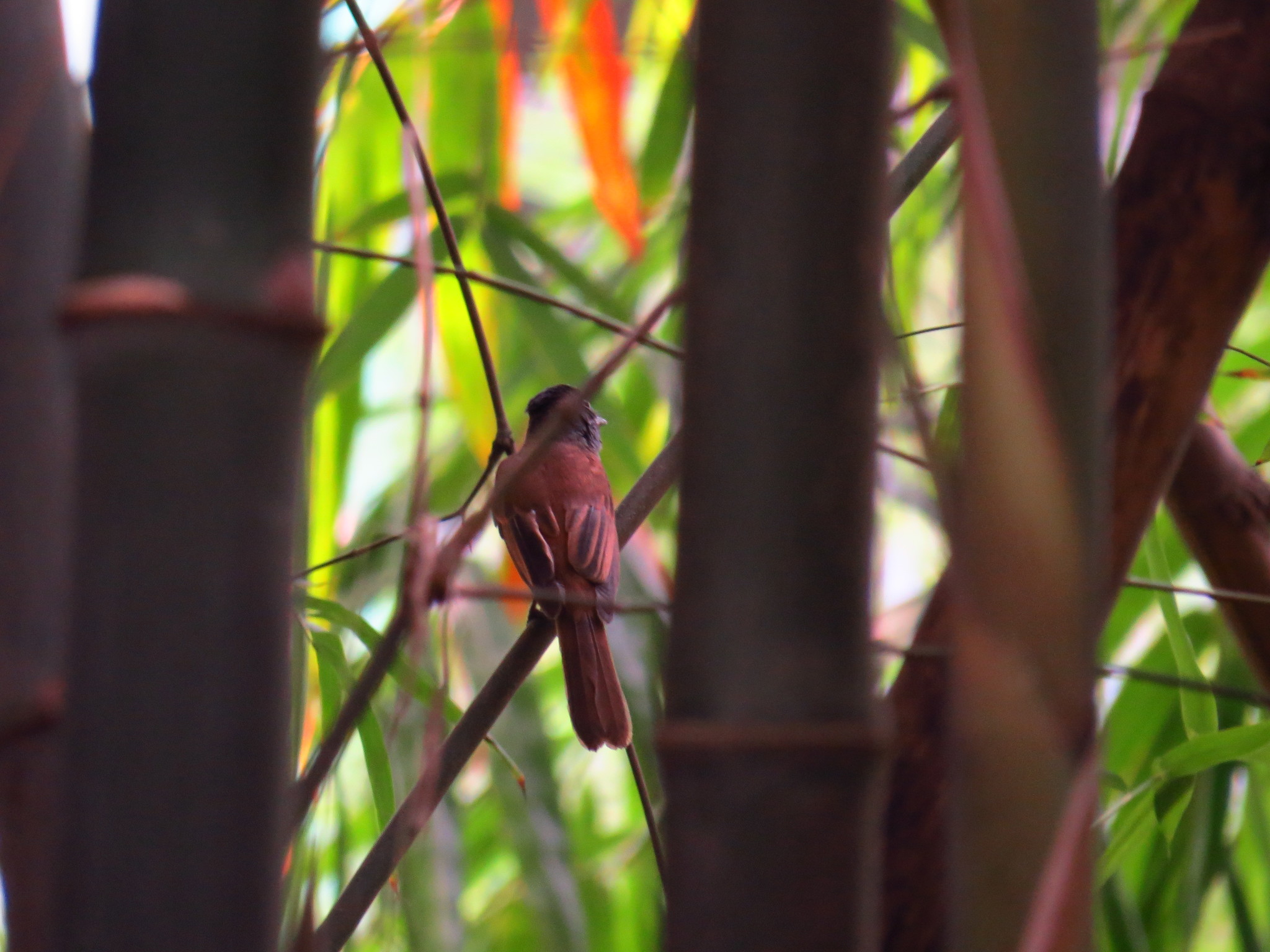
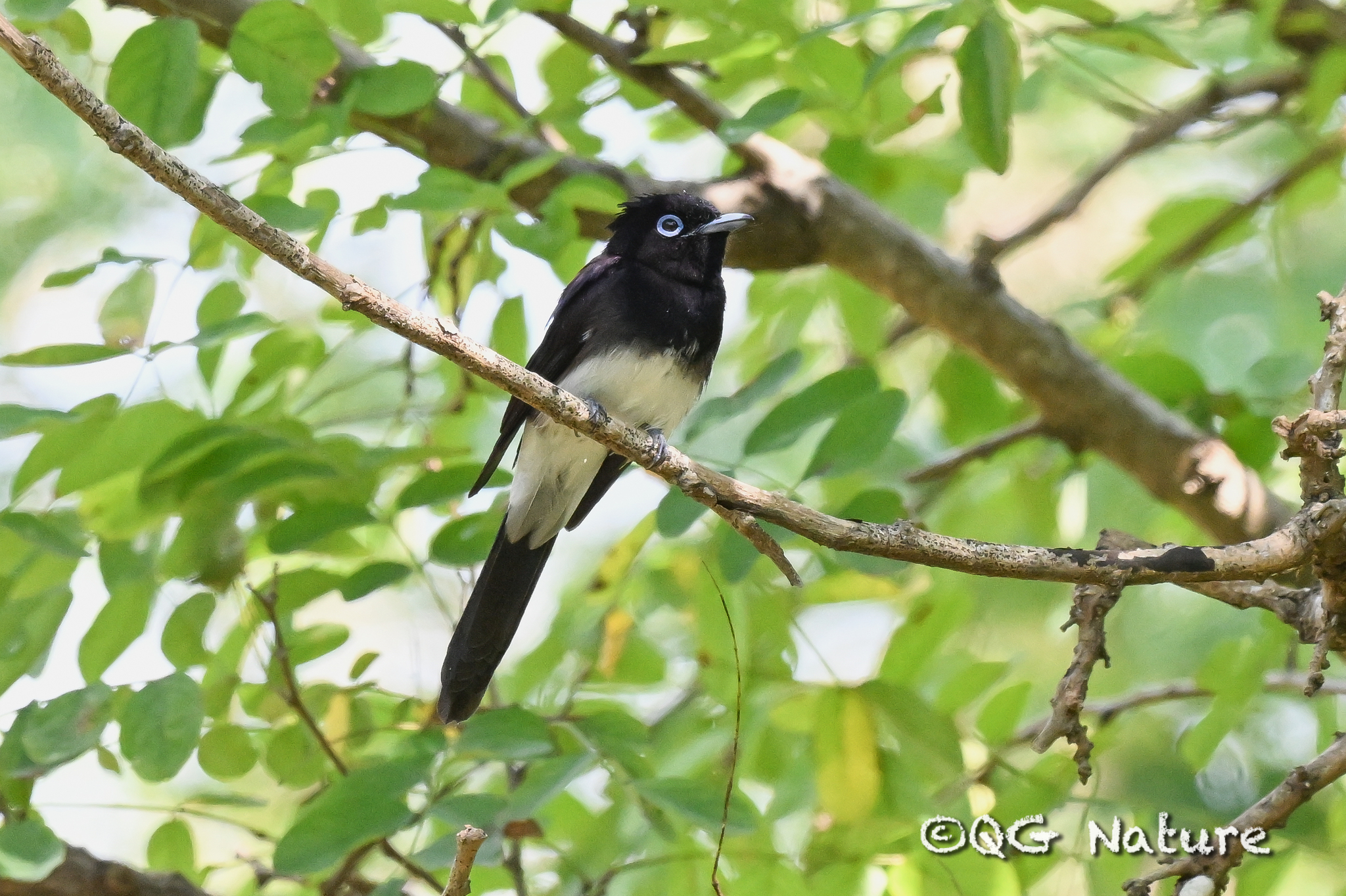
This species is slightly smaller than other paradise flycatchers in the region. Adult males display a glossy black head that shows a purplish-blue sheen, transitioning to blackish-grey on the chest. The underparts range from off-white to pure white. The mantle, back, wings, and rump are a uniform dark chestnut. The most striking feature is the pair of extremely long central tail feathers, black in color, which are notably shorter in immature males. Unlike some related species, there is no white color morph. Adult females resemble males but appear duller overall, with the chestnut areas showing darker brown tones. Both sexes have black legs and feet, a prominent large black eye surrounded by a blue eye-ring, and a short blue bill.
Identification
This species can be distinguished from the similar Amur and Blyth's paradise flycatchers by its smaller size. The entirely dark chestnut mantle and back, combined with the black hood, help separate it from its congeners. Unlike the Asian paradise flycatcher, there is no white morph variant. The extremely long central tail streamers of adult males are diagnostic, though immature males have shorter versions. In the field, watch for the combination of glossy black head, chestnut upperparts, and white underparts, along with the active flycatching behavior typical of the family.
Distribution & Habitat
This species breeds across a restricted range including Japan, South Korea, Taiwan, and the far northern Philippines. The subspecies T.a. atrocaudata breeds in central and southern Korea and Japan, while T.a. illex inhabits the Ryukyu Islands and appears to be resident there. The third subspecies, T.a. periophthalmica, occurs on Lanyu Island off southeast Taiwan and Batan Island in the northern Philippines. After breeding, the species migrates to wintering grounds throughout Southeast Asia, including China, Thailand, Laos, Vietnam, the remainder of the Philippines, Malaysia, Singapore, and Sumatra in Indonesia. It passes through eastern China, Taiwan, Hong Kong, Vietnam, Laos, Singapore, Malaysia, and Thailand during both spring and fall migrations. Important breeding sites include the Gotjawal Forest in Jeju-do, South Korea, a unique forest growing on volcanic lava terrain.
Behavior & Ecology
As a member of the Old World flycatcher family, this species employs typical flycatching behavior, sallying from perches to capture insects in flight. The species has a distinctive vocalization, described in Japanese as tsuki-hi-hoshi, hoi-hoi-hoi. This phrase translates to Moon-Sun-Stars, which inspired the bird's Japanese name sankōchō, meaning bird of three lights. The breeding behavior follows the typical pattern for the genus, with males displaying their impressive tail streamers during courtship displays. The species is generally solitary or found in pairs during the breeding season.
Conservation
Recent surveys have detected a steep decline in portions of the Japanese breeding population, raising conservation concerns for the species. The primary threats appear to be forest loss and habitat degradation within the species' wintering range in Southeast Asia. These pressures on the non-breeding habitats are suspected to be driving the observed population decreases. While a formal IUCN assessment is not provided in the source material, the documented declines in key breeding populations suggest the species may warrant closer monitoring and conservation attention.
Culture
The Japanese name sankōchō (三光鳥) directly references the bird's distinctive song, which in Japanese folklore or tradition is associated with moon, sun, and stars—the three lights. The name breaks down as san meaning three, kō meaning lights, and chō meaning bird. This poetic connection between the bird's vocalization and celestial bodies reflects the importance of natural observations in traditional Japanese culture, where birds often carry symbolic meanings derived from their distinctive characteristics.
Source: Wikipedia · CC BY-SA 3.0
Taxonomy
- Order
- Passeriformes
- Family
- Monarchidae
- Genus
- Terpsiphone
- eBird Code
- japfly1
Vocalizations
Subspecies (3)
-
Terpsiphone atrocaudata atrocaudata
breeds South Korea and Japan (Honshu, Shikoku, and Kyushu); winters Thai-Malay Peninsula, Sumatra, and western Java
-
Terpsiphone atrocaudata illex
Ryukyu Islands (southern Japan)
-
Terpsiphone atrocaudata periophthalmica
breeds Lan-yü Island (southeast of Taiwan) and the Batanes (Itbayat, Batan, Ivojos, and Sabtang), northernmost Philippines; winters in Philippines (Luzon, Mindoro, and Palawan)
Data Sources
CBR Notes: IUCN红色名录等级由NT降为LC
Species description from Wikipedia, licensed under CC BY-SA 3.0.
Bird images and sounds sourced from GBIF, contributed by citizen scientists worldwide under Creative Commons licenses.
Taxonomy data from AviList 2025.