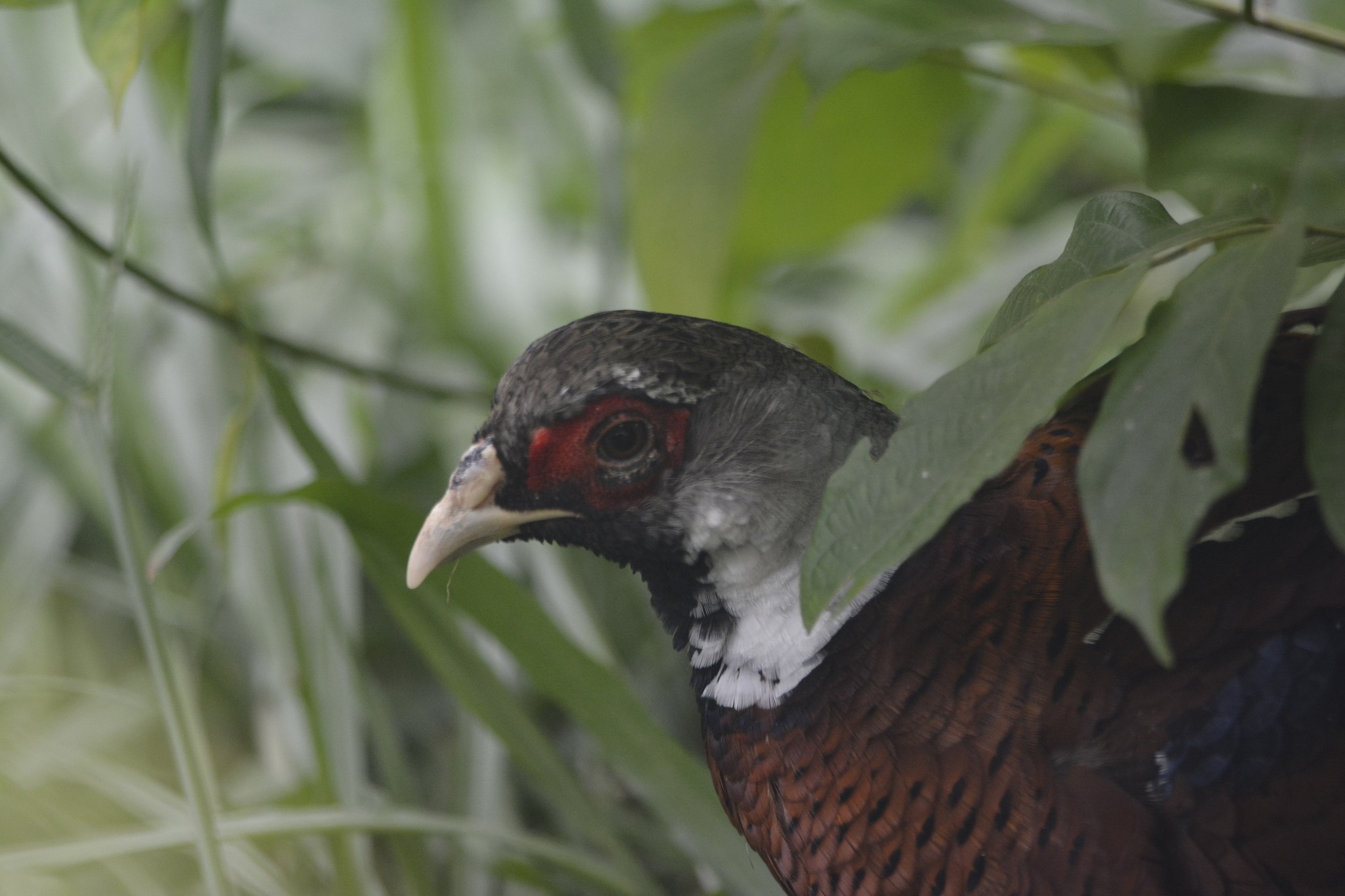
Elliot's Pheasant
Syrmaticus ellioti
白颈长尾雉
Introduction
Syrmaticus ellioti is a large pheasant species endemic to south-eastern China. It inhabits evergreen and mountain forests at altitudes of 200–1,900 m across Guizhou, Hubei, Anhui, Zhejiang, Fujian, Jiangxi, Hunan, Guangxi, and Guangdong provinces. The species is characterized by strong sexual dimorphism and territorial behavior, with males being particularly solitary and defensive of their range. It is evaluated as Near Threatened on the IUCN Red List due to habitat loss, limited range, and hunting pressure, and is listed on CITES Appendix I.
Description
Males measure up to 80 cm in length with brown and white plumage, a black throat, chestnut-brown upper parts, white belly, nape, and wing bars, red bare facial skin, and a long rusty-barred whitish tail. Females are smaller at 50 cm length, with rufous-brown plumage, a blackish throat, whitish belly, and a less prominently barred tail.
Distribution & Habitat
Restricted to south-eastern China, including Guizhou, Hubei, Anhui, Zhejiang, Fujian, Jiangxi, Hunan, Guangxi, and Guangdong provinces. Inhabits evergreen and mountain forests at elevations of 200–1,900 m (660–6,230 ft). No information provided on migration patterns; appears to be resident throughout its range.
Behavior & Ecology
Solitary animals with males being highly territorial. Courtship involves males offering food and displaying to females. Clutch size averages 6–8 eggs. Incubation period is just under four weeks. Juveniles require approximately four months to mature. Diet consists primarily of seeds, leaves, and berries; also known to consume ants.
Conservation
Classified as Near Threatened on the IUCN Red List of Threatened Species. While ongoing habitat loss and hunting for food present concerns, populations do not appear to be declining appreciably. The species has a limited range and is listed on Appendix I of CITES, regulating international trade.
Culture
Alternative common names include Chinese bar-backed pheasant and Chinese barred-backed pheasant. The species was named in 1872 by Robert Swinhoe to honor American ornithologist Daniel Giraud Elliot, recognizing his significant contributions to pheasant studies. No additional cultural or folklore information provided.
Source: Wikipedia · CC BY-SA 3.0
Taxonomy
- Order
- Galliformes
- Family
- Phasianidae
- Genus
- Syrmaticus
- eBird Code
- ellphe1
Distribution
montane bamboo forest of southeastern China
Data Sources
CBR Notes: IUCN红色名录等级由NT降为LC
Species description from Wikipedia, licensed under CC BY-SA 3.0.
Bird images and sounds sourced from GBIF, contributed by citizen scientists worldwide under Creative Commons licenses.
Taxonomy data from AviList 2025.