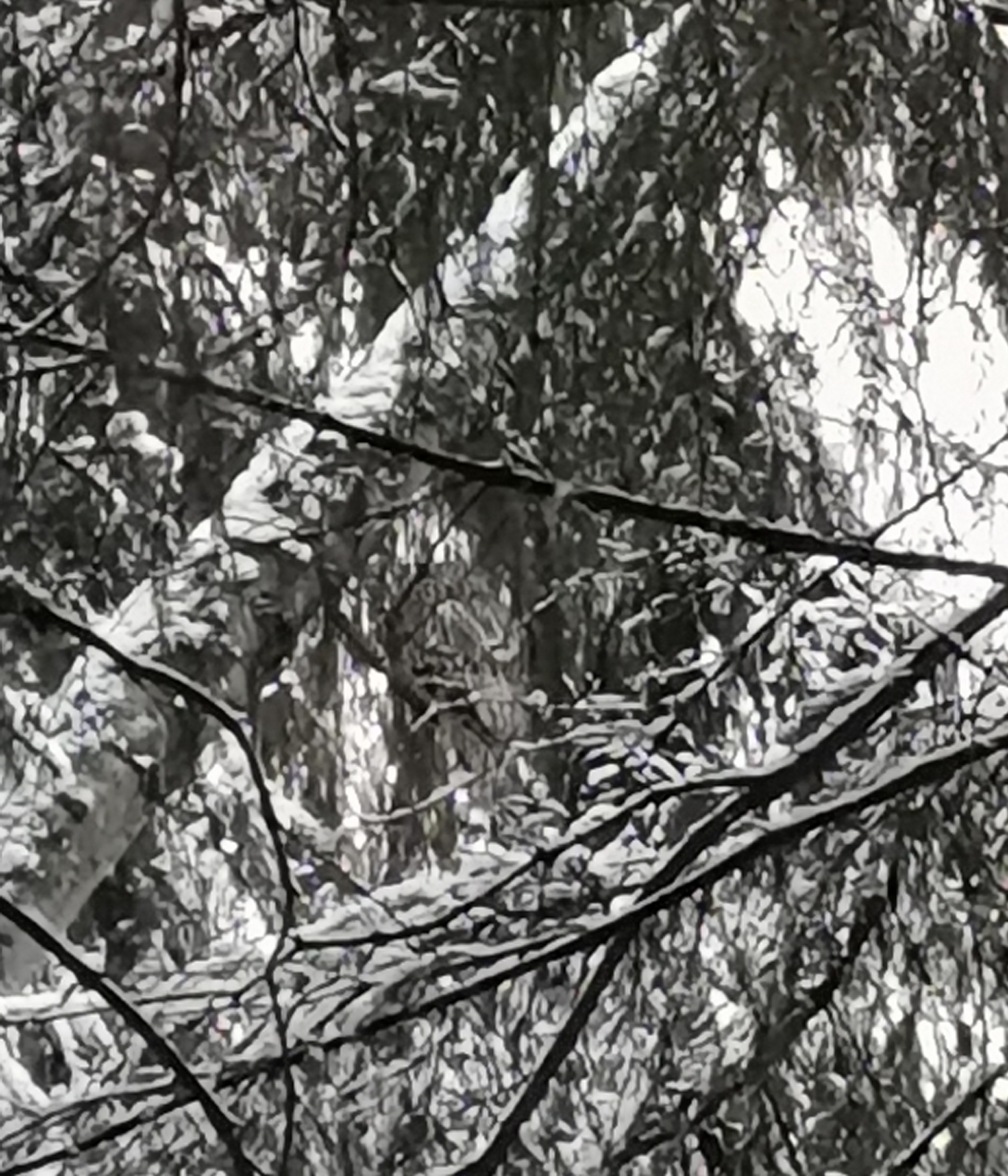
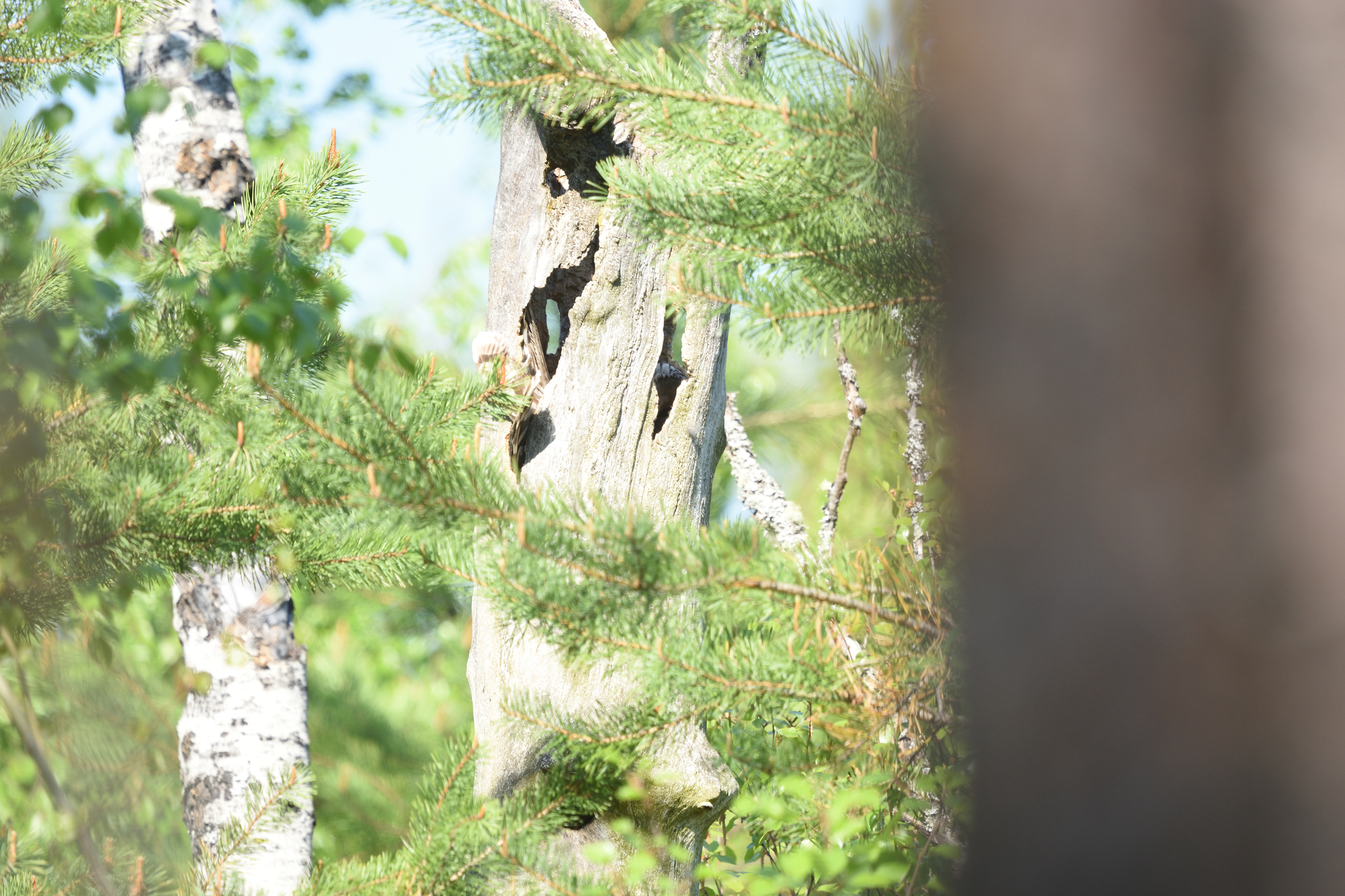
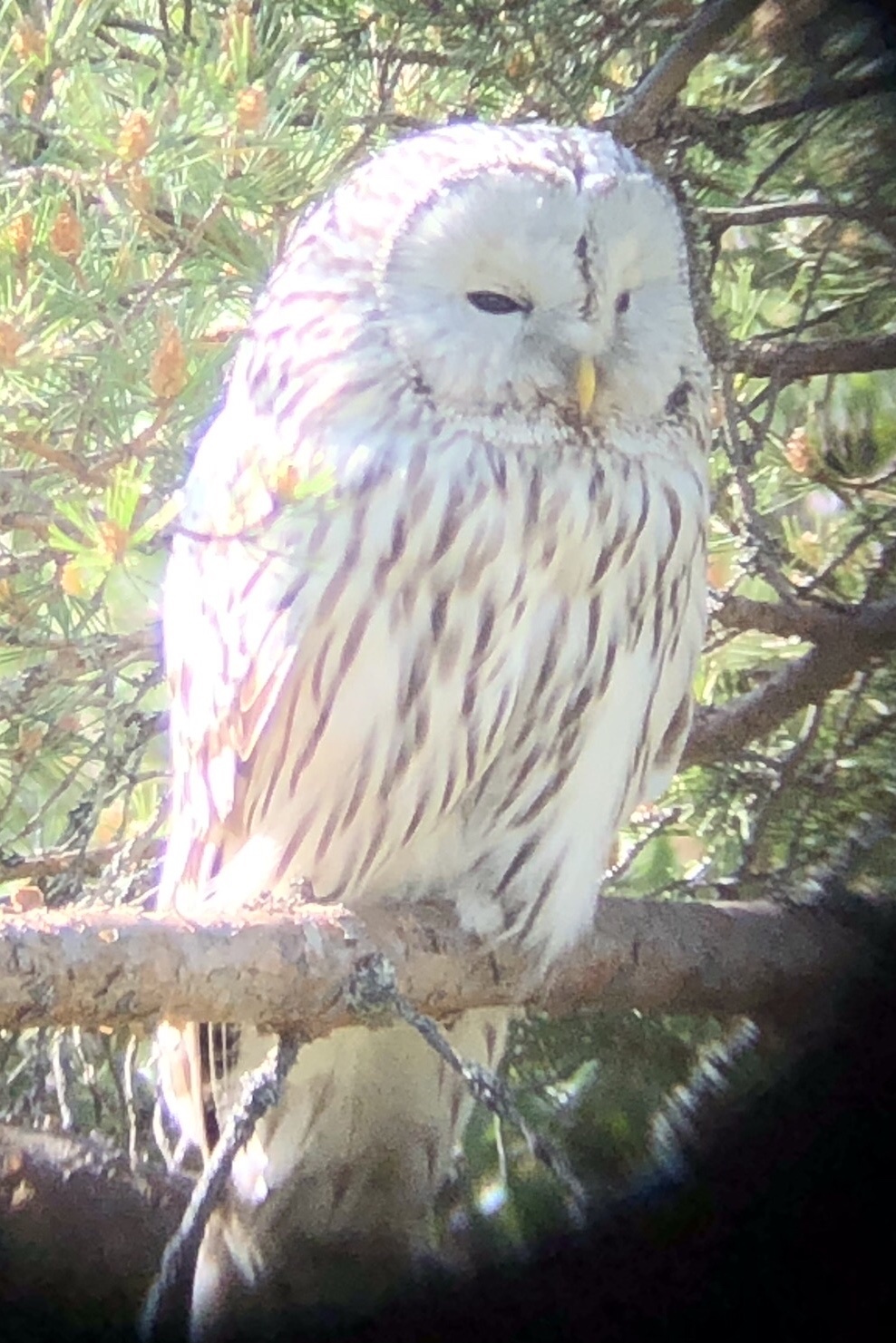
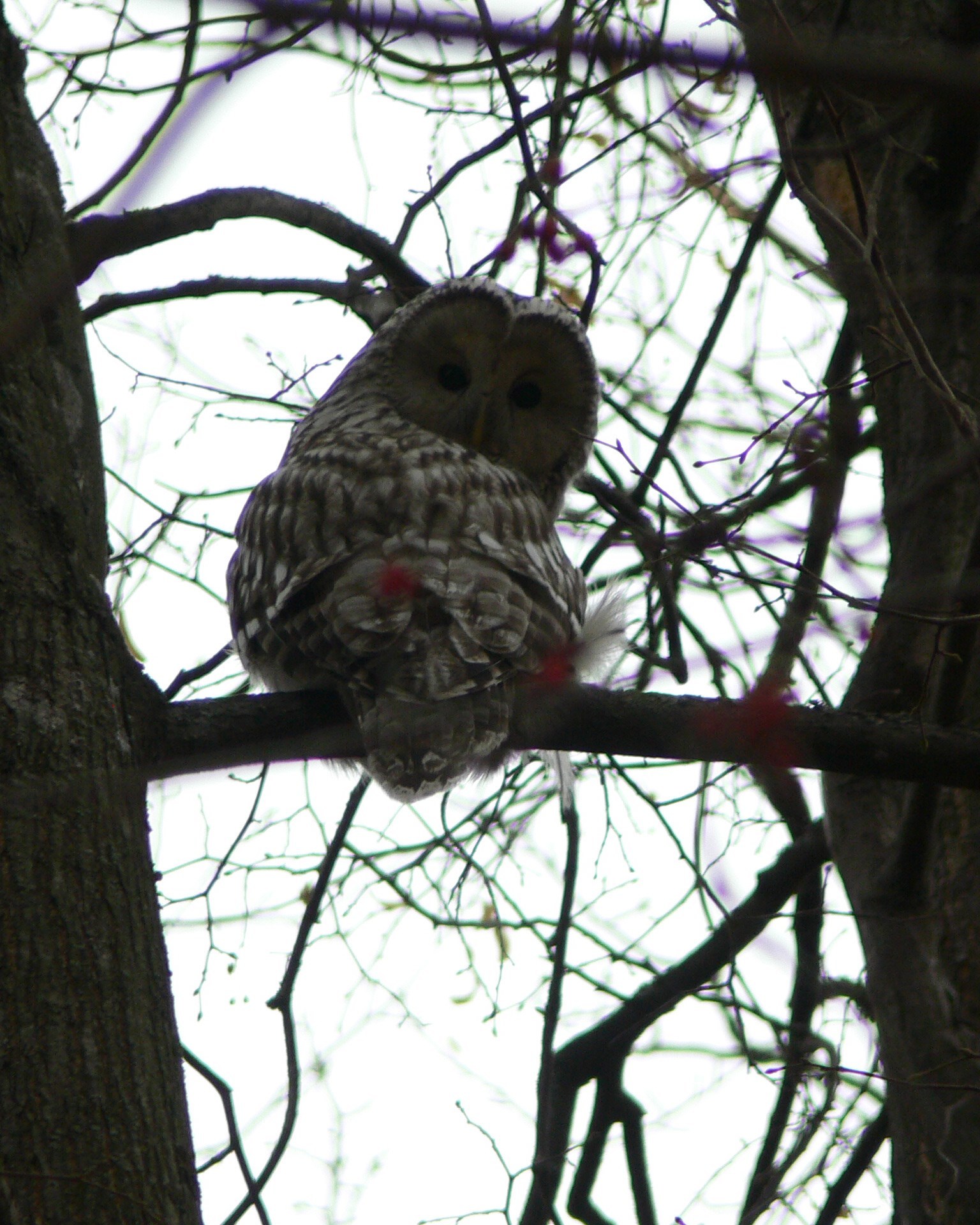
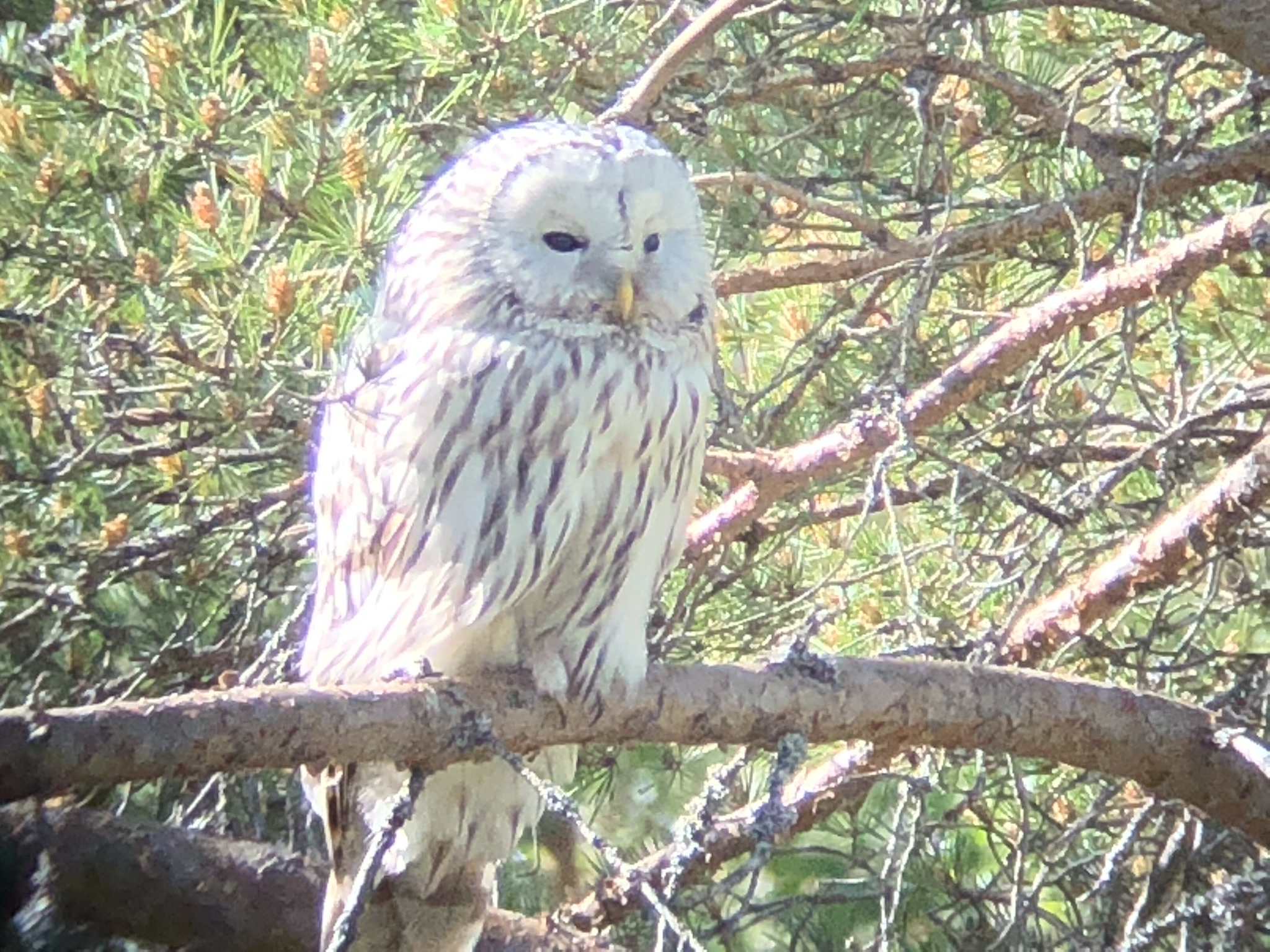
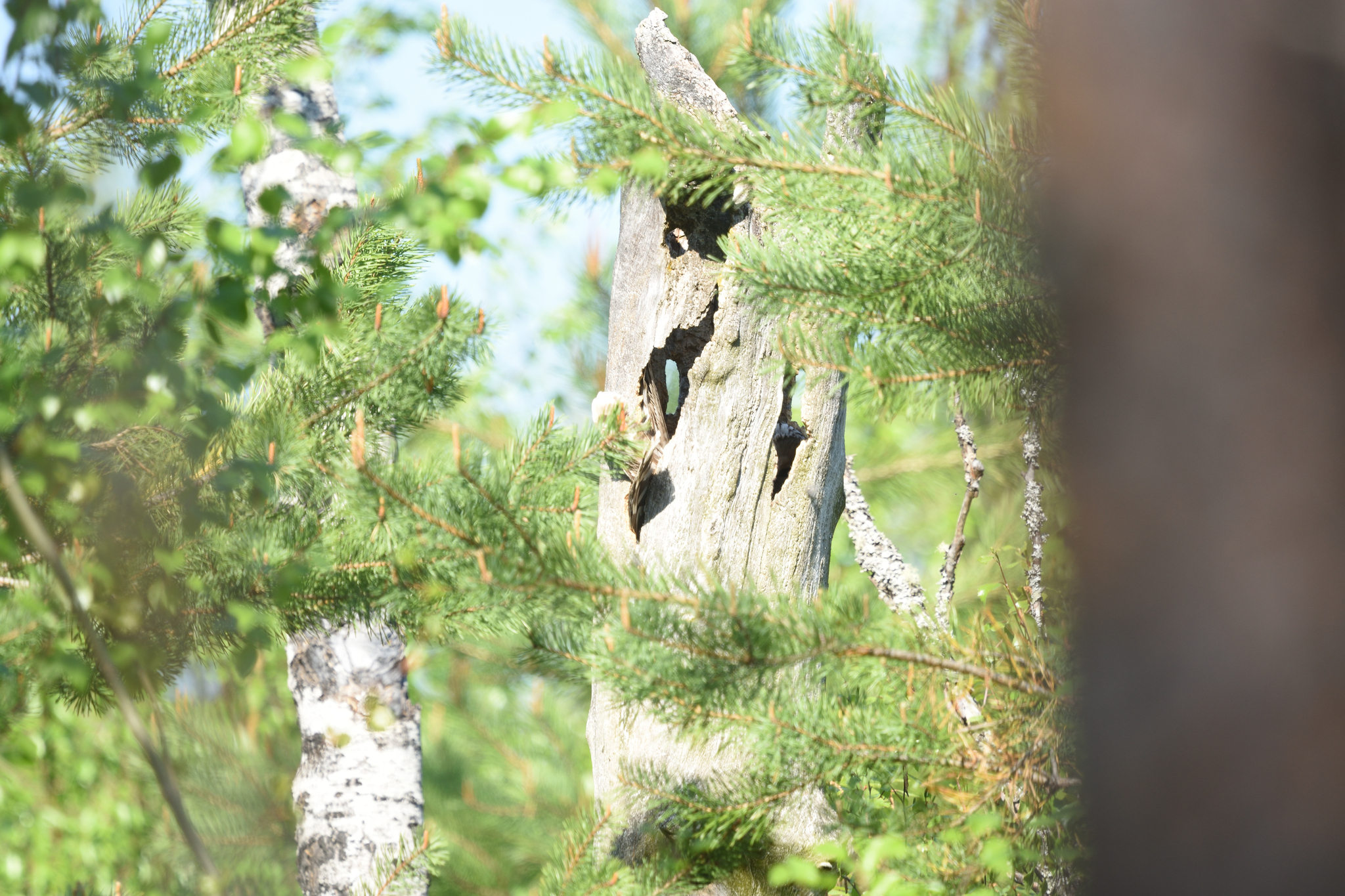
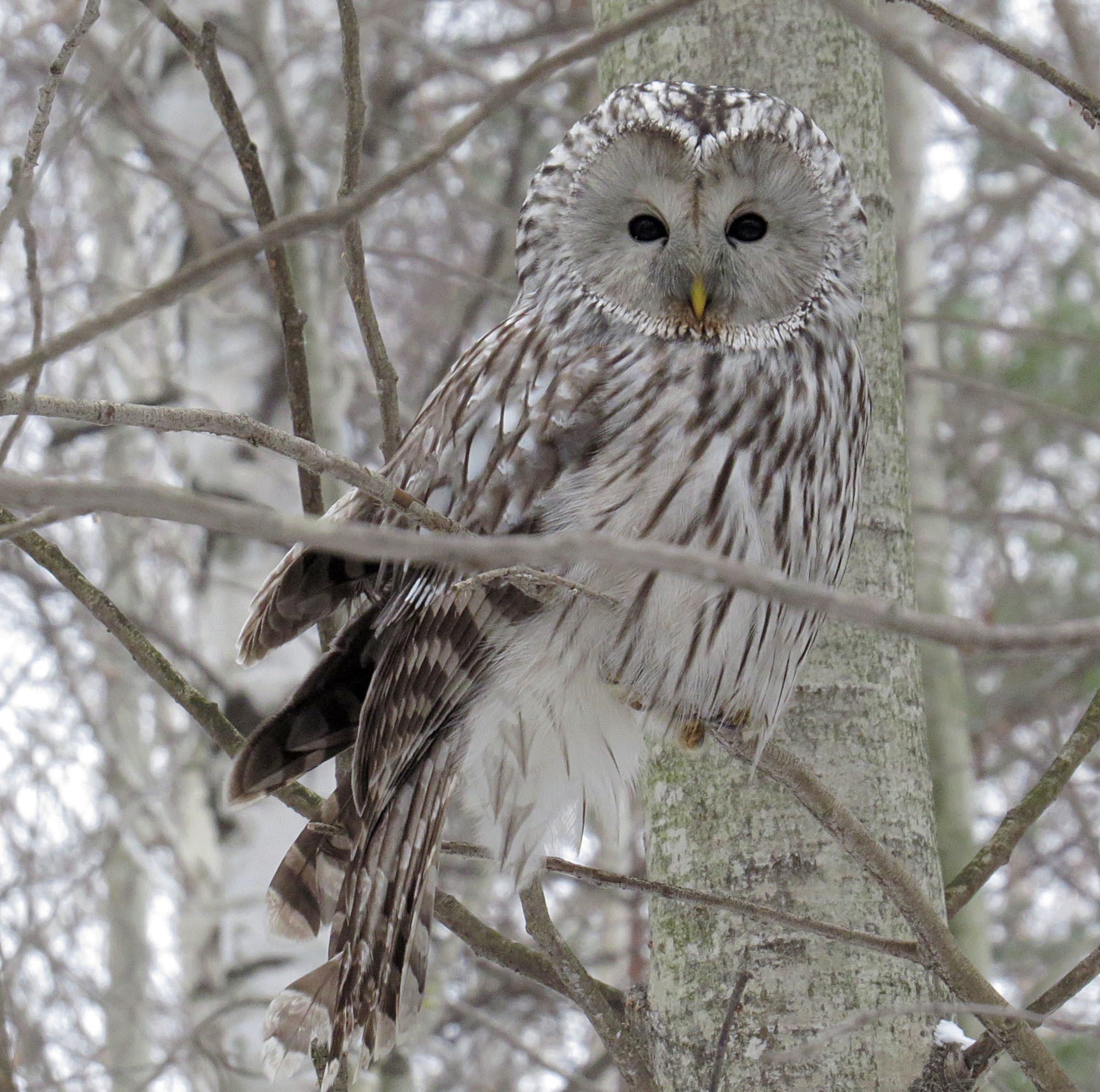
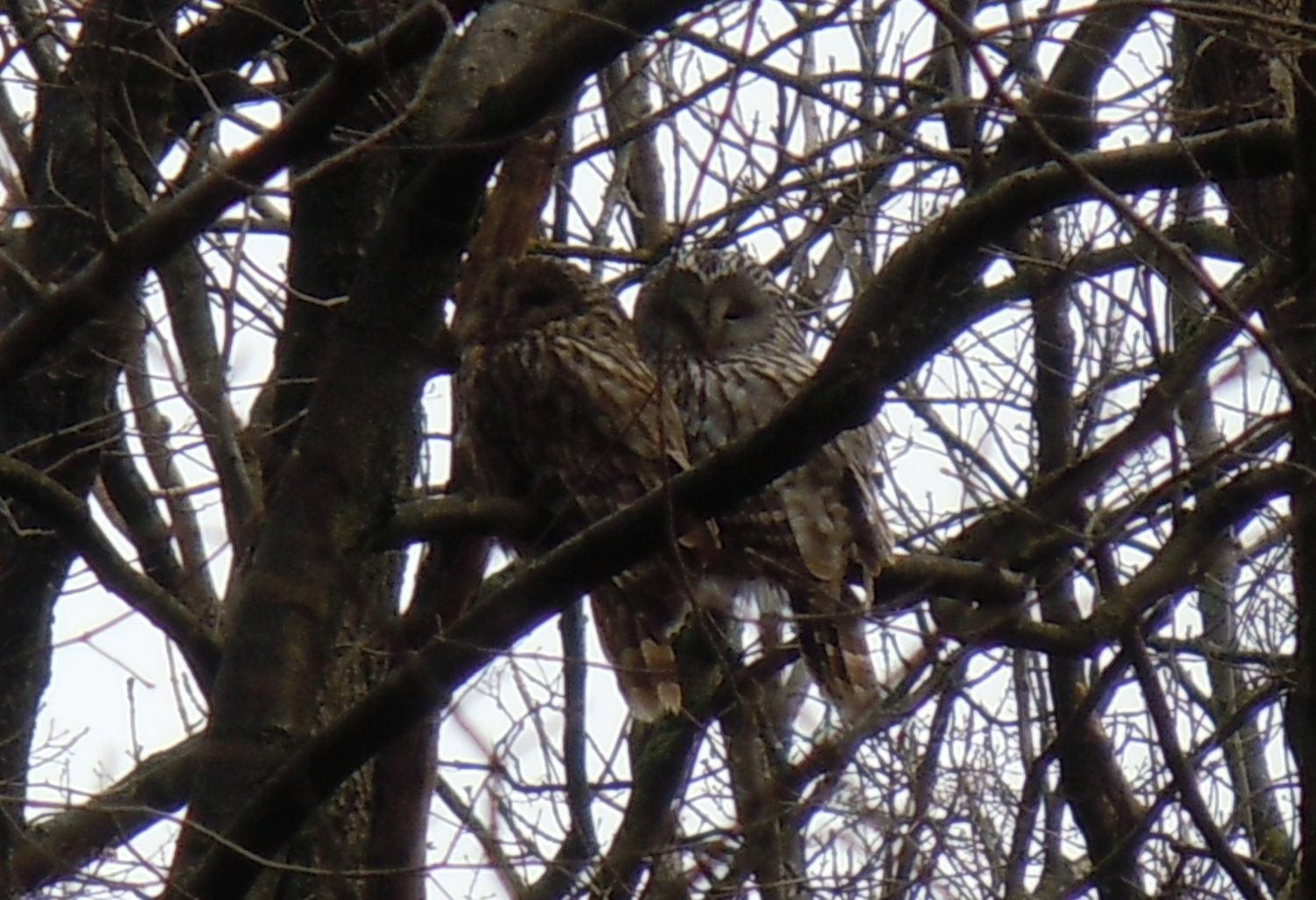
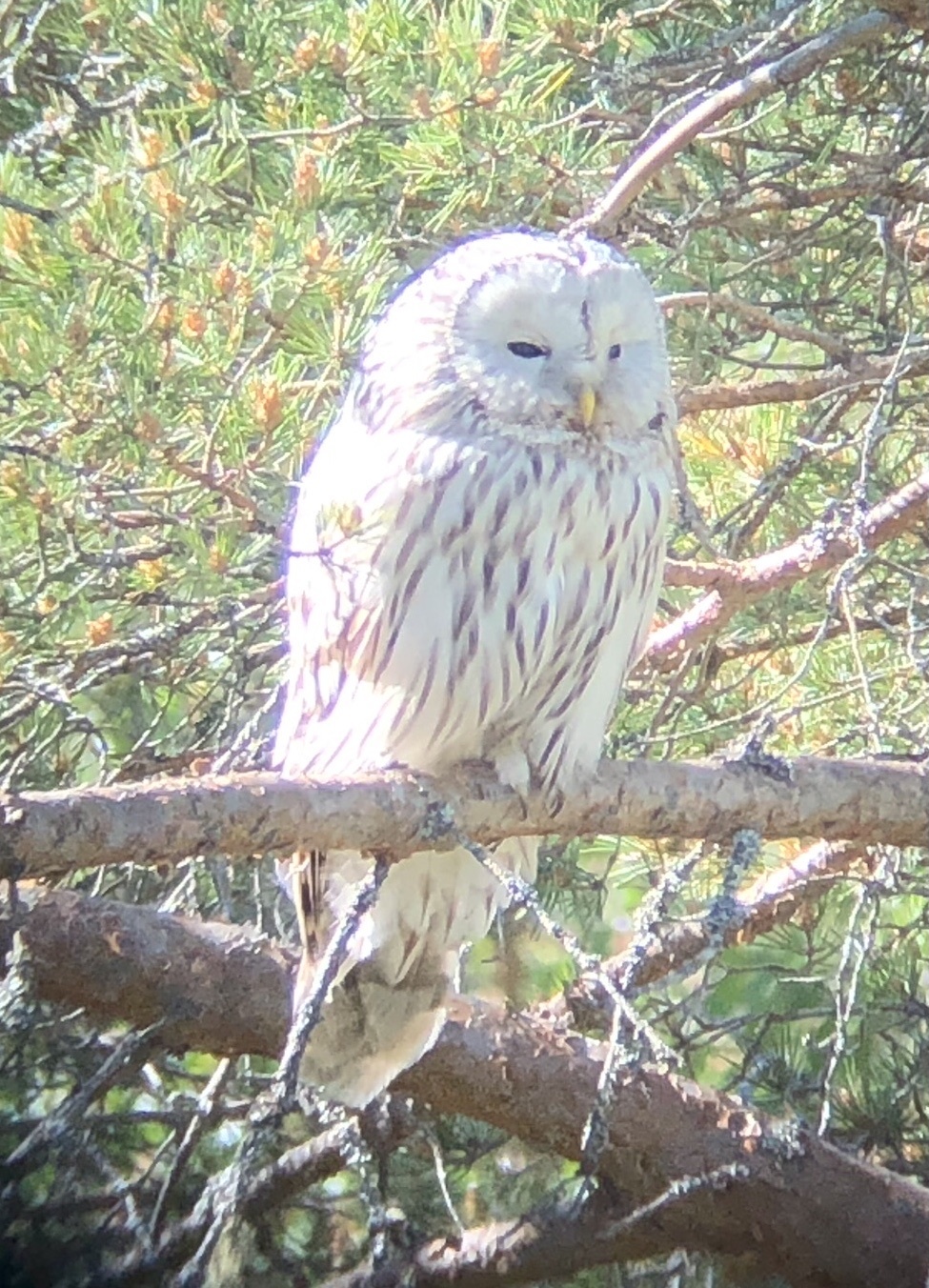
Ural Owl
Strix uralensis
长尾林鸮
Introduction
A large nocturnal owl (Strigidae family, Strix genus). Distribution extends from Scandinavia and montane eastern Europe across the Palearctic through Russia to Sakhalin and throughout Japan. Inhabits taiga forests, mixed forests, and temperate deciduous forests. Distinctive traits include an exceptionally long tail with wedge-shaped tip and a dietary generalist approach focused primarily on small mammals, especially voles. Breeding success strongly correlates with prey populations. Conservation status is Least Concern; populations are stable overall with some local decreases, aided by reintroductions in central Europe.
Description
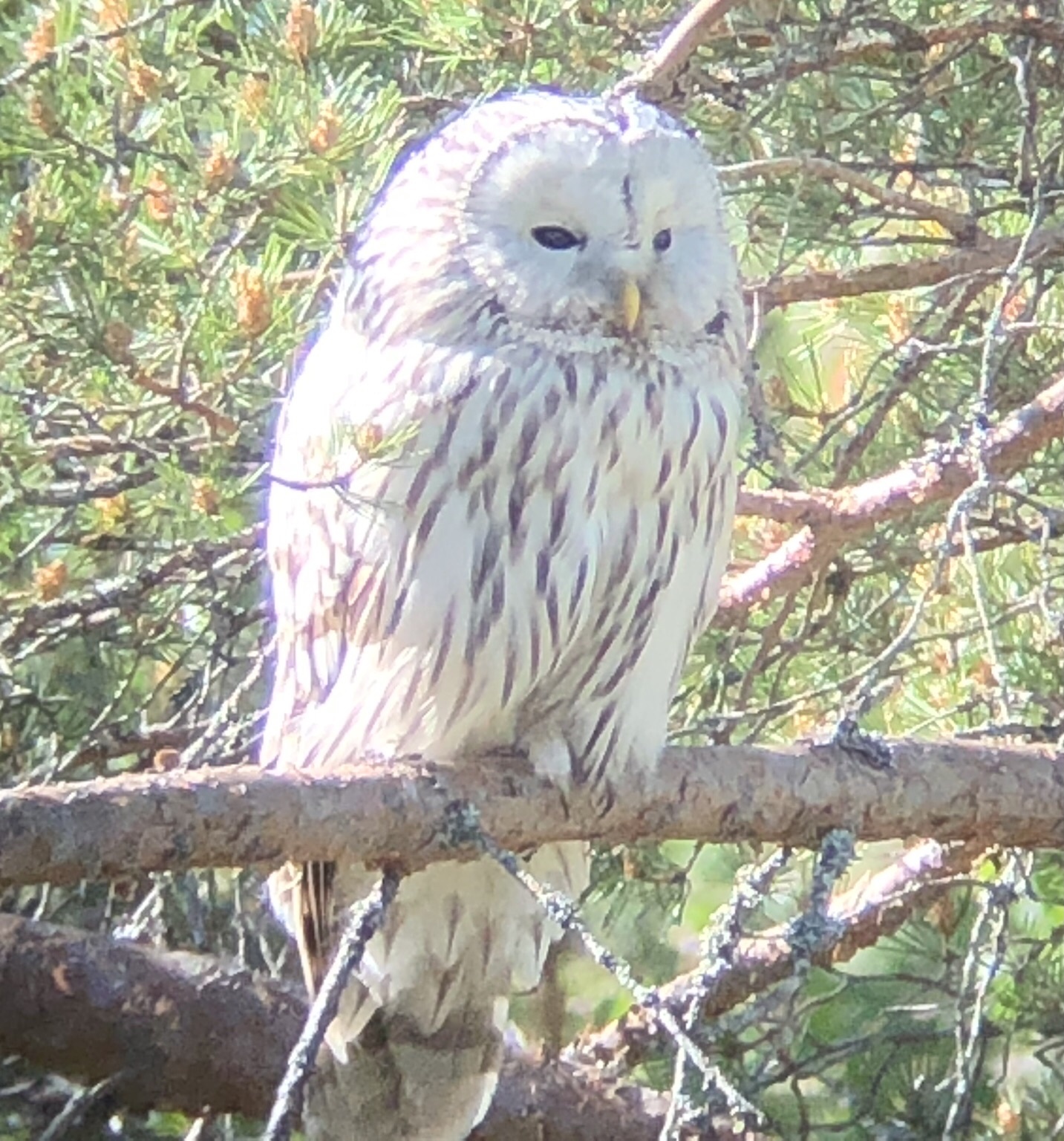
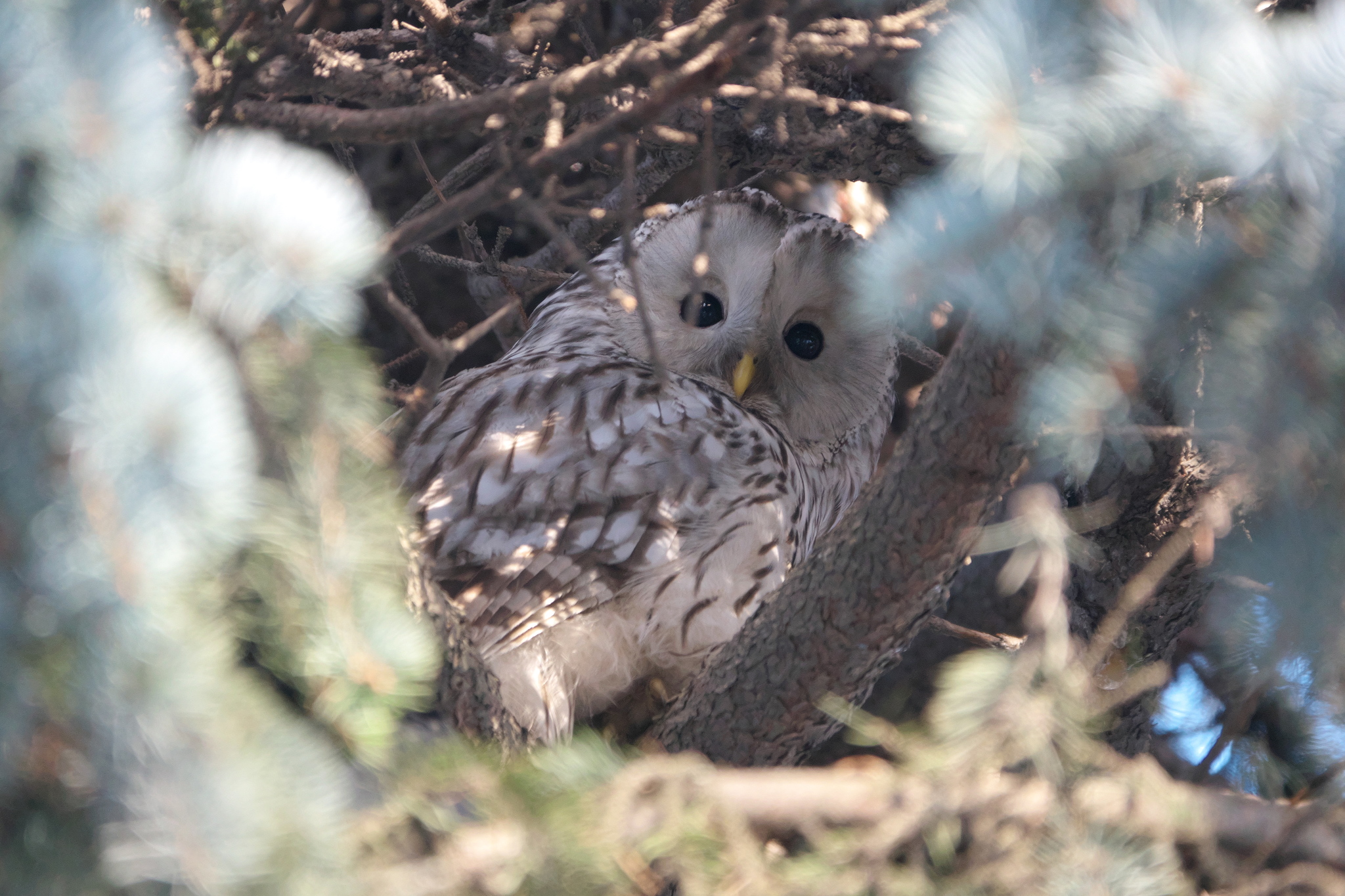
A large owl measuring 50-64 cm in length with a wingspan of 110-134 cm. Has a broad, rounded head with a round facial disc marked by a tiny V-shaped indentation. The species is characterized by an exceptionally long tail with a wedge-shaped tip. Plumage is pale greyish-brown to whitish overall, with a darker grey-brown back and mantle featuring contrasting whitish markings. Underparts are pale cream-ochre to grey-brown with bold dark brown streaking and no crossbars. Eyes are dark brown, relatively small and closely set. The yellowish bill has a dirty yellow cere. Tarsi and toes are covered in greyish feathering; talons are yellowish brown with darker tips. Females are slightly larger than males. Weight ranges from 451-1,050g for males and 569-1,454g for females.
Identification
Distinguished from barred owl by lacking concentric lines on the facial disc. Much larger than tawny owl with a conspicuously shorter tail and relatively larger head; tawny owl shows dark shaft-streaks and crossbars below versus heavy straight streaking. Great grey owl is larger with a huge head, relatively small yellow eyes, strong concentric facial lines, and more uniform dark greyish coloration. Eurasian eagle-owl is much larger with prominent ear tufts, squarish head, and orange eyes. Long-eared owl is much smaller and slimmer with prominent ear-tufts and orange eyes.
Distribution & Habitat
Range extends from Scandinavia across the Palearctic through Russia to Sakhalin and Japan, including northeastern Mongolia, northeastern China, and the Korean Peninsula. In mainland Europe, distribution is spotty in central Europe (Germany, Czech Republic, Austria, Slovenia, Poland) and eastern Europe (Croatia, Bosnia, Serbia, Bulgaria, Romania, Slovakia, Ukraine, Baltic states). Prefers mature but not too dense primary forest in coniferous, mixed, or deciduous areas, typically near forest openings and occasionally in montane areas. Generally sedentary but may make southward movements in severe winters.
Behavior & Ecology
Mainly nocturnal with peaks at dusk and dawn, but cathemeral during warmer months. Highly territorial and sedentary, maintaining territories year-round. Diet is a generalist but predominantly small mammals (50-95% of diet), especially voles; over 200 prey species recorded including rodents, shrews, birds, amphibians, and invertebrates. Males give a deep rhythmic series of notes; females have a similar but hoarser, higher-pitched call. Duetting occurs during courtship. Breeds in tree cavities, stumps, old bird nests, and readily uses nest boxes. Clutch size is typically 3-4 eggs. Incubation lasts 28-35 days. Nestlings fledge at 35 days and can fly at 45 days.
Conservation
IUCN Least Concern with an estimated global population of 350,000-1,200,000 individuals. Most populations show stable or increasing trends. Main threats include forest management reducing old trees with cavities and, historically, habitat loss. Nest box programs have caused population increases in several areas, particularly Finland. Reintroduction programs in the Bohemian Forest and Vienna Woods have been moderately successful. Collision with manmade objects and electrocution are increasing threats as populations expand into more developed areas.
Culture
The Swedish name 'Slaguggla' means 'attacking owl' due to fierce nest defense. German name 'Habichtskauz' translates to 'goshawk-owl.' Russian name refers to 'long-tailed owl.' These names reflect its distinctive long tail and aggressive defensive behavior when protecting nest and young. No extensive mythology or folklore is documented for this species.
Source: Wikipedia · CC BY-SA 3.0
Taxonomy
- Order
- Strigiformes
- Family
- Strigidae
- Genus
- Strix
- eBird Code
- uraowl1
Vocalizations
Subspecies (11)
-
Strix uralensis daurica
south-central Siberia and northeastern Mongolia to northern Amurland (southeastern Siberia) and Manchuria (northeastern China)
-
Strix uralensis davidi
mountains of central China (southeastern Qinghai and Sichuan)
-
Strix uralensis fuscescens
southern Honshu southward to Kyushu (south-central Japan)
-
Strix uralensis hondoensis
northern Honshu (central Japan)
-
Strix uralensis japonica
Hokkaido (northern Japan)
-
Strix uralensis liturata
northern Europe to northwestern Russia, northern Poland, Belarus, and middle Volga
-
Strix uralensis macroura
Carpathian Mountains to Bulgaria and western Balkans
-
Strix uralensis momiyamae
central Honshu (central Japan)
-
Strix uralensis nikolskii
eastern Amurland (southeastern Siberia) and Sakhalin Island to northeastern China and Korean Peninsula
-
Strix uralensis uralensis
eastern European Russia to Sea of Okhotsk
-
Strix uralensis yenisseensis
central Siberian plateau
Data Sources
Species description from Wikipedia, licensed under CC BY-SA 3.0.
Bird images and sounds sourced from GBIF, contributed by citizen scientists worldwide under Creative Commons licenses.
Taxonomy data from AviList 2025.