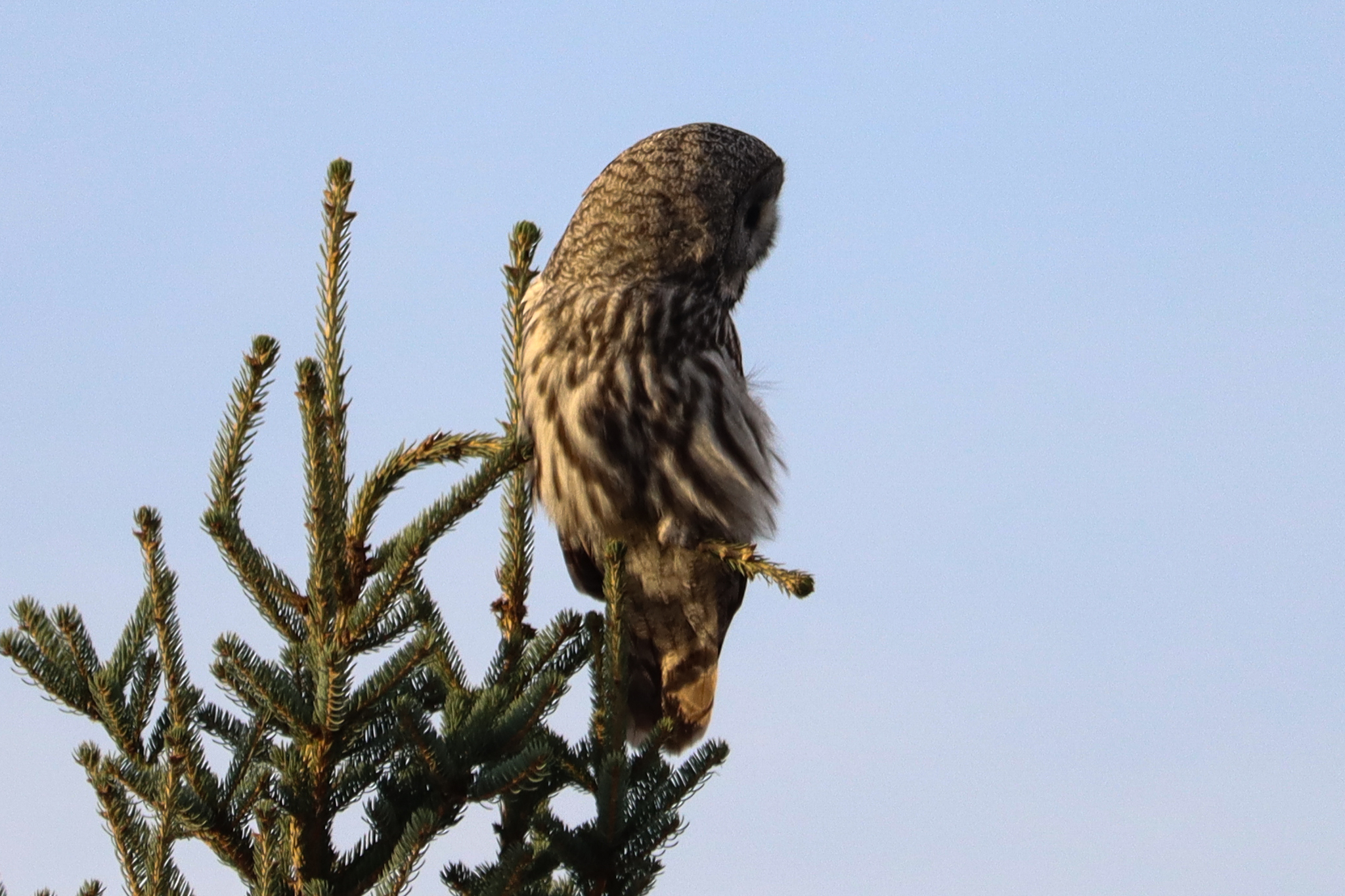
Great Grey Owl
Strix nebulosa
乌林鸮
Introduction
The great grey owl (Strix nebulosa) is a true owl (family Strigidae) and the world's largest species of owl by length. It is distributed across the Northern Hemisphere and is the only Strix species found in both Eastern and Western Hemispheres. Its habitat consists of dense coniferous forests of the taiga near open areas such as meadows or bogs; in Oregon and California, it occupies mixed oak woodlands. Two distinctive traits are its exceptionally large facial disc—the largest of any raptor—and its unique 'snow-plunge' hunting technique, using superb hearing to capture prey moving beneath 60 cm of snow. It is listed as endangered under the California Endangered Species Act, with fewer than 300 individuals estimated in that state.
Description
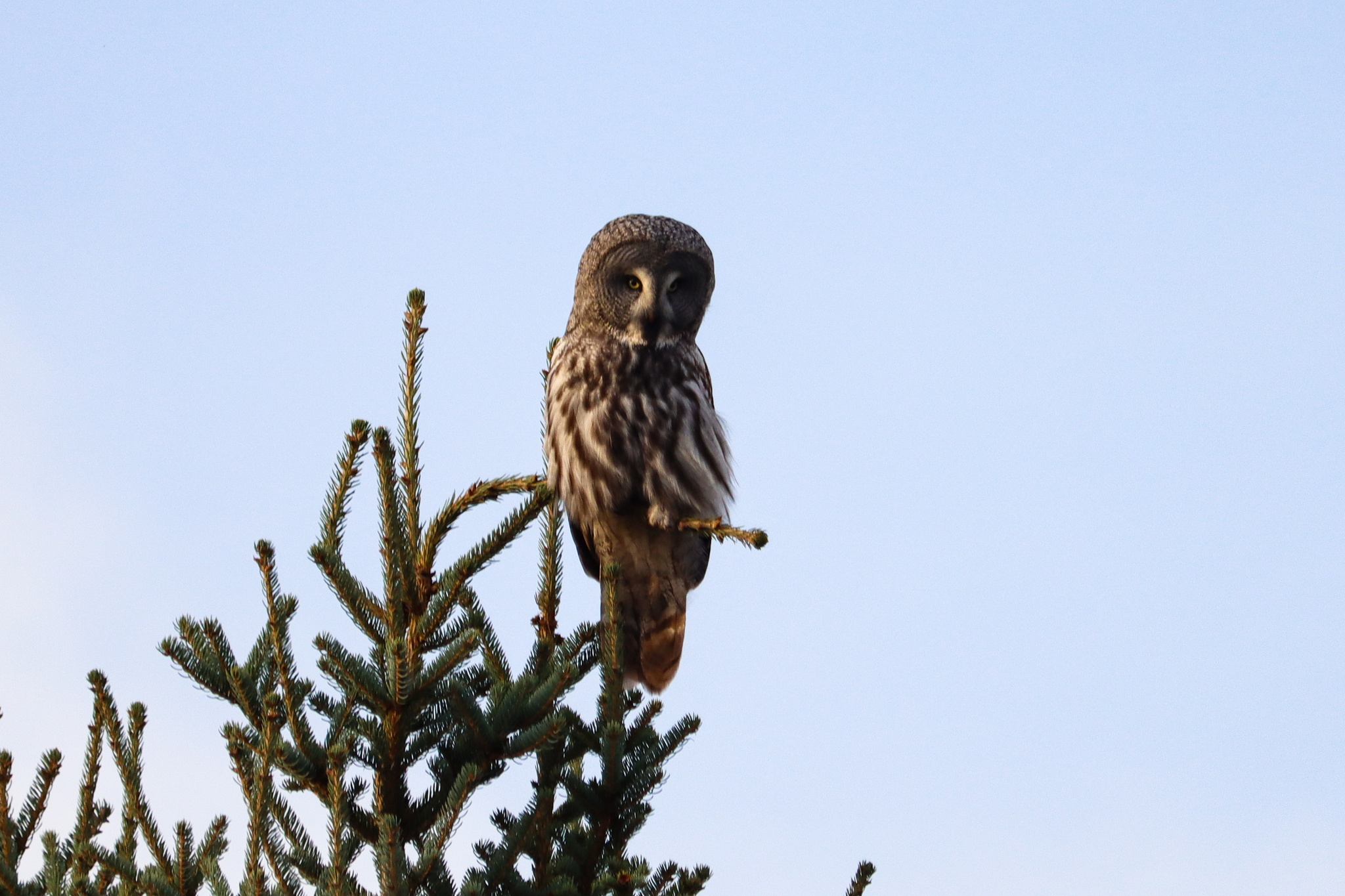
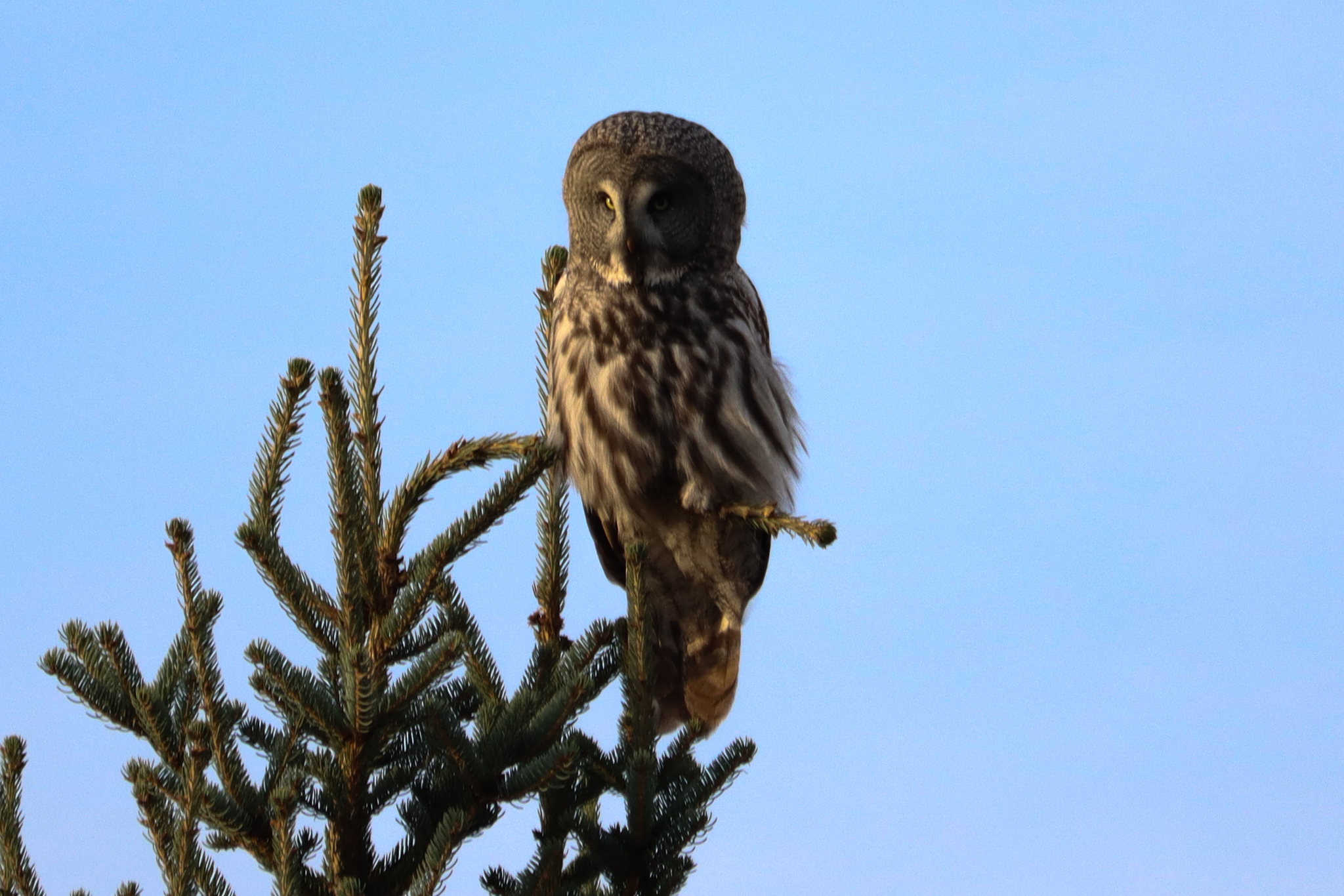
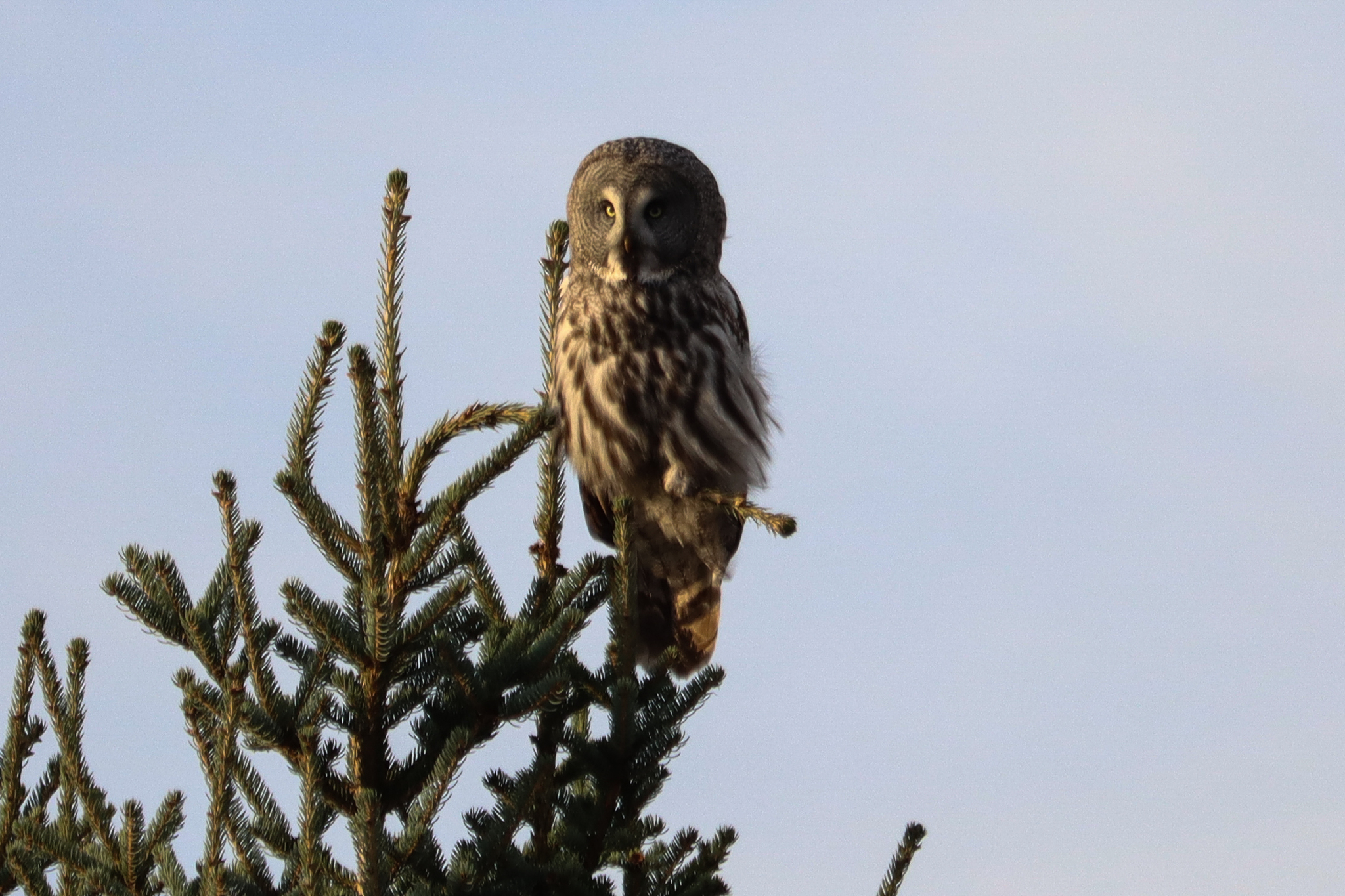
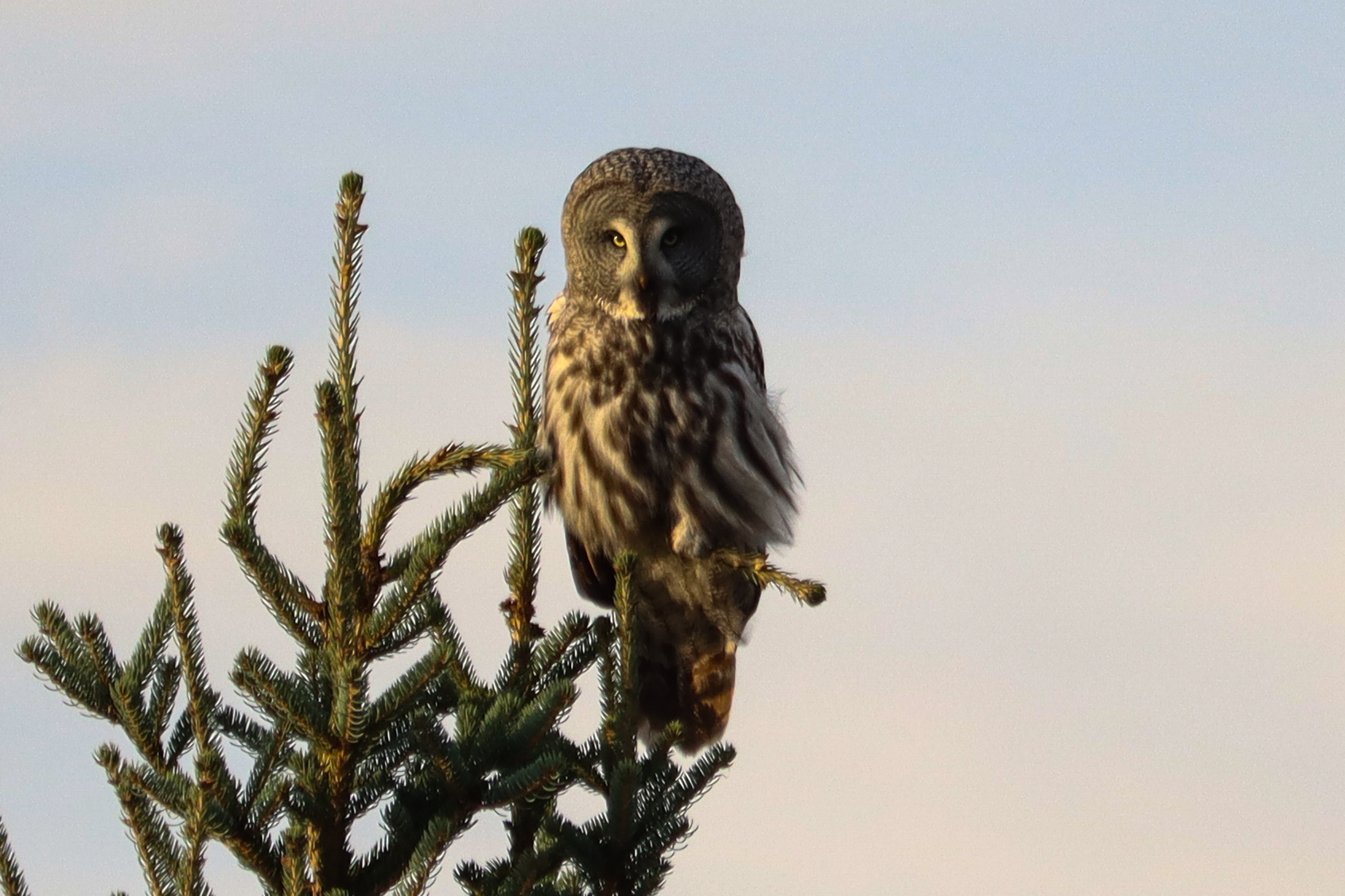
A large, round-headed owl with a grey face and prominent yellow eyes surrounded by darker circles. The underparts are light with dark streaking, while the upperparts are grey with pale bars. No ear tufts are present. A distinctive white collar or 'bow-tie' marks the throat area. The tail is the longest of any owl, tapering to a rounded tip. Length ranges from 61 to 84 cm, averaging 72 cm for females and 67 cm for males. Wingspan can exceed 152 cm, averaging 142 cm for females and 140 cm for males. Adult weight ranges from 580 to 1,900 g, averaging 1,290 g for females and 1,000 g for males. Despite its impressive length, it weighs less than other large owls such as the Eurasian eagle-owl and Blakiston's fish owl.
Identification
The combination of large size, grey plumage, absence of ear tufts, and the distinctive white throat patch distinguishes this species from other large owls. The enormous facial disc is a key识别 feature. Unlike the Eurasian eagle-owl, which has prominent ear tufts, this species lacks them entirely. It is longer but lighter than the Eurasian eagle-owl and Blakiston's fish owl. In flight, the long tail is visible. The species is difficult to locate in the field as it remains still when humans approach and typically ignores playback calls of its own species.
Distribution & Habitat
The species occurs across the Northern Hemisphere. The North American subspecies (S. n. nebulosa) ranges from central Alaska across Canada to southwestern Quebec, south to northern California, northern Idaho, western Montana, Wyoming, and northeastern Minnesota. The Eurasian subspecies (S. n. lapponica) occupies northern Eurasia from Fennoscandia through Siberia to Sakhalin, Kamchatka, Mongolia, Manchuria, and northeastern China. Breeding populations exist in the Pacific states of California, Oregon, and Washington, as well as Scandinavia and Russia. Most populations are sedentary, though northern birds may move south when food is scarce. In winter, individuals may descend to lower elevations to escape deep snow.
Behavior & Ecology
Diet consists almost entirely of small rodents, varying by region: lemmings in northern Canada and Scandinavia, pocket gophers in California's Sierra Nevada, and voles in other areas. Hunting occurs primarily at night, near dawn and dusk, from low perches or through 'snow-plunge' dives into snow up to the bird's body depth. Breeding occurs from March to May; the species does not build nests but uses abandoned raptor nests, broken treetops, or man-made platforms. Clutch size is typically four eggs averaging 42.7 mm by 53.5 mm. Incubation lasts about 30 days. Fledglings leave the nest at 3-4 weeks and fly at 4-5 weeks. The male provides food for the family while the female guards offspring. Vocalizations include deep, rhythmic 'who' notes given in territorial contexts; adults are otherwise silent.
Conservation
The species is listed as endangered under the California Endangered Species Act, with fewer than 300 individuals estimated in the state as of 2015. The primary threat is timber harvesting, which reduces large-diameter trees used for nesting, dense canopy cover for juvenile protection, and hunting perches in clearcuts. Livestock grazing reduces habitat for prey species. Additional threats include rodenticides, vehicle collisions, and West Nile virus, which has been confirmed affecting populations in Ontario, northeastern Oregon, and Yosemite. The species is generally secure across its global range, though localized populations face significant pressures.
Culture
The great grey owl is the provincial bird of Manitoba, Canada. In art, a great grey owl with human hands is depicted on William Schaff's album art for The Magnolia Electric Co., a 2003 alt-country album by Songs: Ohia. The species has acquired various folk names including 'phantom of the north,' 'spectral owl,' 'Lapland owl,' 'spruce owl,' 'bearded owl,' and 'sooty owl'.
Source: Wikipedia · CC BY-SA 3.0
Taxonomy
- Order
- Strigiformes
- Family
- Strigidae
- Genus
- Strix
- eBird Code
- grgowl
Subspecies (2)
-
Strix nebulosa lapponica
boreal forest of Eurasia from Fennoscandia eastward to central Chukotka, in south to Poland, Belarus, and northern Ukraine, northern Mongolia, northeastern China, and Sakhalin
-
Strix nebulosa nebulosa
boreal forest of northern North America
Data Sources
Species description from Wikipedia, licensed under CC BY-SA 3.0.
Bird images and sounds sourced from GBIF, contributed by citizen scientists worldwide under Creative Commons licenses.
Taxonomy data from AviList 2025.